 By
We may earn a commission if you buy through links on this page, at no extra cost to you. This never affects which products we recommend. How we make money.
On this page 12 sections
The Jackery HomePower 2000 Plus v2 is the best portable power station for a refrigerator for most homes: it runs an average 67 W fridge for about 23 hours by our estimate, its 2,400 W output and 4,800 W surge start a compressor with room to spare, and one unit expands to about 12 kWh.
For a single night, the EcoFlow Delta 3 Plus gives about 11.5 hours in 27.6 lb. For outages that last days, the Anker SOLIX S5000 gives about 57 hours, helped by its low 8.8 W standby draw. For a 12 V camping fridge, the Bluetti Elite 30 V2 runs a typical 25 W cooler for about 10.6 hours from its car outlet.
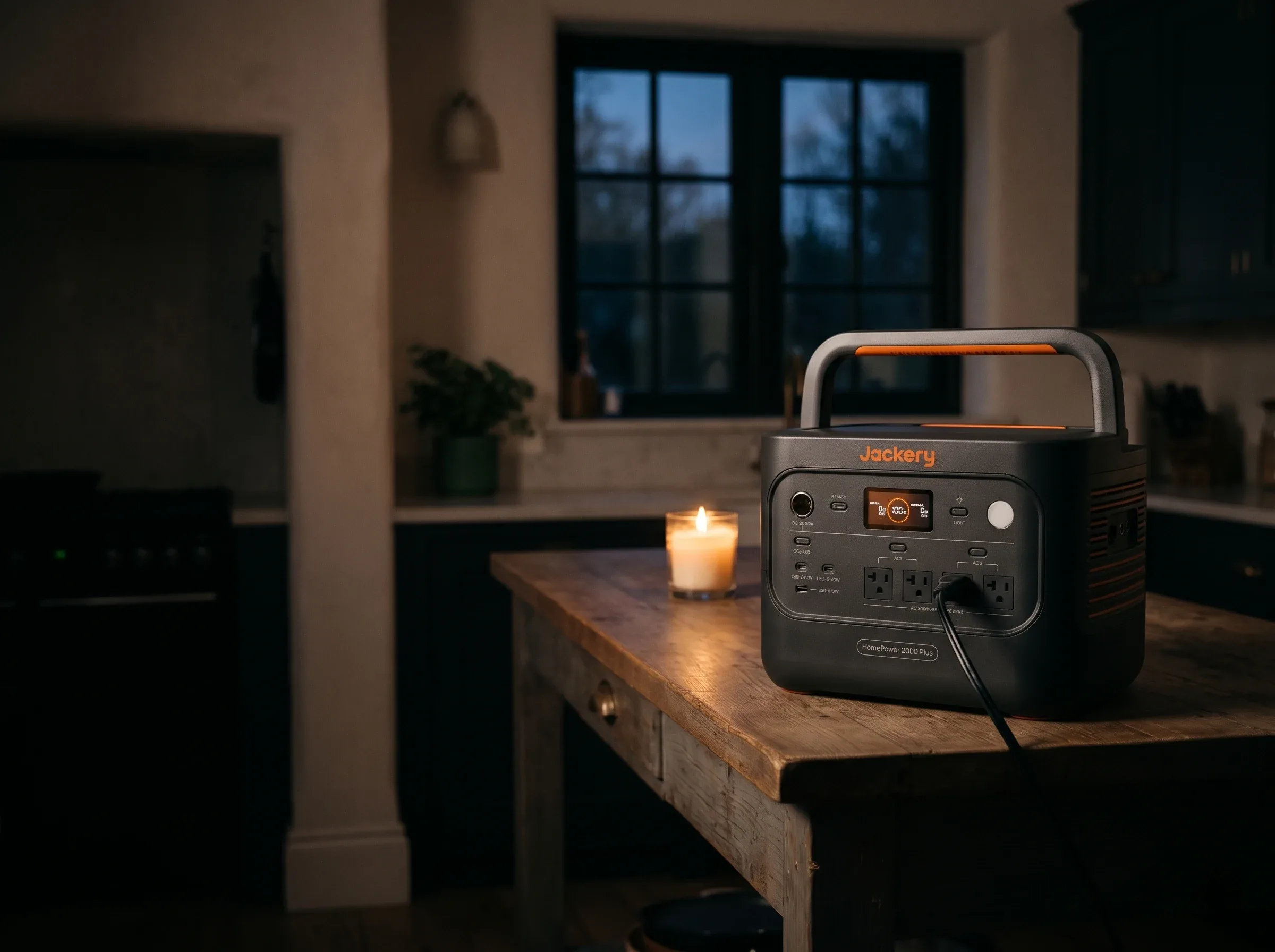
Best overall
Jackery HomePower 2000 Plus v2
About 23 hours of a 67 W fridge, 4,800 W surge, expands to about 12 kWh
- Capacity
- 2,048 Wh
- AC output
- 2,400 W
- Wall charge
- About 1.5 hours
- Weight
- 41.5 lb
Best for overnight
About 11.5 hours of a fridge in 27.6 lb, under 10 ms switchover
1,024 Wh1,800 W27.6 lb
Best for multi-day outages
About 57 hours of a fridge on 5,024 Wh and 8.8 W standby
5,024 Wh4,500 W97 lb
Best for a 12 V camping fridge
12 V, 10 A car outlet: about 10.6 hours of a 25 W 12 V fridge
288 Wh600 W9.5 lb
| Spec | Jackery HomePower 2000 Plus v2 | EcoFlow Delta 3 Plus | Anker SOLIX S5000 | Bluetti Elite 30 V2 |
|---|---|---|---|---|
| Capacity (Wh) | 2048 | 1024 | 5024 | 288 |
| AC output, continuous (W) | 2400 | 1800 | 4500 | 600 |
| AC charge time | About 1.5 hours (Emergency Charging mode) | 56 min | Not stated (1,800 W at 120 V) | About 70 min |
| Max solar input (W) | 800 | 1000 | 3000 | 200 |
| Weight (lb) | 41.5 | 27.6 | 97 | 9.5 |
| Warranty (years) | 3 + 2 with registration | 5 | 5 | 5 |
| Price | Check price | Check price | Check price | Check price |
- Capacity
- 2,048 Wh
- AC output
- 2,400 W
- Wall charge
- About 1.5 hours
- Solar input
- 800 W
- Weight
- 41.5 lb
- Warranty
- 3 + 2 years
- Capacity
- 1,024 Wh
- AC output
- 1,800 W
- Wall charge
- 56 min
- Solar input
- 1,000 W
- Weight
- 27.6 lb
- Warranty
- 5 years
- Capacity
- 5,024 Wh
- AC output
- 4,500 W
- Wall charge
- Not stated
- Solar input
- 3,000 W
- Weight
- 97 lb
- Warranty
- 5 years
- Capacity
- 288 Wh
- AC output
- 600 W
- Wall charge
- About 70 min
- Solar input
- 200 W
- Weight
- 9.5 lb
- Warranty
- 5 years
Yes, a portable power station can run a refrigerator. Two numbers decide whether a given station suits your fridge: its watt-hours, which set how long the fridge runs, and its surge rating, which decides whether the compressor starts at all. This guide picks the stations; for the full runtime method, worked examples and food-safety timing, see how long a power station runs a refrigerator.
Best overall: Jackery HomePower 2000 Plus v2
It runs an average fridge for about 23 hours and starts its compressor with 4,800 W of surge, four times the top of the startup range.
Best overall: Jackery HomePower 2000 Plus v2
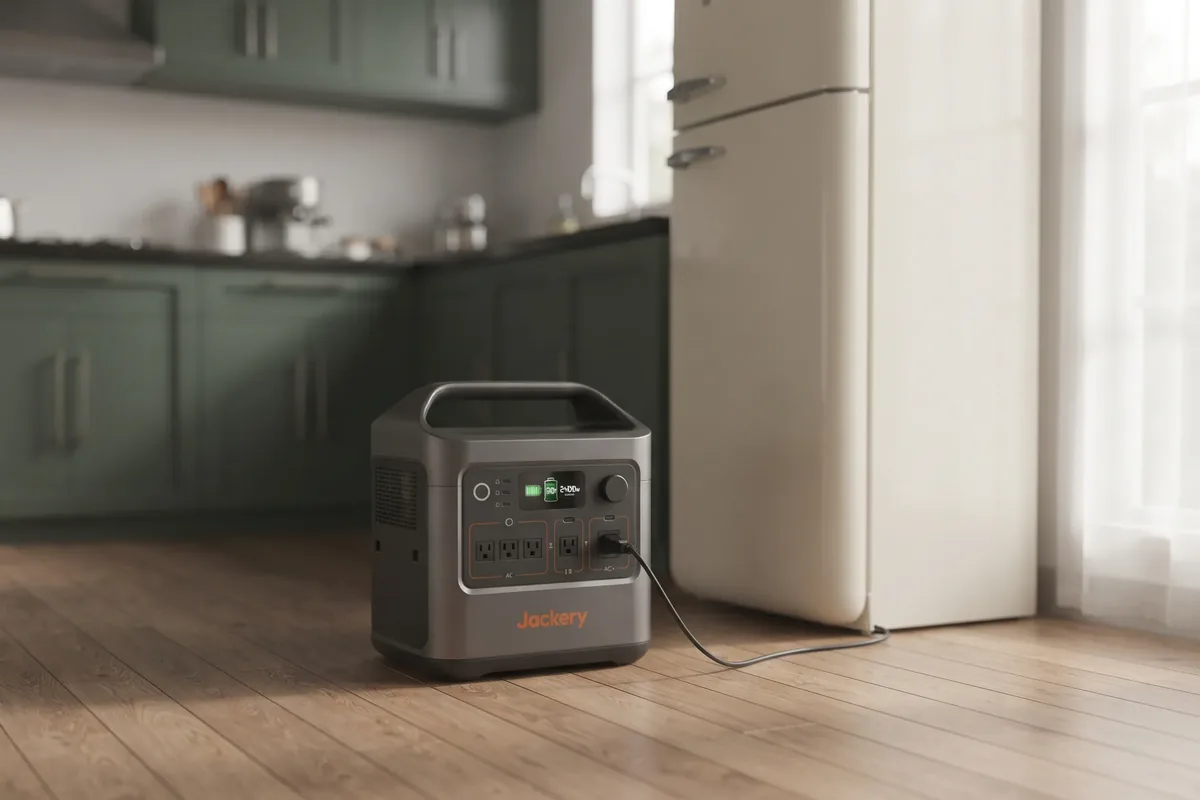
- Capacity
- 2,048 Wh
- AC output
- 2,400 W
- Wall charge
- About 1.5 hours
- Weight
- 41.5 lb
A full day is the size that covers most outages, and the HomePower 2000 Plus v2 gets an average fridge through about 23 hours. Its four 120 V outlets give 2,400 W, far above a fridge's 150 to 400 W running draw, and its 4,800 W surge covers a compressor start with room for a router or lights on the same station.
Leave the fridge plugged into it and the station plugged into the wall: in bypass mode it passes up to 1,800 W through and switches to battery in 10 ms if the grid drops, so the fridge carries on without anyone at home. Jackery says it doesn't support 0 ms switching, which matters for servers, not for a fridge.
When a day isn't enough, up to five Battery Pack 2000 Plus v2 add 2,048 Wh each, about 12 kWh on one unit. The older Battery Pack 2000 Plus doesn't fit.
Jackery quotes about 1.5 hours from the wall in Emergency Charging mode and about 3.2 hours on 800 W of solar. It rates 7.8, the highest of the four stations of 2,010 to 2,074 Wh we've reviewed. See the best 2000Wh portable power stations for the others.
Best for
A fridge through a day-long outage, with room to grow.
Skip if
You need 240 V or more than 800 W of solar.
Pros
- About 23 hours of a 67 W fridge, about 17.5 with a chest freezer
- 2,400 W continuous, 4,800 W surge
- 10 ms switchover in bypass mode
- Expands to about 12 kWh per unit with five Battery Pack 2000 Plus v2
- 41.5 lb
Cons
- 800 W solar input
- Cycles rated to 70%, not 80%
- Warranty is 3 years, plus 2 with registration
Check price on AmazonRead our Jackery HomePower 2000 Plus v2 full review
Best for overnight: EcoFlow Delta 3 Plus
It runs an average fridge for about 11.5 hours, through a night, in a 27.6 lb station rated 8.9.
Best for overnight: EcoFlow Delta 3 Plus
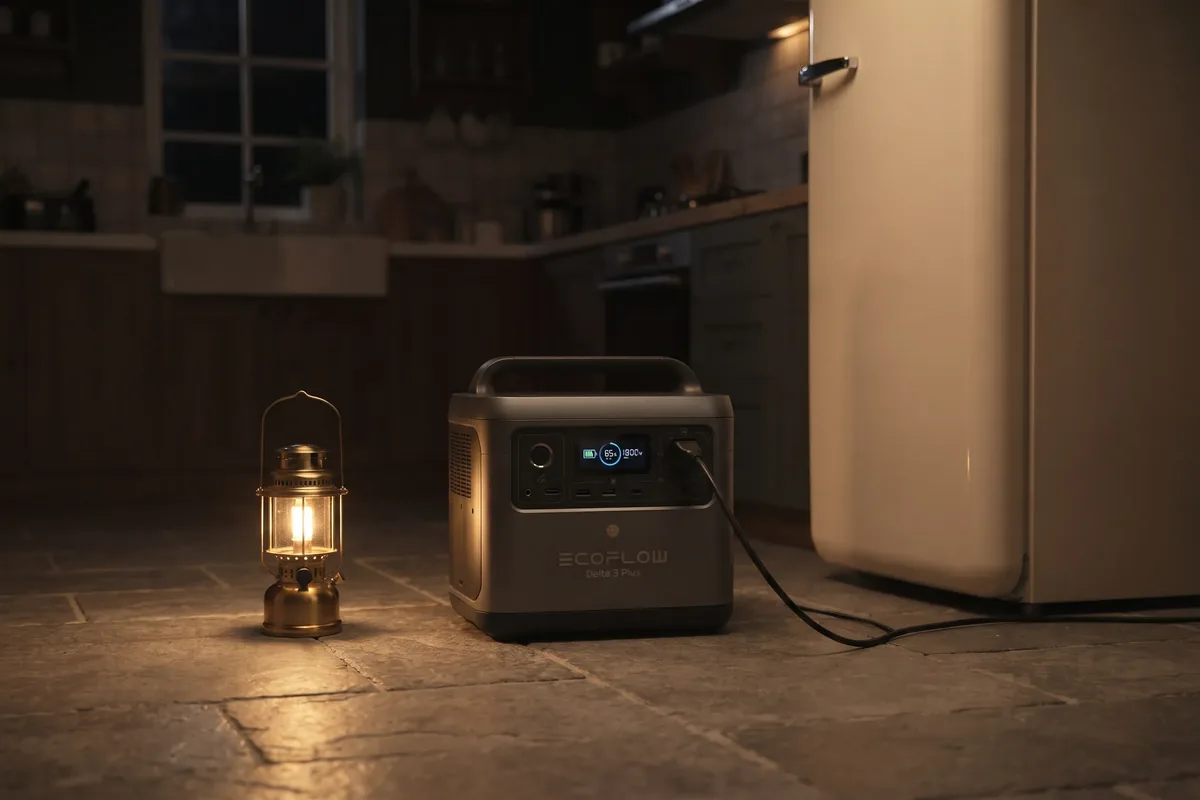
- Capacity
- 1,024 Wh
- AC output
- 1,800 W
- Wall charge
- 56 min
- Weight
- 27.6 lb
Most outages are over by morning, and for those the Delta 3 Plus is enough. It rates 8.9, the highest of any portable station we've reviewed (only the installed DELTA Pro Ultra X rates higher), and its 3,600 W surge clears a compressor start three times over.
It switches over in under 10 ms, so it works as an automatic backup for the fridge. When the grid comes back, EcoFlow quotes a full recharge from the wall in 56 minutes, and 70 minutes from 2 × 500 W of solar, so it's full again before the next night.
Its 1,000 W solar input also covers a fridge and chest freezer's daily use on a 4-sun-hour day by our estimate (see charging below).
If one night turns into two, one extra battery takes it to about 5 kWh (with a DELTA Pro 3 battery); only EcoFlow's listed batteries fit, one at a time. For other stations this size, see the best 1000Wh portable power stations.
Best for
Overnight outages and a station you can lift.
Skip if
Your outages often run past 12 hours and you don't plan to add solar or a battery.
Pros
- About 11.5 hours of a 67 W fridge
- 1,800 W continuous, 3,600 W surge
- Under 10 ms switchover
- EcoFlow quotes a full wall recharge in 56 minutes
- 1,000 W solar input
Cons
- About 8.7 hours with a chest freezer added
- Expands only with one extra battery
Check price on AmazonRead our EcoFlow Delta 3 Plus full review
Best for multi-day outages: Anker SOLIX S5000
Its 5,024 Wh and 8.8 W standby give about 57 hours of an average fridge, more than two days.
Best for multi-day outages: Anker SOLIX S5000
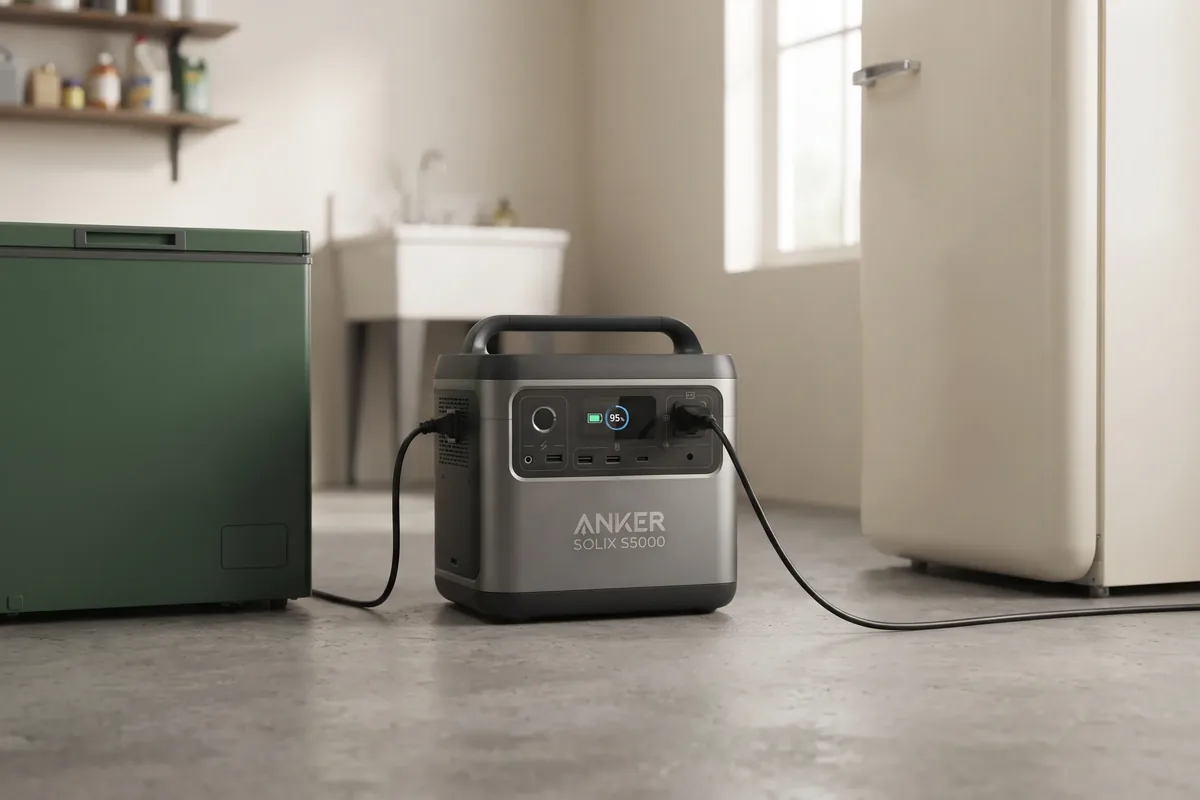
- Capacity
- 5,024 Wh
- AC output
- 4,500 W
- Wall charge
- Not stated
- Weight
- 97 lb
For a storm that takes the power out for days, the S5000 gives the longest fridge runtime of the portable stations we've reviewed by our estimate: about 57 hours. Capacity is half the reason; the other half is the 8.8 W standby draw Anker publishes, under our 10 W default. The Jackery Explorer 5000 Plus holds slightly more (5,040 Wh), but Jackery's 50 W standby figure cuts its fridge runtime to about 39 hours. The EcoFlow TITAN 5000 Classic comes within an hour (about 56.5 hours), but EcoFlow publishes no standby figure, so that number rests on our 10 W default.
Anker quotes up to 86 hours on a 700 L fridge in its own testing. Our 57 hours uses the average US fridge and our formula, so plan with ours unless your fridge is as efficient as Anker's.
Its 3,000 W solar input covers a fridge and freezer's day with plenty to spare, and five BP5000 batteries take one unit to about 30 kWh. A TT-30R and an L14-30R (240 V) outlet let it feed a transfer switch for the fridge's own circuit. See the best whole-home battery backup for that route.
It rates 7.2, below the Explorer 5000 Plus (8.5) and TITAN 5000 Classic (7.9): the Explorer 5000 Plus on AC output and solar input (its 7,200 W and 4,000 W score higher), and below the TITAN 5000 Classic on wall charging and solar input. For a fridge, runtime per charge is the job, and that's where it leads.
Best for
Outages of two days or more, and fridge plus freezer.
Skip if
You need to lift it (97 lb on wheels) or want a 12 V outlet.
Pros
- About 57 hours of a 67 W fridge, about 43 with a chest freezer
- 8.8 W standby draw (Anker)
- 4,500 W continuous, 8,000 W peak
- 3,000 W solar input
- Expands to about 30 kWh with five BP5000
Cons
- 97 lb
- No 12 V car outlet
- Rated 7.2/10
Best for a 12 V camping fridge: Bluetti Elite 30 V2
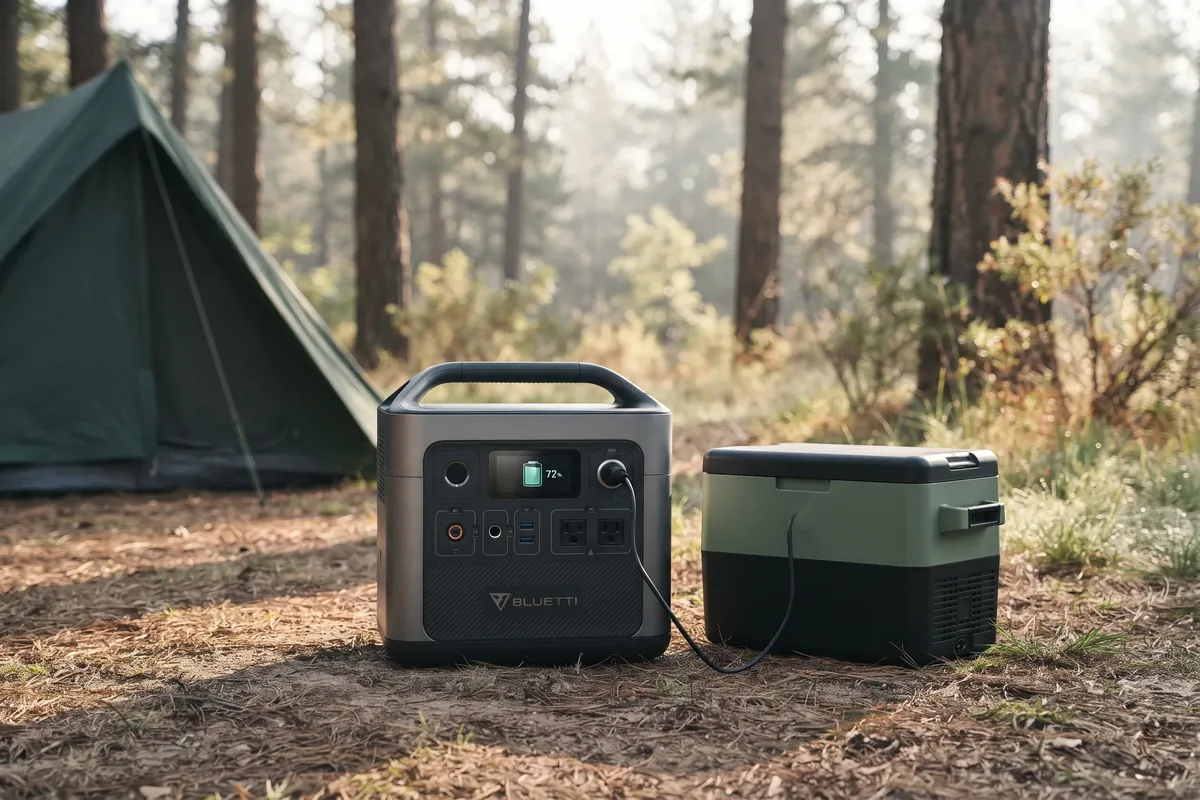
Its 12 V, 10 A car outlet runs a typical 25 W 12 V fridge for about 10.6 hours, from a 9.5 lb station.
Best for a 12 V camping fridge: Bluetti Elite 30 V2
- Capacity
- 288 Wh
- AC output
- 600 W
- Wall charge
- About 70 min
- Weight
- 9.5 lb
A 12 V compressor fridge or electric cooler runs straight from a car outlet, with no inverter in the way, so a small station goes a long way. Our planning figure for a 12 V electric cooler is about 25 W on average (about 45 W while running), and on the Elite 30 V2's car outlet that's about 10.6 hours by our estimate at 92% DC efficiency.
The outlet is rated 12 V, 10 A (120 W), shared with two DC5521 ports, which covers a 12 V fridge's running draw.
Bluetti turns DC-ECO on by default to shut the DC outputs at low load, and its manual says to turn it off for critical loads. Switch it off in the app before you leave a fridge on it.
A 12 V fridge uses about 650 Wh a day by our estimate (25 W ÷ 0.92 × 24 hours). Bluetti's 200 W solar input, at 75% of the panel's rating for 5 peak sun hours, puts back about 750 Wh, enough to keep a fridge going day to day in good sun.
It rates 7.8, the highest of the compact stations we've reviewed, ahead of the EcoFlow River 3 Plus (7.6). For more camp setups, see the best portable power stations for camping.
Best for
A 12 V fridge or cooler on a weekend trip.
Skip if
You want to run a kitchen fridge from AC; pick the Delta 3 Plus.
Pros
- About 10.6 hours of a 25 W 12 V fridge on DC
- 12 V, 10 A car outlet
- 9.5 lb, LiFePO4, 5-year warranty
- Bluetti quotes 2.2 hours on 200 W of solar
- Rated 7.8, the highest compact station we've reviewed
Cons
- Not for a household fridge on AC
- Not expandable
- 200 W solar input
Check price on AmazonRead our Bluetti Elite 30 V2 full review
Refrigerator power draw: plan on about 67 W average, not the running watts
The average US fridge-freezer uses about 588 kWh a year, which is about 67 W around the clock, while it draws 150 to 400 W with the compressor on.
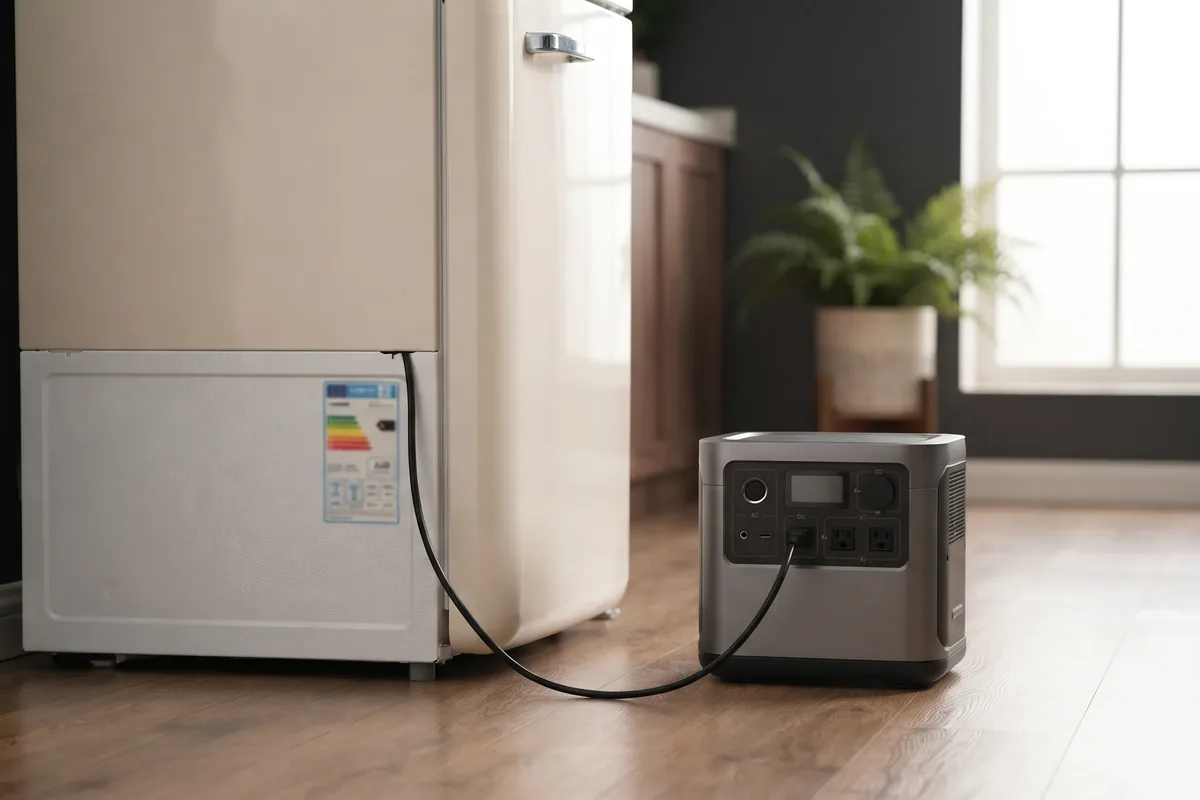
A fridge has three power figures, and each one matters for a different spec:
- Average watts decide runtime. The compressor cycles on and off, so the average is far below the running draw. Take the yearly kWh from the yellow EnergyGuide label and divide by 8.76 (8,760 hours in a year, divided by 1,000): 588 kWh a year ÷ 8.76 ≈ 67 W, the average US refrigerator-freezer. An ENERGY STAR top-freezer at about 360 kWh a year averages about 41 W, and an ENERGY STAR chest freezer at about 215 kWh a year about 25 W. That conversion is our method, and it's the one every runtime on this page uses.
- Running watts must sit under the station's continuous output. Generator sizing charts list a household fridge at about 150 to 400 W while the compressor runs.
- Startup watts must sit under the station's surge rating. The same charts put a fridge's compressor start at about 800 to 1,200 W for an instant.
Standby draw is the fourth number, and it belongs to the station. While the AC inverter is on, the station uses power for itself, even between compressor cycles. We use 10 W unless the maker publishes a figure:
- Anker S5000: 8.8 W.
- Bluetti Elite 30 V2: about 9 W.
- Jackery Explorer 5000 Plus: 50 W.
With a 67 W fridge, the station pulls about 79 W from the battery for the fridge (after 15% inverter loss) plus that standby draw, so a 50 W standby costs far more runtime than a 10 W one.
Our fridge runtimes use battery Wh ÷ (fridge average W ÷ 0.85 + standby W), the same formula as the runtime calculator. They're estimates: a hot kitchen, frequent door openings and a reserve set in the app all shorten them.
| Station | Average fridge (67 W) | Fridge + chest freezer (91 W) | Efficient fridge (41 W) |
|---|---|---|---|
| HomePower 2000 Plus v2 | About 23 h | About 17.5 h | About 35 h |
| Delta 3 Plus | About 11.5 h | About 8.7 h | About 17.6 h |
| SOLIX S5000 | About 57 h | About 43 h | About 88 h |
| Elite 30 V2 | Not suited | Not suited | Not suited |
The fridge + freezer column adds an ENERGY STAR chest freezer (about 25 W) to the average fridge, about 91 W in all. A freezer cuts runtime by about a quarter compared with the fridge alone.
The Elite 30 V2's 600 W AC output has no published surge rating, and Bluetti's manual warns that motors and compressors can start at 2 to 4 times their rated power and overload it, so it's a pick for a 12 V fridge on DC, not a kitchen fridge.
Average fridge (67 W) on each pick
- Anker SOLIX S5000 (5,024 Wh)2.4 days
- Jackery HomePower 2000 Plus v2 (2,048 Wh)23 h
- EcoFlow Delta 3 Plus (1,024 Wh)12 h
How we chose the fridge picks: runtime, surge and standby draw
We ranked every station we've reviewed by fridge runtime and checked that its surge or continuous rating covers a compressor start of up to 1,200 W.
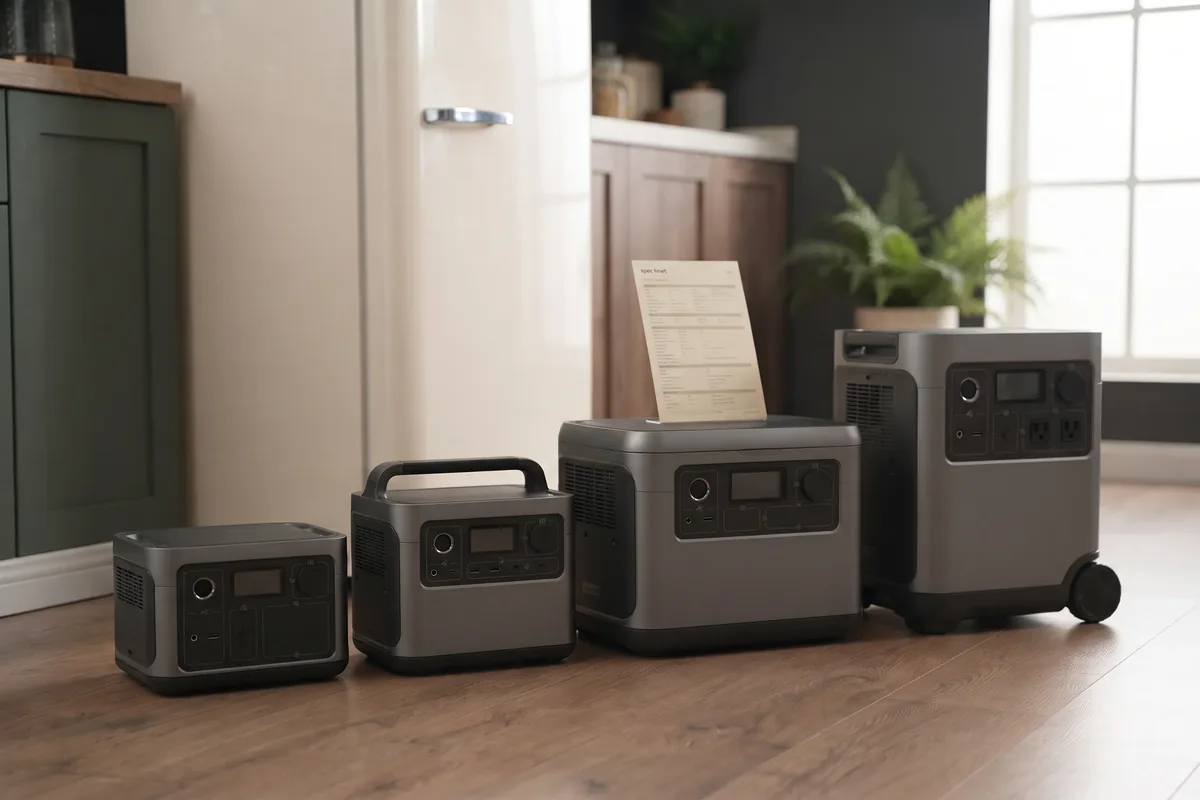
We picked from the stations we've reviewed in full. For a refrigerator we weighted fridge runtime (capacity and standby draw), surge rating against a compressor start, UPS switchover for automatic backup, solar input for long outages, expansion and weight. Each station also has an OffGrid Current rating out of 10, computed from its specs in seven areas. The weights are on how we test.
We haven't tested these units hands-on, and we don't rank by price.
The picks cover four jobs: a full day at home, one night, several days, and a 12 V fridge at camp. A higher rating doesn't win a role on its own. The EcoFlow DELTA Pro Ultra X rates 9.6, but it's an installed whole-home system of about 299 lb, not a station you carry to the fridge.
Stations that rate above a pick are listed under "Also considered" with the reason they missed.
Fridge runtime on 23 reviewed stations: 11.5 to 57 hours
Above 1 kWh, fridge runtime runs from about 11.5 hours to about 57, and standby draw reorders stations of the same size.
Sorted by fridge runtime (average 67 W fridge on AC). Standby is the maker's figure where one is published, otherwise our 10 W default. Compact stations are left out: at about 3 hours of a household fridge, they suit a 12 V fridge on DC, covered above.
| Station | Capacity | Standby | Fridge hours | Rating |
|---|---|---|---|---|
| Anker SOLIX S5000 | 5,024 Wh | 8.8 W | About 57 | 7.2 |
| EcoFlow TITAN 5000 Classic | 5,018 Wh | 10 W (default) | About 56.5 | 7.9 |
| EcoFlow DELTA Pro 3 | 4,096 Wh | 10 W (default) | About 46 | 7.0 |
| Anker SOLIX F3800 Plus | 3,840 Wh | 10 W (default) | About 43 | 7.8 |
| Jackery Explorer 5000 Plus | 5,040 Wh | 50 W | About 39 | 8.5 |
| Anker SOLIX F3000 | 3,072 Wh | 10 W (default) | About 34.6 | 7.4 |
| Jackery HomePower 3600 Pro Max | 3,584 Wh | 25 W | About 34.5 | 6.9 |
| Bluetti Elite 300 | 3,014 Wh | 10 W (default) | About 33.9 | 6.2 |
| EcoFlow Delta Pro | 3,600 Wh | 30 W | About 33.1 | 5.6 |
| Bluetti Apex 300 | 2,765 Wh | 20 W | About 28 | 8.7 |
| Anker SOLIX S2000 | 2,010 Wh | 6 W | About 23.7 | 4.6 |
| Bluetti Elite 200 V2 | 2,074 Wh | 10 W | About 23.3 | 6.4 |
| Jackery HomePower 2000 Plus v2 | 2,048 Wh | 10 W (default) | About 23 | 7.8 |
| Anker SOLIX C2000 Gen 2 | 2,048 Wh | 10 W (default) | About 23 | 7.5 |
| GRECELL H2400 | 1,843 Wh | 10 W (default) | About 20.7 | 5.8 |
| Goal Zero Yeti 1500 | 1,505 Wh | 10 W (default) | About 16.9 | 6.4 |
| Jackery Explorer 1000 Plus | 1,264 Wh | 22 W | About 12.5 | 6.8 |
| Bluetti AC180 | 1,152 Wh | 15 W | About 12.3 | 6.4 |
| EcoFlow Delta 3 Plus | 1,024 Wh | 10 W (default) | About 11.5 | 8.9 |
| DJI Power 1000 V2 | 1,024 Wh | 10 W (default) | About 11.5 | 8.5 |
| EcoFlow Delta 3 | 1,024 Wh | 10 W (default) | About 11.5 | 8.4 |
| Anker SOLIX C1000 Gen 2 | 1,024 Wh | 10 W (default) | About 11.5 | 8.0 |
| Jackery Explorer 1000 v2 | 1,024 Wh | 10 W (default) | About 11.5 | 5.1 |
Two rows show how much standby matters:
- S2000: it holds less than the HomePower 2000 Plus v2 but runs a fridge longer on its 6 W standby.
- Explorer 5000 Plus: the biggest battery in the table falls to fifth on its 50 W.
- HomePower 3600 Pro Max: with more capacity than the F3000, it runs a fridge slightly less long on Jackery's 25 W no-load draw.
The EcoFlow DELTA Pro Ultra X (12,288 Wh, about 138 hours by our estimate) is left out because it's an installed system, not a portable station.
Compressor surge: why 3,000 W or more of surge is the safe range
A fridge needs about 800 to 1,200 W for an instant to start, so a station's surge rating, not its battery, decides whether it starts.
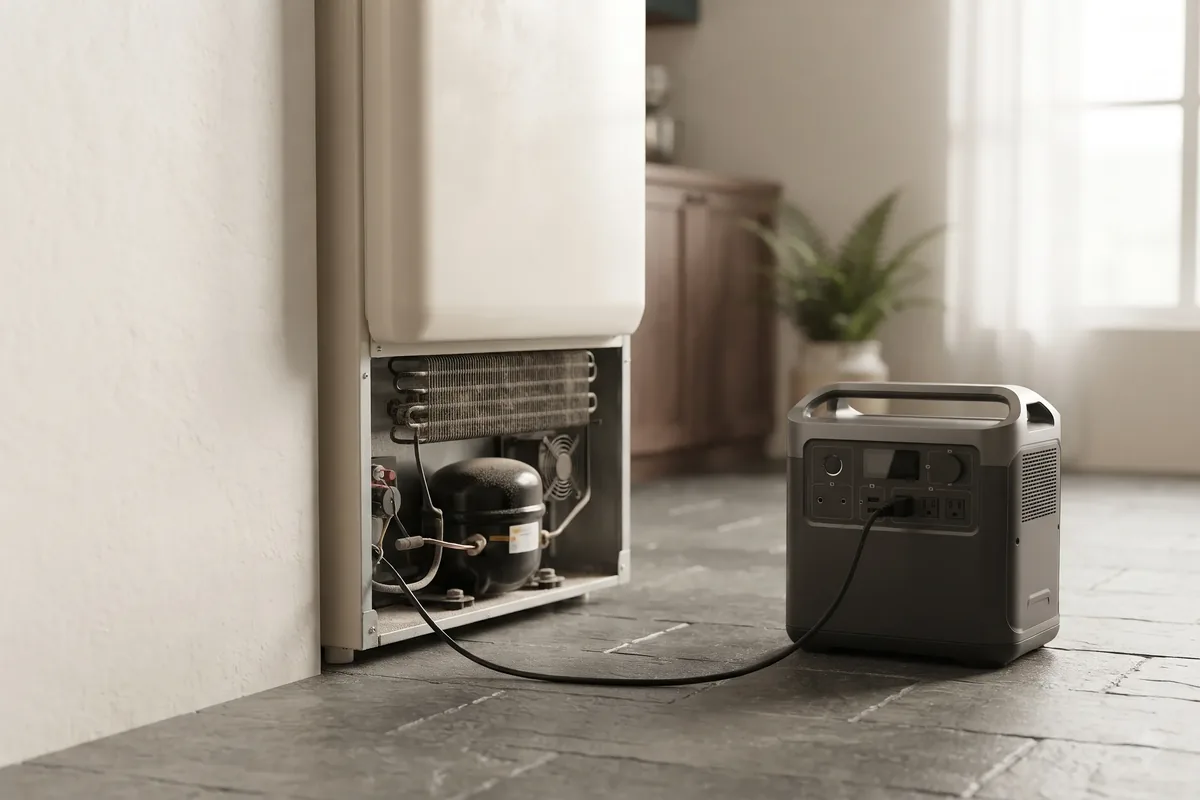
Each time the compressor kicks on, it draws several times its running power for a moment. If that's above the station's surge rating, the station trips its overload protection and the fridge doesn't start, however full the battery.
Our three household-fridge picks are all well above the 800 to 1,200 W range:
- Delta 3 Plus: 3,600 W.
- HomePower 2000 Plus v2: 4,800 W.
- S5000: 8,000 W peak. Anker notes the S5000's 8,000 W peak lasts only a fraction of a second. Its 4,500 W continuous output alone covers a fridge's start.
Small stations are where it fails. The Jackery Explorer 300 is rated 300 W continuous and 500 W surge, under the startup range of a full-size fridge.
Several large stations, including the Bluetti Apex 300, Anker SOLIX F3800 Plus and EcoFlow TITAN 5000 Classic, publish no surge figure. Their continuous output (3,840 W, 6,000 W and 4,000 W) already exceeds a fridge's startup range on its own.
Two habits keep starts reliable: plug the fridge straight into the station's AC outlet with its own cord, not a long, thin extension cord, and don't start a microwave or kettle on the same station as the compressor cycles on. For how starting and running watts add up across several appliances, see surge vs continuous watts.
Charging during a long outage: solar, generator and car
An average fridge uses about 2.1 kWh a day from a station, which takes about 710 W of solar panels on a 4-sun-hour day by our estimate.
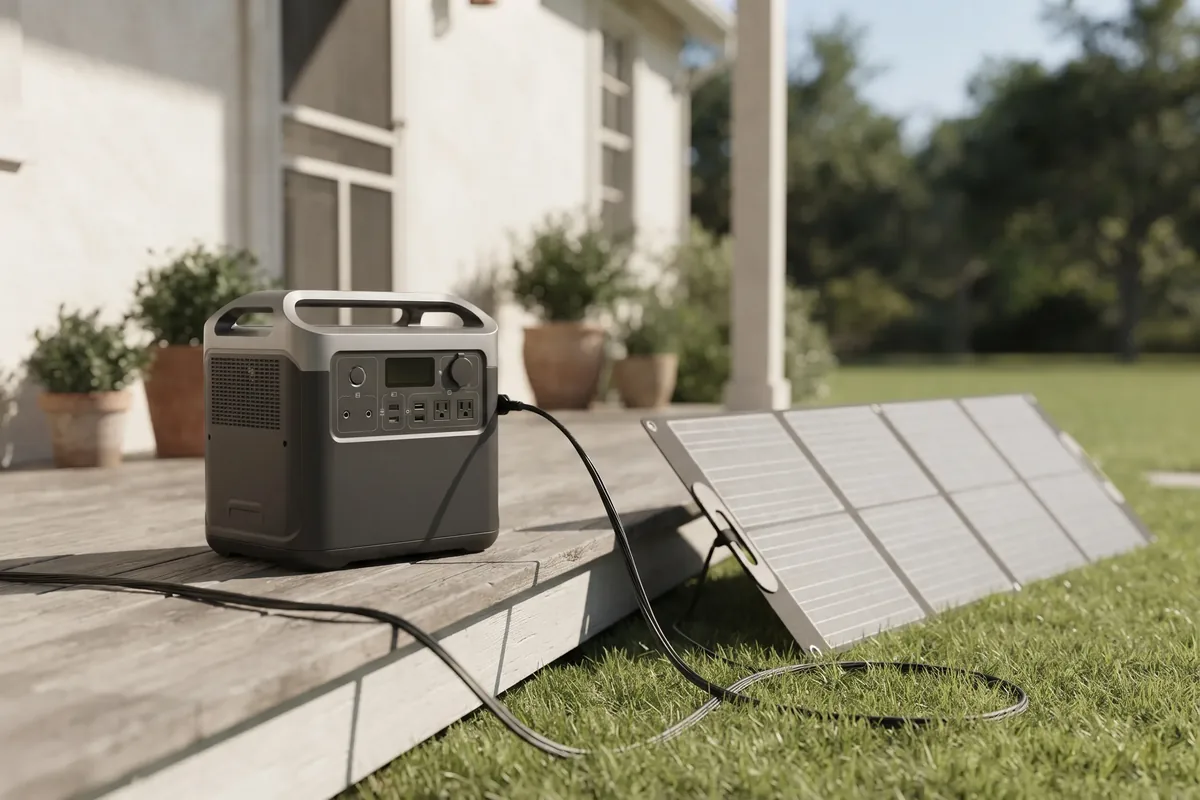
Battery size gets you through the first day. Recharging decides the rest. An average fridge plus 10 W standby uses about 2.1 kWh a day from the battery, and a fridge with a chest freezer about 2.8 kWh.
By our estimate a panel gives about 75% of its rating, so at 4 peak sun hours it takes about 710 W of panels to cover the fridge and about 940 W for the fridge and freezer.
| Station | Max solar | Solar refill | Wall refill |
|---|---|---|---|
| HomePower 2000 Plus v2 | 800 W | About 3.2 h (Jackery) | About 1.5 h (Jackery, Emergency mode) |
| Delta 3 Plus | 1,000 W | 70 min (EcoFlow, 2 × 500 W) | 56 min (EcoFlow) |
| SOLIX S5000 | 3,000 W | About 2.2 h (our estimate) | 99 min at 4,300 W (Anker) |
| Elite 30 V2 | 200 W | About 2.2 h (Bluetti) | About 70 min (Bluetti, Turbo) |
The S5000's 99 minutes needs 240 V input. On a 120 V outlet it charges at 1,800 W, at least 2.8 hours from empty at that rate.
All four can also charge from a generator. Running a gas generator for an hour or two to refill the station, then shutting it off, keeps the fridge on quiet battery power the rest of the day. Jackery quotes about 1.5 hours for the HomePower 2000 Plus v2 on a generator.
From a car, the HomePower 2000 Plus v2 takes about 3.8 hours on Jackery's 600 W alternator charger, EcoFlow's 800 W Alternator Charger tops up the Delta 3 Plus's 1 kWh in about 1.3 hours, and Bluetti quotes about 4.2 hours for the Elite 30 V2 from a 12 V socket. See charging from a car and what size solar panel you need.
What to look for in a refrigerator power station: surge, standby and switchover
Look past capacity: a station needs the surge to start the compressor, a low standby draw and fast switchover to back the fridge up unattended.
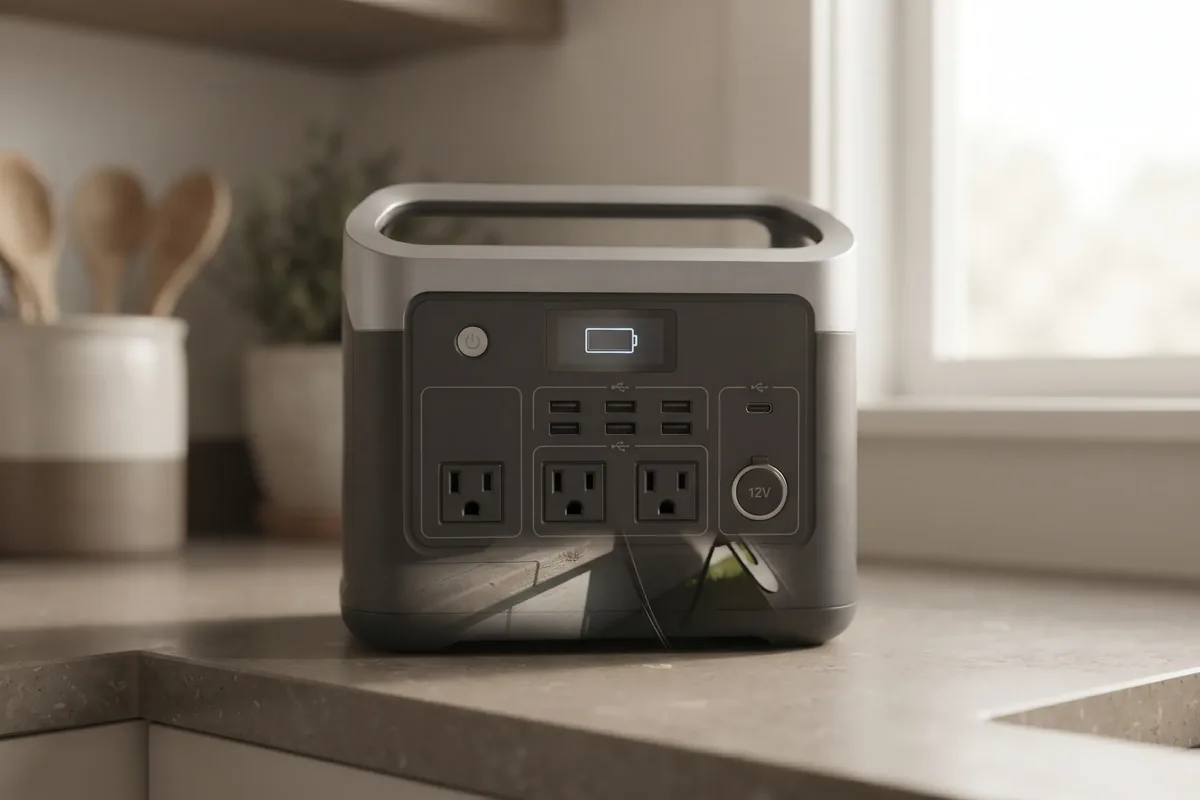
- Capacity for your outage: about 1 kWh for a night, about 2 kWh for a day, 3.5 kWh or more for several days, with an average fridge. Use the runtime calculator with your label's kWh.
- Surge rating: at least the 800 to 1,200 W startup range; 3,000 W or more leaves room for other loads.
- Standby draw: a published figure under 10 W stretches runtime; a 50 W figure shortens it by about a third on a 67 W fridge.
- Switchover for automatic backup: a station that switches in 10 ms or so, left plugged in between the wall and the fridge, keeps it running when the grid drops while you're out. See using a power station as a UPS.
- AC or DC: a kitchen fridge needs AC; a 12 V fridge or cooler should run from a 12 V car outlet, which skips the inverter and its standby draw. The S5000 has no 12 V outlet.
- Solar input and expansion: for outages past a day, enough solar to cover the fridge's daily use, or a battery you can add.
- LiFePO4 battery: all four picks use LiFePO4 cells; the older Jackery Explorer 300 uses lithium-ion (NMC).
- Weight and warranty: the picks run from 9.5 lb (Elite 30 V2) and 27.6 lb (Delta 3 Plus) to 41.5 lb (HomePower 2000 Plus v2) and 97 lb (S5000); the Elite 30 V2 carries a 5-year warranty and the HomePower 2000 Plus v2 3 years plus 2 with registration.
- Pure sine wave AC: use a station with a pure sine wave AC output for a compressor.
The cheapest way to stretch any station is to keep the door shut. FoodSafety.gov says a closed fridge keeps food safe for up to 4 hours with no power and a full freezer about 48 hours, so you can also cycle the fridge on the station rather than run it nonstop.
Power stations make no fumes and can sit in the kitchen. See are power stations safe indoors and what else a station can run in an outage.
Also considered for a fridge: higher-rated and longer-running stations
Ten stations that rate higher than a pick or run a fridge longer, and why each missed.
| Model | Capacity | Why it missed a pick |
|---|---|---|
| EcoFlow DELTA Pro Ultra X12,288 Wh | 12,288 Wh | Rated 9.6 with about 138 hours of a fridge, but it's an installed system of about 299 lb with Smart Home Panel 3, not a portable station. |
| Bluetti Apex 3002,765 Wh | 2,765 Wh | Rated 8.7 against the HomePower 2000 Plus v2's 7.8, and about 28 hours of a fridge against 23, but it weighs 83.8 lb against 41.5 lb, publishes no surge figure, has no built-in 12 V outputs, and switches over in 0 or 20 ms depending on mode. |
| Jackery Explorer 5000 Plus | — | Rated 8.5 against the S5000's 7.2, but its 50 W standby gives about 39 hours of a fridge against 57, and it weighs 134.5 lb against 97 lb. |
| DJI Power 1000 V21,024 Wh | 1,024 Wh | Rated 8.5 with the same 1,024 Wh as the Delta 3 Plus, but 31.3 lb against 27.6 lb, no published surge figure and no published switchover time. |
| EcoFlow Delta 31,024 Wh | 1,024 Wh | Rated 8.4, the same 1,024 Wh, 3,600 W surge and 27.6 lb as the Delta 3 Plus, but half the solar input (500 W against 1,000 W). |
| Anker SOLIX C1000 Gen 21,024 Wh | 1,024 Wh | Rated 8.0 and 24.9 lb with about 11.5 hours of a fridge, but 3,000 W surge against 3,600 W, 600 W of solar against 1,000 W, and it isn't expandable. |
| EcoFlow TITAN 5000 Classic | — | Rated 7.9 against the S5000's 7.2 and about 56.5 hours of a fridge on our 10 W default, but EcoFlow publishes no standby or surge figure, and it's 120 V only with 102.5 lb on the main unit. |
| Anker SOLIX F3800 Plus3,840 Wh | 3,840 Wh | Rated 7.8 with about 43 hours of a fridge, but that's 14 hours less than the S5000, at 136.7 lb. |
| Anker SOLIX F30003,072 Wh | 3,072 Wh | Rated 7.4 against the S5000's 7.2, but about 34.6 hours of a fridge against 57, 3,072 Wh, and it expands to 12,288 Wh against about 30 kWh. |
| Anker SOLIX C2000 Gen 22,048 Wh | 2,048 Wh | The same 2,048 Wh and about 23 hours as the HomePower 2000 Plus v2, but rated 7.5 against 7.8, 4,000 W surge against 4,800 W, and it expands only to 4,096 Wh against about 12 kWh. |
For every outage load, not just the fridge, see the best portable power stations for home backup. For our pick in every size, see the best portable power stations.
FAQ
Fridge runtimes, sizes, Jackery models, power banks and freezers, answered with our runtime method.
Can a portable power station run a refrigerator?
Yes, if its continuous output covers the fridge's running draw (about 150 to 400 W) and its surge rating covers the compressor's start (about 800 to 1,200 W). Every 1 kWh station we've reviewed with a published surge figure clears that. A 300 W station usually doesn't.
How long it runs depends on watt-hours: about 11.5 hours on 1 kWh and 23 on 2 kWh for an average fridge.
How long will a Jackery 3000 run a refrigerator?
We haven't reviewed a Jackery 3000-class station, so we don't give a figure for it. Take its watt-hours from Jackery's spec sheet and divide by about 89 W (an average 67 W fridge ÷ 0.85, plus 10 W standby). By that method any 3,000 Wh station gives about 34 hours.
For scale, the Jackery HomePower 3600 Pro Max we've reviewed (3,584 Wh) gives about 34.5 hours on Jackery's 25 W no-load figure.
What size Jackery do I need to run a refrigerator?
- One night: a 1 kWh model such as the Explorer 1000 v2 (about 11.5 hours of an average fridge).
- A full day: the HomePower 2000 Plus v2 (about 23 hours).
- Several days: the Explorer 5000 Plus (about 39 hours on its 50 W standby) or the HomePower 3600 Pro Max (about 34.5 hours on its 25 W no-load draw).
The Explorer 300's 500 W surge is too low for a full-size fridge.
What power bank can power a fridge?
A phone power bank can't: it has no AC outlet and only USB output.
A 12 V fridge or cooler can run from a small power station's car outlet, such as the Bluetti Elite 30 V2's 12 V, 10 A socket, about 10.6 hours for a 25 W fridge by our estimate. A kitchen fridge needs a station of about 1 kWh or more with AC and enough surge.
Can a power station run a refrigerator and a freezer?
Yes. An average fridge plus an ENERGY STAR chest freezer (about 91 W together) runs for about 8.7 hours on the Delta 3 Plus, about 17.5 on the HomePower 2000 Plus v2 and about 43 on the SOLIX S5000, by our estimate. Plug each into its own AC outlet so their starts don't coincide on one cord.
How do I find my fridge's watts?
Read the yearly kWh on the yellow EnergyGuide label and divide by 8.76 for average watts: 588 kWh a year is about 67 W. If the label is gone, the ENERGY STAR product finder lists yearly use for certified models. For worked examples, see how long a power station runs a refrigerator.
Will a power station switch over to the fridge automatically in an outage?
Yes, if it has UPS or EPS switchover and you leave it plugged in between the wall and the fridge. All four picks switch in about 10 ms or less, so the fridge keeps running while you're out.
Can I run a refrigerator on solar with a power station?
Yes, with enough panels. By our estimate an average fridge needs about 710 W of panels on a 4-sun-hour day, and a fridge plus chest freezer about 940 W. The Delta 3 Plus (1,000 W input) and S5000 (3,000 W) can take that much; the HomePower 2000 Plus v2's 800 W covers the fridge alone.
Is a power station or a gas generator better for a fridge?
For a few days, a power station: it's silent, makes no fumes, sits in the kitchen and switches over by itself. For long outages you can pair the two, running a generator for an hour or two to refill the station.