 By
We may earn a commission if you buy through links on this page, at no extra cost to you. This never affects which products we recommend. How we make money.
On this page 9 sections
Our verdict · DJI
The most output and fastest recharge of any 1 kWh station we cover
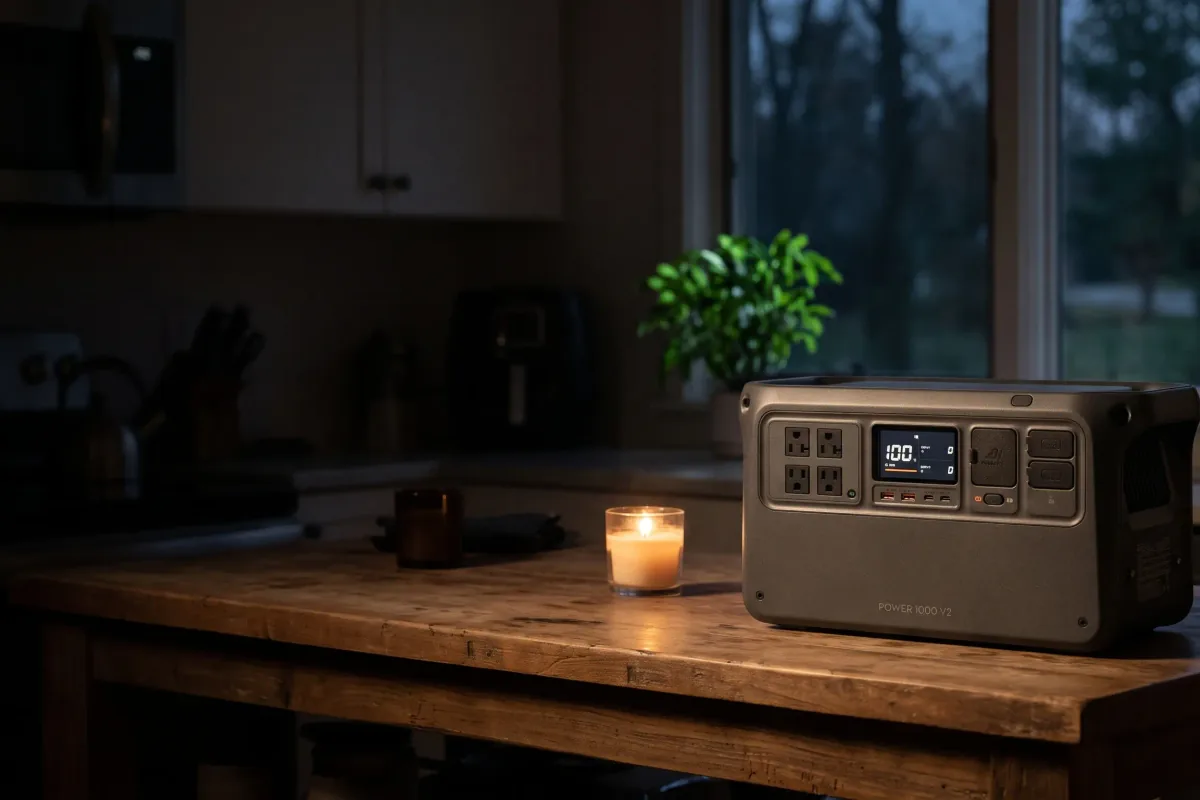
The DJI Power 1000 V2 pairs a 1,024 Wh LiFePO4 battery with 2,600 W of continuous output and an 1,800 W recharge that fills it in 56 minutes. It is the strongest 1 kWh station we cover and DJI backs it for five years, but solar charging runs through add-on adapters, the UPS is basic, and it weighs more than the Anker, EcoFlow and Jackery rivals.
- Capacity
- 1,024 Wh
- AC output
- 2,600 W
- Wall charge
- 56 min
- Weight
- 31.3 lb
Best for
Power tools, kitchen appliances, DJI drone pilots and anyone who wants a full recharge in under an hour
Skip it if
You need a built-in solar port, a published UPS switchover time or the lightest 1 kWh unit
- 2,600 W continuous output, the highest at 1 kWh
- 0–80% in 37 min, full in 56 min
- Two 140 W USB-C ports and fast drone charging
- Five-year warranty; expands to 11,264 Wh
- No built-in solar input: needs a DJI adapter
- 31.3 lb, heavier than rivals
- Basic UPS only, switchover time not published
Rating breakdown (mid-size (1 to 1.5 kwh) class)
| Criterion | Weight | Score | Based on |
|---|---|---|---|
| Wall charging speed | 20% | 10.0 | 1,800 W input |
| AC output | 20% | 10.0 | 2,600 W |
| Solar input | 10% | 10.0 | 1,200 W |
| Backup switchover | 15% | 3.0 | not stated |
| Portability | 10% | 5.1 | 33 Wh/lb |
| Expandability | 10% | 10.0 | to 11,264 Wh |
| Battery life & warranty | 15% | 10.0 | 5-year warranty, 4,000+ cycles |
| Capacity (Wh) | 1024 |
|---|---|
| Battery chemistry | LiFePO4 |
| Rated cycle life | 4,000 cycles to 80% |
| AC output, continuous (W) | 2600 |
| AC output, surge (W) | — |
| AC charge time | 56 min (0–100%, Super Recharge) |
| Max AC charging input (W) | 1800 |
| Max solar input (W) | 1200 |
| Solar input voltage range | — |
| UPS switchover (ms) | — |
| Weight (lb) | 31.3 |
| Expandable to (Wh) | 11264 |
| Warranty (years) | 5 |
Key specs at a glance: 1,024 Wh, 2,600 W and a five-year warranty
The V2 keeps the original's 1,024 Wh but raises output to 2,600 W in a 31.3 lb case.
- 1,024 Wh capacity: about 1.7 nights of CPAP with the humidifier on, or about 10 hours of fridge and router.
- 2,600 W output: DJI rates it to hold 2,600 W until the battery runs out, enough for a kettle, a microwave, a circular saw or a hair dryer.
- LiFePO4, 4,000 cycles to 80%: DJI measured this charging in Standard mode and discharging at 1,000 W. See LiFePO4 vs lithium-ion.
- Five-year warranty: DJI's FAQ gives five years as the default; some accessories are not covered.
- 31.3 lb, 448 × 225 × 230 mm: two handles make it a one-person carry, but it is 6.4 lb heavier than the Anker SOLIX C1000 Gen 2 and 7.5 lb heavier than the Jackery Explorer 1000 v2.
- Expandable to 11,264 Wh: each DJI Power Expansion Battery 2000 adds 2,048 Wh through the SDC port; five of them plus the station make 11,264 Wh.
- Operating range: DJI rates it for use from 14 to 113°F (−10 to 45°C) and for charging from 32 to 113°F (0 to 45°C).
Spec sheets are easy to misread; watts vs watt-hours explains which number answers which question.
Charging speed: 0 to 80% in 37 minutes, full in 56
Super Recharge pulls about 1,800 W from the wall; solar needs a DJI adapter on the SDC port.
From a wall outlet, the Power 1000 V2 reaches 80% in 37 minutes and 100% in 56 minutes, DJI says. That needs Super Recharge, switched on in the DJI Home app, which draws about 1,800 W, so use a wall socket with nothing else heavy on the same circuit. A switch on the unit picks Fast or Standard recharge; DJI calls Standard quieter and suits it to overnight charging, and recommends it for longer battery life. After five fast charges in a row, the station drops back to Standard for one cycle for battery maintenance, and it also lowers the charge rate if it gets too hot.
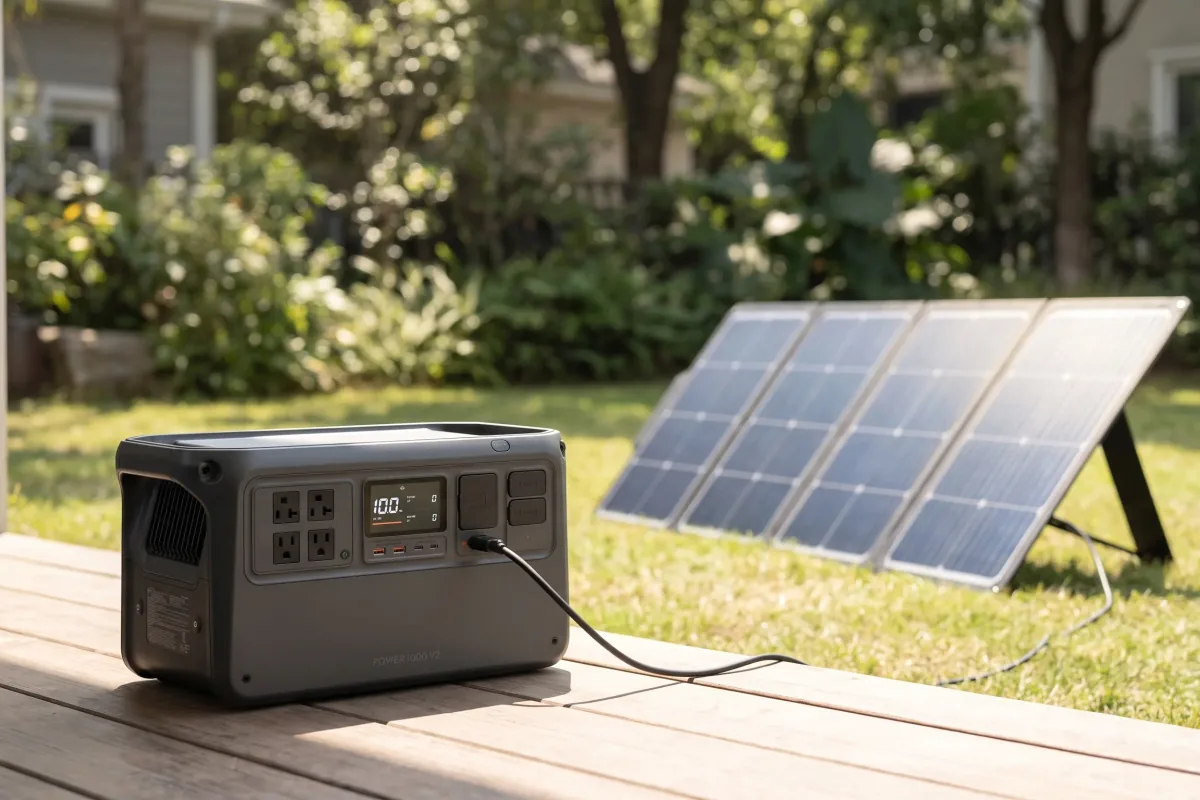
There is no solar port on the unit itself. Solar enters the SDC port through one of two DJI accessories:
- Solar Panel Adapter Module (MPPT): up to 400 W from as many as three panels in parallel (not in series), with MC4-to-XT60 cables. By our estimate (75% of 400 W) a full charge takes about 3.4 hours of peak sun.
- 1.8kW Solar/Car Super Fast Charger: up to 1,200 W of solar plus 600 W from a car at once. By our estimate (75% of 1,200 W) that is about 1.1 hours of peak sun for a full charge.
From a car, DJI's 1kW Super Fast Car Charger and the 1.8 kW charger plug into the SDC port; a plain car-outlet adapter is far slower. Budget for one of these if you plan to charge away from the wall; our solar panel sizing guide and solar charging guide show how many watts you need.
Capacity and real runtime: a fridge and router for about 10 hours
The same 1,024 Wh as its rivals, so runtimes match; the V2 just gets it back faster.
Estimated runtimes on the Power 1000 V2
- CPAP, no humidifier, low-draw (11 W, DC)3.6 days
- Laptop charging (60 W, USB-C)16 h
- CPAP with humidifier, typical (56 W, AC)14 h
- Fridge + Wi-Fi router10 h
- 1,200 W microwave0.7 h
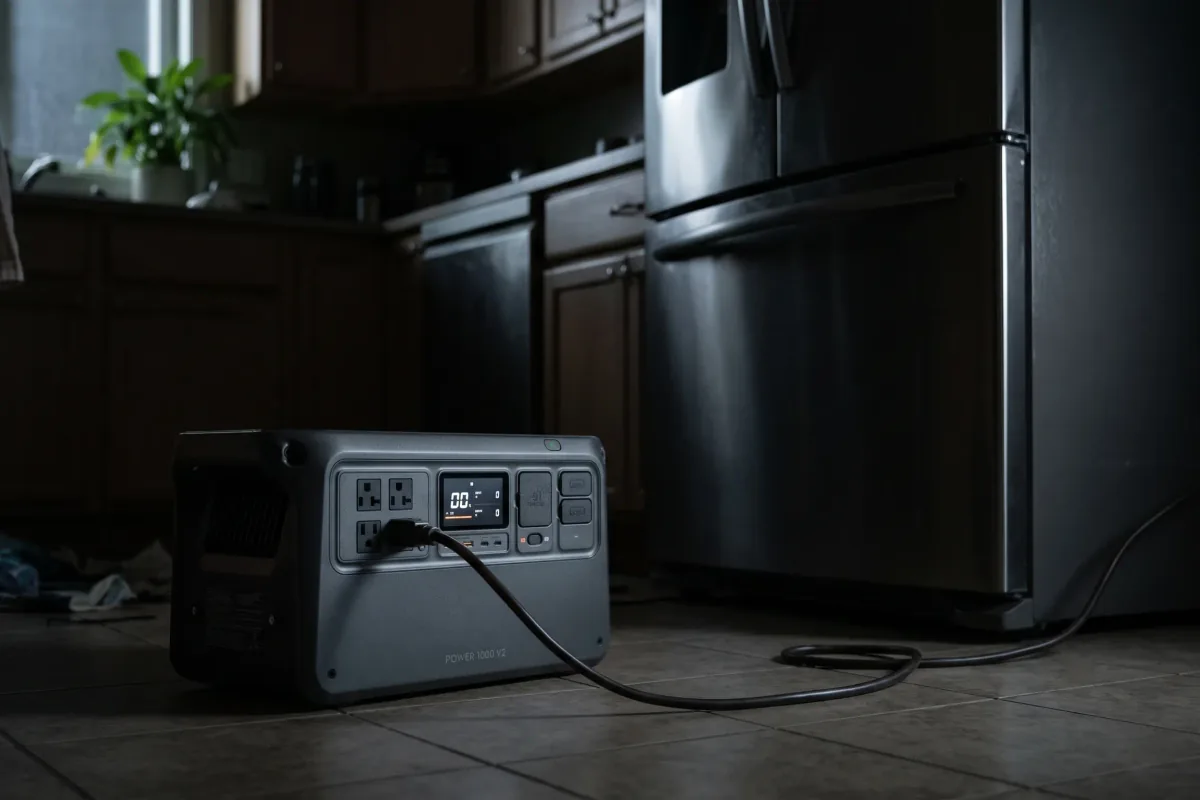
The 1,024 Wh battery matches every rival in this class, so runtimes match too. A CPAP without humidifier on DC lasts about 10 nights; with the humidifier on AC it is about 1.7 nights. The difference is how fast you get it back: with a working outlet or a generator, an hour of charging restores the whole battery. Try your own devices in the runtime calculator, or see the fridge runtime guide.
How many amp hours is it? DJI rates it in watt-hours only. Divided by 12 V, 1,024 Wh is about 85 Ah, a useful figure if you are comparing it with a 12 V RV battery.
How long does it last over the years? 4,000 cycles to 80% is more than ten years at one full cycle a day. For storage, DJI's manual says keep it at about 60%, and every six months run it below 15%, leave it off for two hours, then charge it to 100% in Standard mode. Our guide to how long power stations last covers the rest.
Output: 2,600 W across four AC outlets, with no 240 V
Four 120 V outlets share 2,600 W, so a kettle, microwave or circular saw all run.
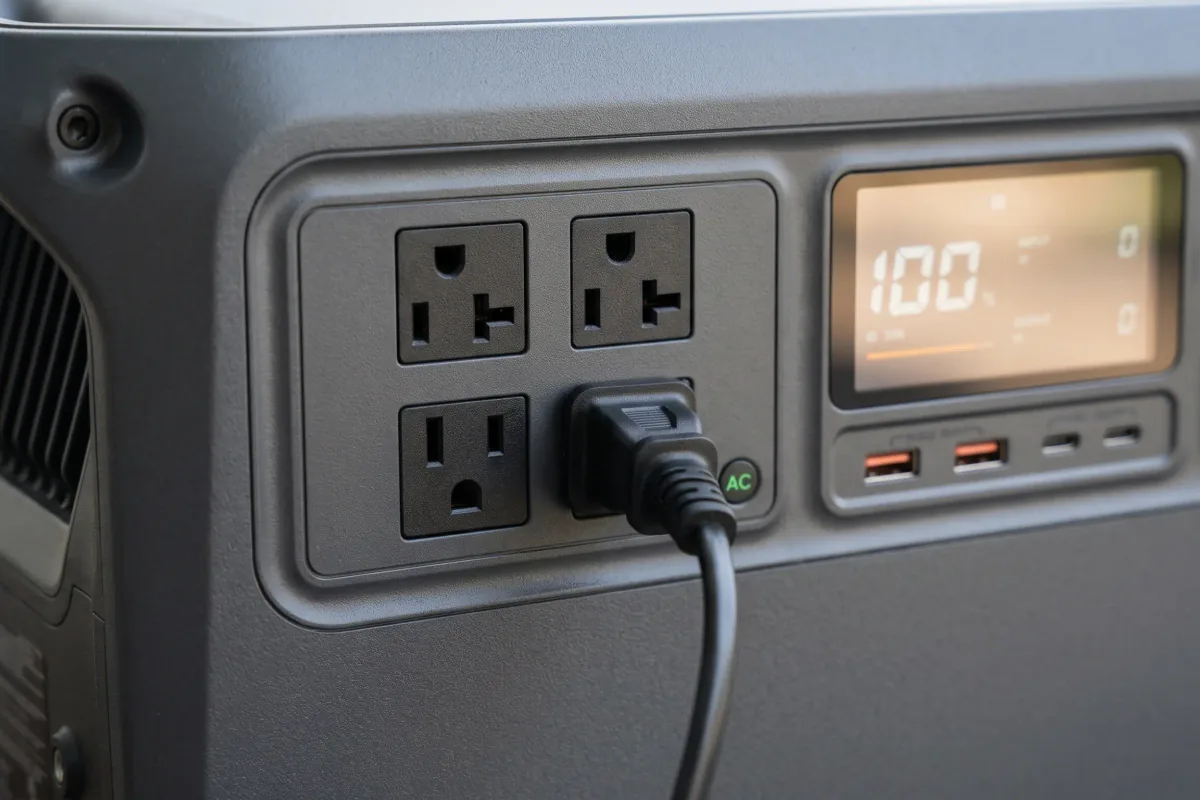
Four 120 V AC outlets share 2,600 W (20 A maximum). A 1,500 W kettle or microwave, a circular saw or a space heater on low all run without overload. Two 140 W USB-C ports (280 W together) charge laptops at full speed, two 24 W USB-A ports cover phones, and the SDC and SDC Lite ports fast-charge DJI drone batteries through DJI's charging cables.
What it can't do is run high-draw loads for long: by our method a 1,200 W microwave empties it in about 43 minutes and a 1,500 W heater in about 35. DJI does not publish a surge figure for the V2, so check a motor's starting draw against our surge vs continuous watts guide. It has no 240 V outlet or 30 A RV port, so it can't run a central air conditioner or a 240 V well pump. There is no built-in car (12 V) socket either; DC loads run from USB.
By default the AC output switches itself off after 30 minutes with nothing drawing from it, and the whole unit after 60 minutes with no input or output; both timeouts change in the DJI Home app. Raise the AC timeout before you rely on it for a low-draw load that cycles, such as a fridge.
Backup (UPS) and app: a basic UPS with no published switchover time
DJI says it does not switch in 0 ms, so keep it away from medical and sensitive equipment.
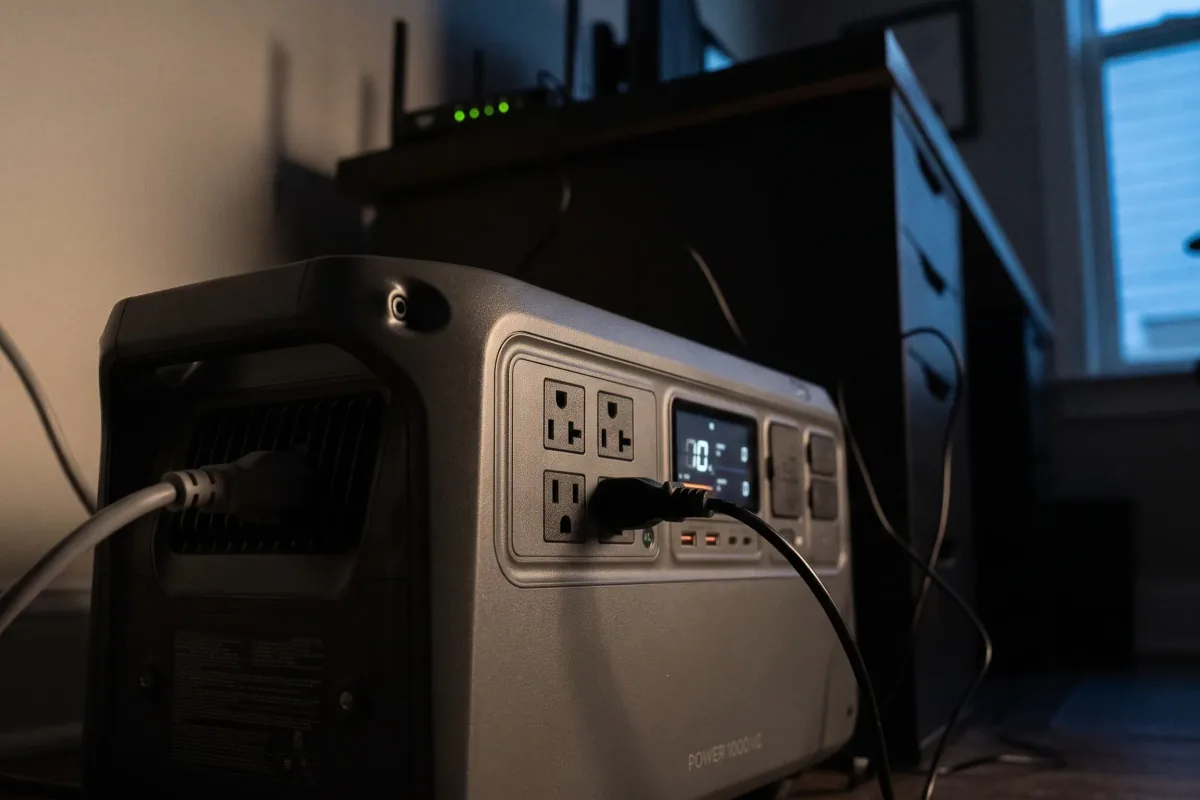
Plug the station into the wall, connect your device and press the AC button once; when the UPS icon shows, it takes over if the power fails. While the grid is up, the wall outlet powers both the station and the connected device. DJI calls this a basic UPS feature and says it does not support 0 ms switching, so it is not for medical equipment or anything that must never blink. DJI does not publish the switchover time, and its manual adds that output may be lowered in UPS mode in some regions. For a desktop PC, use our UPS guide to decide whether that matters.
The DJI Home app connects over Wi-Fi and Bluetooth. It switches Super Recharge on and off, sets the charge limit and the AC and device timeouts, shows input and output watts, and installs firmware updates.
Noise: as quiet as 26 dB in Standard recharge
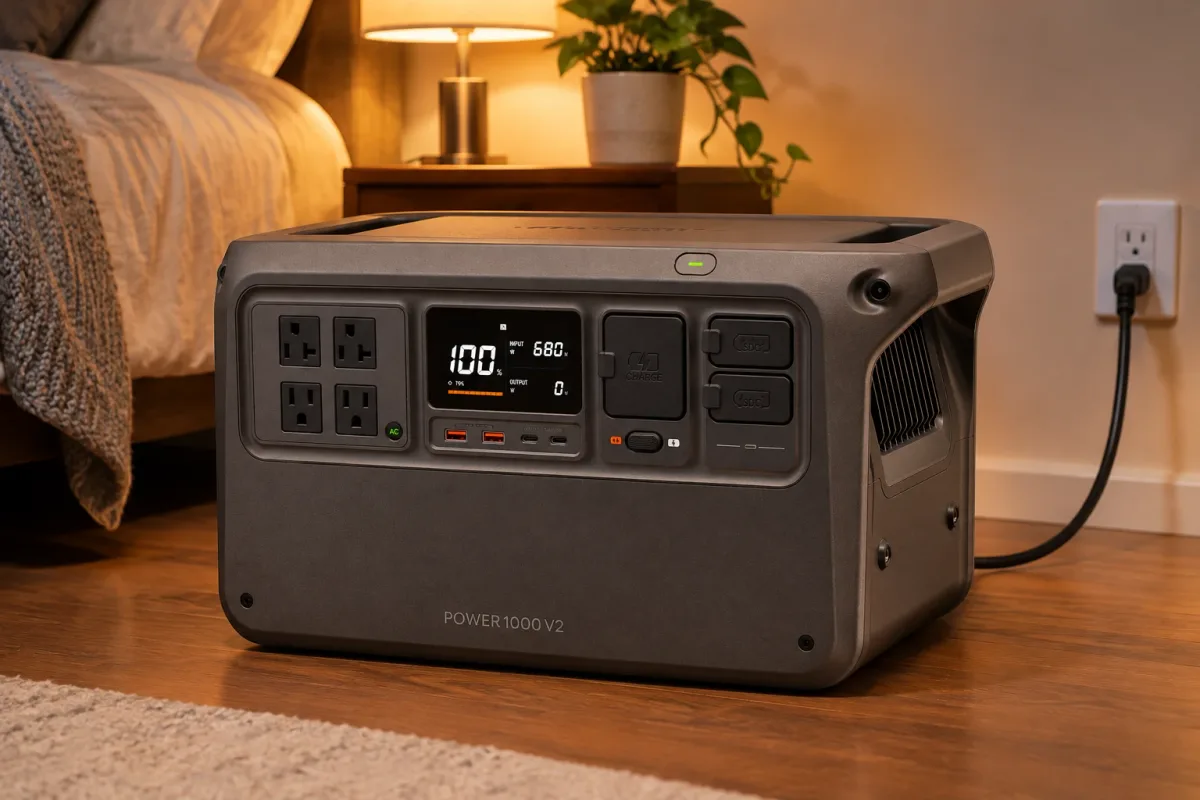
DJI quotes about 26 dB while charging in Standard mode, quiet enough for a bedroom.
DJI says the Power 1000 V2 runs as quietly as 26 dB while charging in Standard mode. That is why DJI suggests Standard for overnight charging; Fast and Super Recharge push more power and run the fans harder. DJI does not publish a figure for Super Recharge or for heavy output, so expect more fan noise when it runs a microwave or charges at 1,800 W.
How it compares: more output than the C1000 Gen 2, Delta 3 Plus and Explorer 1000 v2
All four hold 1,024 Wh; the DJI leads on output, the others on built-in solar and UPS.
| Spec | DJI Power 1000 V2 | Anker SOLIX C1000 Gen 2 | EcoFlow Delta 3 Plus | Jackery Explorer 1000 v2 |
|---|---|---|---|---|
| Capacity (Wh) | 1024 | 1024 | 1024 | 1024 |
| AC output, continuous (W) | 2600 | 2000 | 1800 | 1500 |
| AC charge time | 56 min (0–100%, Super Recharge) | 49 min (UltraFast) | 56 min | 50 min (Emergency, app) |
| Max solar input (W) | 1200 | 600 | 1000 | 400 |
| Weight (lb) | 31.3 | 24.9 | 27.6 | 23.8 |
| Warranty (years) | 5 | 5 | 5 | 3 + 2 with registration |
| Price | Check price | Check price | Check price | Check price |
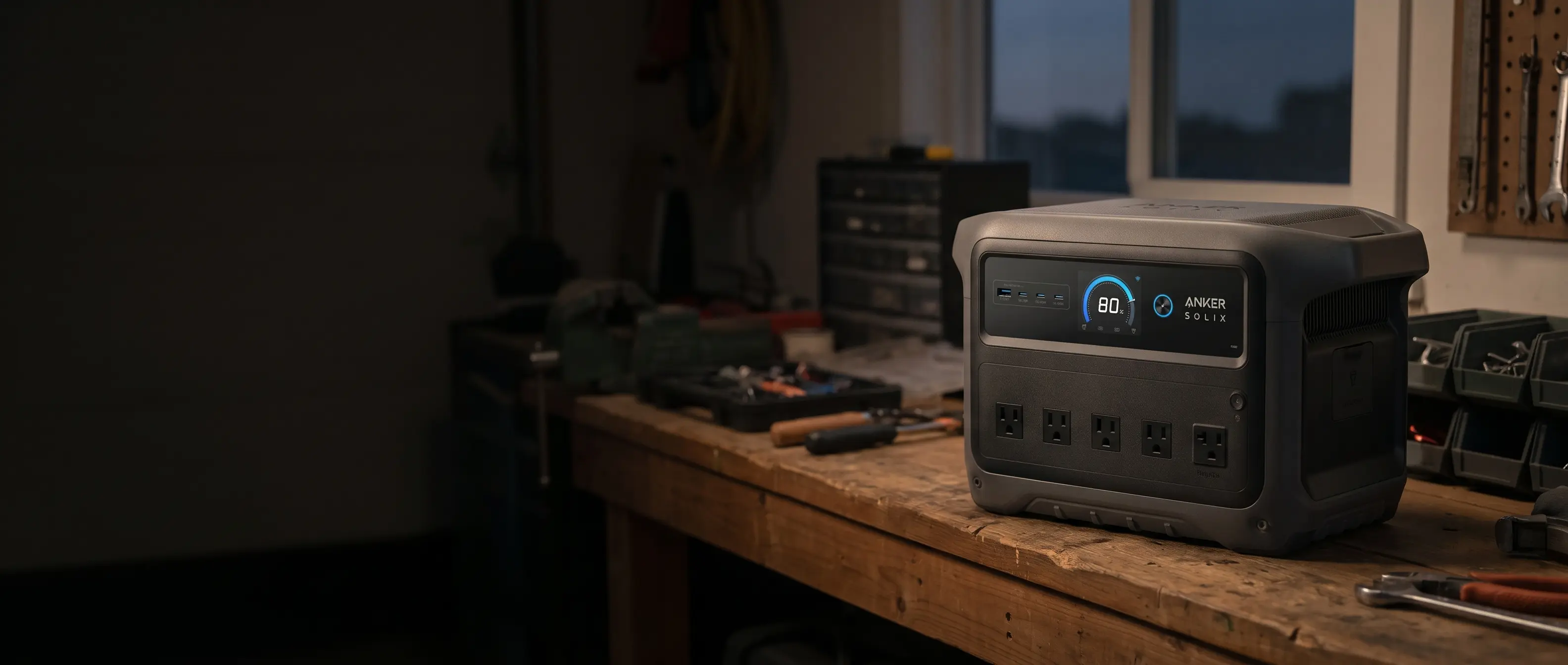
- Anker SOLIX C1000 Gen 2: 2,000 W output and a 49-minute recharge at 24.9 lb, with a built-in 600 W solar port and a 10 ms UPS, but it is not expandable. Lighter and simpler for solar, but 600 W less output.
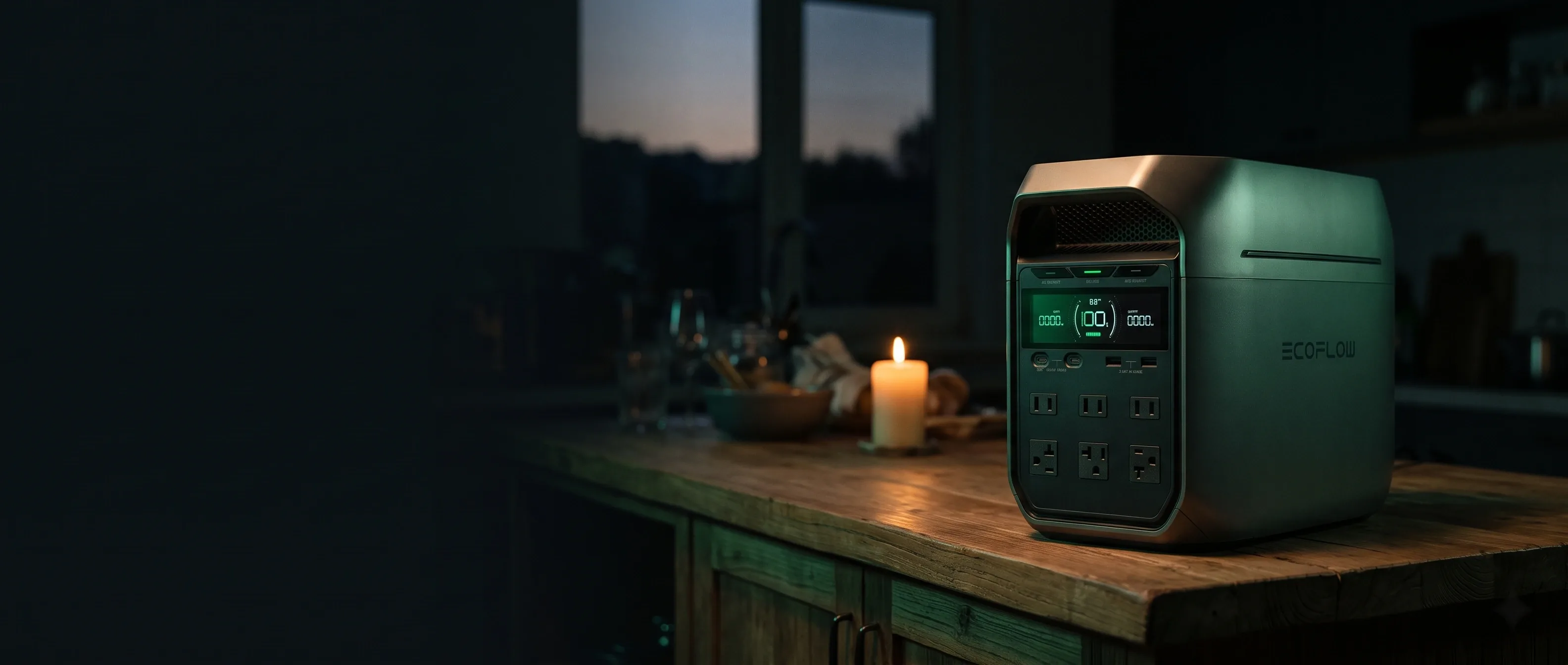
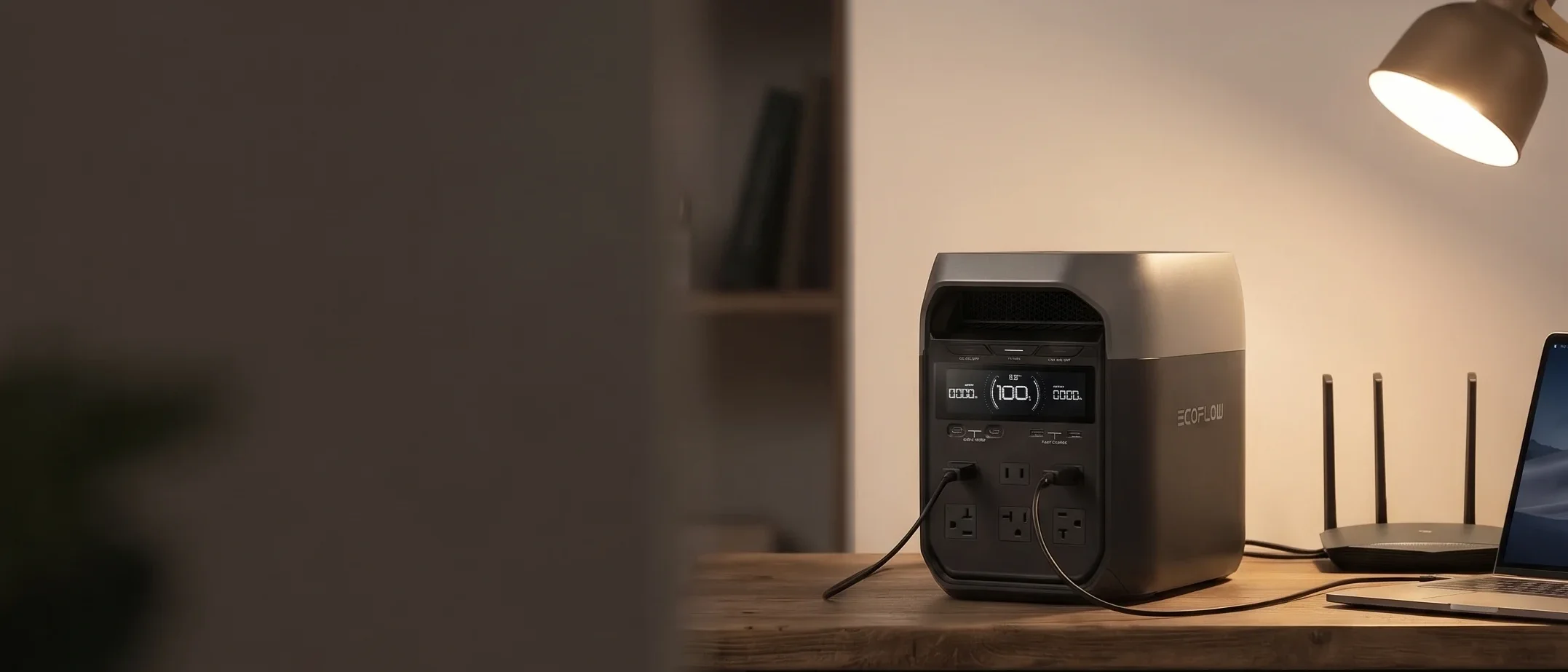
- EcoFlow Delta 3 Plus: 1,800 W, a 56-minute recharge and 1,000 W of built-in solar input, plus a sub-10 ms UPS, at 27.6 lb and expandable to 5,000 Wh. The better choice for backup and solar; the DJI wins on raw output and expands further.
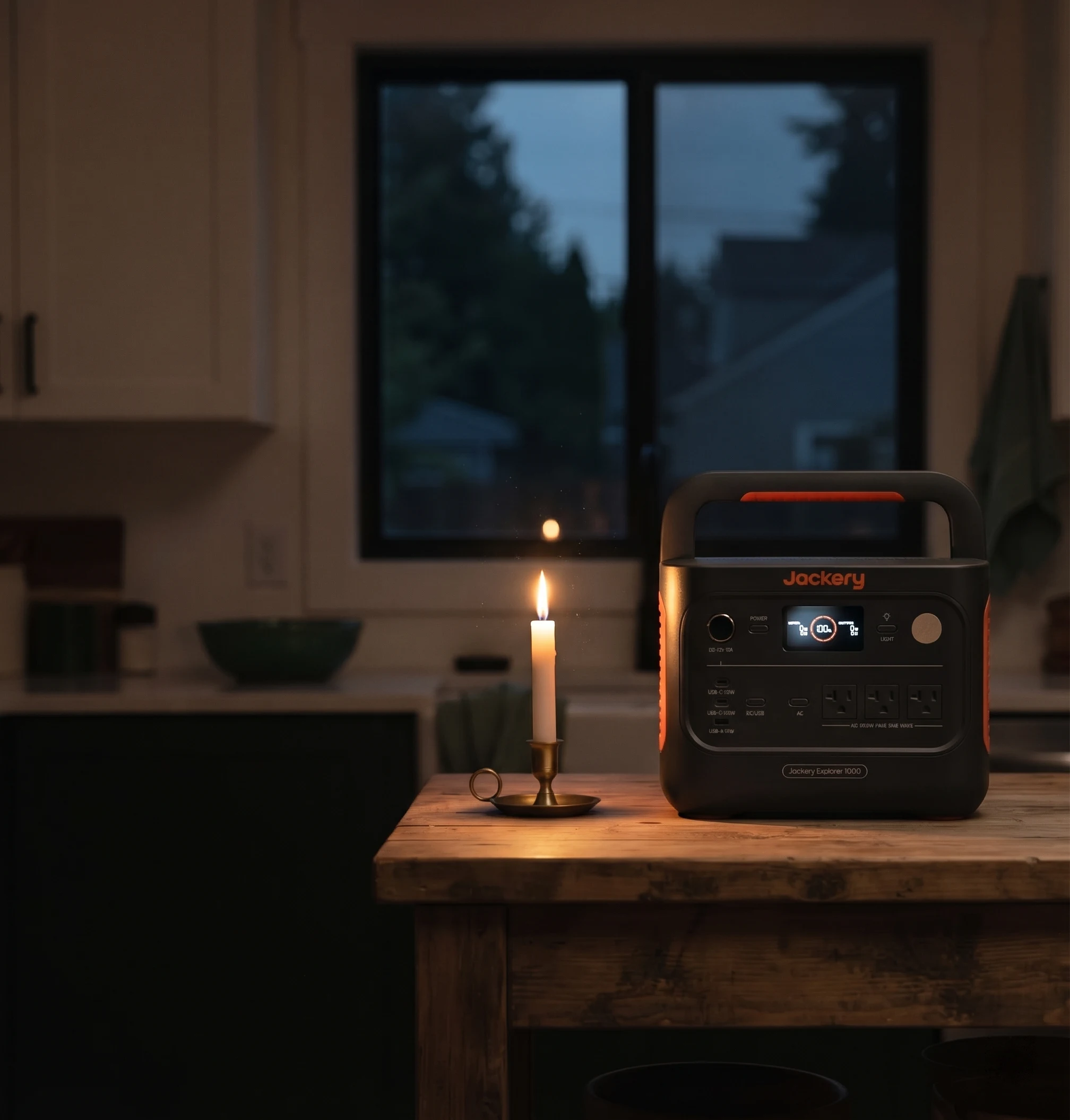
- Jackery Explorer 1000 v2: 1,500 W at 23.8 lb. The lightest of the four, but the weakest output, only 400 W of solar and no expansion.
DJI Power 1000 vs V2. The original DJI Power 1000 has the same 1,024 Wh and 448 × 225 × 230 mm case. The V2 raises continuous output from 2,200 W to 2,600 W, cuts a full recharge from 70 to 56 minutes (37 minutes to 80%), and adds expansion to 11,264 Wh. It weighs 31.3 lb against 28.7 lb. The original has been replaced by the V2.
Who should buy the DJI Power 1000 V2: drone pilots and power-tool users
Buy it for output and fast wall charging; look elsewhere if solar or a fast UPS comes first.
Good fit: DJI drone pilots who want fast field charging, tradespeople running power tools, and campers or van owners who want to run a kettle or microwave and recharge fast from the wall or a car. The expansion batteries also make it a starting point for longer home backup.
Look elsewhere if: you charge mainly from solar and don't want extra adapters, you need a fast, published UPS switchover for a computer, or weight matters more than output. Our best portable power stations guide lists the alternatives by size.
FAQ
Answers on the V2's differences from the original, solar, microwaves, expansion and lifespan.
Is the DJI Power 1000 V2 good?
Yes, if output and charging speed matter most. It holds 2,600 W, the most of any 1 kWh station we cover, recharges in 56 minutes and carries a five-year warranty. Its weak points are the adapter-only solar input, a basic UPS with no published switchover time and its 31.3 lb weight.
What's the difference between the DJI Power 1000 and the Power 1000 V2?
The V2 raises continuous output from 2,200 W to 2,600 W, charges to 80% in 37 minutes and full in 56 (the original takes about 70), has two 140 W USB-C ports and expands to 11,264 Wh. Capacity stays at 1,024 Wh, and it weighs about 31.3 lb against 28.7 lb.
How long does the DJI Power 1000 V2 last?
On one charge, about 10 hours for a fridge and router, or about 13.5 hours for a CPAP with the humidifier on, by our estimates. Over its life, DJI rates the battery for 4,000 cycles to 80% capacity.
How many amp hours is the DJI Power 1000 V2?
DJI lists 1,024 Wh, not amp hours. At 12 V that equals about 85 Ah.
Can the DJI Power 1000 V2 charge from solar panels?
Yes, but not directly. It needs the DJI Solar Panel Adapter Module (up to 400 W) or the 1.8kW Solar/Car Super Fast Charger (up to 1,200 W of solar) on its SDC port.
Can it run a microwave?
Yes. A typical 1,000 to 1,500 W microwave is well within its 2,600 W output, and a 1,200 W microwave runs for about 43 minutes on a full battery by our estimate.
Is the DJI Power 1000 V2 expandable?
Yes. Up to five DJI Power Expansion Battery 2000 units (2,048 Wh each) connect through the SDC port. One adds up to 3,072 Wh in total; all five reach 11,264 Wh.
Does it work as a UPS for a computer?
Only as a basic UPS. DJI says it does not switch in 0 ms and publishes no switchover time, so a desktop PC may restart when the power drops.