 By
We may earn a commission if you buy through links on this page, at no extra cost to you. This never affects which products we recommend. How we make money.
On this page 9 sections
Our verdict · EcoFlow
Whole-home capacity and fast charging, but 120 V only
The EcoFlow TITAN 5000 Classic stores 5 kWh in an LFP battery, delivers 4,000 W at 120 V and expands to 30 kWh with add-on batteries. With one extra battery, the bundle on Amazon holds about 10 kWh, enough for a fridge and essentials for four days, but it can't power 240 V appliances.
- Capacity
- 5,018 Wh
- AC output
- 4,000 W
- Weight
- 102.5 lb
Best for
Homes that want days of backup for 120 V circuits and room to add batteries
Skip it if
You need 240 V for a well pump, dryer or central air
- 5 kWh LFP, expands to 30 kWh
- 4,000 W AC input charges from the wall fast
- 3,200 W solar on a 30–250 V input
- Under 30 dB, quiet enough indoors
- 120 V only, no 240 V output
- 102.5 lb main unit
- Surge rating and cycle life not published
Rating breakdown (whole-home (3.5 kwh and up) class)
| Criterion | Weight | Score | Based on |
|---|---|---|---|
| Wall charging speed | 20% | 10.0 | 4,000 W input |
| AC output | 20% | 3.3 | 4,000 W |
| Solar input | 10% | 7.3 | 3,200 W |
| Backup switchover | 15% | 10.0 | 10 (standalone EPS) or 20 (with Smart Home Panel 10) ms |
| Portability | 10% | 10.0 | 49 Wh/lb |
| Expandability | 10% | 10.0 | to 30,106 Wh |
| Battery life & warranty | 15% | 7.0 | 5-year warranty, cycles not stated |
| Capacity (Wh) | 5018 |
|---|---|
| Battery chemistry | LiFePO4 |
| Rated cycle life | — |
| AC output, continuous (W) | 4000 |
| AC output, surge (W) | — |
| AC charge time | — |
| Max AC charging input (W) | 4000 |
| Max solar input (W) | 3200 |
| Solar input voltage range | 30–250 V (1 port, 16 A) |
| UPS switchover (ms) | 10 (standalone EPS) or 20 (with Smart Home Panel 10) |
| Weight (lb) | 102.5 |
| Expandable to (Wh) | 30106 |
| Warranty (years) | 5 |
Key specs at a glance: TITAN 5000 Classic, 5 kWh at 120 V
5,018 Wh and 4,000 W of single-phase 120 V power in a 102.5 lb rolling unit
- 5,018 Wh capacity (about 10 kWh with the extra battery): about two days of a fridge and router on the main unit, four with the bundle.
- 4,000 W output at 120 V, 60 Hz: runs a microwave, space heater and fridge at once, but nothing that needs 240 V.
- LFP battery: EcoFlow rates the system for 10 years of use and backs it with a 5-year warranty. See LiFePO4 vs lithium-ion.
- 102.5 lb, 24.5 × 13.2 × 16.9 in: it rolls into place and stays there; each extra battery adds 82.7 lb.
- Expandable to 30 kWh: one main unit plus up to five TITAN 5kWh Batteries, added without an installer.
- Safety listings: EcoFlow states UL 9540 certification, testing to UL 9540A and UL 1741 compliance, with an IP20 rating, so it belongs indoors and dry.
- Temperature range: EcoFlow lists charging at 32–113°F and discharging at 14–113°F.
In the box: the main unit, an AC charging cable (C20), a solar charging cable and a quick start guide. Spec sheets are easy to misread; watts vs watt-hours explains which number answers which question.
Charging speed: 4,000 W wall input, about 1.3 hours at full rate
EcoFlow lists 4,000 W of AC input and 3,200 W of solar, but publishes no charge time.
At its full 4,000 W of AC input, the 5,018 Wh battery refills in about 1.3 hours by our estimate. EcoFlow doesn't publish a charge time, and it doesn't say which outlet or circuit the full rate needs. A standard 15 A household outlet supplies at most 1,800 W (120 V × 15 A); at that rate a full charge takes about 2.8 hours by our estimate.
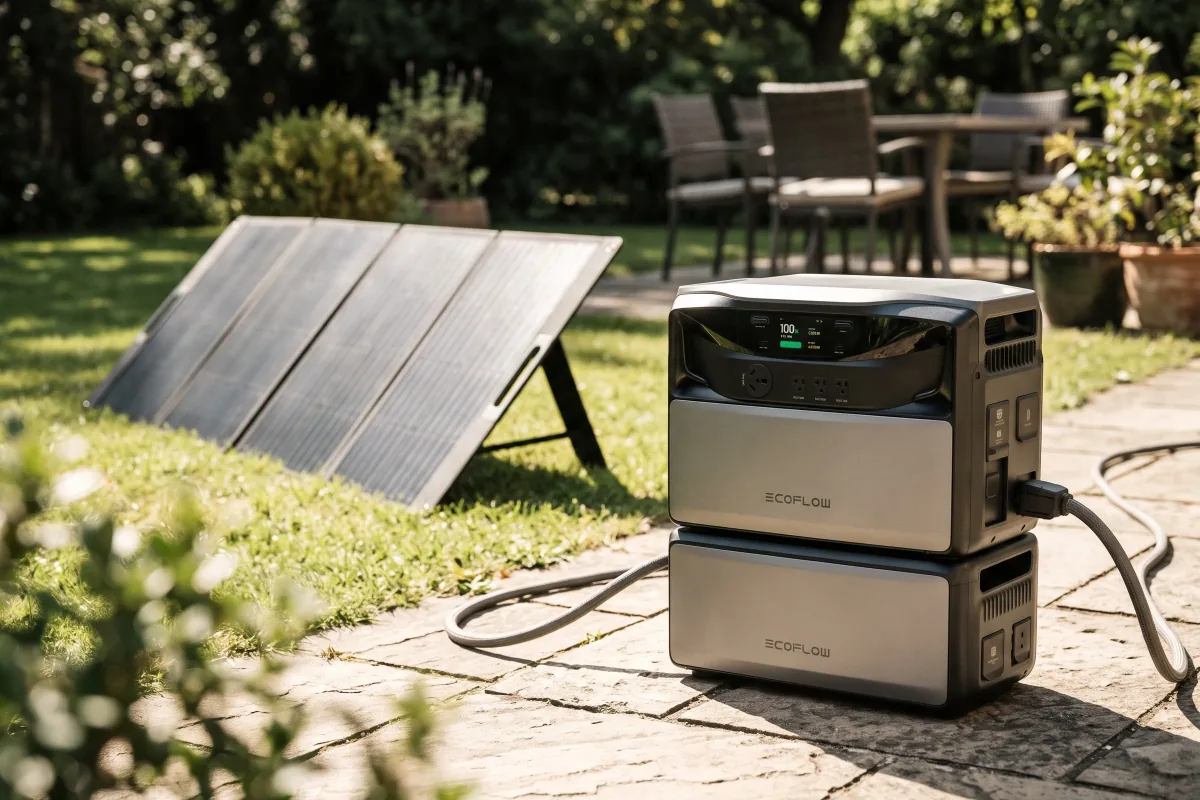
Solar enters one MPPT port at up to 3,200 W, 30 to 250 V and 16 A. That high voltage lets you wire panels in long series strings with thinner cable; our series vs parallel guide shows how to stay under the limit. A full 3,200 W array delivers about 2,400 W at our 75% estimate, so the main unit refills in about 2.1 hours of full sun, and a 5-peak-sun-hour day yields about 12,000 Wh, enough to refill the 10 kWh bundle. Our solar panel sizing guide helps plan the array.
During a long outage, EcoFlow says you can also recharge from an EcoFlow or third-party generator using the included AC cable, and it lists EV chargers among the charging options. In the app, Storm mode charges the battery to 100% ahead of a severe-weather event the system detects.
Capacity and real runtime: a fridge runs two days, the full stack nearly two weeks
Its 5,018 Wh runs a fridge and router for about 49 hours, and each extra 5 kWh battery adds about as much again.
Estimated runtimes on the TITAN 5000 Classic
- CPAP, no humidifier, low-draw (11 W, DC)17.5 days
- CPAP with humidifier, typical (56 W, AC)2.8 days
- Fridge + Wi-Fi router2.1 days
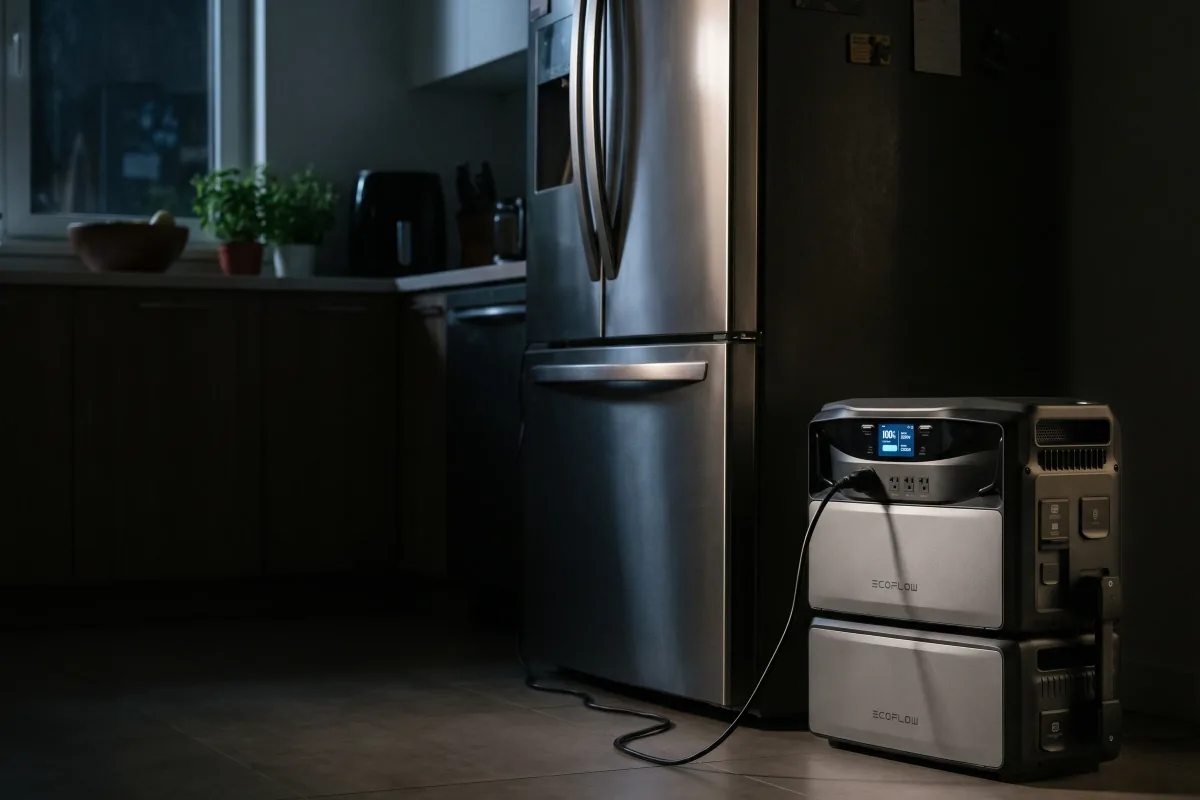
On the main unit alone, a fridge and router run for about two days. By our estimate, the same pair draws about 102 W from the battery, so:
- Main unit (5,018 Wh): about 49 hours, or two days.
- Amazon bundle with one extra battery (about 10,035 Wh): about 98 hours, or four days.
- Full system with five extra batteries (30,106 Wh): about 296 hours, or 12 days.
A CPAP with its humidifier on runs for about eight nights on the main unit and 16 on the bundle. EcoFlow's spec table lists 5,017.6 Wh per unit; the bundle's Amazon listing says 10,017 Wh. Try your own devices in the runtime calculator, and see how long a power station runs a refrigerator for fridge sizes.
Output: 4,000 W through four 120 V outlets, no 240 V
Three 20 A outlets and a TT-30R RV outlet share 4,000 W of single-phase 120 V power.
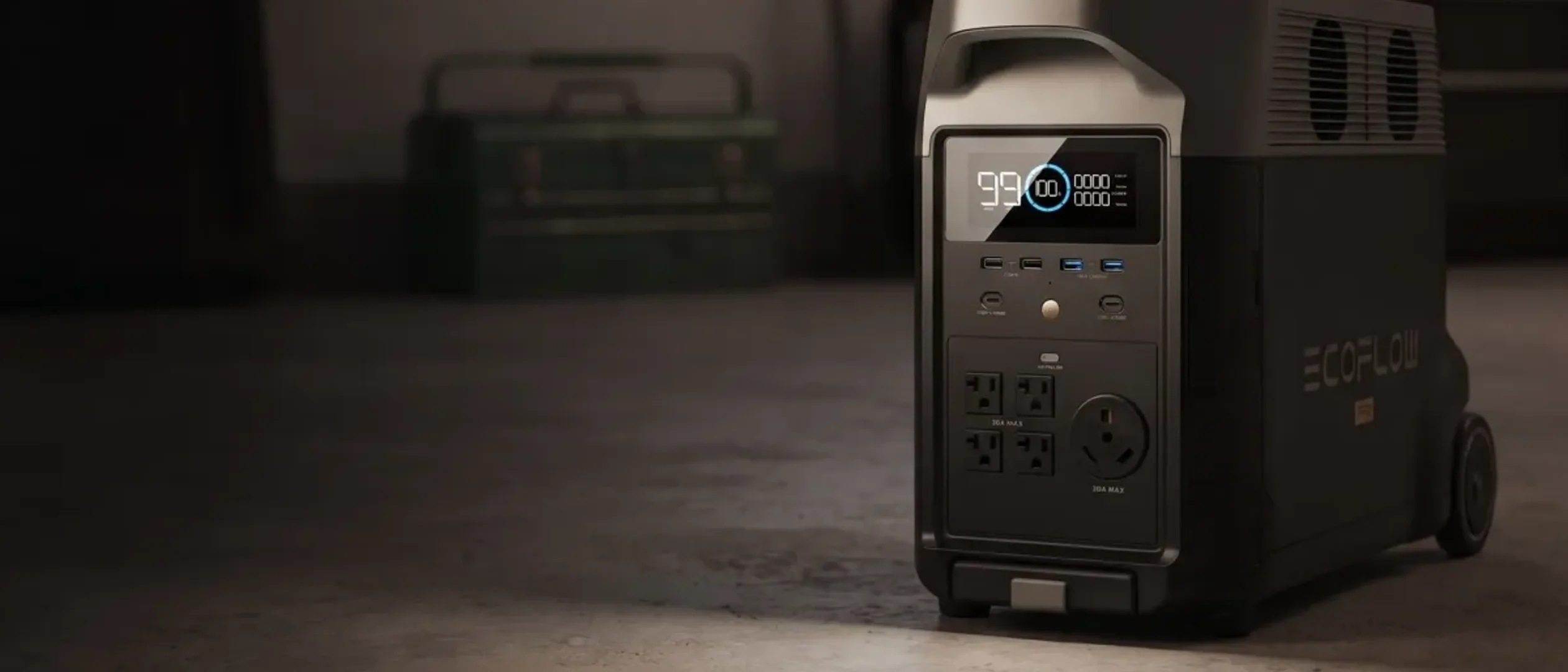
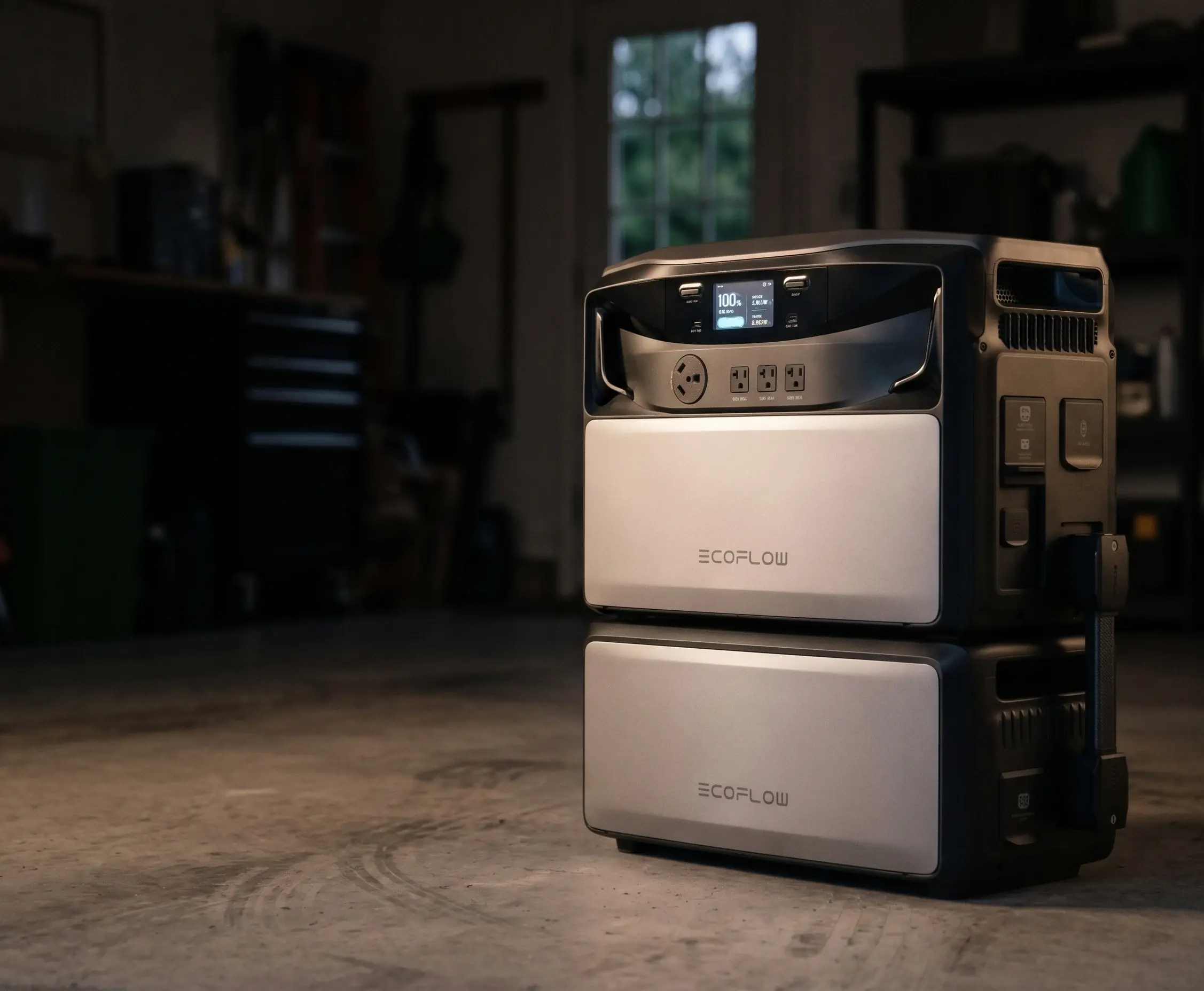
Four AC outlets share 4,000 W at 120 V: three NEMA 5-20R household outlets and one TT-30R RV outlet. That covers a fridge, microwave, space heater and router together, or an RV plugged into the TT-30 port. One 60 W USB-C and one 18 W USB-A port handle phones, tablets and a laptop.
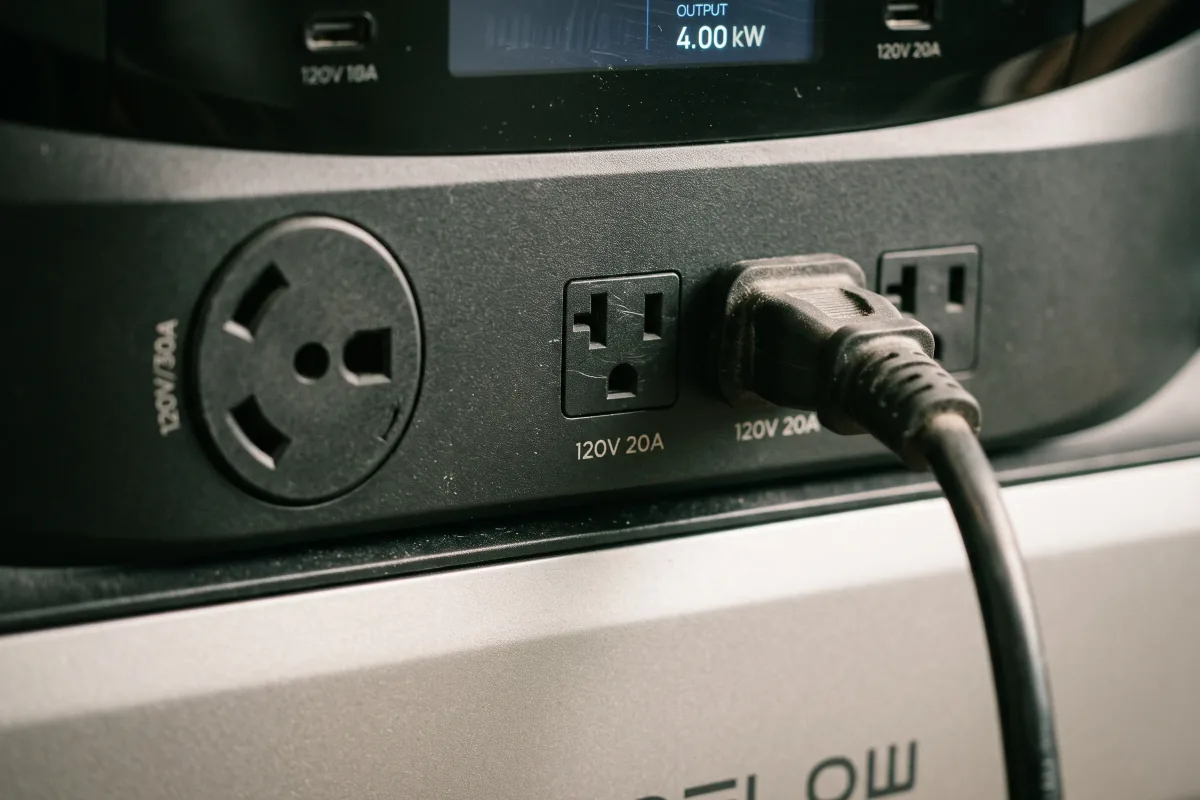
It is single-phase 120 V only, so it won't run a well pump, electric dryer, range or central air; EcoFlow's own page carries the same warning. EcoFlow describes the Classic as built for 120 V essentials such as refrigerators, lights and communications gear. It doesn't publish a surge figure, so large motors that start hard are worth checking first; our surge vs continuous watts guide explains why. There's no 12 V car outlet either, so DC devices run from USB or through the inverter. For a list of typical loads, see what a power station can run in an outage.
Backup (UPS) and app: 10 ms on its own, 20 ms with Smart Home Panel 10
Plugged in directly, its EPS switches in 10 ms; wired to EcoFlow's 10-circuit panel, within 20 ms.
With appliances plugged straight into it, the TITAN's EPS function switches to battery within 10 ms of a grid cut, EcoFlow says. Wired to a home through EcoFlow's Smart Home Panel 10, the switchover is within 20 ms and covers up to 10 circuits. EcoFlow notes the two setups have different transfer times. Either keeps lights, routers and most computers running through a cut; a desktop PC with a weak power supply is the one to try first. Our UPS guide explains what those milliseconds mean.
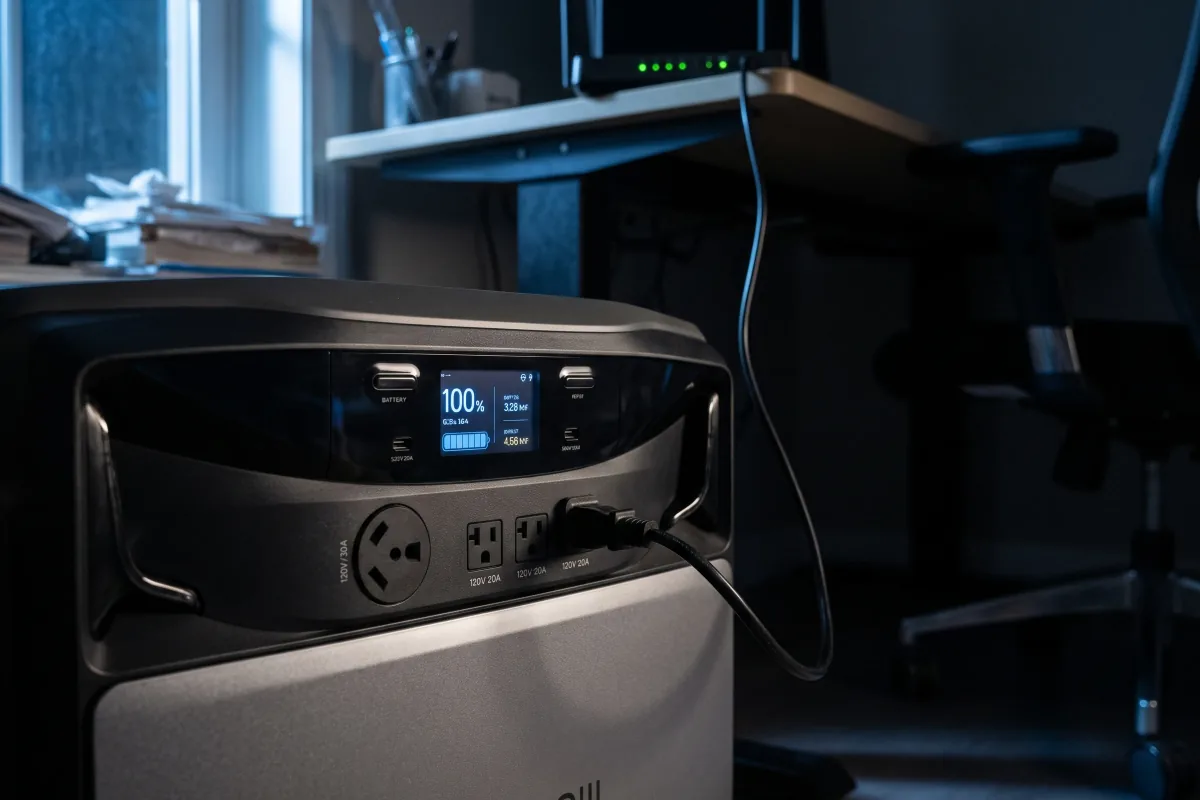
The Smart Home Panel 10 is a wall-mounted, 22.49 lb subpanel that an electrician installs; the TITAN plugs into it. Our transfer switch guide compares it with a manual switch or interlock.
The EcoFlow app connects over Wi-Fi and Bluetooth 5.0. Its OASIS 3.0 mode forecasts solar up to three days ahead, charges at off-peak rates and powers the home at peak times, which only pays off if your utility has time-of-use rates and the system is wired in through the panel.
Noise: under 30 dB at 2,000 W, quiet enough indoors
EcoFlow measured it at 1 m and 77°F; the bigger TITAN models are rated under 39 dB.
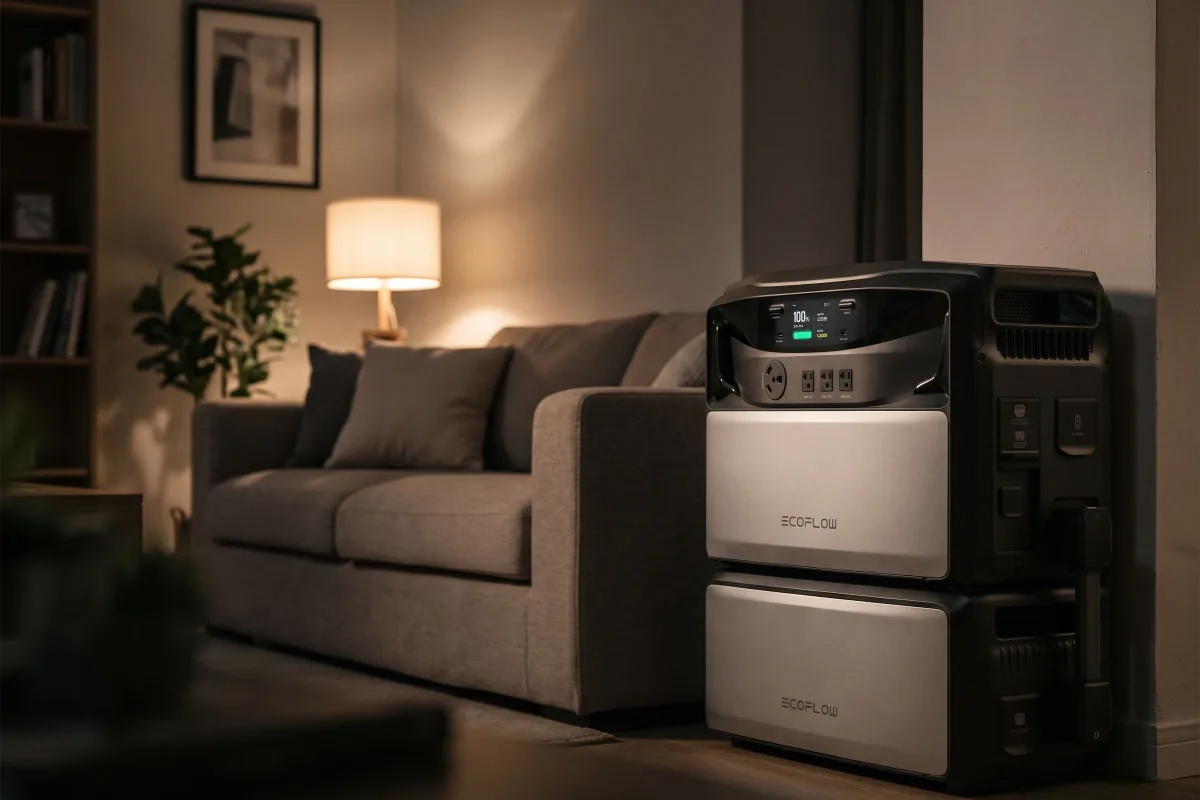
EcoFlow rates the TITAN Classic at under 30 dB at 2,000 W, measured 1 m away at 77°F. Its headline figure is under 25 dB; the detailed note is the one with a stated load. That is about as quiet as a whisper, so it can sit in a utility room or garage next to living space. The TITAN 5000 and 5000 Plus are rated under 39 dB at their higher test loads. A gas generator is much louder and has to stay outside. EcoFlow says it suits homes and garages that are dry, ventilated and inside its temperature range; see are power stations safe indoors.
How it compares: TITAN Classic vs Anker, Jackery and EcoFlow's own range
The fastest wall charging of the 5 kWh rivals, but the only one without 240 V.
| Spec | EcoFlow TITAN 5000 Classic | Anker SOLIX S5000 | Jackery Explorer 5000 Plus |
|---|---|---|---|
| Capacity (Wh) | 5018 | 5024 | 5040 |
| AC output, continuous (W) | 4000 | 4500 | 7200 |
| AC charge time | — | Not stated (1,800 W at 120 V; up to 4,500 W at 240 V) | About 3.5 hr on a 120 V outlet; 1.7 hr via Smart Transfer Switch or 4,000 W high-PV (per Jackery) |
| Max solar input (W) | 3200 | 3000 | 4000 |
| Weight (lb) | 102.5 | 97 | 134.5 |
| Warranty (years) | 5 | 5 | 5 + 2 optional |
| Price | Check price | Check price | Check price |
On our rating, the TITAN 5000 Classic sits just above the Anker SOLIX F3800 Plus, above the Anker SOLIX S5000 and the EcoFlow DELTA Pro 3, and below the Jackery Explorer 5000 Plus and the DELTA Pro Ultra X. Its wall charging and expansion score top marks; its 4,000 W output and unpublished cycle life cost it.
- Anker SOLIX S5000: the same 5 kWh and 30 kWh ceiling, with 4,500 W output, 8,000 W surge and 6,000 cycles at 97 lb. Its AC input is 1,800 W at 120 V, so the TITAN charges faster from the wall. See Anker SOLIX vs EcoFlow.
- Jackery Explorer 5000 Plus: 7,200 W with 240 V output and 4,000 W solar, but 134.5 lb. The pick if you need 240 V circuits. See EcoFlow vs Jackery.
- Anker SOLIX F3800 Plus: 3,840 Wh and 6,000 W at 120/240 V on wheels, at 136.7 lb.
- EcoFlow DELTA Pro 3: 4,096 Wh with 240 V output and a 10 ms switchover, on wheels. Less capacity, more flexibility.
- EcoFlow DELTA Pro Ultra X: 12,288 Wh and 12,000 W at 120/240 V, an installed system rather than a rolling one.
- TITAN 5000 and TITAN 5000 Plus: EcoFlow's bigger TITANs add 120/240 V split-phase and 7.2 kW output; the 5000 Plus takes 8 kW of solar on two inputs. We haven't reviewed them.
For a brand view, see EcoFlow vs Bluetti, and for the whole class, our whole-home battery backup guide.
Who should buy the EcoFlow TITAN 5000 Classic: 120 V homes wanting days of backup
A strong fit for fridges, lights and networking over several days, not for 240 V loads.
Good fit: homes on 120 V circuits that want two to four days of backup, fast wall and solar charging, a quiet unit that can live indoors, and the option to grow to 30 kWh. RV owners with a 30 A TT-30 hookup can plug straight in.
Look elsewhere if: you need 240 V for a well pump or central air, you want a published surge rating for large motors, or you want a station you can carry; at 102.5 lb it is moved on its wheels or not at all.
FAQ
Capacity, 240 V, fridge runtime, solar and brand questions about the TITAN 5000 Classic
How much capacity does the TITAN Classic with extra battery have?
About 10 kWh: two 5,017.6 Wh units. You can add up to five extra batteries to one main unit for 30 kWh in total.
Does the EcoFlow TITAN 5000 Classic support 240 V?
No. It outputs 120 V only. For 240 V appliances, look at the Jackery Explorer 5000 Plus, the EcoFlow DELTA Pro 3 or EcoFlow's TITAN 5000 and 5000 Plus.
How long will the TITAN 5000 Classic run a refrigerator?
About two days for a fridge and router on the main unit, about four days with one extra battery and about 12 days with five, by our estimate.
Can it charge from solar panels or a generator?
Yes. One solar input takes up to 3,200 W at 30 to 250 V, and EcoFlow says any EcoFlow or third-party generator can charge it through the included AC cable.
Does it work as a UPS?
Yes. EcoFlow says its EPS switches in 10 ms with devices plugged in directly, and within 20 ms when wired through the Smart Home Panel 10.
What's the difference between the TITAN 5000 Classic, TITAN 5000 and 5000 Plus?
All three start at 5 kWh and expand to 30 kWh. The Classic is 120 V only with 4,000 W output and 3,200 W solar; the TITAN 5000 adds 120/240 V and 7.2 kW output with 4,000 W solar; the 5000 Plus adds 8,000 W of solar on two inputs.
Is EcoFlow better than Jackery, Anker or Bluetti for home backup?
It depends on the model. Among 5 kWh units, the TITAN Classic charges fastest from the wall but lacks the 240 V that the Jackery Explorer 5000 Plus offers, and the Anker SOLIX S5000 publishes a surge rating and 6,000 cycles. Our EcoFlow vs Jackery, Anker SOLIX vs EcoFlow and EcoFlow vs Bluetti pages compare each brand model by model.
Is the EcoFlow TITAN 5000 Classic worth it?
It is if your backup needs are 120 V: it pairs fast charging, quiet running and 30 kWh of headroom. If you need 240 V or a published cycle life, a rival fits better.