 By
We may earn a commission if you buy through links on this page, at no extra cost to you. This never affects which products we recommend. How we make money.
On this page 11 sections
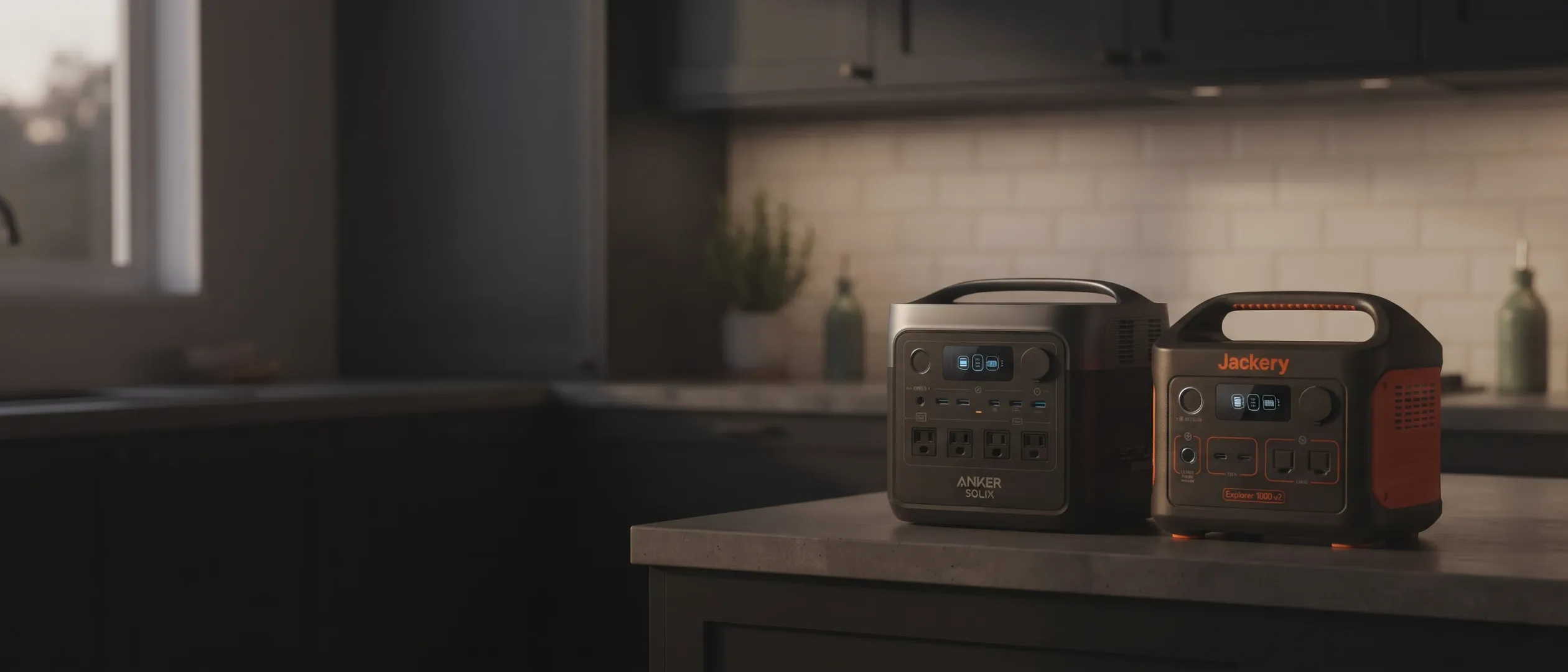
Choose Anker SOLIX for compact and 1 kWh stations and a 5-year warranty with no registration; choose Jackery for 2 kWh and whole-home stations, where its HomePower 2000 Plus V2 and Explorer 5000 Plus rate highest of either brand. At 1 kWh, Anker's SOLIX C1000 Gen 2 rates 8.0 against 6.8 for Jackery's best, the Explorer 1000 Plus.
The short answer: Anker SOLIX vs Jackery
In Jackery vs Anker, Anker wins the small sizes and Jackery the big ones
- Choose Anker SOLIX for a 1 kWh station with more output and solar input (C1000 Gen 2: 2,000 W and 600 W, against 1,500 W and 400 W on the Explorer 1000 v2), a tiny DC-only power bank-style station (C300 DC), or a 5-year warranty you don't have to register for.
- Choose Jackery for a 2 kWh station that can grow to 12 kWh (HomePower 2000 Plus V2) or a whole-home station with the highest rating of either brand (Explorer 5000 Plus, 8.5).
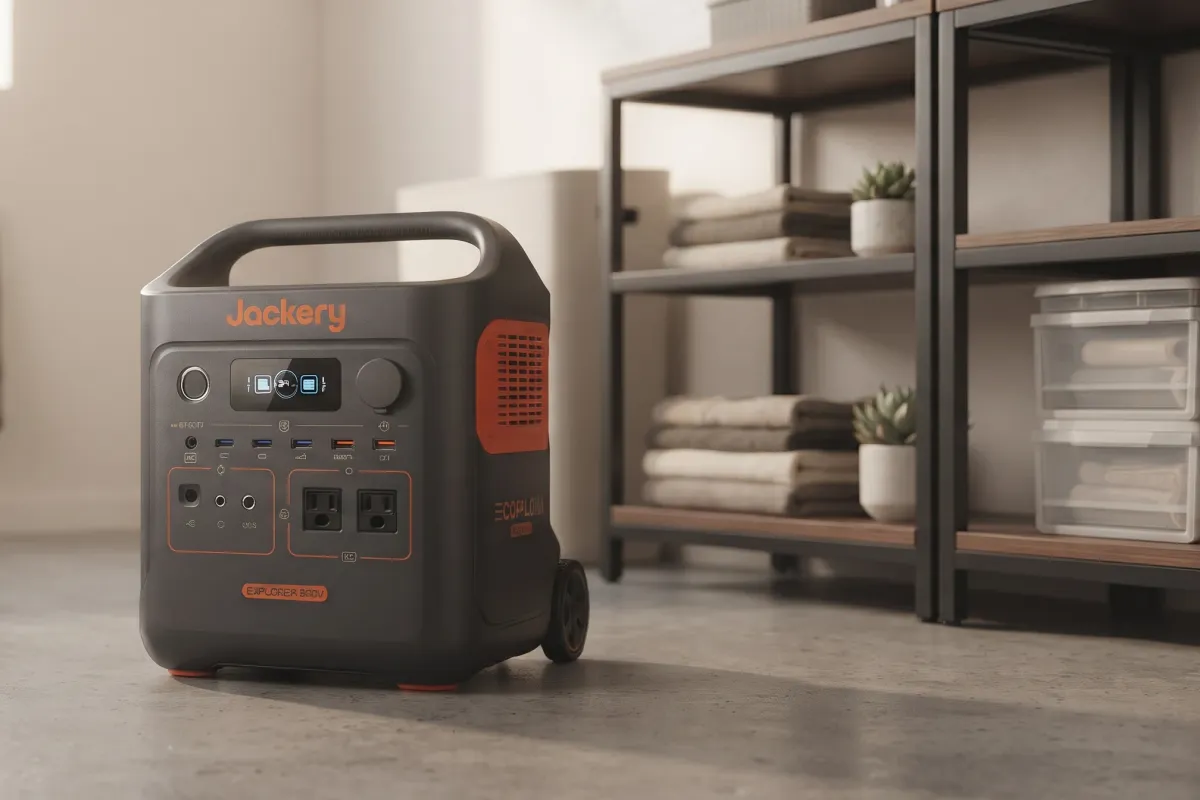
Anker SOLIX is the home energy line of Anker Innovations, the charger and power bank maker. Jackery is a power station specialist that sells its Explorer and HomePower stations alongside SolarSaga panels. They share no batteries or accessories, so expansion packs from one never fit the other.
Anker SOLIX vs Jackery at a glance
Same LiFePO4 chemistry on most models; different warranty terms and cycle ratings
| Feature | Anker SOLIX | Jackery |
|---|---|---|
| Warranty | 5 years, all seven reviewed | 3 + 2 with registration on most |
| Cycle rating | to 80% capacity | to 70% capacity |
| 1 kWh output | 2,000 W | 1,500–2,000 W |
| 1 kWh solar | 600 W | 400–800 W |
| Biggest reviewed | 5,024 Wh, 4,500 W (S5000) | 5,040 Wh, 7,200 W (5000 Plus) |
Anker SOLIX vs Jackery lineups compared
We've reviewed seven Anker SOLIX and six Jackery stations, from under 300 Wh to over 5 kWh
From Anker SOLIX we've reviewed the DC-only 288 Wh C300 DC, the 1 kWh C1000 Gen 2, the 2 kWh S2000 and C2000 Gen 2, the 3 kWh F3000, the 3.84 kWh F3800 Plus and the 5 kWh S5000.
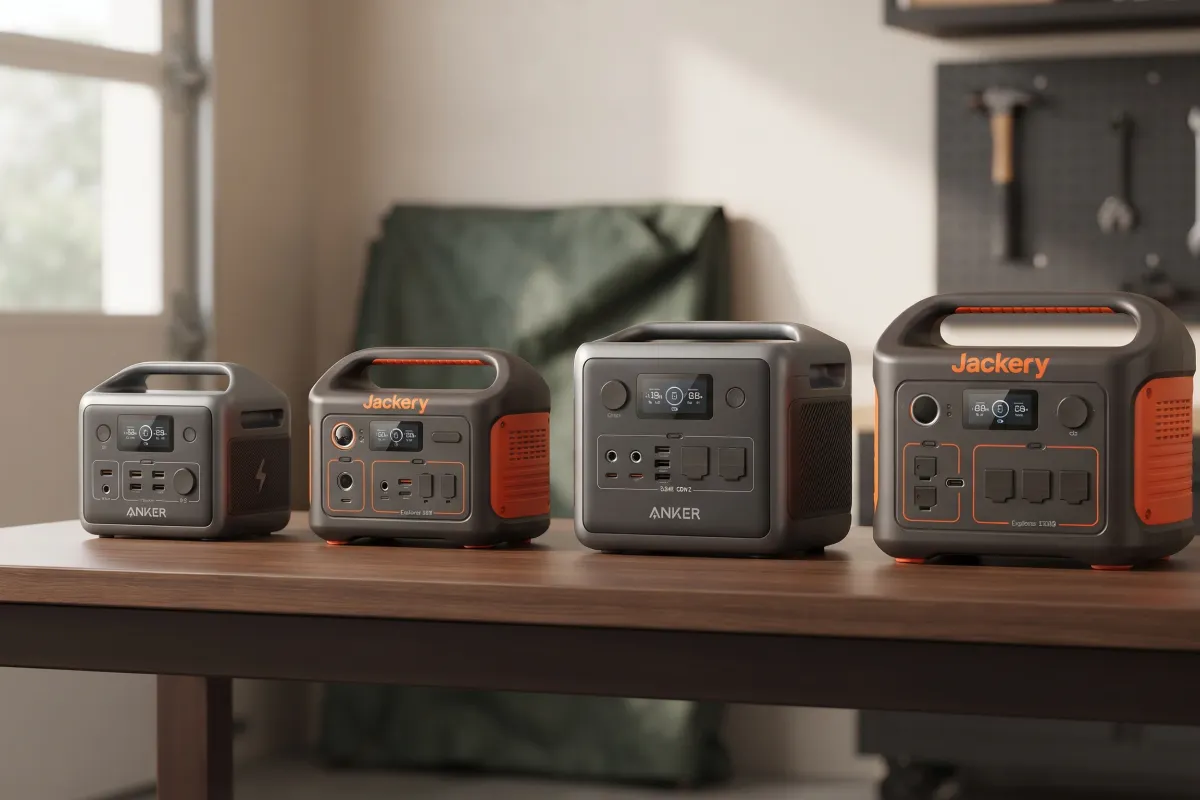
From Jackery we've reviewed four Explorer and two HomePower stations: the 293 Wh Explorer 300, the 1 kWh Explorer 1000 v2 and 1.26 kWh Explorer 1000 Plus, the 2 kWh HomePower 2000 Plus V2, the 3.6 kWh HomePower 3600 Pro Max and the 5 kWh Explorer 5000 Plus.
One chemistry difference stands out: the Explorer 300 uses NMC lithium-ion, rated for 800 cycles to 80%. Every other model on this page uses LiFePO4. See LiFePO4 vs lithium-ion for what that means for lifespan.
Anker SOLIX vs Jackery ratings by size: two classes each
Anker leads compact and mid-size; Jackery leads large and whole-home
Our ratings come from each model's specs (how we rate) and are compared within a size class.
| Size | Anker SOLIX | Jackery |
|---|---|---|
| Compact (under 1 kWh) | C300 DC 6.8 | Explorer 300 5.0 |
| Mid-size (1 to 1.5 kWh) | C1000 Gen 2 8.0 | Explorer 1000 Plus 6.8, 1000 v2 5.1 |
| Large (2 to 3 kWh) | C2000 Gen 2 7.5, F3000 7.4, S2000 4.6 | HomePower 2000 Plus V2 7.8 |
| Whole-home (3.5 kWh and up) | F3800 Plus 7.8, S5000 7.2 | Explorer 5000 Plus 8.5, HomePower 3600 Pro Max 6.3 |
- Compact: the C300 DC has no AC outlets (300 W of DC and USB-C) but charges faster (280 W vs 90 W) and weighs 6.17 lb against 7.1 lb. The Explorer 300 has 300 W AC outlets, which the Anker lacks, but scores near zero for wall charging (about 4.5 hours, Jackery's figure) and lower for battery life on its NMC cells.
- Mid-size: the C1000 Gen 2 scores top marks for wall charging and a 10 ms switchover; the Explorer 1000 Plus scores higher for solar (800 vs 600 W) and can add batteries, but switches over in 20 ms. The Explorer 1000 v2 trails both on output (1,500 W) and solar (400 W), and switches over in 20 ms like the 1000 Plus.
- Large: the HomePower 2000 Plus V2 rates highest: 10 ms switchover and expansion to 12,288 Wh in a 41.5 lb unit. The F3000 is far stronger on output (3,600 W) and solar (2,400 W) but heavier (91.5 lb) and switches in 20 ms. The C2000 Gen 2 (7.5) matches it on battery, output, solar and 10 ms switchover but expands only to about 4 kWh. The S2000 has no expansion and scores zero for output and solar in its class (1,500 W, 400 W).
- Whole-home: the Explorer 5000 Plus scores full marks for output (7,200 W), switchover, portability for its capacity, expansion and battery life; its 1,800 W wall input is its one weak score. The F3800 Plus matches it on output and solar but switches in 20 ms. The HomePower 3600 Pro Max loses points for its 1,200 W solar input and a warranty listed at 1 year.
Whole-home flagships: Explorer 5000 Plus vs F3800 Plus
| Explorer 5000 Plus | F3800 Plus | |
|---|---|---|
| Output, 120/240 V | 7,200 W | 6,000 W |
| Solar input | 4,000 W (high-voltage) | 3,200 W |
| Expansion per unit | 30,240 Wh | about 26.9 kWh |
| Switchover | 0 ms (Online UPS) or 20 ms | 20 ms |
Both take 1,800 W from a 120 V outlet and weigh about the same (134.5 lb vs 136.7 lb). The Explorer 5000 Plus rates 8.5 to the F3800 Plus's 7.8: it scores higher for switchover, for capacity per pound and for battery life, while the F3800 Plus scores higher for wall charging. Anker's warranty is a flat 5 years; Jackery's is 5 years with 2 more optional.
Charging and solar: Anker SOLIX vs Jackery
Anker charges its 1 kWh model faster; Jackery's big stations take the most solar
At 1 kWh, Anker quotes 49 minutes for the C1000 Gen 2 at 1,600 W in UltraFast mode, which you switch on in the app (normal charging is 1,200 W). Jackery quotes 50 minutes for the Explorer 1000 v2 in its app's Emergency mode and 1.58 hours in standard mode. Jackery quotes 1.7 hours for the Explorer 1000 Plus at 1,200 W.
Solar input by model:
| Size | Anker SOLIX | Jackery |
|---|---|---|
| Compact | C300 DC: 100 W | Explorer 300: 100 W |
| Mid-size | C1000 Gen 2: 600 W | 1000 Plus: 800 W; 1000 v2: 400 W |
| Large | F3000: 2,400 W; S2000: 400 W | HomePower 2000 Plus V2: 800 W |
| Whole-home | F3800 Plus: 3,200 W; S5000: 3,000 W | 5000 Plus: 4,000 W; 3600 Pro Max: 1,200 W |
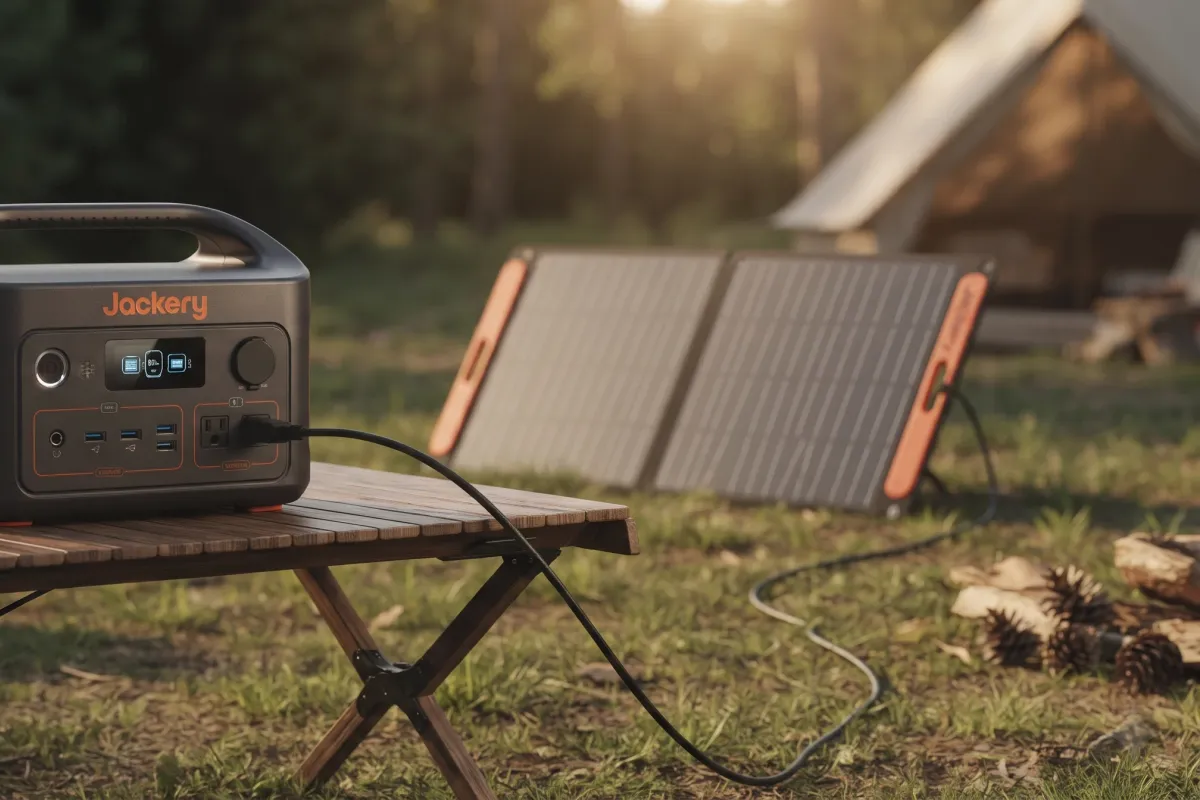
Jackery uses DC8020 solar inputs on its newer stations and sells its own SolarSaga panels; Anker uses XT60-type inputs on its smaller models and wide-voltage high-PV inputs on the F3000, F3800 Plus and S5000, taking panel strings up to 165 V Voc. Third-party panels work on both if each input's voltage and current limits are respected. See what size solar panel you need.
Both brands' large stations charge from 240 V in different ways: the Anker S5000 takes up to 4,500 W at 240 V, and the F3000 takes 3,600 W through a TT-30R (RV) cable or a 240 V EV adapter. Jackery quotes 1.3 hours for the HomePower 3600 Pro Max on 240 V with an optional cable, and 1.7 hours for the Explorer 5000 Plus through its Smart Transfer Switch or high-voltage solar.
Backup (UPS) and expansion: Anker SOLIX vs Jackery
Anker's small stations switch over faster; Jackery's big ones expand further
UPS switchover decides whether a computer or router keeps running when the power cuts:
- 10 ms or faster: Anker C1000 Gen 2, S2000, S5000; Jackery HomePower 2000 Plus V2 and HomePower 3600 Pro Max (under 10 ms).
- 20 ms: Anker F3000 and F3800 Plus; Jackery Explorer 1000 v2 and 1000 Plus.
- Explorer 5000 Plus: 20 ms by default, or 0 ms in its Online UPS mode (the outlets never drop power), which you enable in the app; it covers the four 120 V outlets up to 3,600 W.
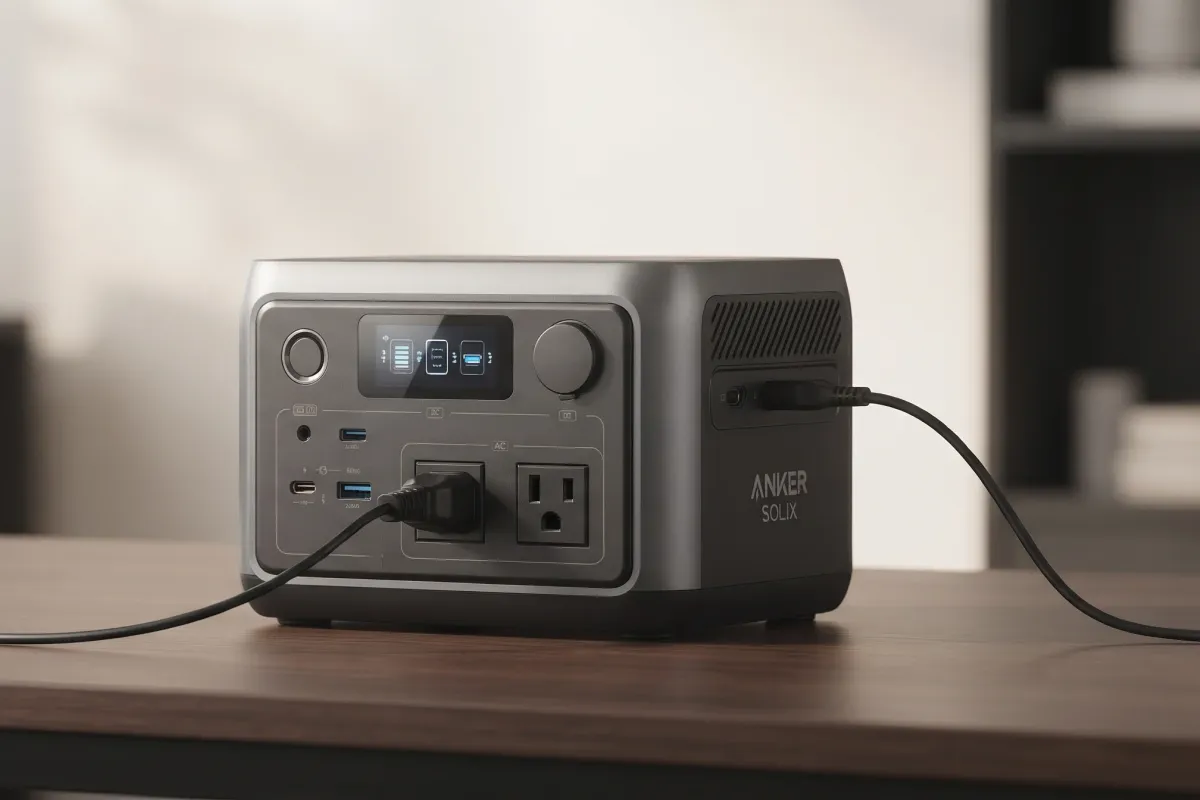
Jackery's manuals for the 1000 v2 and HomePower 2000 Plus V2 say they don't support 0 ms switching and shouldn't be used for data servers or workstations. For a home office, see using a power station as a UPS.
Expansion, per station:
- Anker: the C300 DC, C1000 Gen 2 and S2000 can't add batteries. The C2000 Gen 2 takes one BP2000 (about 4 kWh), the F3000 takes up to three BP3000s (12,288 Wh), the F3800 Plus up to six BP3800s (about 26.9 kWh) and the S5000 up to five batteries (about 30 kWh).
- Jackery: the Explorer 300 and 1000 v2 can't add batteries. The Explorer 1000 Plus reaches 5 kWh with the Battery Pack 1000 Plus (an older pack, so check it's still sold), the HomePower 2000 Plus V2 12,288 Wh with up to five Battery Pack 2000 Plus v2s, the HomePower 3600 Pro Max about 21.5 kWh, and the Explorer 5000 Plus 30,240 Wh.
At 2 kWh, both brands expand: the C2000 Gen 2 to about 4 kWh and the HomePower 2000 Plus V2 to 12,288 Wh (the S2000 can't). At 1 kWh, it's the reverse of what many expect: the Anker C1000 Gen 2 can't add batteries, but Jackery's Explorer 1000 Plus can.
Battery life and warranty: Anker SOLIX vs Jackery
Anker gives 5 years on everything; Jackery's 5 years need registration on most models
- Anker SOLIX: 5 years on all seven models we've reviewed, with no registration step.
- Jackery: 3 years, plus 2 more when you register, on the Explorer 300, 1000 v2, 1000 Plus and HomePower 2000 Plus V2. The Explorer 5000 Plus has 5 years plus 2 optional. The HomePower 3600 Pro Max listing we have shows 1 year.
Cycle ratings aren't directly comparable. Anker states cycles to 80% of capacity (4,000 on the C1000 Gen 2 and F3000, 6,000 on the S2000 and S5000). Jackery states cycles to 70% (4,000 on the Explorer 1000 v2, 1000 Plus and 5000 Plus; 6,000 on the HomePower 2000 Plus V2 and 3600 Pro Max). A rating to 70% is an easier target, so a Jackery "4,000 cycles" means less than an Anker "4,000 cycles". Either way, these batteries outlast years of regular use; see how long portable power stations last.
Cold weather: most Anker models run down to −4°F; most Jackery models to 14°F, with the Explorer 5000 Plus at 5°F. Most of both brands charge from 32°F; the HomePower 2000 Plus V2 charges from 14°F. See cold weather use.
Apps and smart features: Anker app vs Jackery app
Both connect over Wi-Fi and Bluetooth; Jackery's app unlocks its fastest charging and its 0 ms mode
Both brands' 1 kWh and larger stations work with a phone app over Wi-Fi and Bluetooth. In each, the app is where some key features live:
- Anker: UltraFast charging on the C1000 Gen 2 is switched on in the app, and its Time-of-Use mode is set there.
- Jackery: Emergency charging on the Explorer 1000 v2 and HomePower 2000 Plus V2 runs from the app, as does the Explorer 5000 Plus's 0 ms Online UPS mode. The HomePower 2000 Plus V2's app adds a charging plan, a Time-of-Use mode (with a default 60% backup reserve) and a self-powered mode.
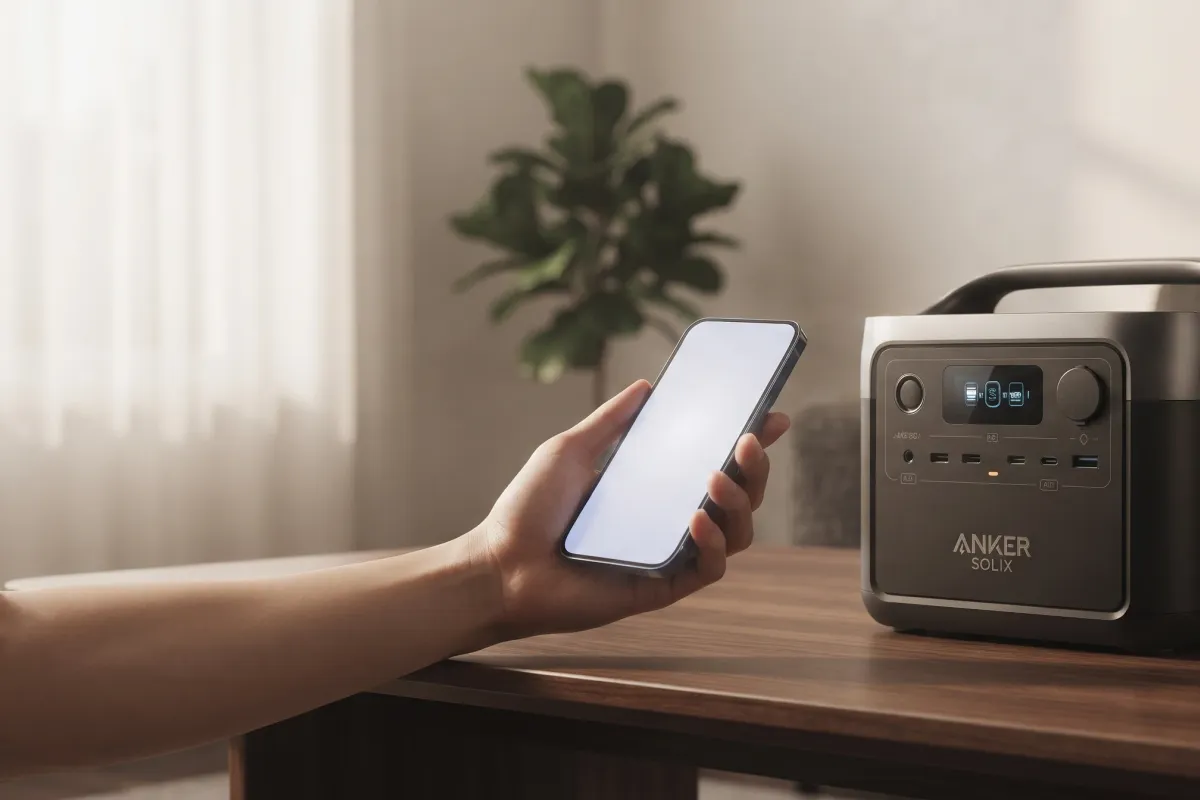
Neither app is needed for basic use: the stations' buttons and screens handle on, off and outlets. If you won't use an app, avoid relying on modes that need one.
Head-to-head: C1000 Gen 2 vs Explorer 1000 v2
Same 1,024 Wh battery; the Anker gives more output, solar and a faster switchover
| Spec | Anker SOLIX C1000 Gen 2 | Jackery Explorer 1000 v2 |
|---|---|---|
| Capacity (Wh) | 1024 | 1024 |
| AC output, continuous (W) | 2000 | 1500 |
| AC charge time | 49 min (UltraFast) | 50 min (Emergency, app) |
| Max solar input (W) | 600 | 400 |
| Weight (lb) | 24.9 | 23.8 |
| Warranty (years) | 5 | 3 + 2 with registration |
| Price | Check price | Check price |
These are each brand's best-known 1 kWh stations, and they hold exactly the same 1,024 Wh, so runtimes match:
Estimated runtimes on either station
- Wi-Fi router (12 W, DC)3.3 days
- CPAP with humidifier, typical (56 W, AC)14 h
- Fridge (67 W average, AC)12 h
- Fridge (67 W, AC) + router (12 W, DC)10 h
The C1000 Gen 2 delivers 2,000 W against 1,500 W, takes 600 W of solar against 400 W, and switches over in 10 ms against 20 ms. The Explorer 1000 v2 is the lighter at 23.8 lb against 24.9 lb. Neither can add batteries. For more room to grow at this size, Jackery's 1,264 Wh Explorer 1000 Plus runs the same fridge for about 14 hours by our estimate and expands to 5 kWh with an older battery pack.
Who should buy Anker SOLIX, and who should buy Jackery
Pick the brand that leads at the size you need
Best Anker SOLIX pick: 1 kWh
Anker SOLIX C1000 Gen 2
Pick it for camping, CPAP use, apartments and desk backup where 1 kWh is enough.
Pros
- 2,000 W output
- 49-minute UltraFast charge (Anker)
- 10 ms switchover, 5-year warranty
Cons
- Not expandable
- 600 W solar input
Best Jackery pick: whole-home
Jackery Explorer 5000 Plus
Pick it for whole-home backup and long outages with solar.
Pros
- 7,200 W at 120/240 V
- 4,000 W high-voltage solar
- Expands to 30,240 Wh
Cons
- 134.5 lb
- 1,800 W from a 120 V outlet
Anker SOLIX strengths: 5-year warranty with no registration, cycles rated to 80%, 2,000 W and 600 W solar at 1 kWh, 10 ms switchover on the C1000 Gen 2, S2000 and S5000. Limits: the C1000 Gen 2 and S2000 can't add batteries and the C2000 Gen 2 stops at about 4 kWh; the F3000 and F3800 Plus switch over in 20 ms.
Jackery strengths: expansion from 1.26 kWh up, the highest-rated large and whole-home models of the two, a 0 ms mode on the Explorer 5000 Plus. Limits: 5 years only with registration on most models, cycles rated to 70%, 20 ms switchover on the 1 kWh models, an NMC battery on the Explorer 300.
- Camping and travel: Anker C1000 Gen 2, or the C300 DC if you only need USB-C and DC. See best portable power stations for camping.
- Home backup at 2 kWh: Jackery HomePower 2000 Plus V2, for 10 ms switchover and expansion to 12 kWh. See best portable power stations for home backup.
- Whole-home: Jackery Explorer 5000 Plus; Anker's F3800 Plus if you want 3,200 W of solar and up to about 26.9 kWh from one unit. See best whole-home battery backup.
- Warranty without paperwork: Anker SOLIX.
Weighing other brands too? See Anker SOLIX vs EcoFlow, Anker SOLIX vs Bluetti, EcoFlow vs Jackery, Jackery vs Bluetti and our best portable power stations across every brand.
FAQ
Anker SOLIX or Jackery: what buyers ask before choosing
Which is better, Jackery or Anker power stations?
It depends on size. Anker SOLIX rates higher in our compact and mid-size classes (C300 DC 6.8, C1000 Gen 2 8.0); Jackery rates higher in large and whole-home (HomePower 2000 Plus V2 7.8, Explorer 5000 Plus 8.5).
Which is better, Solix or Jackery?
At 1 kWh, the Anker SOLIX C1000 Gen 2: more output (2,000 W), more solar (600 W) and a 10 ms switchover, against the Explorer 1000 v2's 1,500 W, 400 W and 20 ms.
Is the Anker SOLIX worth it?
For a 1 kWh station, yes: the C1000 Gen 2 is the highest-rated model of either brand at that size, with a 5-year warranty that needs no registration. Its main limit is that it can't add batteries.
What brand is better than Jackery?
At small sizes, Anker SOLIX rates higher in our method; at 1 kWh, EcoFlow's Delta 3 Plus does too (see EcoFlow vs Jackery). At whole-home size, Jackery's Explorer 5000 Plus is among the highest-rated stations we've reviewed.
Do Anker and Jackery batteries work with each other?
No. Expansion batteries, cables and most accessories are brand-specific. Solar panels can cross over with the right adapter cable, within each input's voltage and current limits.
Which has the better warranty?
Anker SOLIX: 5 years on every model we've reviewed, with no registration. Jackery gives 3 years plus 2 with registration on most models, and 5 plus 2 optional on the Explorer 5000 Plus.
Are Jackery's cycle ratings lower than Anker's?
They're measured differently: Jackery counts cycles to 70% of capacity, Anker to 80%. A Jackery and an Anker with the same cycle number don't last equally long; the Anker figure is the stricter one.