 By
We may earn a commission if you buy through links on this page, at no extra cost to you. This never affects which products we recommend. How we make money.
On this page 9 sections
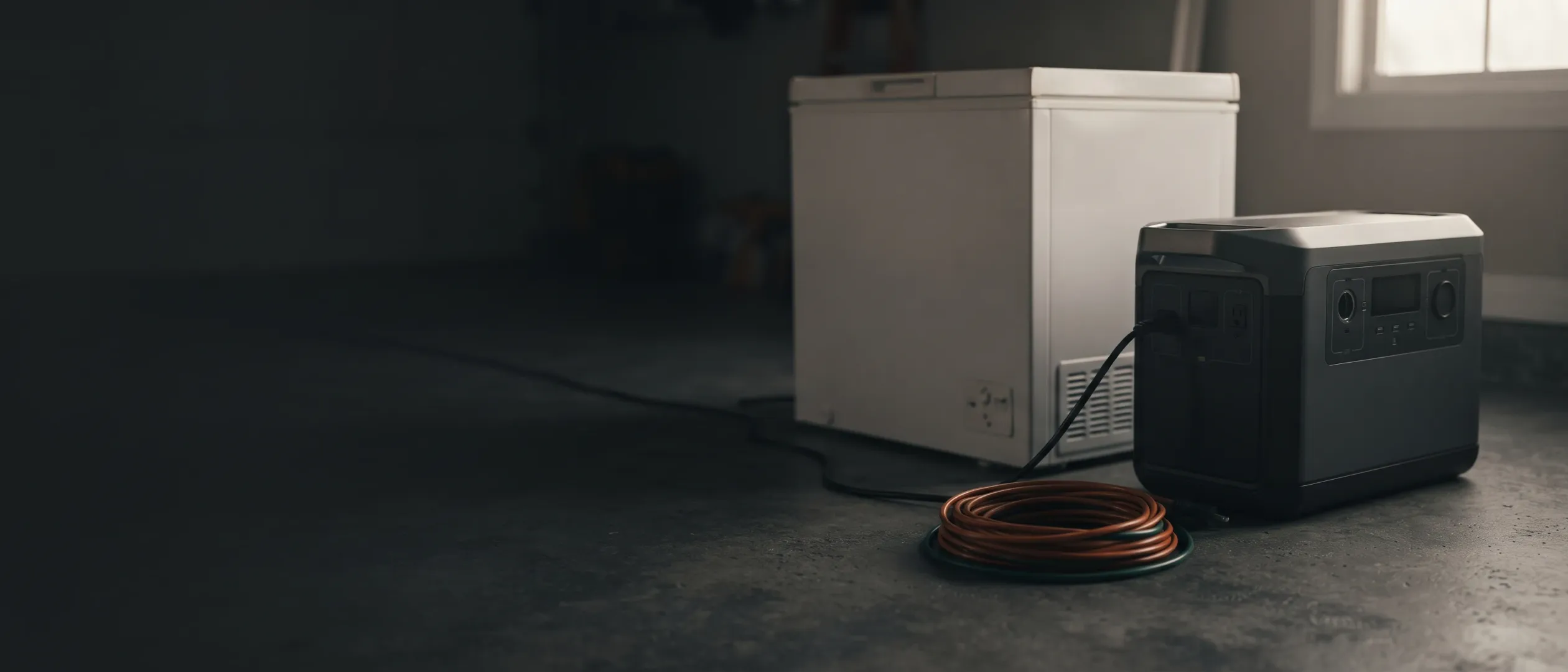
Running watts are what an appliance draws while it works; surge (starting) watts are the brief burst a motor or compressor needs to get going. On a portable power station, the running watts of everything you plug in must fit under the continuous output, and the biggest startup burst must fit under the surge rating. A station that clears one but not the other will shut its AC outlets off.
Surge watts vs running watts: a short burst and a steady draw
Running watts must fit under continuous output; the starting burst must fit under the surge rating.
Running watts (also called rated, continuous or operating watts) are the power an appliance uses once it's up and running. A refrigerator that draws 150 W while the compressor runs has 150 running watts. On a power station, the matching number is the continuous AC output: the most its inverter can deliver, all the time, to everything plugged in at once.
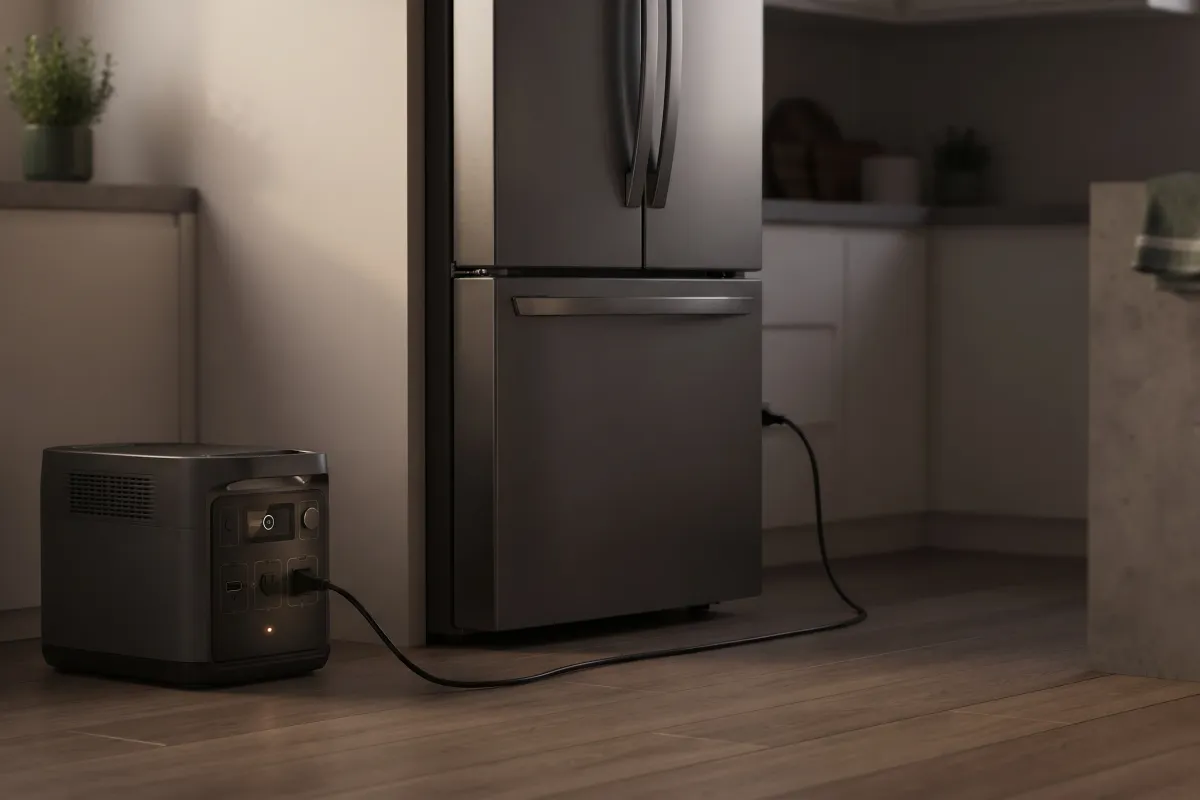
Surge watts (starting, peak or startup watts) are the short spike an appliance pulls the instant it switches on. EcoFlow describes it as lasting only a few seconds; for a small motor it's often less. On a power station, the matching number is the surge or peak rating: how far above its continuous output the inverter can go for that moment.
The two ratings answer different questions:
| Question | Appliance number | Station number |
|---|---|---|
| Can it keep it running? | Running watts | Continuous AC output |
| Can it start it? | Starting (surge) watts | Surge (peak) output |
| How long will it run? | Average watts | Capacity in Wh |
A big surge figure is not extra running power. A station rated 1,800 W continuous and 3,600 W surge can start a motor that briefly needs 3,000 W, but it can't run a 3,000 W appliance. For the third row of that table, capacity and runtime, see watts vs watt-hours.
Why motors need starting watts: 2 to 4 times running power
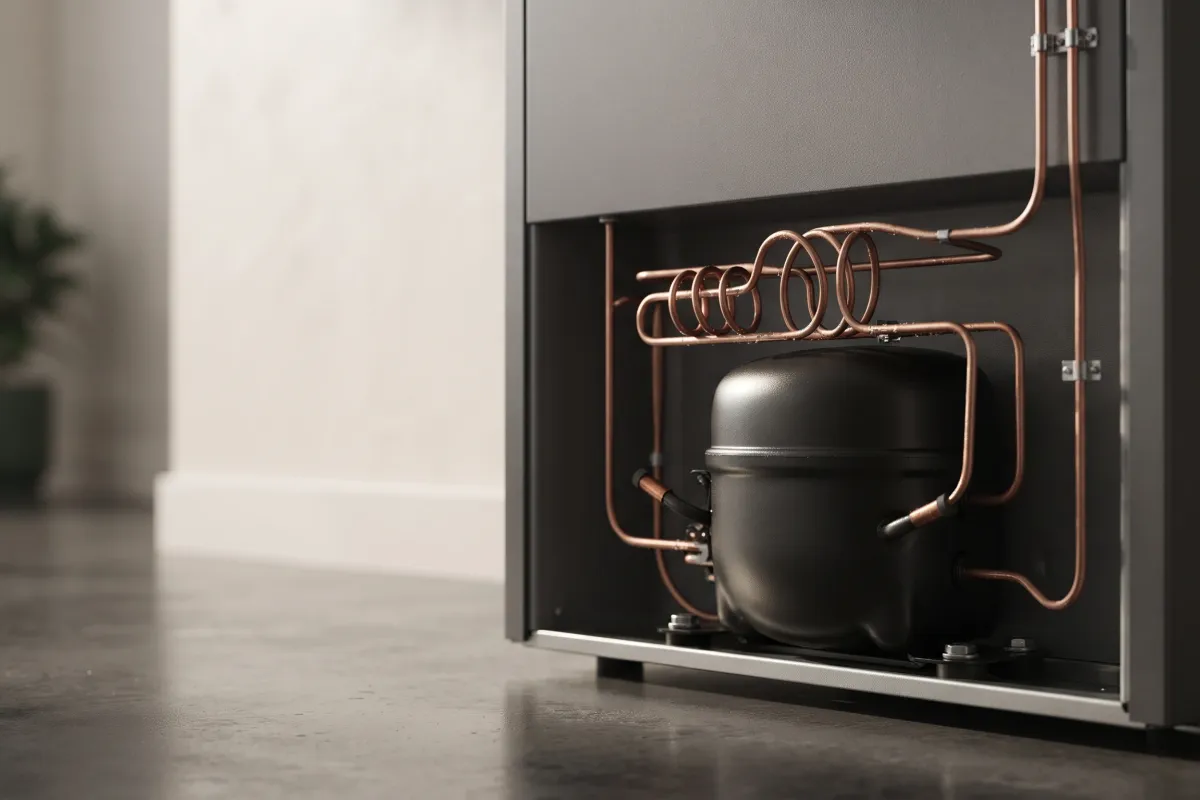
A motor at rest draws far more current than one already turning, for a fraction of a second to a few seconds.
An electric motor that isn't turning yet behaves almost like a short piece of wire: until it spins up and starts pushing back against the supply, it pulls a large current. Compressors in fridges, freezers and air conditioners have it worse, because they start against refrigerant pressure. Once the motor reaches speed, the current falls to its running level. Bluetti's own manual puts it plainly: motor loads such as fridges and pumps start at two to four times their rated power.
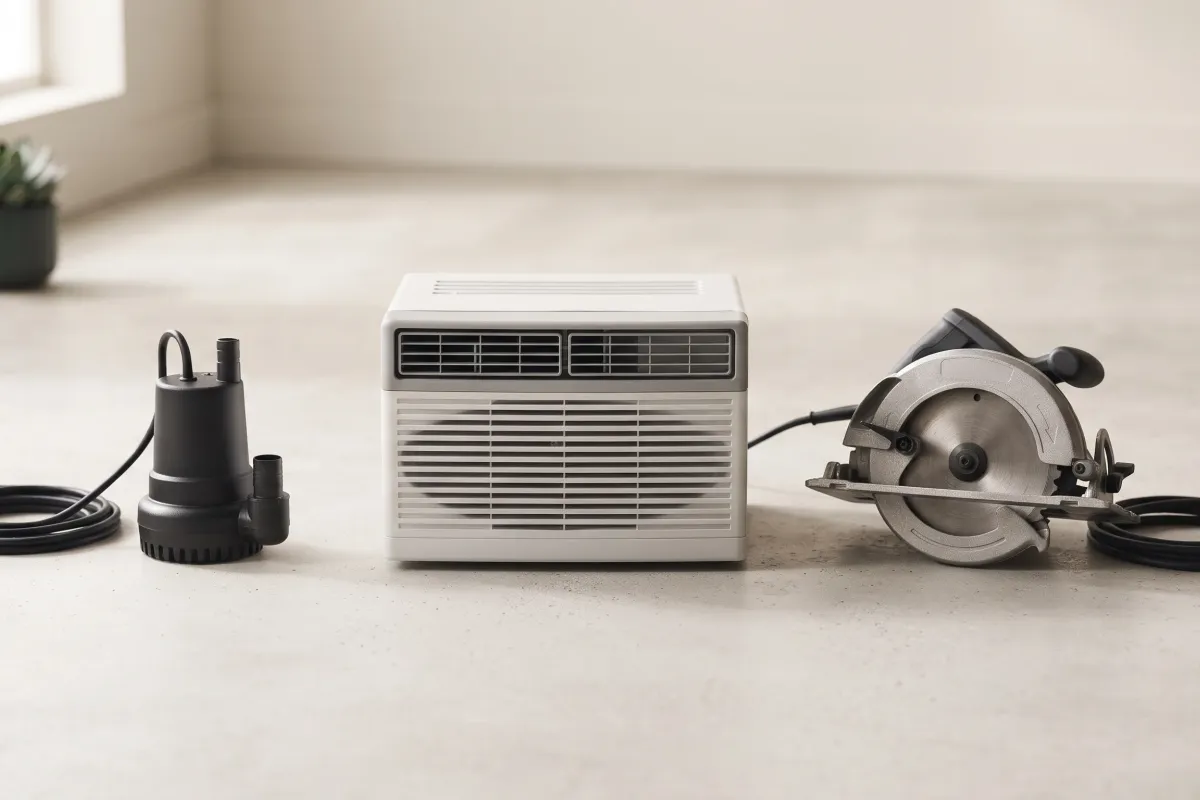
Loads that only heat or light have no motor to start, so their starting and running watts are the same:
- No starting surge: space heaters, kettles, toasters, coffee makers, microwaves (the magnetron, not the turntable), hair dryers, irons, TVs, laptops and phone chargers, LED lights, CPAP machines.
- Starting surge: refrigerators and freezers, sump and well pumps, window and central air conditioners, furnace blowers, washing machines, air compressors, circular saws and other corded power tools, some blenders and box fans.
Some motor nameplates list LRA (locked-rotor amps), the current a motor draws if it can't turn at all. LRA × voltage is a worst case: a motor that starts normally only approaches that current for a fraction of a second, so LRA × voltage overstates what most appliances need. Motor type matters too: induction motors in pumps, compressors and air conditioners have the biggest starting surge, while universal motors in saws, drills and blenders start with less of a jump. If an appliance lists starting watts, use that; if it only lists LRA, treat the result as the upper bound.
Starting and running watts chart: fridges need 800–1,200 W to start
Champion's chart puts household motors at least twice their running watts at startup, and fridges more.
These ranges come from Champion Power Equipment's generator wattage chart. They're broad because models differ a lot, so check your appliance's label or manual where it gives a figure, and size for the top of the range when it doesn't.
| Appliance | Running watts | Starting watts |
|---|---|---|
| Refrigerator | 150–400 | 800–1,200 |
| Freezer | 100–500 | 500–1,000 |
| Sump pump, 1/3 HP | 500–800 | 1,000–1,600 |
| Sump pump, 1/2 HP | 800–1,050 | 1,300–2,150 |
| Well pump, 1/2 HP | 750–1,000 | 1,500–2,000 |
| Well pump, 1 HP | 1,000–2,000 | 2,000–4,000 |
| Window AC, 5,000 BTU | 450–600 | 900–1,200 |
| Window AC, 10,000 BTU | 900–1,200 | 1,800–2,400 |
| Central AC, 3 ton | 3,000–3,500 | 5,000–6,000 |
| Furnace fan, 1/2 HP | 300–800 | 800–1,600 |
| Washing machine | 500–1,000 | 1,000–2,300 |
| Circular saw, 7-1/4 in | 1,200–1,800 | 2,400–3,600 |
| Air compressor, 1 HP | 1,500 | 4,500 |
| Microwave | 600–1,200 | none |
| Space heater | 750–1,500 | none |
| TV, 32–55 in | 80–400 | none |
| CPAP, no heated humidifier | 30–60 | none |
Two points the chart doesn't show. First, many well pumps and all central air conditioners in the US run on 240 V, which only a few stations supply, and they connect through a transfer switch, not a plug. Second, a fridge's running watts aren't its average: the compressor cycles on and off, so a fridge that runs at 150 W averages far less over a day. Average watts decide runtime. So for "how many watts does a refrigerator use", there are three answers: about 150–400 W running, 800–1,200 W for a moment at startup, and a much lower average; see how long a power station runs a refrigerator.
How to calculate surge watts for several appliances
Add everyone's running watts, then the extra starting watts of the single biggest motor.
Appliances rarely all start in the same second, so you don't add every starting figure together. The usual method, which EcoFlow and the generator makers use:
- List what you'll run at the same time, with each item's running watts.
- Add the running watts. The total must be at or below the station's continuous output.
- Find the single biggest starting figure and add its extra (starting minus running) to the total from step 2. That peak must be at or below the station's surge rating.
- Leave headroom. Pick a station whose continuous and surge ratings sit comfortably above your totals, roughly 10–20% more, because chart figures are typical, not maximums, and you'll add a device sooner or later.
Our runtime calculator does steps 1 and 2 for you, flags loads that need starting surge, and gives the runtime too.
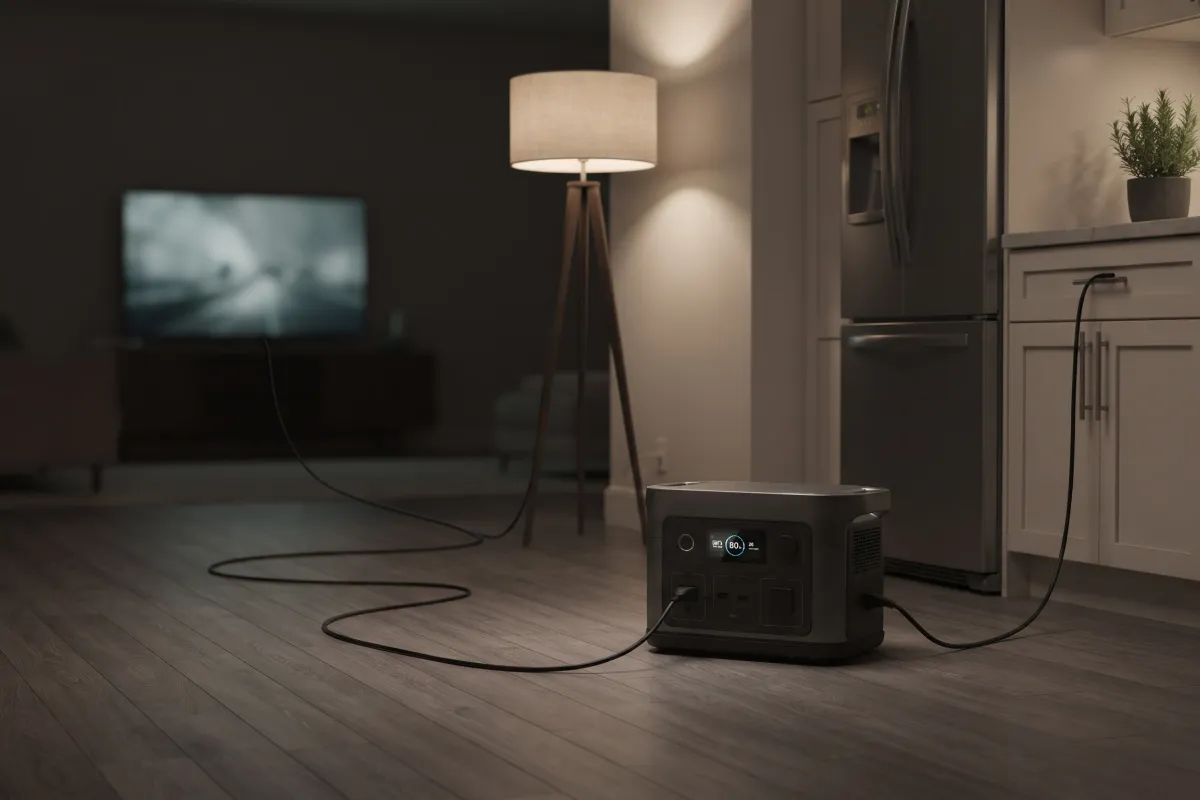
Worked example: an outage kit. A refrigerator (taking the top of the chart: 400 W running, 1,200 W starting), a 55-inch TV at 90 W and four LED lights at 40 W (our runtime calculator figures).
- Running: 400 + 90 + 40 = 530 W
- Peak at the fridge's start: 530 + (1,200 − 400) = 1,330 W
Now check three stations we review against that:
| Station | Continuous / surge | Runs 530 W? | Starts at 1,330 W? |
|---|---|---|---|
| Jackery Explorer 300 | 300 W / 500 W | No | No |
| EcoFlow River 3 Plus | 600 W / 1,200 W | Yes | No (130 W over) |
| EcoFlow Delta 3 Plus | 1,800 W / 3,600 W | Yes | Yes |
The River 3 Plus is the instructive one: it runs the whole kit comfortably, but at the top of the chart the fridge's start would push it past its 1,200 W surge. A fridge nearer the low end of the range would start fine, and switching the TV off while the fridge kicks in buys back 90 W. Without a figure from your fridge's maker, a station with a surge rating well above your peak is the safe choice. The sizing side (how many watt-hours for how many hours) is in how to choose a portable power station.
Ways to cut the peak if you're close:
- Start the motor first, then plug in everything else.
- Don't run two motors that could start together (a fridge and a freezer on the same station both cycle on their own).
- A soft starter, sold for RV air conditioners, lowers a compressor's starting draw; it's fitted to the appliance, so follow its maker's instructions.
Power station surge ratings: most are twice continuous output
Sixteen of the stations we review publish a surge figure, and thirteen of them rate it at exactly twice continuous.
Of the stations we review, these are the published continuous and surge figures, with surge as a multiple of continuous:
| Station | Continuous | Surge | Ratio |
|---|---|---|---|
| Jackery Explorer 300 | 300 W | 500 W | 1.7× |
| EcoFlow River 3 Plus | 600 W | 1,200 W | 2× |
| Bluetti EB3A | 600 W | 1,200 W | 2× |
| Jackery Explorer 1000 v2 | 1,500 W | 3,000 W | 2× |
| Anker SOLIX S2000 | 1,500 W | 3,000 W | 2× |
| EcoFlow Delta 3 Plus | 1,800 W | 3,600 W | 2× |
| EcoFlow Delta 3 | 1,800 W | 3,600 W | 2× |
| Anker SOLIX C1000 Gen 2 | 2,000 W | 3,000 W | 1.5× |
| Jackery Explorer 1000 Plus | 2,000 W | 4,000 W | 2× |
| Jackery HomePower 2000 Plus v2 | 2,400 W | 4,800 W | 2× |
| GRECELL H2400 | 2,400 W | 4,800 W | 2× |
| EcoFlow Delta Pro | 3,600 W | 7,200 W | 2× |
| EcoFlow Delta Pro 3 | 4,000 W | 8,000 W | 2× |
| Jackery HomePower 3600 Pro Max | 2,000 W (4,000 W at 240 V) | 4,000 W (8,000 W at 240 V) | 2× |
| Anker SOLIX S5000 | 4,500 W | 8,000 W | 1.8× |
| Jackery Explorer 5000 Plus | 7,200 W | 14,400 W | 2× |
Two things stand out. First, most makers rate surge at exactly twice continuous, but Anker's C1000 Gen 2 is the exception: it has more continuous output than the Delta 3 Plus (2,000 W vs 1,800 W) yet less surge (3,000 W vs 3,600 W). If you're starting a pump rather than running a kettle, the lower continuous rating can be the better station.
Second, several current stations publish no surge figure at all: the Bluetti Elite 200 V2, Bluetti Elite 30 V2, Bluetti Apex 300, Anker SOLIX F3800 Plus, EcoFlow TITAN 5000 Classic and DJI Power 1000 V2. The Bluetti AC180's spec sheet says "Surge Power 2,700W", but its product page gives the same 2,700 W as its Power Lifting mode, so we don't treat it as a surge rating. That doesn't mean these stations can't start a motor; it means the maker hasn't said how far above continuous they go. For a fridge or pump on one of them, leave the starting watts under the continuous rating, or ask the maker.
Surge vs X-Boost, Power Lifting and SurgePad: boost modes don't start motors
A boost mode runs a heating appliance at lower voltage, which a motor can't use to start.
Several makers advertise a second, larger "boost" number. It is not a surge rating, and it's easy to confuse with one:
| Maker | Name | What it does |
|---|---|---|
| EcoFlow | X-Boost | Lowers the voltage so a heating appliance above the rated output runs, at reduced power |
| Bluetti | Power Lifting | Same idea; Bluetti's manuals limit it to pure resistive loads |
| Anker | SurgePad | Same idea, on some SOLIX models such as the C300 and C300 DC |
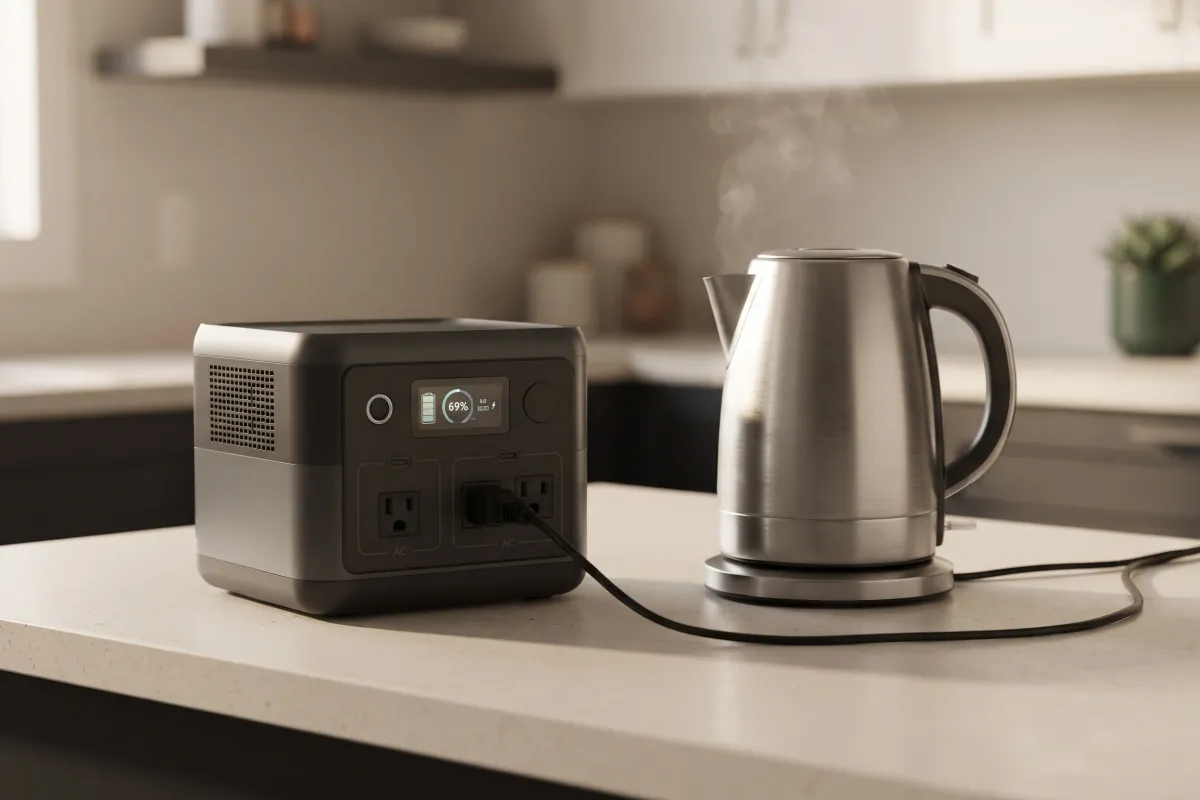
A kettle or hair dryer is a resistive load: give it less voltage and it simply draws less power and heats more slowly. A motor can't do that; it needs full voltage to develop starting torque, so a boost mode doesn't help a fridge, pump or saw start. Bluetti's Elite 200 V2 manual is explicit: Power Lifting runs pure resistive loads rated 2,600 to 3,900 W, and the actual output is still 2,600 W.
EcoFlow lists surge and X-Boost as separate figures. On the EcoFlow River 3 Plus they happen to be equal (1,200 W each), which is where most of the confusion comes from. When a spec sheet gives only a boost figure, treat the station's surge as unpublished, not as that number.
Power station surge vs gas generator starting watts
A station's surge is usually twice its continuous rating; a gas generator's starting watts are only 10–20% above running.
Gas generators publish the same pair of numbers, usually printed on the control panel or box as "running watts" and "starting watts" (or "rated" and "peak"); a generator's starting watts mean exactly what a station's surge means. The physics is the same, but the headroom differs:
- A gas generator gets its starting watts from the inertia of the spinning engine and alternator. EcoFlow puts a typical generator's starting figure only 10–20% above its running figure.
- A power station's surge comes from the inverter's electronics, which can briefly pass more current than they can sustain; most stations we review rate it at about twice continuous.
So a station can start loads a generator of the same running rating would struggle with, but it runs out of battery far sooner. The full trade-off, with fuel, noise and indoor safety, is in portable power station vs generator.
Startup surge too high: the inverter shuts off its AC outlets
Overload protection cuts the AC the moment the peak passes the surge rating, with charge still in the battery.
If the peak at startup goes over a station's surge rating, or the running total stays over its continuous rating, the inverter's overload protection switches the AC outlets off. Nothing is usually damaged; you'll see an overload warning on the screen or in the app, and you reset by unplugging the load and turning AC back on (the exact steps are in each maker's manual).
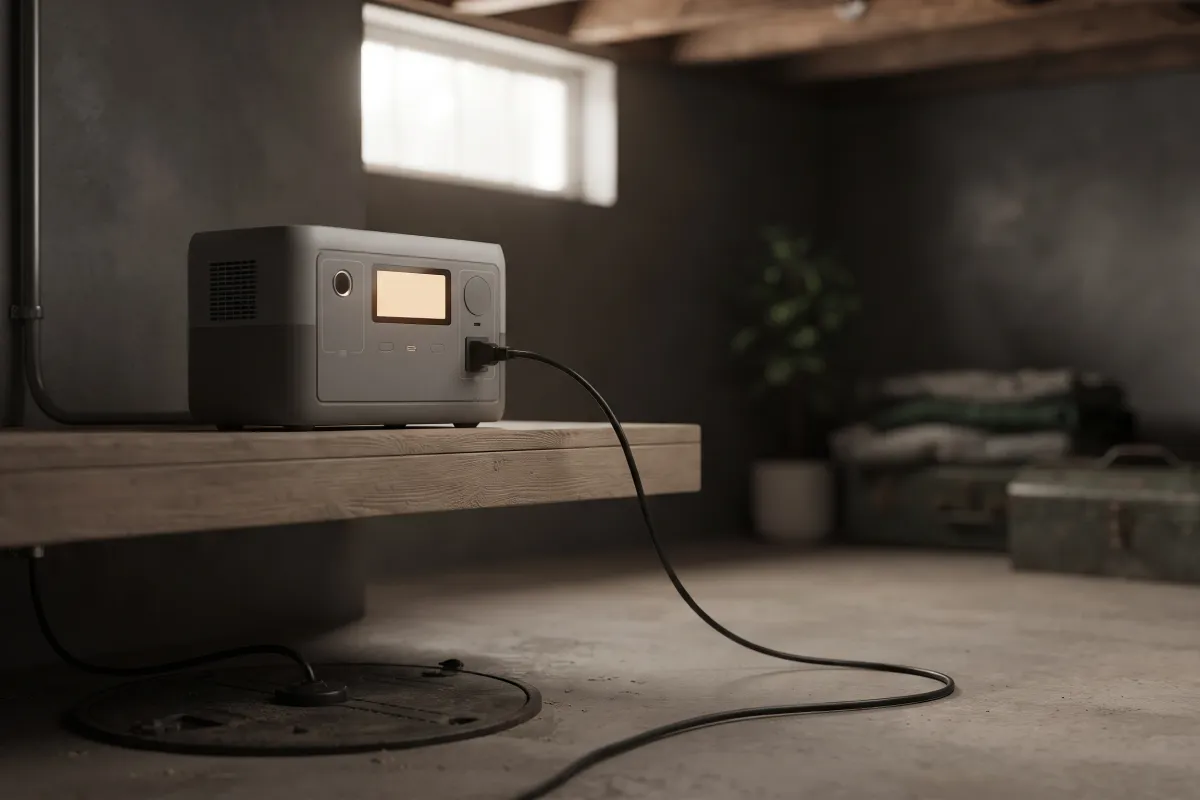
Signs it's the surge, not the battery:
- The station shuts off the moment the appliance kicks on, with charge left in the battery.
- A light dims or flickers as the motor starts.
- The appliance hums but doesn't start, then the station trips.
If that happens, take other loads off before the motor starts, check the appliance's starting watts, and if it's still over, move to a station with a higher surge rating. A station that won't start a fridge it ran yesterday is also worth checking for battery or charging problems, since a nearly empty battery can't deliver its full output. For a list of what a station can run in an outage, see what a portable power station can run, and for picks sized for fridges and pumps, the best portable power stations for home backup.
FAQ
Surge ratings answer "will it start?"; continuous ratings answer "will it keep running?"
What is the difference between running watts and surge watts?
Running watts are the steady draw while an appliance works; surge (starting) watts are the brief burst a motor needs to start. On a power station, running watts must fit under the continuous output and the biggest start must fit under the surge rating.
Are starting watts and surge watts the same?
Yes. Starting, surge, peak and startup watts all mean the brief draw at switch-on. "Rated", "running" and "continuous" all mean the steady figure.
What does 4,000 surge watts mean?
It means the station can supply up to 4,000 W for the moment a motor starts, not that it can run 4,000 W. The Jackery Explorer 1000 Plus is an example: 2,000 W continuous and 4,000 W surge, so it runs up to 2,000 W and can start a motor whose startup peak, with everything else on, stays under 4,000 W.
How long does a surge last?
Usually a fraction of a second to a few seconds while a motor spins up. Makers rarely state how long their surge rating holds; DJI is one exception, listing the Power 1000's 2,600 W maximum for 30 seconds and a 4,400 W peak.
Do I add up the starting watts of everything?
No. Add the running watts of everything that's on, then add the extra starting watts of the single biggest motor. Motors rarely start in the same instant, but if two can (a fridge and a freezer), allow for both.
Is 7,500 or 9,000 running watts enough to run a house?
For essentials, often; for a whole house with central air, an electric range and a dryer at once, usually not, whether it's a generator or a station. A 7,500 W or 9,000 W generator can cover essentials such as a fridge, sump pump, furnace fan and lights if you stagger the starts. Among stations we review, the Jackery Explorer 5000 Plus is rated 7,200 W continuous and 14,400 W surge, enough to start a 3-ton central AC (5,000–6,000 starting watts on Champion's chart) on 240 V through a transfer switch, but its 5,040 Wh battery would run a 3,000–3,500 W air conditioner for only about 1.2 to 1.4 hours by our estimate (5,040 Wh × 85% ÷ the load). See whole-home battery backup.
Can a 1,000 W power station run a refrigerator?
Usually, if its surge rating covers the fridge's start: a typical fridge needs 800–1,200 starting watts on Champion's chart. A station with 1,000 W continuous and 2,000 W surge clears that. On a station with no published surge, keep the fridge's starting watts under its continuous rating.
Does X-Boost or Power Lifting help start a fridge?
No. Boost modes lower the voltage to run heating appliances above the rated output; a motor needs full voltage to start. Use the surge rating for motors.