 By
We may earn a commission if you buy through links on this page, at no extra cost to you. This never affects which products we recommend. How we make money.
On this page 8 sections
Add your devices below to see how many hours a portable power station will run them. The calculator also shows how much energy you use per day, and the capacity we'd recommend. It also checks whether the station can run everything at once and flags devices that need a burst of extra power to start.
Estimated runtime
9.9 hours
on a 1,024 Wh station
One day uses 242% of this battery — more than it holds
- Average load
- 80 W
- Energy per day
- 2,482 Wh
- Peak (all on)
- 202 W
- Recommended
- 3,000 Wh
- Add the station's continuous output to check everything can run at once.
- Includes a motor or compressor. Check the station's surge rating can start it.
- Includes 10 W inverter idle draw while AC is on.
Planning estimate: capacity × 85% (AC) or 92% (DC) ÷ average load, plus inverter idle draw. Cold, battery age and low-battery cutoffs shorten real runtime. Our method
How the calculator works
The formula, and the three details that make it realistic
Runtime ≈ battery capacity ÷ the average power your devices pull from the battery. (New to these units? Start with watts vs watt-hours.)
That sounds simple, but three details make the difference between a useful estimate and an optimistic one.
Conversion losses: AC vs DC
Your devices don't get every watt-hour in the battery. Turning the battery's DC power into household AC power loses energy, so for AC outlets we assume 85% efficiency. USB and 12 V outlets skip that conversion, so we use 92% for DC loads. Real efficiency varies by model and load; these are planning figures, and they're the same ones we use across the site (see how we test).
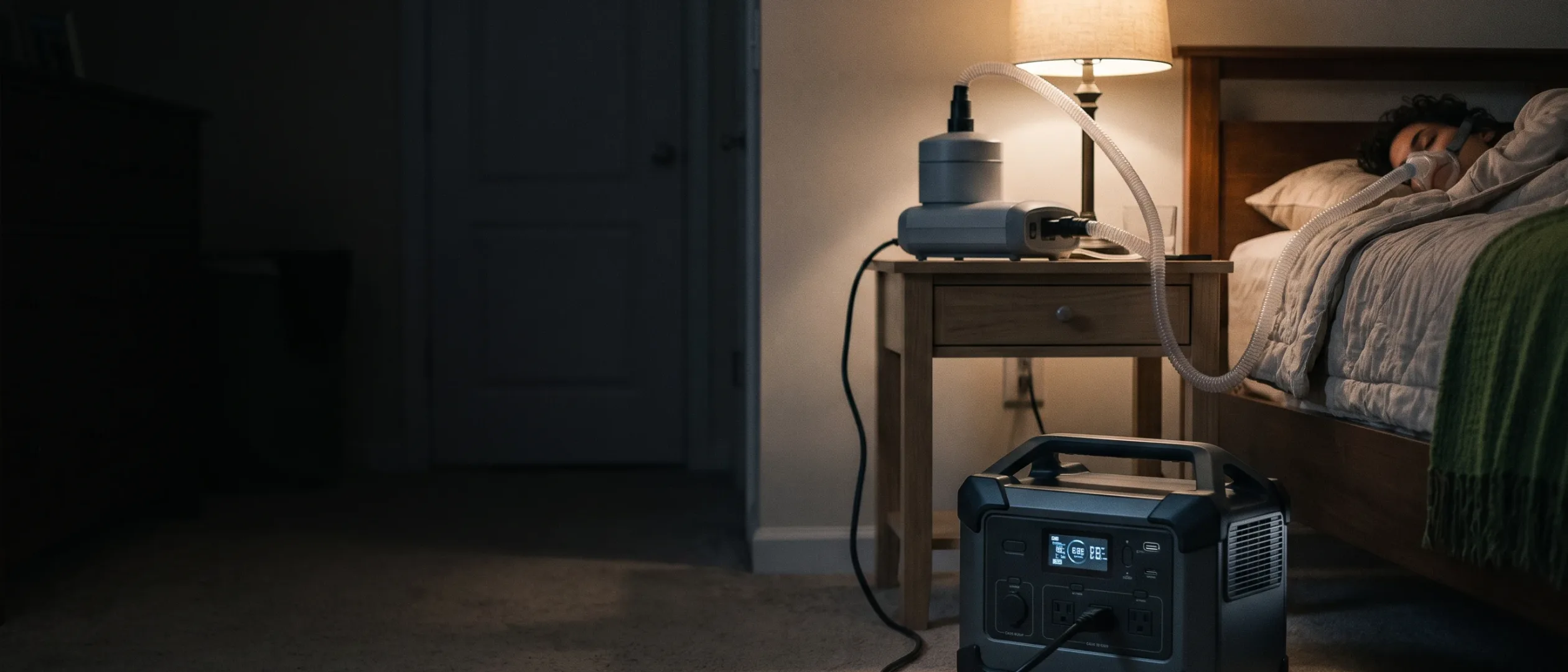
Tip: if a device can run from USB-C or a 12 V DC cord (many routers, CPAP machines and coolers can), it will usually run longer than from the AC outlet. For CPAP numbers by humidifier setting, see how long a power station runs a CPAP.
Average draw vs running watts
Fridges and freezers don't run their compressor all the time. A fridge might draw well over 100 W while the compressor runs, but averaged over a day it uses far less. A typical new full-size fridge uses on the order of 600 kWh a year, which works out to roughly 50–70 W on average.
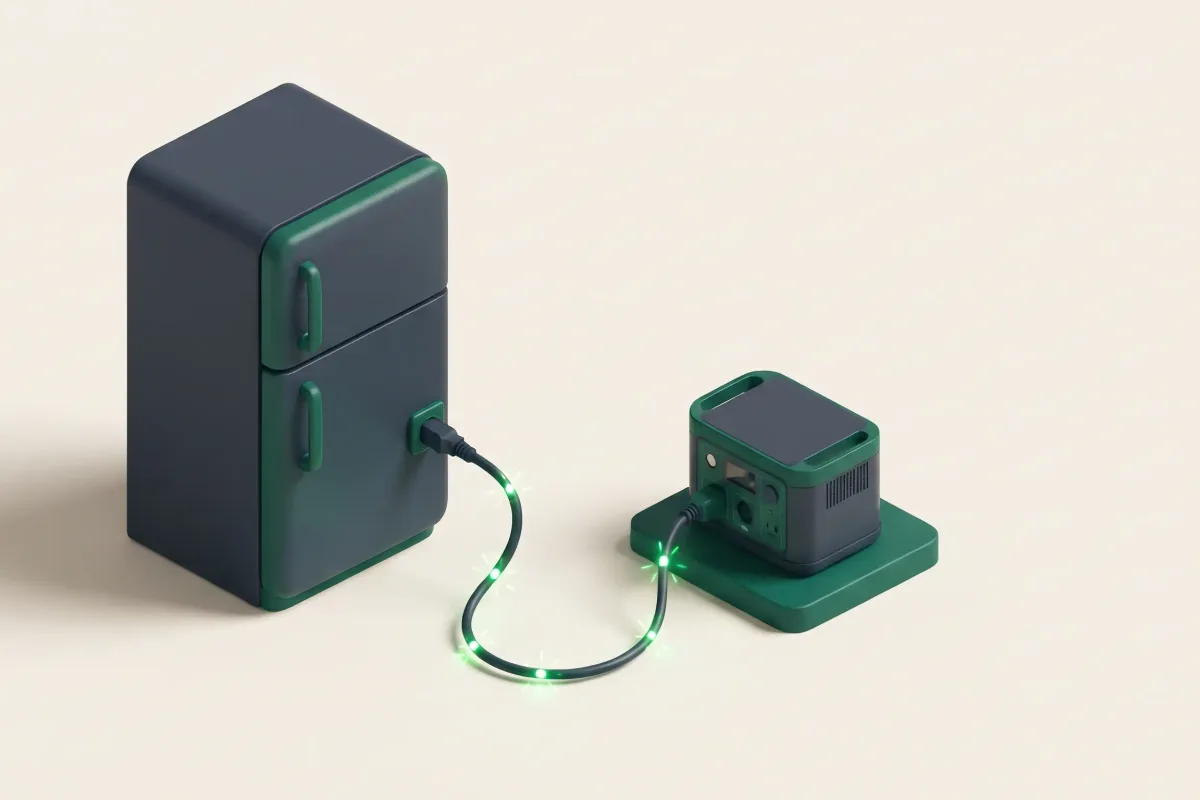
The calculator uses average watts for runtime and running watts for the "everything on at once" check. Your fridge's yellow EnergyGuide label lists its yearly kWh: divide by 8,760 and multiply by 1,000 to get its average watts. For typical figures, see how long a power station runs a fridge.
Inverter idle draw
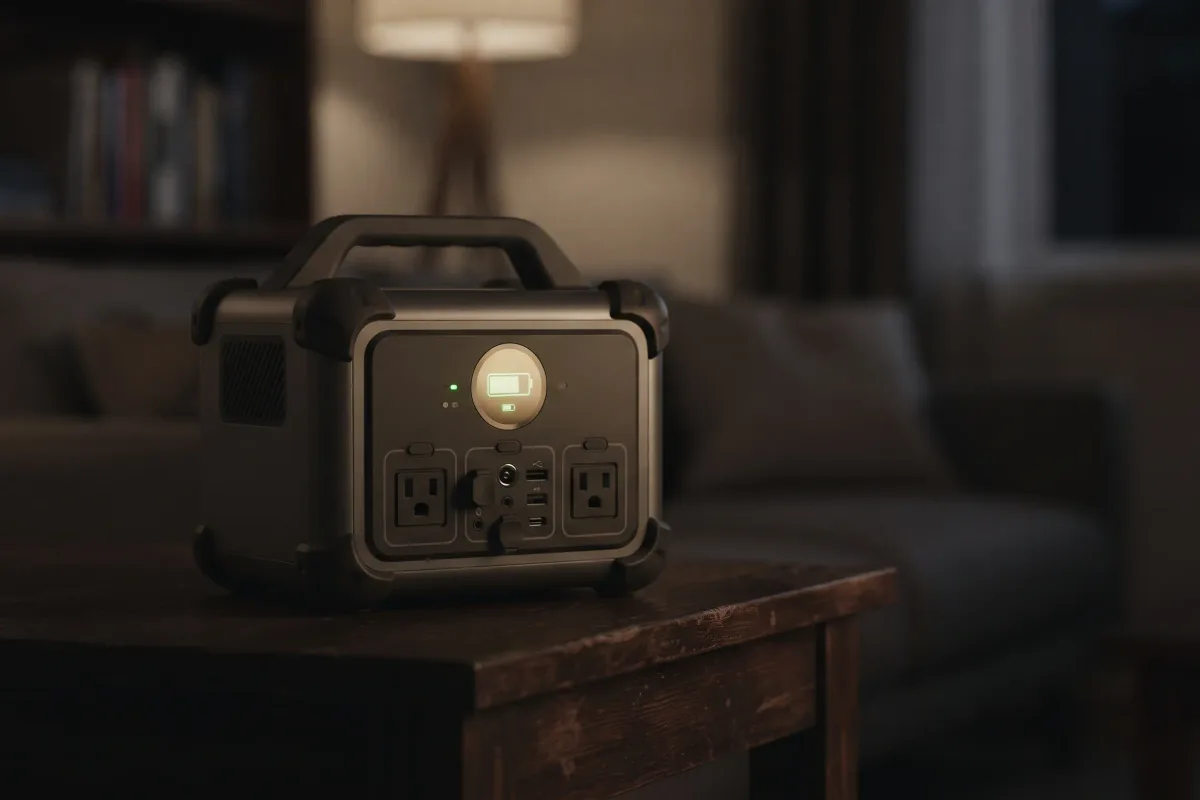
A power station's inverter uses some power just by being switched on, even with nothing plugged in. We add 10 W whenever any AC device is in your list. It varies by model (you can change it under advanced settings). Over 24 hours that's 240 Wh, a real slice of a 1,000 Wh battery, so switch AC output off when you don't need it.
Worked examples
Common setups, using the defaults above
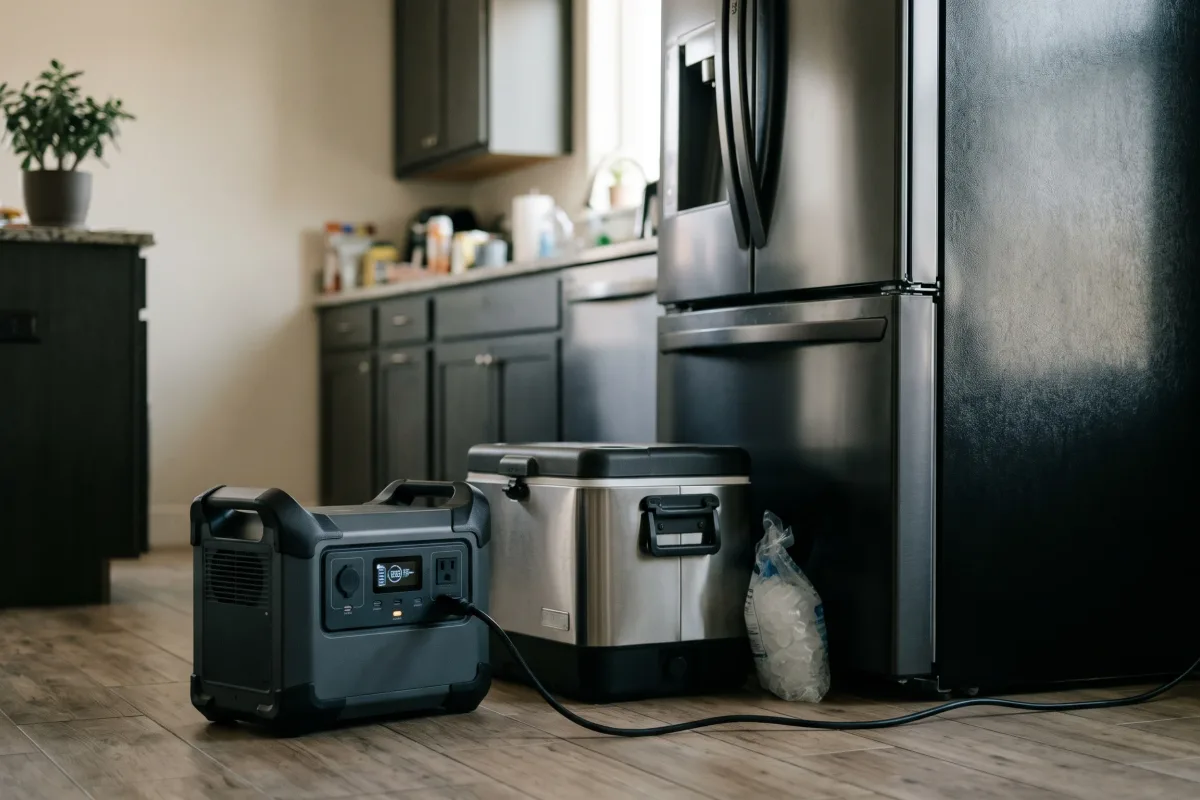
These use the calculator's default values, so you can reproduce them above.
Fridge + Wi-Fi router during an outage
- 1,024 Wh station11 h
- 2,048 Wh station22 h
A mid-size station keeps a fridge and internet going for most of a night. To cover a full day you'd want about 2,700 Wh with our 20% margin. That's home-backup territory (for example, a 3.84 kWh station like the Anker SOLIX F3800 Plus), or a mid-size station you recharge with solar.
CPAP for one night
- No humidifier, DC cord · 300 Wh7.9 h
- No humidifier, DC cord · 500 Wh13 h
- With humidifier, AC · 500 Wh5.4 h
- With humidifier, AC · 1,024 Wh11 h
The humidifier and the AC outlet together more than double the energy a CPAP needs. Running without the humidifier on a DC cord is the single biggest way to stretch a small battery. Confirm your machine's real draw and any medical needs with your device documentation and equipment supplier.
A camping weekend (per day)
- Energy needed per day2.4 days
- …of which inverter idle10 h
Leaving the inverter on all day accounts for roughly 240 of those 1,388 Wh. Turn AC on only for the lights and laptop, or use DC/USB versions, and a 1,000 Wh station goes noticeably further.
Why real runtime is often shorter
Plan for these and leave a margin
- Cold weather. Lithium batteries deliver less energy in the cold, and many stations limit charging below freezing.
- Battery age. Capacity fades with charge cycles and time; a several-year-old battery holds less than its rating. How fast depends partly on chemistry (see LiFePO4 vs lithium-ion).
- Low-battery cutoff. Stations shut off before the cells are truly empty to protect the battery.
- High loads. Big loads near the inverter's limit run less efficiently than light ones.
- Forgotten AC output. Idle draw adds up over a day.
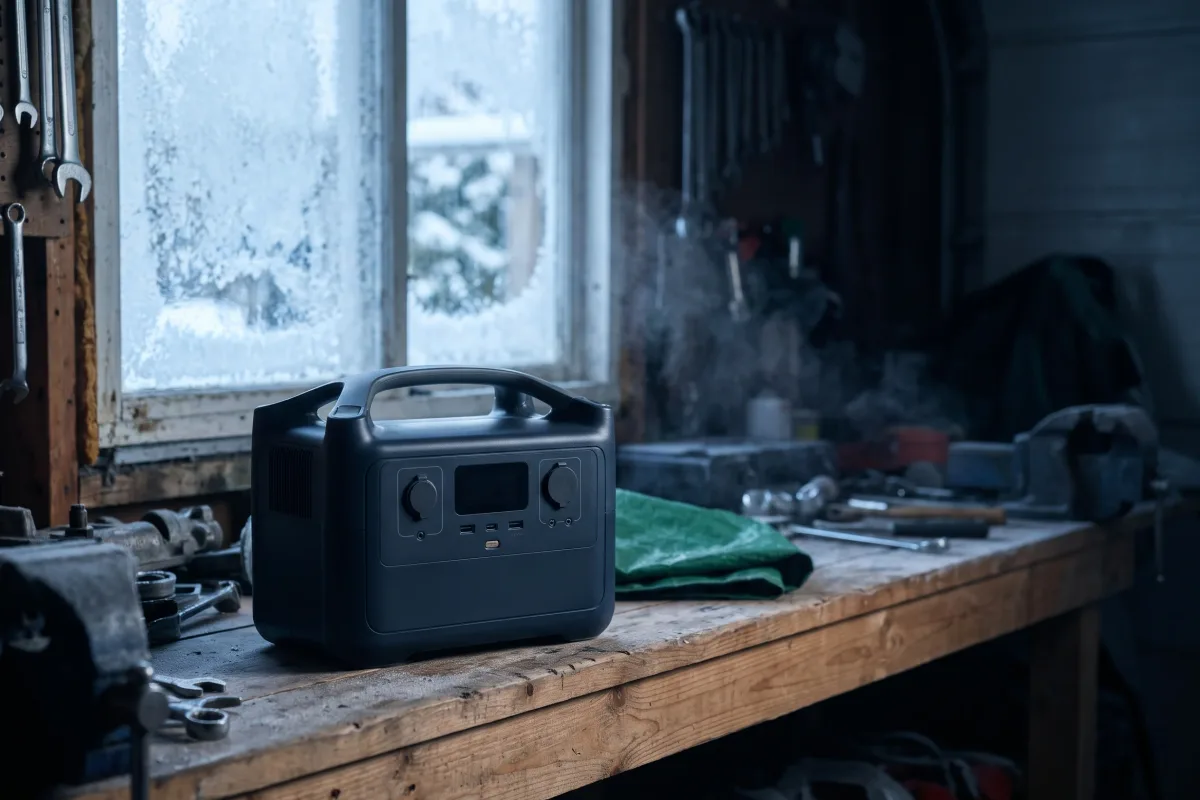
Treat the result as a planning estimate, and leave a margin.
Sizing: capacity and output
The two numbers that decide whether a station will work for you
Two numbers decide whether a station will work for you:
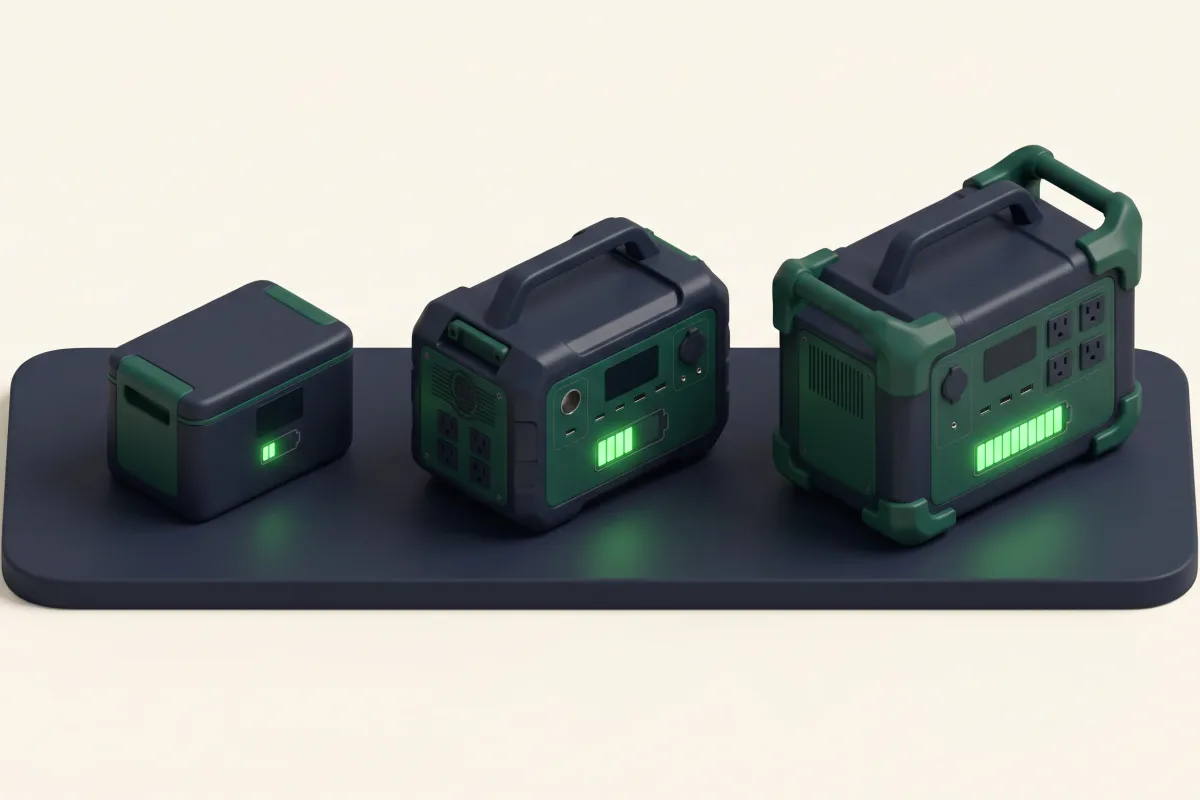
- Capacity (Wh): how long it lasts. Use the recommended figure, which adds a 20% margin to your daily energy and multiplies by the days you want to cover.
- Continuous output (W): what it can run at once. Add the running watts of everything you'll use at the same moment and stay under the station's continuous rating. Fridges, freezers, pumps and power tools also need a surge rating high enough to start their motors.
Enter your station's output and surge figures in step 1 and the calculator checks both for you.
Ready to choose a station? See The Best Portable Power Stations.
FAQ
Quick answers to common questions
How accurate is this calculator?
It's a planning estimate based on published specs and typical device draws, not a measurement of your setup. Your devices' real wattage, temperature and battery age all shift the result. For the best estimate, enter the wattage from your own device labels.
Is it better to use AC or USB outlets?
When a device can use either, DC or USB is usually more efficient because it avoids converting DC to AC, and it lets you switch the inverter off entirely.
Does cold weather reduce runtime?
Yes. Lithium batteries deliver less energy in the cold, and many stations restrict charging at low temperatures. Keep the station somewhere above freezing when you can.
Can I use a power station while it's charging?
Many stations support pass-through charging, so you can run devices while they recharge from the wall or solar. Check your model's manual for limits.