 By
We may earn a commission if you buy through links on this page, at no extra cost to you. This never affects which products we recommend. How we make money.
On this page 9 sections
Our verdict · Anker SOLIX
2 kWh and 2,400 W in a 41.7 lb box, with a 10 ms switch and a 1.5-hour wall charge
The C2000 Gen 2 packs 2,048 Wh and 2,400 W into 41.7 lb, refills from the wall in about an hour and a half, and switches to battery in 10 ms. It rates 7.5 by our method, third among the 2 to 3 kWh stations we cover: the HomePower 2000 Plus V2 expands much further for the same battery and output, and the Apex 300 adds 240 V.
- Capacity
- 2,048 Wh
- AC output
- 2,400 W
- Wall charge
- 100% in 88 min at 1,800 W; 58 min with AC + solar
- Weight
- 41.7 lb
Best for
Home backup for a fridge, router and lights; RV and van trips; anyone who wants 2 kWh they can still lift.
Skip it if
You'll charge mostly from solar (800 W max) or need more than about 4 kWh.
- 2,048 Wh LiFePO4 rated for 4,000 cycles to 80%
- 100% in 88 minutes at 1,800 W (Anker)
- 10 ms switchover
- 41.7 lb for 2 kWh; 5-year warranty
- 800 W solar input
- Expands only to about 4 kWh
- 120 V only, no 240 V
Rating breakdown (large (2 to 3 kwh) class)
| Criterion | Weight | Score | Based on |
|---|---|---|---|
| Wall charging speed | 20% | 6.4 | 1,800 W input |
| AC output | 20% | 6.0 | 2,400 W |
| Solar input | 10% | 3.2 | 800 W |
| Backup switchover | 15% | 10.0 | 10 ms |
| Portability | 10% | 9.7 | 49 Wh/lb |
| Expandability | 10% | 7.0 | to 4,096 Wh |
| Battery life & warranty | 15% | 10.0 | 5-year warranty, 4,000+ cycles |
| Capacity (Wh) | 2048 |
|---|---|
| Battery chemistry | LiFePO4 |
| Rated cycle life | 4,000 cycles to 80% |
| AC output, continuous (W) | 2400 |
| AC output, surge (W) | 4000 |
| AC charge time | 100% in 88 min at 1,800 W; 58 min with AC + solar (2,600 W) (Anker) |
| Max AC charging input (W) | 1800 |
| Max solar input (W) | 800 |
| Solar input voltage range | 11–60 V, 17 A (one XT60i input) |
| UPS switchover (ms) | 10 |
| Weight (lb) | 41.7 |
| Expandable to (Wh) | 4096 |
| Warranty (years) | 5 |
Key specs at a glance: 2,048 Wh and 2,400 W in 41.7 lb
Twice the C1000 Gen 2's battery in a box you can still carry, with a TT-30R outlet for RVs
- 2,048 Wh LiFePO4, rated for 4,000 cycles to 80% capacity. See LiFePO4 vs lithium-ion.
- 2,400 W continuous, 4,000 W peak at 120 V, from NEMA 5-20R outlets and a TT-30R RV outlet (2,400 W max).
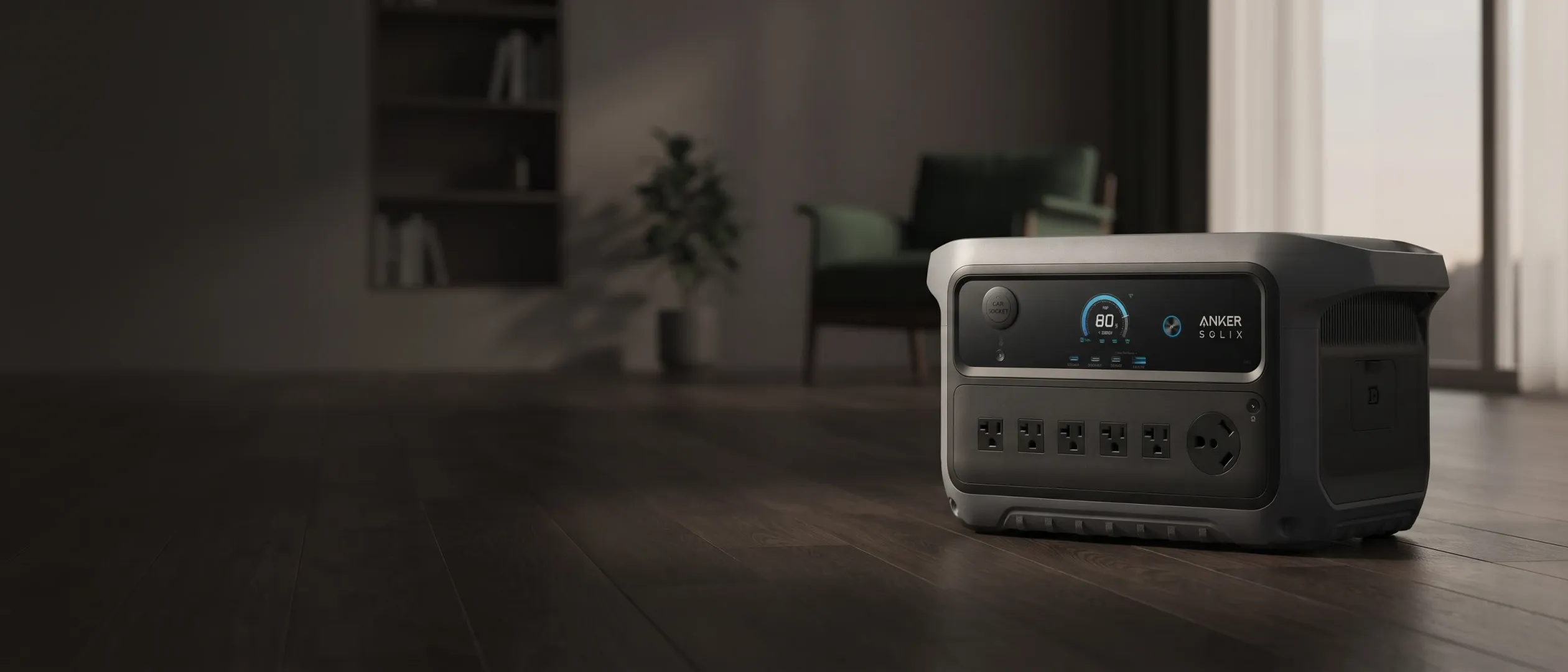
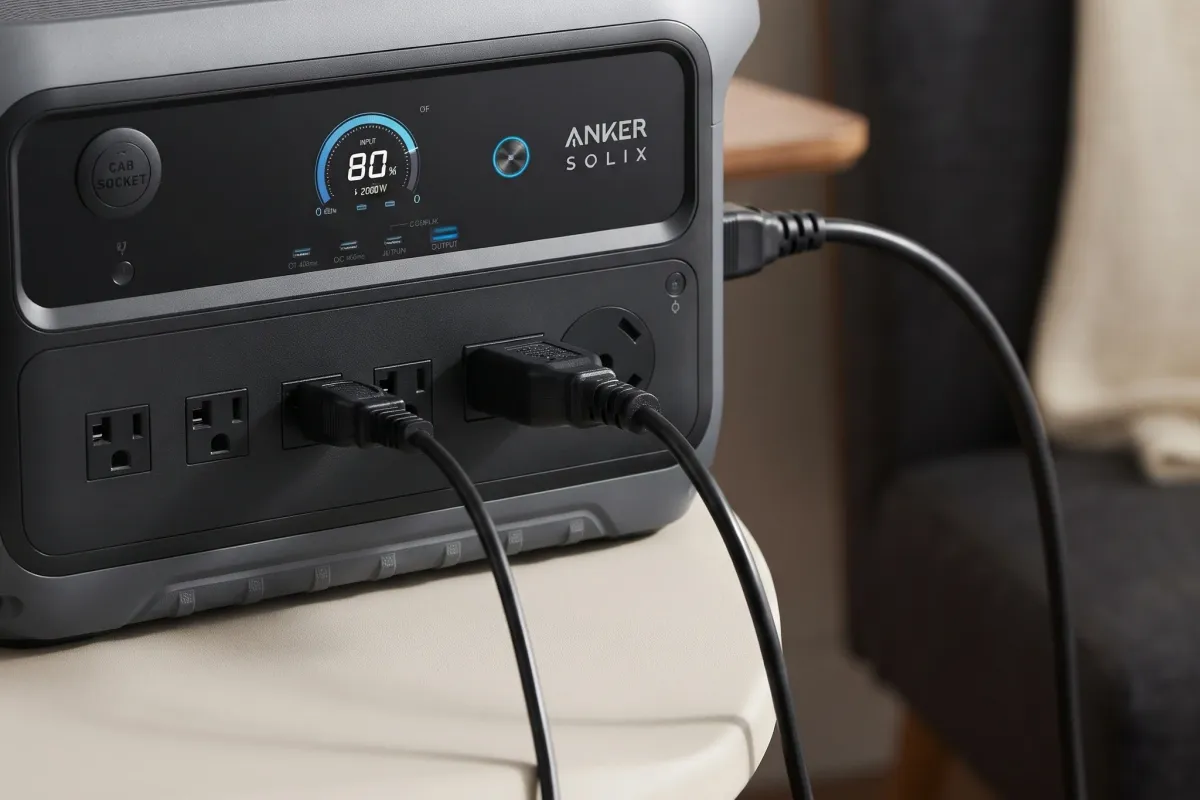
- 41.7 lb (18.9 kg), 18.1 × 9.8 × 10.1 in, with an LCD screen and every port (AC, TT-30R, USB-C, USB-A, car socket, AC input, XT60i solar input and the expansion port) on the unit. In the box: the station, a 15 A AC charging cable and the user manual.
- Ports: two 140 W USB-C, one 15 W USB-C, one 12 W USB-A and a 12 V car outlet (10 A). The 15 W USB-C and the USB-A share 20 W.
- Expansion: one Anker SOLIX BP2000 (Gen 2) battery, 2,048 Wh, takes it to about 4 kWh; Anker's C2000 Gen 2 page names no other compatible battery.
- Warranty: 5 years.
On our method it rates 7.5 among large (2 to 3 kWh) stations. How We Test explains the scoring; watts vs watt-hours explains the specs.
Charging speed: 100% in 88 minutes from the wall, 58 with solar too
Anker quotes 88 minutes at 1,800 W, 58 minutes at 2,600 W of wall and solar, and 3 hours on 800 W of solar
From a standard 120 V outlet the C2000 Gen 2 takes up to 1,800 W, and Anker quotes 100% in 88 minutes. Anker's comparison table also lists 80% in 45 minutes. Add solar at the same time and the total rises to 2,600 W, with Anker quoting 100% in 58 minutes; solar is used first and the wall supplies the rest.
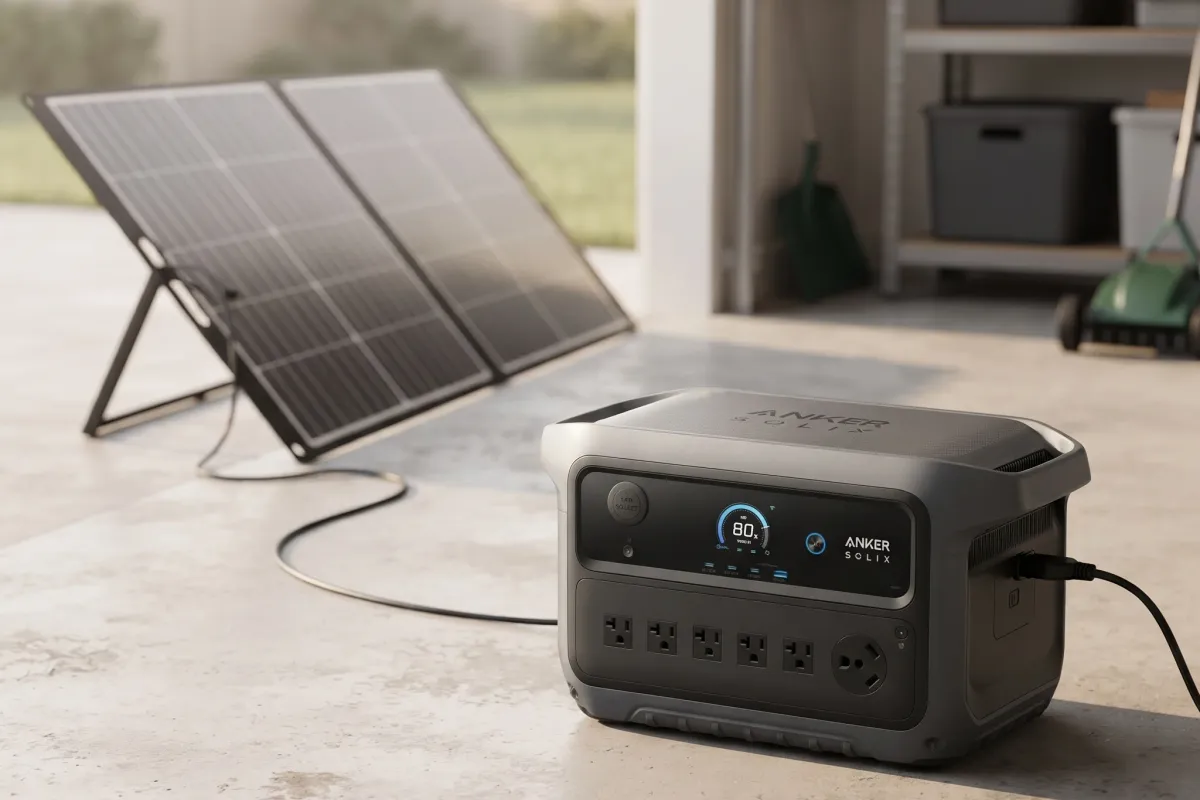
Solar: one XT60i input takes 11–60 V at up to 17 A, 800 W max, and Anker quotes 3 hours at a full 800 W. Panels rarely deliver their rating: at 75% of 800 W (600 W), a full charge takes about 3.4 hours of strong sun by our estimate. Keep each string's open-circuit voltage (Voc) under 60 V; see series vs parallel solar panels and solar panel sizing.
Car: a standard car socket gives only 100 W, which Anker puts at about 23 hours to full. Anker's 800 W alternator charger, sold separately, brings that down to about 3 hours.
Solar is its weak spot in our ratings (3.2): 800 W from one input is modest for 2 kWh, where the F3000 and Apex 300 take 2,400 W.
Capacity and real runtime: about a day for a fridge
2,048 Wh runs a fridge for about 23 hours, or fridge, freezer, lights and router for about 10
Estimated runtimes on the C2000 Gen 2 (2,048 Wh)
- Wi-Fi router (12 W, DC)6.5 days
- CPAP with humidifier, typical (56 W, AC)27 h
- Fridge (67 W average, AC)23 h
- Fridge (67 W, AC) + router (12 W, DC)20 h
- Essentials: fridge, freezer, 4 LED lights, router10 h
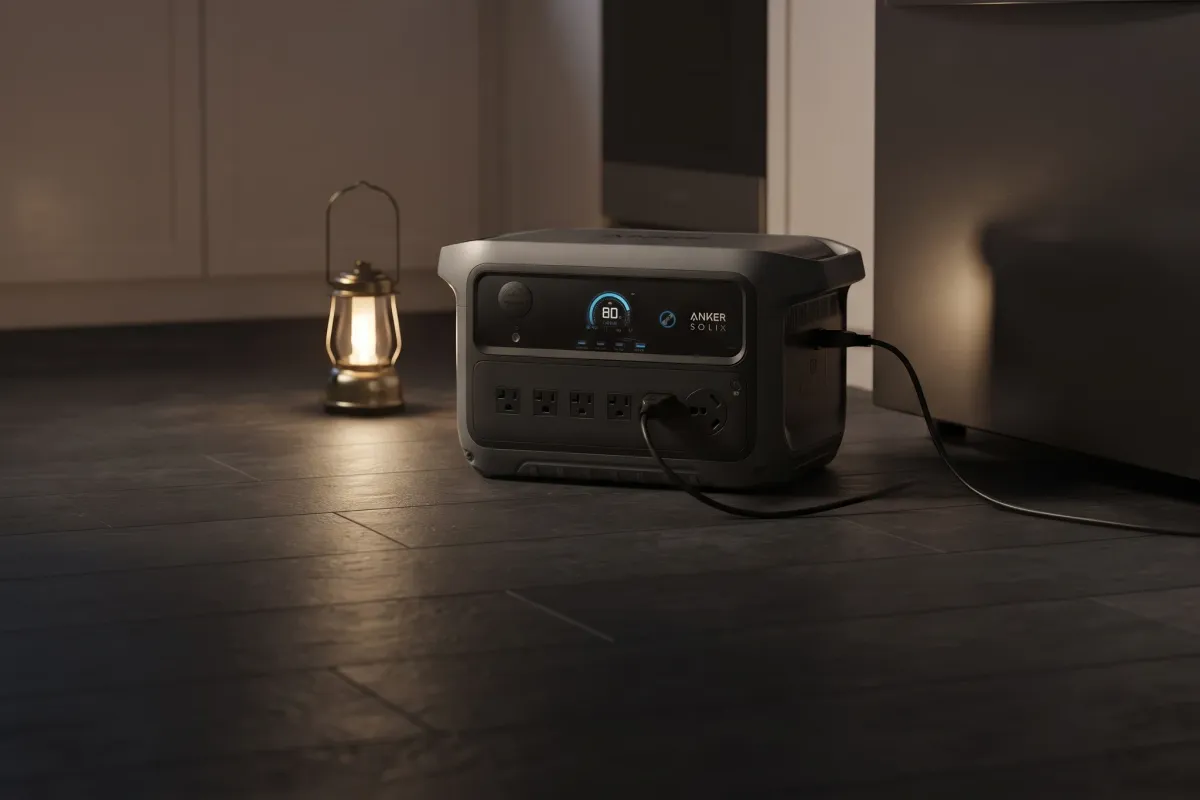
- Fridge: about 23 hours on its own, about 20 with a router. See how long a power station runs a fridge.
- Overnight essentials: fridge, chest freezer, lights and router for about 10 hours.
- CPAP: a typical machine with the humidifier for about 27 hours, more than three nights.
- With a BP2000 (about 4 kWh): the fridge runs about 46 hours and the essentials about 21 hours, by our estimate.
Real runtimes drop in the cold, with an older battery and with a reserve set in the app. Try your own devices in the runtime calculator.
Output: 2,400 W for most single appliances, 120 V only
It runs a microwave, a circular saw or an RV's 30-amp hookup, but not 240 V appliances
The C2000 Gen 2 delivers 2,400 W continuous with a 4,000 W peak at 120 V. That covers most single household appliances: a microwave, a coffee maker, a kettle, a circular saw or a fridge with headroom. Its TT-30R outlet takes a travel trailer's 30-amp plug directly, up to 2,400 W.
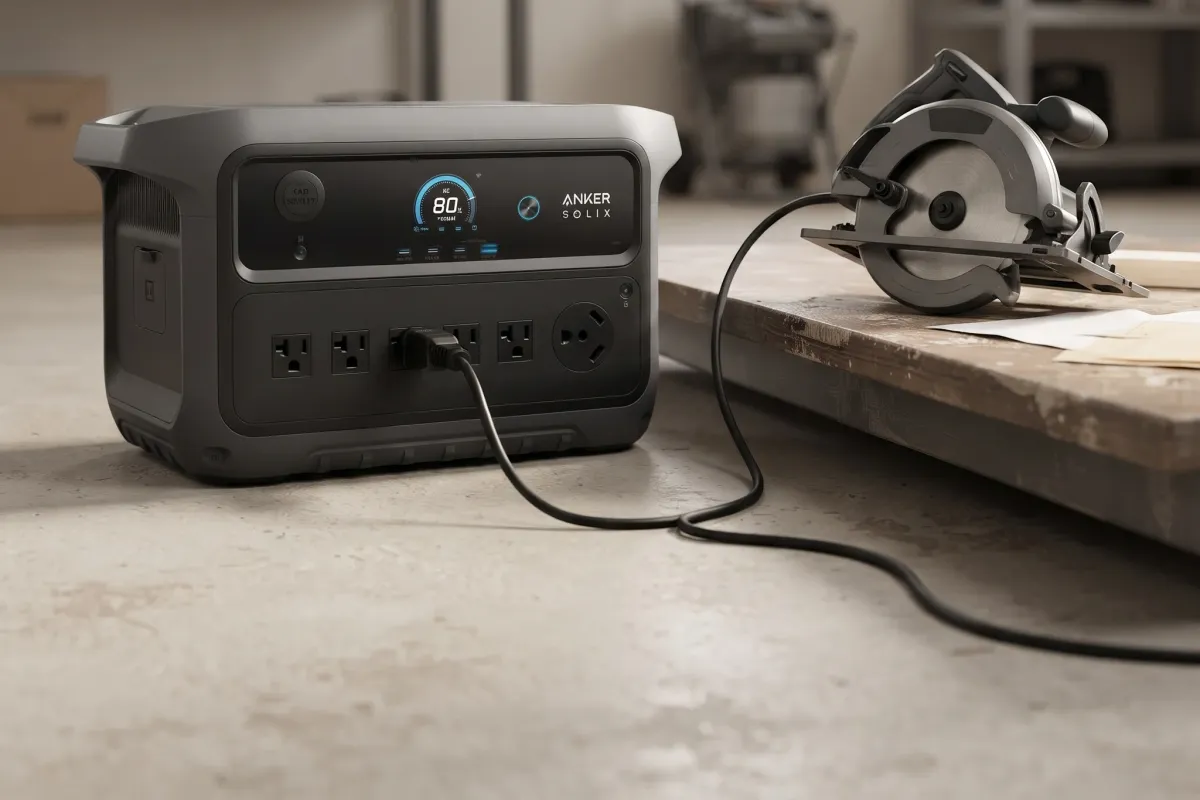
There's no 240 V output, so it can't run a well pump, dryer or central AC on a 240 V circuit; for that, see the Apex 300 or whole-home stations. Add up what runs at once: a microwave (about 1,100 W in our calculator) and a fridge's running draw fit within 2,400 W, but a microwave and a kettle together can exceed it. See surge vs continuous watts for how peak and continuous ratings differ.
For laptops and phones, two 140 W USB-C ports charge the largest laptops at full speed.
Backup (UPS) and app: a 10 ms switch with Storm Guard
Anker rates the switchover at 10 ms, fast enough for desktop computers and network gear
Plugged into the wall, the C2000 Gen 2 passes power through and switches to battery in 10 ms when the grid fails. That keeps routers, modems, desktop PCs and CPAP machines running, and scores full marks in our ratings. See using a power station as a UPS.
The Anker app offers four working modes, according to Anker's FAQ: Standard, Time-of-Use (TOU) for scheduling charging around your electricity rates, Storm Guard and a Fast Charging Plan.
To power home circuits rather than plugging appliances in, use a transfer switch or inlet installed by an electrician; never back-feed a wall outlet. Our transfer switch guide explains the options.
Noise: 30 dB below 1,000 W
Anker rates it at 30 dB under a 1,000 W load
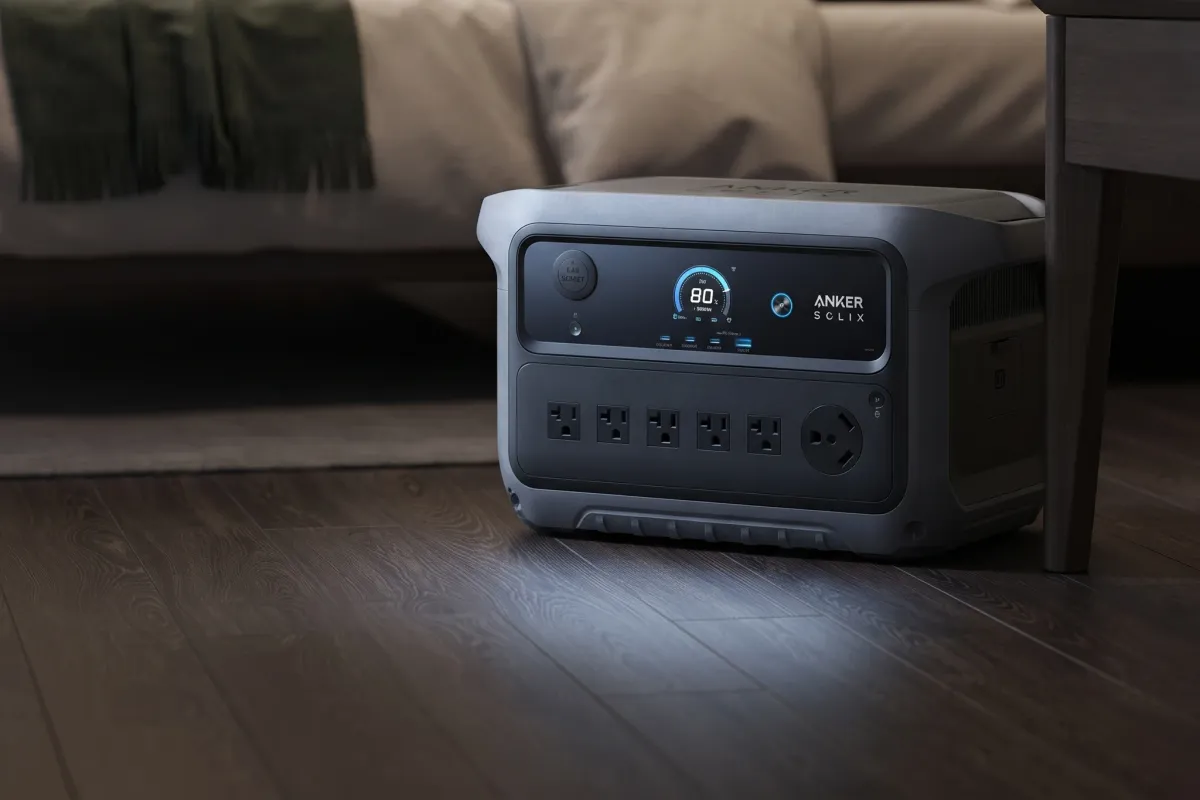
Anker's comparison table gives 30 dB with loads under 1,000 W, quiet enough for a bedroom or a home office. The fans get louder when it's charging at full speed or running near its 2,400 W limit.
How it compares: third among 2 kWh stations
The HomePower 2000 Plus V2 matches it and expands further; the F3000 and Apex 300 add output and solar
| Spec | Anker SOLIX C2000 Gen 2 | Jackery HomePower 2000 Plus v2 | Anker SOLIX F3000 |
|---|---|---|---|
| Capacity (Wh) | 2048 | 2048 | 3072 |
| AC output, continuous (W) | 2400 | 2400 | 3600 |
| AC charge time | 100% in 88 min at 1,800 W; 58 min with AC + solar (2,600 W) (Anker) | About 1.5 hours (Emergency Charging mode) | Under 3 h (Anker) |
| Max solar input (W) | 800 | 800 | 2400 |
| Weight (lb) | 41.7 | 41.5 | 91.5 |
| Warranty (years) | 5 | 3 + 2 with registration | 5 |
| Price | Check price | Check price | Check price |
- Jackery HomePower 2000 Plus V2 (7.8): the same 2,048 Wh, 2,400 W, 1,800 W wall input, 800 W solar and 10 ms switchover, at 41.5 lb. It expands to 12,288 Wh with up to five batteries against the C2000 Gen 2's 4 kWh, which is the whole difference in our scores. Its warranty is 3 years plus 2 with registration.
- Anker SOLIX F3000 (7.4): 3,072 Wh and 3,600 W with 2,400 W of solar and expansion to 12,288 Wh, but 91.5 lb, a 20 ms switchover and slower wall charging.
- Bluetti Apex 300 (8.7): the top-rated large station we cover: 2,764.8 Wh, 3,840 W at 120/240 V and 2,400 W of solar, at 83.8 lb.
- Bluetti Elite 200 V2 (6.4): 2,073.6 Wh and 2,600 W with 1,000 W of solar, but not expandable, a switchover of up to 15 ms and 53.4 lb.
- Anker SOLIX C1000 Gen 2 (8.0, mid-size): half the battery (1,024 Wh) and 2,000 W at 24.9 lb, with a 49-minute UltraFast charge by Anker's figure, but no expansion.
The C2000 Gen 2 scores full marks for switchover and battery life and nearly full for weight per kWh; it loses points for solar (3.2) and expansion (7). For brand-level comparisons, see Anker SOLIX vs Jackery and Anker SOLIX vs Bluetti.
Who should buy the Anker SOLIX C2000 Gen 2: home backup you can lift
Pick it for a fast-charging, liftable 2 kWh; pick the HomePower 2000 Plus V2 if you'll expand
Good fit: home backup for a fridge, router and lights through a day-long outage; RV and van trips with a 30-amp hookup; a home office that needs a 10 ms switchover; anyone who wants 2 kWh at about 42 lb and a 5-year warranty.
Look elsewhere if: you'll lean on solar (800 W is modest at this size), need more than about 4 kWh, or need 240 V. For home backup across sizes, see our best portable power stations for home backup.
FAQ
C2000 Gen 2 questions: worth it, lifespan, the C1000 Gen 2, the F3000, Bluetti and Jackery
Is the Anker SOLIX C2000 Gen 2 good?
Yes. It rates 7.5 by our method, with a 10 ms switchover, an 88-minute wall charge (Anker), a 4,000-cycle LiFePO4 battery and a 5-year warranty at 41.7 lb. Its limits are 800 W of solar and expansion to about 4 kWh.
How long does the Anker SOLIX C2000 Gen 2 last?
The battery is rated for 4,000 cycles to 80% capacity, far more than occasional backup use will reach. On one charge it runs a 67 W average fridge for about 23 hours by our estimate.
What's the difference between the C1000 Gen 2 and the C2000 Gen 2?
The C2000 Gen 2 has twice the battery (2,048 Wh vs 1,024 Wh), more output (2,400 W vs 2,000 W), more solar (800 W vs 600 W) and can add a battery, at 41.7 lb against 24.9 lb. The C1000 Gen 2 charges faster (49 minutes in UltraFast mode by Anker's figure) and is easier to carry.
C2000 Gen 2 or F3000?
The C2000 Gen 2 for a liftable 2 kWh with a 10 ms switchover; the F3000 for more capacity (3,072 Wh), 3,600 W, 2,400 W of solar and expansion to 12,288 Wh, at 91.5 lb on wheels.
Which is better, the Bluetti Elite 200 V2 or the Anker SOLIX C2000 Gen 2?
The C2000 Gen 2 in our ratings (7.5 vs 6.4): faster switchover (10 ms vs up to 15 ms), lighter (41.7 vs 53.4 lb) and expandable. The Elite 200 V2 takes more solar (1,000 W).
Anker SOLIX C2000 Gen 2 or Jackery HomePower 2000 Plus V2?
They match on 2,048 Wh, 2,400 W, 1,800 W wall charging, 800 W solar and a 10 ms switchover, and weigh 41.7 lb against 41.5 lb. The Jackery expands much further (12,288 Wh vs about 4 kWh) and rates higher (7.8 vs 7.5); the Anker has a straight 5-year warranty against Jackery's 3 years plus 2 with registration. See Anker SOLIX vs Jackery.
Can the C2000 Gen 2 add a battery?
Yes, one Anker SOLIX BP2000 (Gen 2) of 2,048 Wh, for about 4 kWh in total.
Can it run a house?
It can run selected appliances or circuits through a transfer switch installed by an electrician, at 120 V and up to 2,400 W. It can't run 240 V appliances or a whole house.