 By
We may earn a commission if you buy through links on this page, at no extra cost to you. This never affects which products we recommend. How we make money.
On this page 8 sections
Our verdict · Bluetti
A bit more battery than most 1 kWh stations, with a 5-year warranty
Gives you about 12% more capacity than the usual 1,024 Wh station, charges to 80% in under an hour and carries a 5-year warranty. In return it's heavier, slower on solar and switches over in 20 ms rather than 10.
- Capacity
- 1,152 Wh
- AC output
- 1,800 W
- Wall charge
- 80% in 45 min
- Weight
- 35.3 lb
Best for
Essentials backup and camping where a little extra capacity and a long warranty matter more than the fastest charging or the lightest unit.
Skip it if
You need a sub-10 ms UPS for a desktop PC, want 2,000 W output, or will carry it often.
- 1,152 Wh LiFePO4, 3,500+ cycles
- 0–80% from the wall in about 45 minutes
- Wireless charging pad on top
- 5-year warranty
- 35.3 lb, heavier than rivals
- 20 ms UPS switchover
- 500 W solar input
- Only one USB-C port (100 W)
Rating breakdown (mid-size (1 to 1.5 kwh) class)
| Criterion | Weight | Score | Based on |
|---|---|---|---|
| Wall charging speed | 20% | 7.9 | 1,440 W input |
| AC output | 20% | 6.3 | 1,800 W |
| Solar input | 10% | 3.9 | 500 W |
| Backup switchover | 15% | 6.0 | 20 ms |
| Portability | 10% | 5.1 | 33 Wh/lb |
| Expandability | 10% | 4.0 | 1,958 Wh with B80 (Power Bank Mode) |
| Battery life & warranty | 15% | 9.0 | 5-year warranty, 3,500+ cycles |
| Capacity (Wh) | 1152 |
|---|---|
| Battery chemistry | LiFePO4 |
| Rated cycle life | 3,500+ cycles |
| AC output, continuous (W) | 1800 |
| AC output, surge (W) | — |
| AC charge time | 80% in 45 min |
| Max AC charging input (W) | 1440 |
| Max solar input (W) | 500 |
| Solar input voltage range | 12–60 V |
| UPS switchover (ms) | 20 |
| Weight (lb) | 35.3 |
| Expandable to (Wh) | 1,958 Wh with B80 (Power Bank Mode) |
| Warranty (years) | 5 |
Key specs at a glance
What the numbers mean in practice
- 1,152 Wh capacity: a little more than most 1 kWh stations. Enough to keep a fridge and router going through the night, or a CPAP for two nights on DC.
- 1,800 W continuous, 2,700 W Power Lifting: runs most single kitchen appliances (coffee maker, microwave, kettle), but not several at once.
- LiFePO4, 3,500+ cycles to 80%: the long-life chemistry. See LiFePO4 vs lithium-ion.
- 35.3 lb: heavier than most rivals; it's best for setups where it mostly stays put.
- Expandable to 1,958 Wh with a Bluetti B80 battery (806 Wh) through Power Bank Mode.
Spec sheets are easy to misread; watts vs watt-hours explains which number answers which question.
Charging speed
Fast to 80%
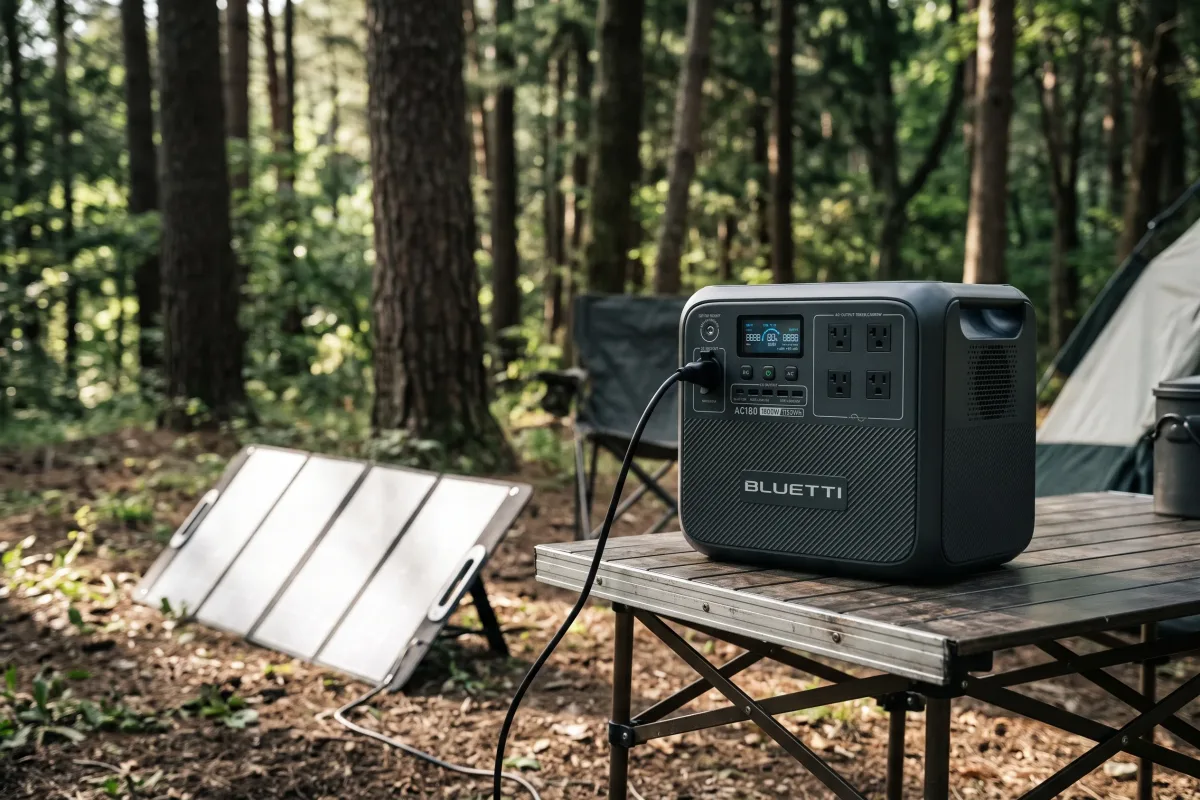
The AC180 takes 1,440 W from the wall and goes from 0 to 80% in about 45 minutes. The last 20% is slower, so plan on a bit over an hour for a full charge. That matters most when you get a short window of grid power during a long outage.
It also accepts up to 500 W of solar through one input (12–60 V), roughly 2.5–3 hours to full in strong sun with enough panels.
Capacity and real runtime
How long it actually keeps things running
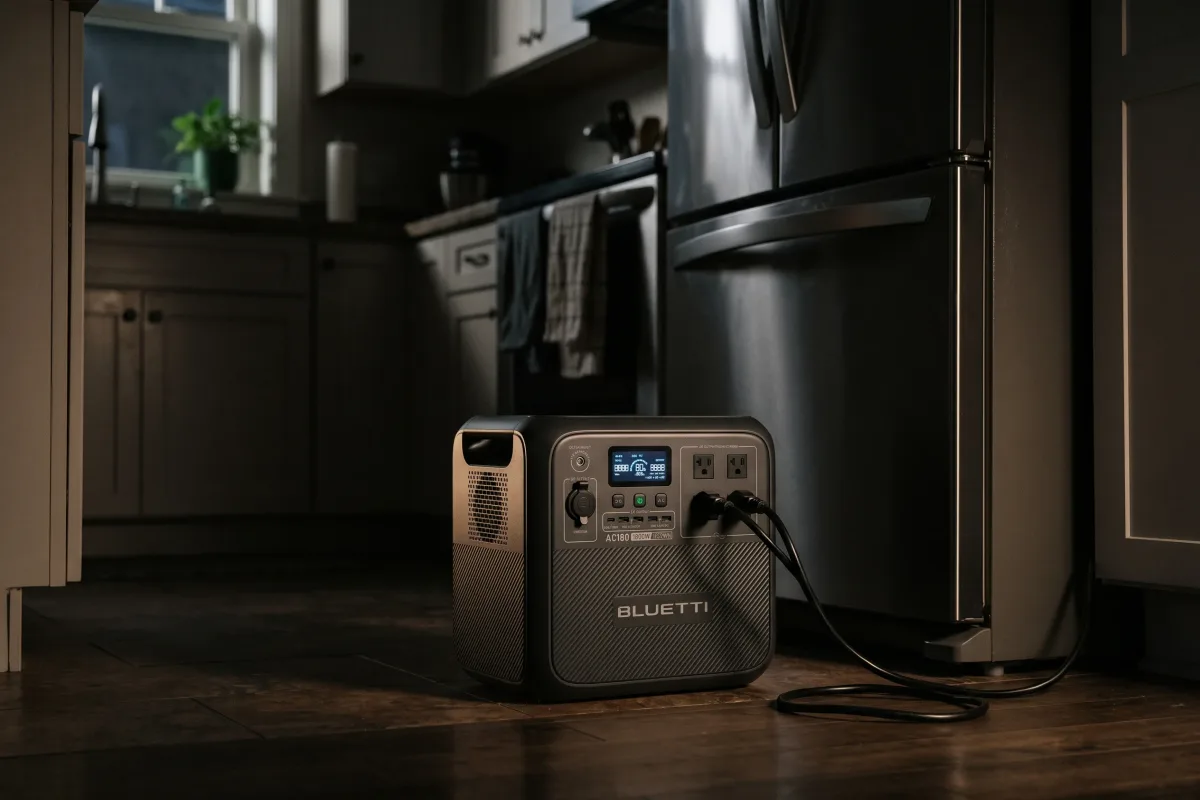
Estimated runtimes on the AC180
- CPAP, no humidifier, DC cord30 h
- CPAP with humidifier, AC13 h
- Fridge + Wi-Fi router12 h
A fridge and router running through the night is realistic; a full day of fridge backup needs either a B80 battery or some solar. Try your own devices in the runtime calculator.
Output: what it can and can't run
Solid for one appliance at a time
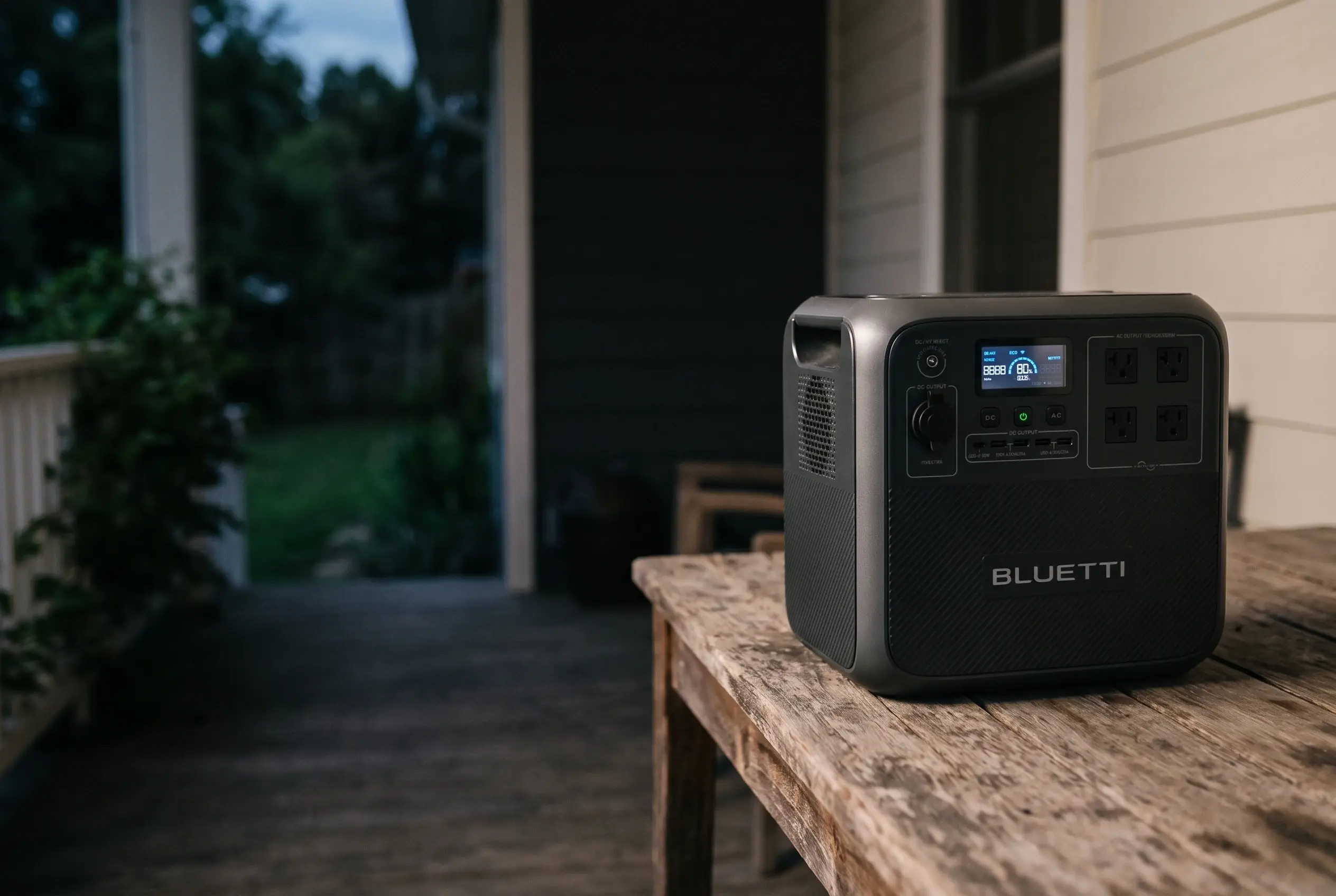
The 1,800 W continuous rating covers most single household appliances across its 4 AC outlets. Power Lifting Mode lets simple heating appliances, like kettles and hair dryers, run at up to 2,700 W by lowering their power, which isn't the same as extra continuous output. For small devices there's one 100 W USB-C port, two USB-A ports, a 12 V car socket and a 15 W wireless charging pad on top.
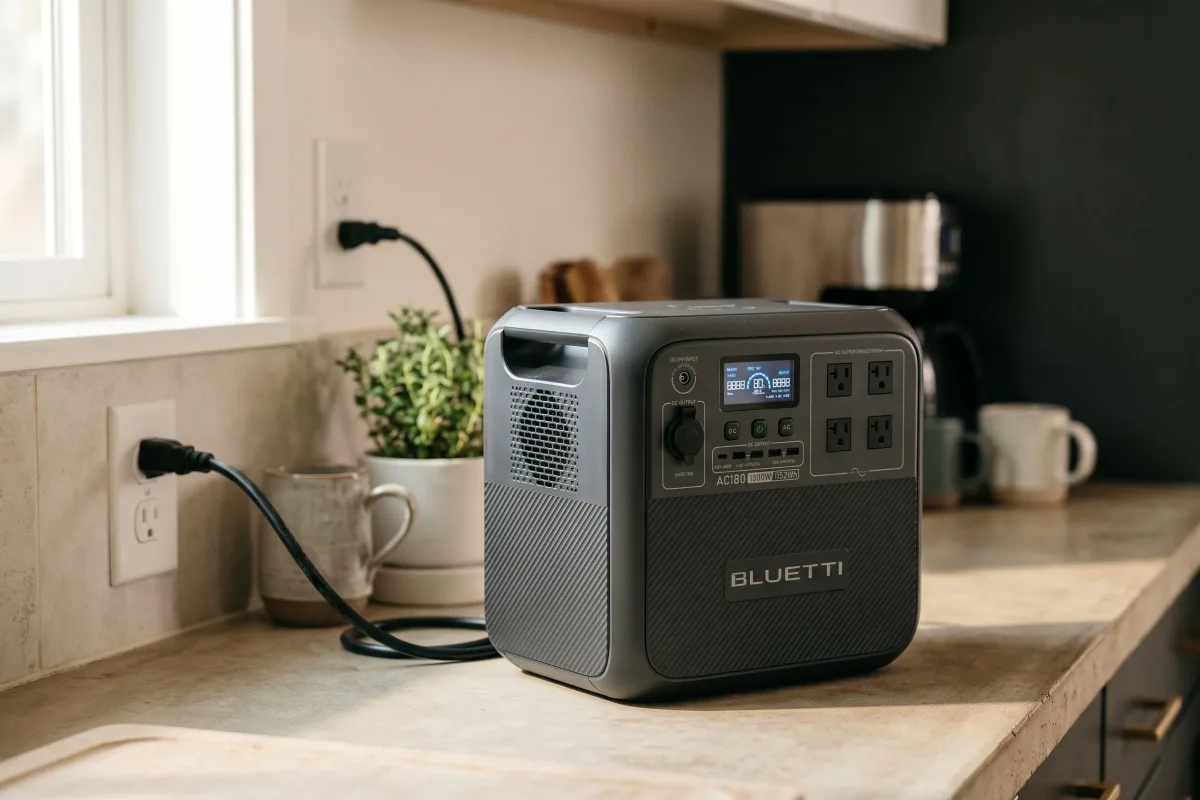
What it won't do well: run a microwave and a coffee maker together, power a space heater for long, or start larger motors like well pumps. Some competitors in this size class, such as the Anker SOLIX C1000 Gen 2, offer 2,000 W continuous.
Backup (UPS) and app
Fine for routers, test your PC
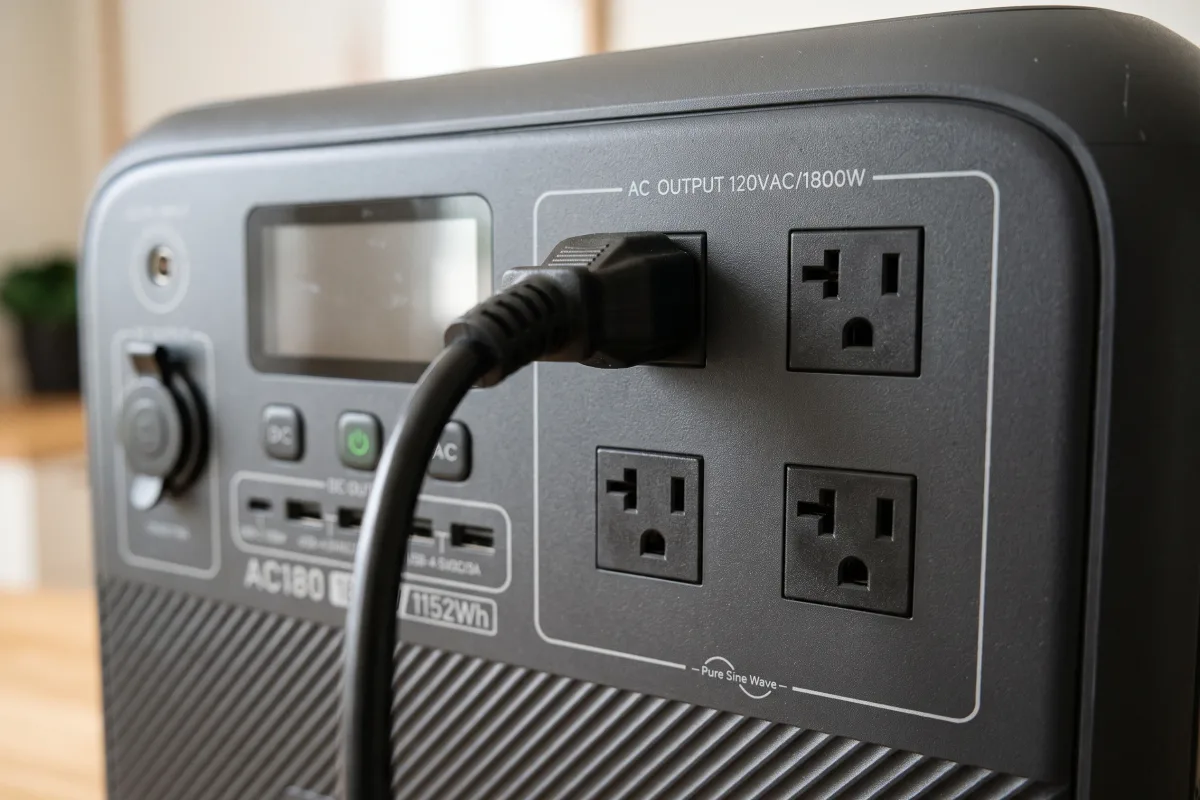
The AC180 switches to battery in 20 ms when the grid drops. That keeps routers, modems, lights and laptops running, but some desktop PCs may restart, so test yours before relying on it. Our guide to using a power station as a UPS explains why. The Bluetti app (Bluetooth) lets you monitor output and change charging settings from your phone.
How it compares
Against similar 1 kWh stations
| Spec | Bluetti AC180 | Anker SOLIX C1000 Gen 2 | EcoFlow Delta 3 Plus |
|---|---|---|---|
| Capacity (Wh) | 1152 | 1024 | 1024 |
| AC output, continuous (W) | 1800 | 2000 | 1800 |
| AC charge time | 80% in 45 min | 49 min (UltraFast) | 56 min |
| Max solar input (W) | 500 | 600 | 1000 |
| Weight (lb) | 35.3 | 24.9 | 27.6 |
| Warranty (years) | 5 | 5 | 5 |
| Price | Check price | Check price | Check price |
- Anker SOLIX C1000 Gen 2: less capacity (1,024 Wh), but 2,000 W output, a 10 ms switchover, 600 W solar and about 10 lb lighter. Not expandable.
- EcoFlow Delta 3 Plus: less capacity (1,024 Wh) and the same 1,800 W, but a faster full charge, 1,000 W solar and expandable to 5 kWh.
The AC180's edge is the extra capacity and the 5-year warranty. For the brands overall, see EcoFlow vs Bluetti.
Who should buy it
And who should look elsewhere
Good fit: essentials backup (fridge, router, lights, CPAP); car camping where the unit mostly stays put; anyone who values a long warranty and a little more battery.
Look elsewhere if: you need a sub-10 ms switchover for a desktop PC, want the lightest unit for its capacity (the Jackery Explorer 1000 v2 is 23.8 lb), or expect to add a lot of capacity later (the EcoFlow Delta 3 Plus expands to 5 kWh).
In our buying guides, the AC180 is most capacity in a mid-size unit in Best Value Portable Power Stations.
FAQ
Quick answers to common questions
How long will the AC180 run a refrigerator?
About 12 hours for a typical fridge plus a router, or a little longer for the fridge alone. Real results depend on your fridge's average draw.
Can the AC180 be used as a UPS?
Yes. It switches over in 20 ms, fine for routers, lights and laptops. Test a desktop PC before relying on it.
Is the AC180 expandable?
Partly. A B80 battery (806 Wh) recharges it through Power Bank Mode, for 1,958 Wh in total.
Is it LiFePO4?
Yes: it uses LiFePO4 (LFP) cells rated for 3,500+ cycles to 80% capacity.