 By
We may earn a commission if you buy through links on this page, at no extra cost to you. This never affects which products we recommend. How we make money.
On this page 8 sections
Our verdict · EcoFlow
A 4 kWh home station with 120 V and 240 V from one unit and room to grow to 48 kWh
The DELTA Pro 3 fixes the original DELTA Pro's biggest gap: it gives 240 V from a single unit. It suits whole-home backup through a transfer switch, but its 4,000 W output is lower than its main rivals.
- Capacity
- 4,096 Wh
- AC output
- 4,000 W
- Wall charge
- 0–80% in about 50 min
- Weight
- 113.5 lb
Best for
Home backup of selected circuits, including 240 V ones, with a transfer switch, and owners who want to add batteries later.
Skip it if
You want something portable, or need more than 4,000 W at once.
- 4,096 Wh LiFePO4, 4,000 cycles to 80%
- 120 V and 240 V from a single unit
- 10 ms switchover
- 2,600 W solar input
- Expands to 48 kWh
- 4,000 W output, below the Explorer 5000 Plus and F3800 Plus
- About 113.5 lb
- EcoFlow doesn't state AC input watts or a surge rating
Rating breakdown (whole-home (3.5 kwh and up) class)
| Criterion | Weight | Score | Based on |
|---|---|---|---|
| Wall charging speed | 20% | 3.0 | input not stated |
| AC output | 20% | 3.3 | 4,000 W |
| Solar input | 10% | 7.2 | 2,600 W |
| Backup switchover | 15% | 10.0 | 10 ms |
| Portability | 10% | 10.0 | 36 Wh/lb |
| Expandability | 10% | 10.0 | to 48,000 Wh |
| Battery life & warranty | 15% | 10.0 | 5-year warranty, 4,000+ cycles |
| Capacity (Wh) | 4096 |
|---|---|
| Battery chemistry | LiFePO4 |
| Rated cycle life | 4,000 cycles to 80% |
| AC output, continuous (W) | 4000 |
| AC output, surge (W) | — |
| AC charge time | 0–80% in about 50 min (input not stated) |
| Max AC charging input (W) | — |
| Max solar input (W) | 2600 |
| Solar input voltage range | — |
| UPS switchover (ms) | 10 |
| Weight (lb) | 113.5 |
| Expandable to (Wh) | 48000 |
| Warranty (years) | 3 + 2 with app registration |
Key specs at a glance
What the numbers mean in practice
- 4,096 Wh capacity: about two days of a fridge and router.
- 4,000 W at 120 V and 240 V: runs large appliances and 240 V loads, a few at a time. X-Boost runs some heating devices up to 6,000 W at reduced power.
- LiFePO4, 4,000 cycles to 80%: see LiFePO4 vs lithium-ion.
- About 113.5 lb: it rolls on wheels and is meant to stay in one place.
- Expandable to 48 kWh with extra batteries.
- Warranty: 3 years, plus 2 with app registration.
Spec sheets are easy to misread; watts vs watt-hours explains which number answers which question.
Charging speed
0–80% in about 50 minutes
EcoFlow quotes 0–80% in about 50 minutes, but doesn't state the wall input watts or which charging setup that figure needs.
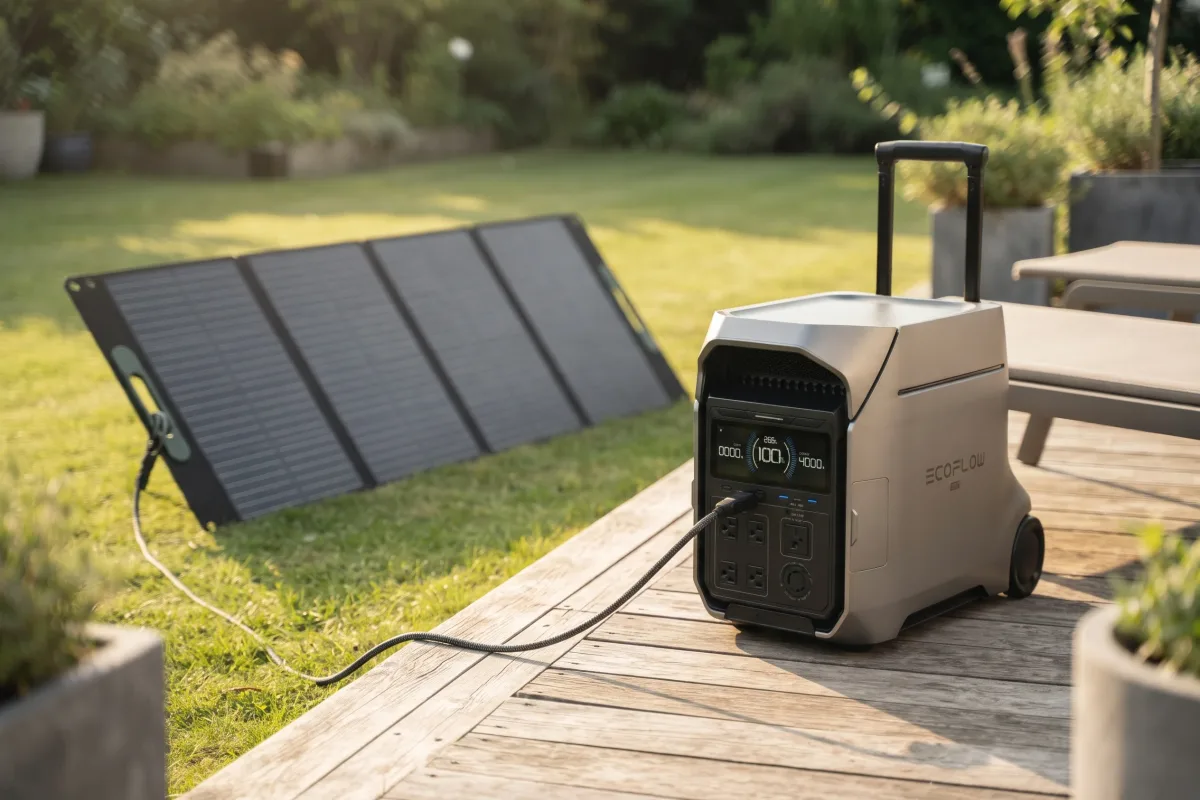
It takes up to 2,600 W of solar, among the highest of the stations we've reviewed. See solar panel sizing.
Capacity and real runtime
About two days of essentials
Estimated runtimes on the DELTA Pro 3
- CPAP, no humidifier, DC cord4.5 days
- CPAP with humidifier, AC44 h
- Fridge + Wi-Fi router44 h
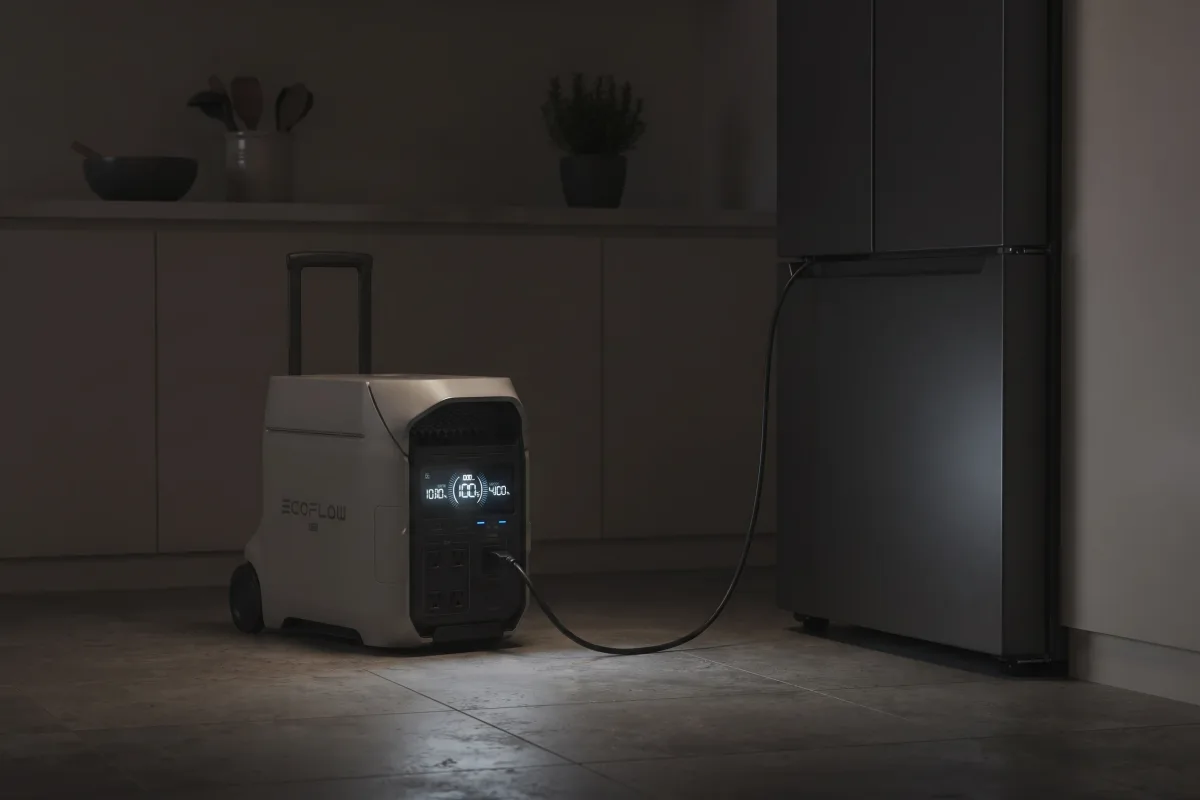
A fridge and router run for nearly two days. Large loads such as central air drain it much faster. Try the runtime calculator, and see how long a power station runs a refrigerator.
Output: what it can and can't run
4,000 W at 120 V and 240 V
A single unit supplies both 120 V and 240 V, up to 4,000 W combined, including while it's charging. That covers a fridge, freezer, lights and 240 V loads, as long as the total stays under 4,000 W.
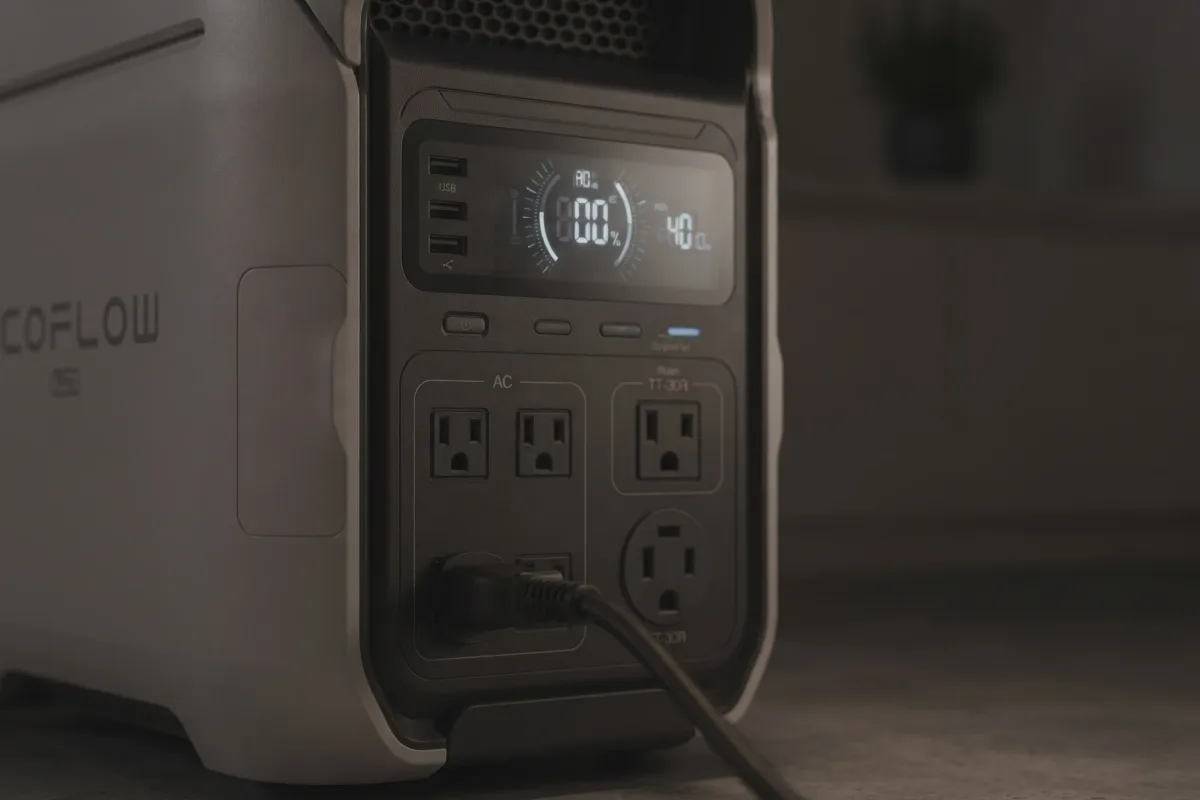
It won't run several large appliances at once. EcoFlow doesn't publish a surge rating, so check startup loads such as well pumps against its output.
Backup (UPS) and app
10 ms switchover
Plugged into the grid, it switches to battery in 10 ms, fast enough for most computers. With a transfer switch installed by a licensed electrician, it can take over selected home circuits; see our transfer switch for a portable power station guide. See using a power station as a UPS.
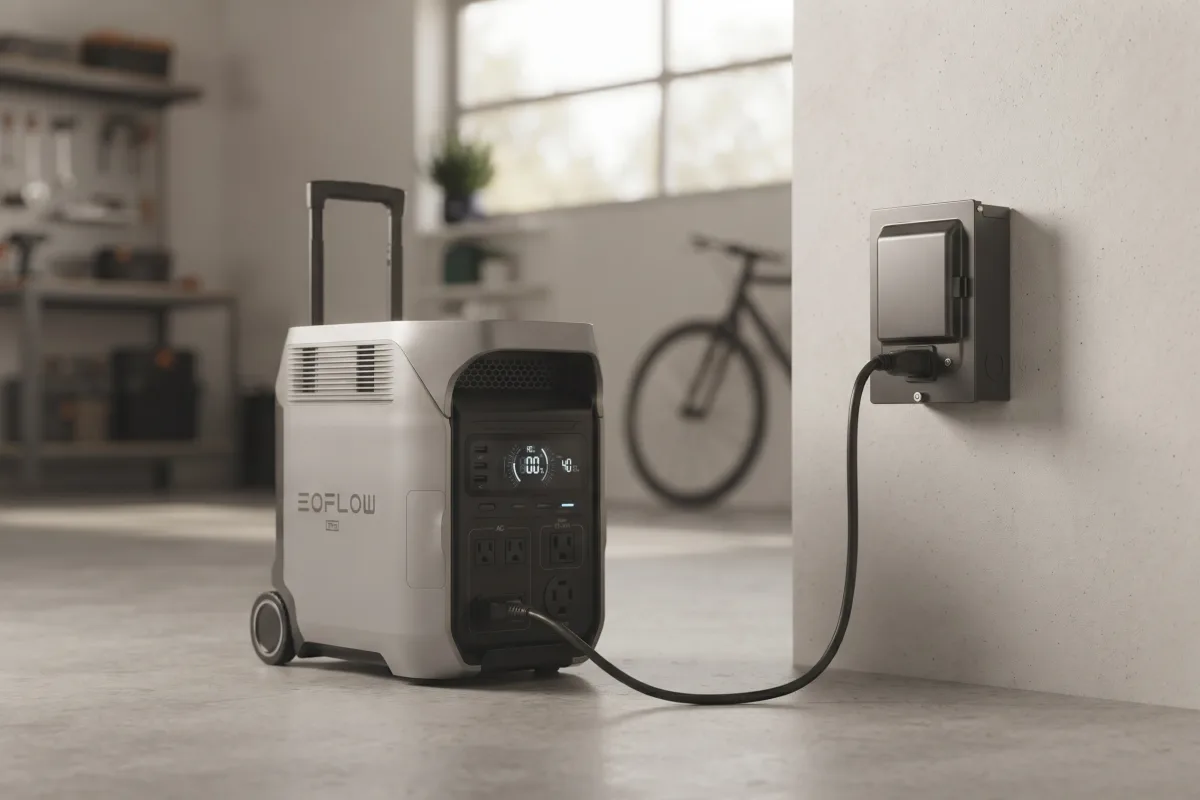
It works with the EcoFlow app over Wi-Fi and Bluetooth.
How it compares
Against other home backup stations
| Spec | EcoFlow Delta Pro 3 | Jackery Explorer 5000 Plus | Anker SOLIX F3800 Plus |
|---|---|---|---|
| Capacity (Wh) | 4096 | 5040 | 3840 |
| AC output, continuous (W) | 4000 | 7200 | 6000 |
| AC charge time | 0–80% in about 50 min (input not stated) | 1.7 hr (fastest mode, per Jackery) | — |
| Max solar input (W) | 2600 | 4000 | 3200 |
| Weight (lb) | 113.5 | 134.5 | 136.7 |
| Warranty (years) | 3 + 2 with app registration | 5 + 2 optional | 5 |
| Price | Check price | Check price | Check price |
- EcoFlow DELTA Pro: the original, with 3,600 Wh and 3,600 W but 120 V only from one unit.
- Jackery Explorer 5000 Plus: more capacity (5,040 Wh) and output (7,200 W), with 0 ms switchover.
- Anker SOLIX F3800 Plus: 6,000 W at 120/240 V and expansion to 53.8 kWh, but a 20 ms switchover.
- Anker SOLIX S5000: 5,024 Wh and 4,500 W at 120/240 V in 97 lb, with a 10 ms switchover and expansion to about 30 kWh.
- Bluetti Apex 300: 2,764.8 Wh and 3,840 W at 120/240 V in 83.8 lb, with expansion batteries for more capacity.
Who should buy it
And who should look elsewhere
Good fit: homeowners who want 240 V circuit backup from one unit, with strong solar input and room to add batteries.
Look elsewhere if: you need more than 4,000 W at once, where the Explorer 5000 Plus or F3800 Plus suit better, or only need a fridge and router through outages. See the best portable power stations for home backup.
In our buying guides, the Delta Pro 3 is best switchover with expansion in Best Whole-Home Battery Backup (Portable).
FAQ
What's the difference between the DELTA Pro and DELTA Pro 3?
The DELTA Pro 3 adds 240 V from one unit, a 10 ms switchover, more capacity (4,096 Wh) and more solar input (2,600 W).
Can the DELTA Pro 3 run 240 V appliances?
Yes, up to 4,000 W combined across its 120 V and 240 V output.
How long will the DELTA Pro 3 run a fridge?
About 44 hours for a fridge and router together.
How far can it expand?
Up to 48 kWh with extra batteries, according to EcoFlow.
Does it work as a UPS?
Yes. EcoFlow rates its switchover at 10 ms.