
 By
We may earn a commission if you buy through links on this page, at no extra cost to you. This never affects which products we recommend. How we make money.
On this page 9 sections
Yes: you can charge a portable power station from your car, with the engine running. A 12 V socket delivers only about 100–120 W, so a 1 kWh station takes about 12 hours (Jackery's figure for the Explorer 1000 v2); an alternator charger wired to the car battery delivers 560–800 W and refills 1 kWh in about 1.3 to 2.5 hours, by EcoFlow's and Bluetti's figures. Small stations are the exception: Bluetti lists about 4.2 hours from a 12 V socket for the 288 Wh Elite 30 V2.
Three ways to charge a power station from a car: socket, 24 V or alternator
A 12 V socket gives about 120 W; a 24 V socket about 200 W on stations that accept it; an alternator charger up to 800 W.
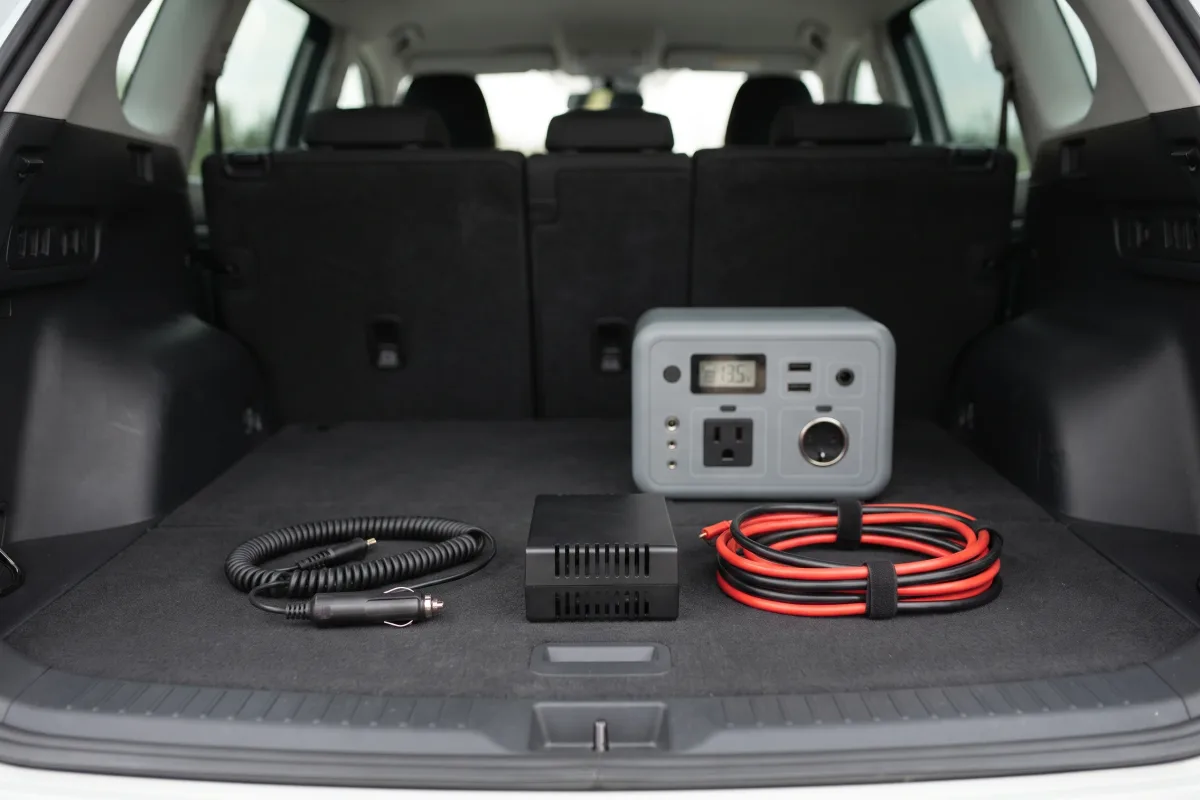
Most power stations we've reviewed come with or offer a car charging cable that plugs into the 12 V accessory socket (the old cigarette lighter). It works in any car, but it's slow. Trucks and some RVs have 24 V sockets that double the power on stations built for it. For real speed, an alternator charger (also called a DC-DC charger) wires straight to the car's starter battery and charges at several hundred watts.
| Method | Typical power | 1 kWh refill | Install |
|---|---|---|---|
| 12 V socket | about 100–120 W | about 12 h (Jackery, Explorer 1000 v2) | none |
| 24 V socket | about 200 W | about 6.3–6.8 h for 1,152 Wh (Bluetti AC180) | none |
| Alternator charger | 560–800 W | 1.3–2.5 h (EcoFlow, Bluetti) | wired to the battery |
| Solar at camp (400 W of panels) | about 300 W in full sun | about 3.4 h of full sun (our estimate) | none |
The solar row is our estimate at 75% of the panels' rating; solar works only while parked in the sun, but needs no fuel or engine time. Is an alternator charger worth it? If you drive most days and run a fridge or CPAP from a 1 kWh or larger station, yes: a socket can't keep up, while an alternator charger refills the battery in an hour or two of driving. For a compact station or occasional trips, the socket cable is enough.
How to charge a power station from a car socket, step by step
- Start the engine (or switch a hybrid or EV on).
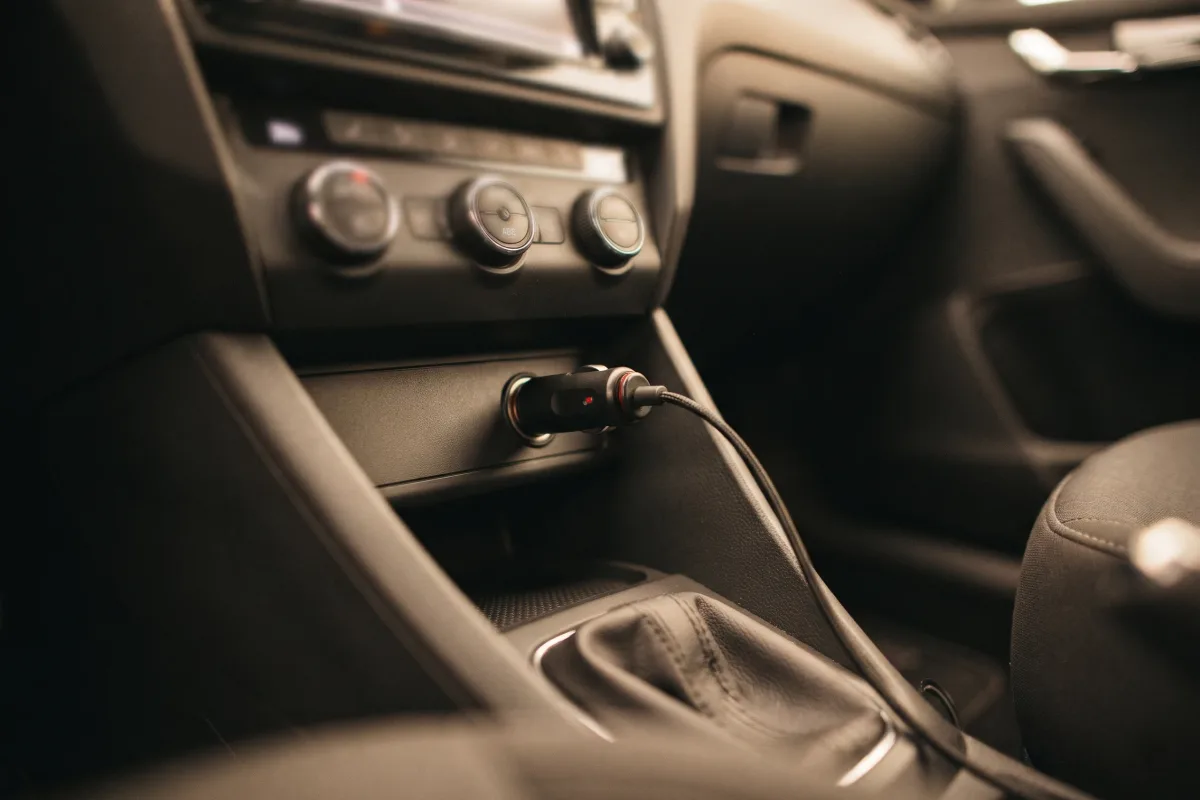
- Plug the maker's car cable into the 12 V socket and the station's car or DC input. The station end varies by model: Jackery uses a DC8020 input, Anker SOLIX models an XT60i input, Goal Zero an 8 mm input, so use the cable sold for your station.
- Check the input watts on the station's screen or app: about 100–120 W from a 12 V socket is normal.
- Secure the station so it can't slide when you brake, and keep it out of direct sun.
- Unplug before you switch off for a long stop, so nothing draws on the starter battery.
Our guide to charging a power station with solar covers the solar side of a road trip.
Car socket charging times by station: 4 hours to 2 days
Makers list about 4.2 hours for a 288 Wh station and about 12 hours for 1 kWh; Jackery lists 50.5 hours for its 5 kWh Explorer 5000 Plus.
These are the makers' own car-charging times and inputs, from a 12 V socket unless noted:
| Station (capacity) | Car input | Maker's time |
|---|---|---|
| Bluetti Elite 30 V2 (288 Wh) | 12 V 120 W / 24 V 240 W | 4.2 h / 2.2 h |
| EcoFlow River 3 Plus (286 Wh) | up to 220 W | 3.3 h at 220 W |
| Jackery Explorer 1000 v2 (1,024 Wh) | 12 V | about 12 h |
| Bluetti AC180 (1,152 Wh) | 12 V 100 W / 24 V 200 W | 12–12.5 h / 6.3–6.8 h |
| Goal Zero Yeti 1500 (1,505 Wh) | 12 V 10 A | 13.6 h |
| Anker SOLIX C2000 Gen 2 (2,048 Wh) | 100 W | 23 h |
| Jackery Explorer 5000 Plus (5,040 Wh) | 11–16 V 8 A | 50.5 h |
The River 3 Plus's 220 W needs a source that can supply it; a 10 A, 12 V socket gives about 120 W, so expect longer from one. On a 2 kWh or larger station, a socket can't refill the battery in a day of driving; it only slows the drain.
Why a 12 V car socket charges so slowly: a 10 A fuse
Toyota's manuals limit the socket to 12 V at 10 A, or 120 W, and stations cap their own car input near that.
A car's accessory socket sits on a small fused circuit. Toyota's owner's manuals limit it to accessories under 12 V and 10 A (120 W), and Kia's to under 10 A. Power stations match that: Jackery's car cable is rated 10 A at 12 V, the Explorer 1000 Plus limits car input to 11 A, and Anker lists 100 W car input for the SOLIX C2000 Gen 2.
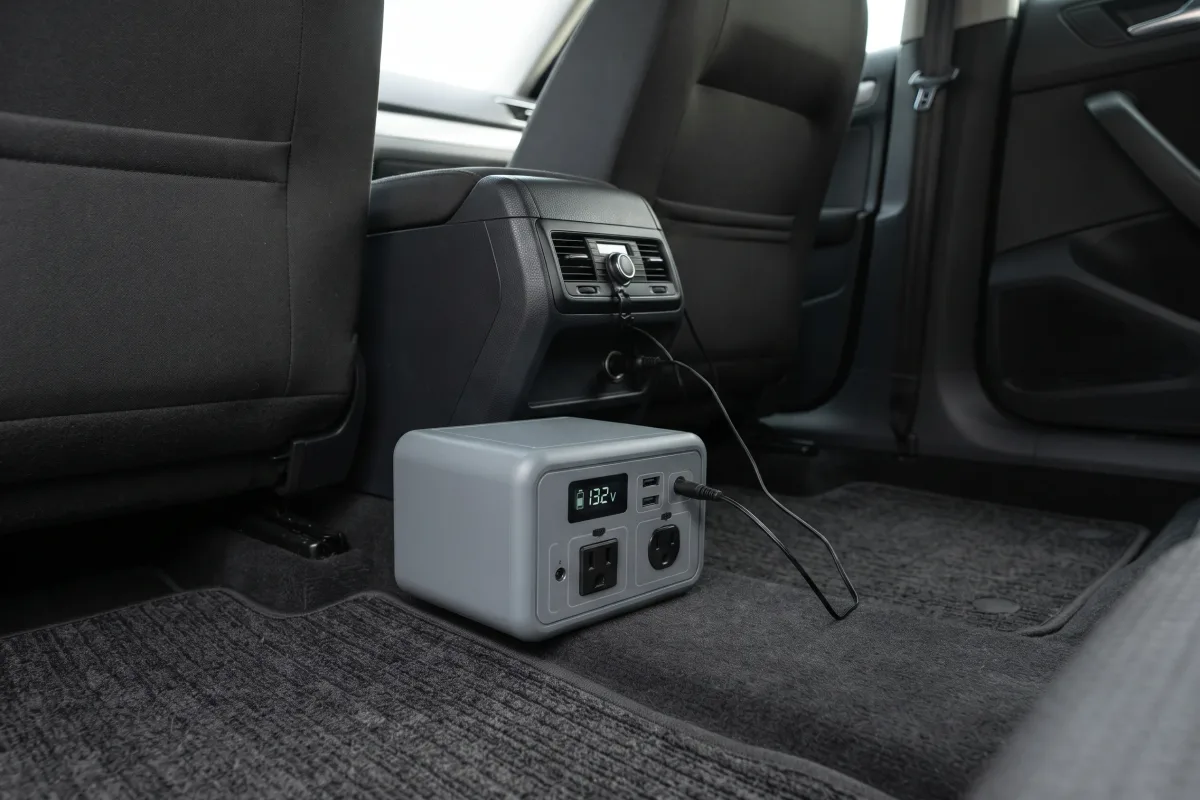
Losses add to the time. Jackery's 12 hours for 1,024 Wh works out to about 85 W reaching the battery on average, below the socket's 120 W: some power is lost in the cable and charging circuit, and charging slows as the battery nears full. Plugging a higher-current adapter into a 10 A socket doesn't help; it blows the car's fuse.
Inverter charging is worse. Charging through a small inverter in the socket, with the station's AC charger plugged into it, loses energy twice and still draws from the same 120 W socket. Use the maker's DC car cable.
Alternator chargers: 560 to 800 W while you drive
EcoFlow says its 800 W Alternator Charger tops up 1 kWh in about 1.3 hours; Bluetti says its 560 W Charger 1 fills 1 kWh in about 2.5.
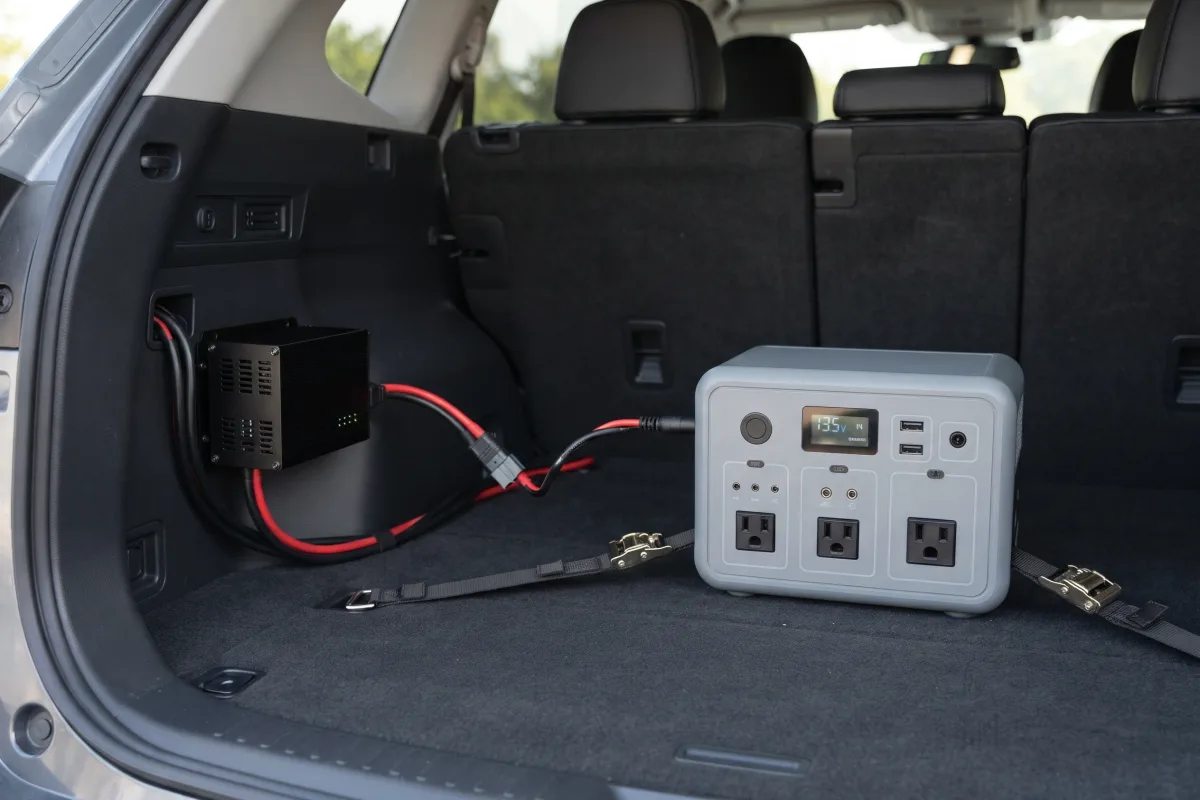
An alternator charger is a box wired to the starter battery with heavy cable, usually fitted in the cargo area. It draws from the alternator while the engine runs and feeds the station's high-power DC input.
| Charger | Output | Maker's claim | Works with |
|---|---|---|---|
| EcoFlow 800W Alternator Charger | 800 W | 1 kWh in about 1.3 h | all EcoFlow, most other brands |
| Anker SOLIX alternator charger | 800 W | C2000 Gen 2 in about 3 h | Anker SOLIX (XT60i input) |
| Jackery DC-DC alternator charger | 600 W | HomePower 2000 Plus v2 in about 3.8 h | Jackery HomePower 2000 Plus v2 |
| Bluetti Charger 1 | 560 W | 1 kWh in about 2.5 h | all Bluetti, most other brands |
- Installation: EcoFlow's charger connects to the starter battery with a cable run through the firewall; EcoFlow says handy owners can fit it but recommends a professional. Fusing and cable size matter at these currents, so if in doubt, have it fitted.
- Connectors: EcoFlow's charger feeds DELTA stations through an XT150 cable and other stations through an XT60 cable (some larger DELTA models need an adapter); Anker's feeds the SOLIX XT60i input.
- Battery protection: both EcoFlow and Bluetti list under-voltage protection so the charger stops before it drains the starter battery; Bluetti also lists short-circuit, reverse-connection and over-temperature protection.
- Reverse charging: EcoFlow's unit can also run the other way, letting the station recharge a flat starter or RV house battery at up to 800 W, or maintain it at 100 W.
- Real output depends on the car: the claimed times assume the full rated watts, which a small alternator or a car with heavy electrical loads may not deliver.
On the stations we've reviewed, EcoFlow lists the alternator charger for the EcoFlow Delta 3 Plus (1.3 hours) and Delta Pro 3; Jackery lists its 600 W unit for the Jackery HomePower 2000 Plus v2 (about 3.8 hours); and Anker its 800 W unit for the C2000 Gen 2 (about 3 hours).
Engine on or off: charge while the engine runs
Kia warns that using the socket with the vehicle off can drain the battery, and Toyota's Prius manual says the same for its 12 V battery.
Car makers are clear: use the socket with the engine (or hybrid system) running.

- Engine off: Kia's manual says to use the outlet only when the vehicle is on, because long use with it off can discharge the battery. Jackery notes that many cars cut the socket entirely when the ignition is off, so the station shows 0 W.
- Hybrids: Toyota's Prius manual says the outlet works only in ACCESSORY or ON mode and that using it with the hybrid system off can drain the 12 V battery. Bluetti says its alternator charger works with hybrids that have an alternator and a starter battery.
- Idling: idling counts as running, but Anker notes output is lower and less steady than when driving.
- Weak car battery: Jackery says a weak battery can drop the voltage below the station's minimum, so the station stops charging to protect both.
If the station won't charge from the car at all, our power station not charging guide walks through the car-charging checks.
24 V trucks and RVs: double the socket power
On a 24 V socket, Bluetti lists 240 W for the Elite 30 V2 and 200 W for the AC180, twice their 12 V figures.
Heavy trucks, some RVs and boats run 24 V systems. A station that accepts 24 V car input charges about twice as fast from them:
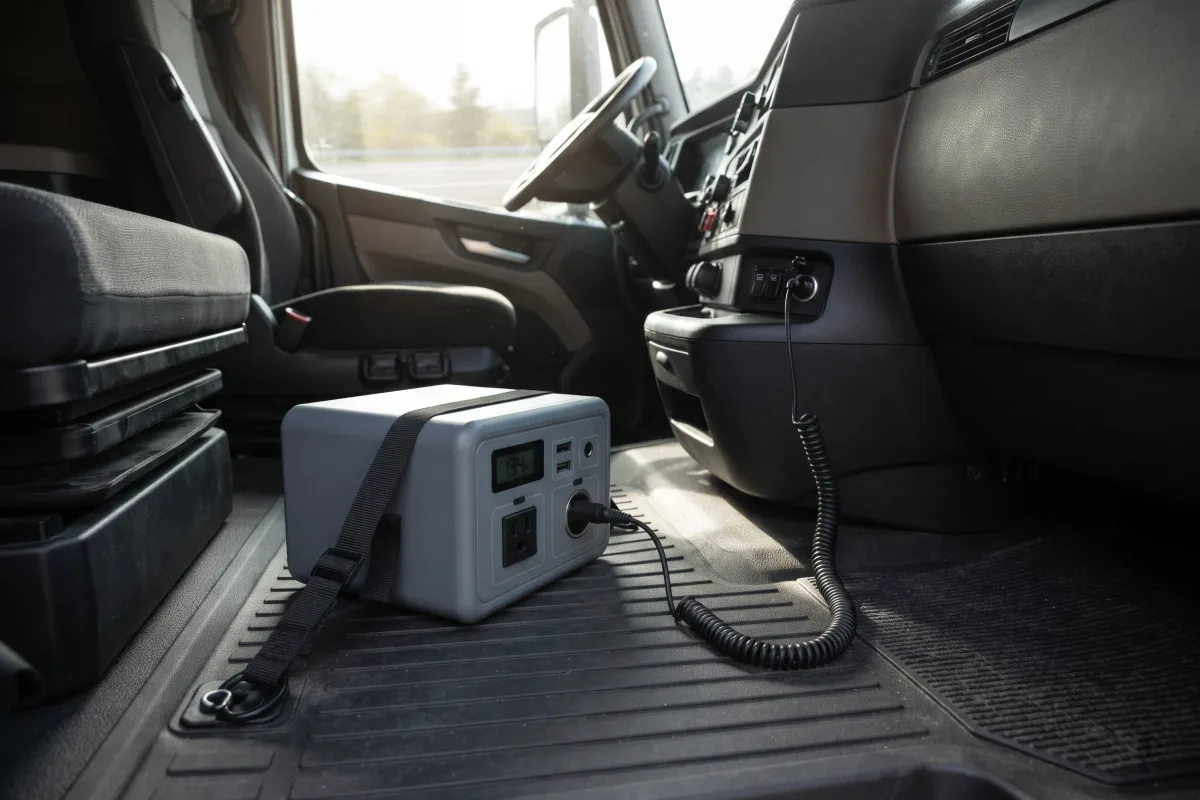
- Bluetti Elite 30 V2: 240 W at 24 V, about 2.2 hours, against 120 W and 4.2 hours at 12 V.
- Bluetti AC180: 200 W at 24 V, about 6.3–6.8 hours, against 12–12.5 hours at 12 V.
- Bluetti Elite 200 V2: 192 W at 24 V, 96 W at 12 V.
- EcoFlow River 3 and Delta Pro: car input listed at 12/24 V, 8 A.
Not every station accepts 24 V: Jackery's HomePower 2000 Plus v2 manual says it car-charges from 12 V vehicles only. Anker adds that 24 V isn't automatically faster, because the station's own car-input limit still applies. Check the manual before plugging into a 24 V socket.
Electric vehicles: charging a station from an EV, and the reverse
A power station can add only a few miles to an EV: the DOE puts Level 1 charging at about 5 miles per hour at 1.9 kW.
Charging a station from an EV. An EV's 12 V socket works like any car's, with the car switched on. Many EVs also have vehicle-to-load (V2L), a 120 V outlet or adapter powered by the main battery; Kia's manual limits its V2L to appliances under 16 A and stops it at the discharge limit you set. A station's AC charger plugs straight in, which is far faster than the 12 V socket.
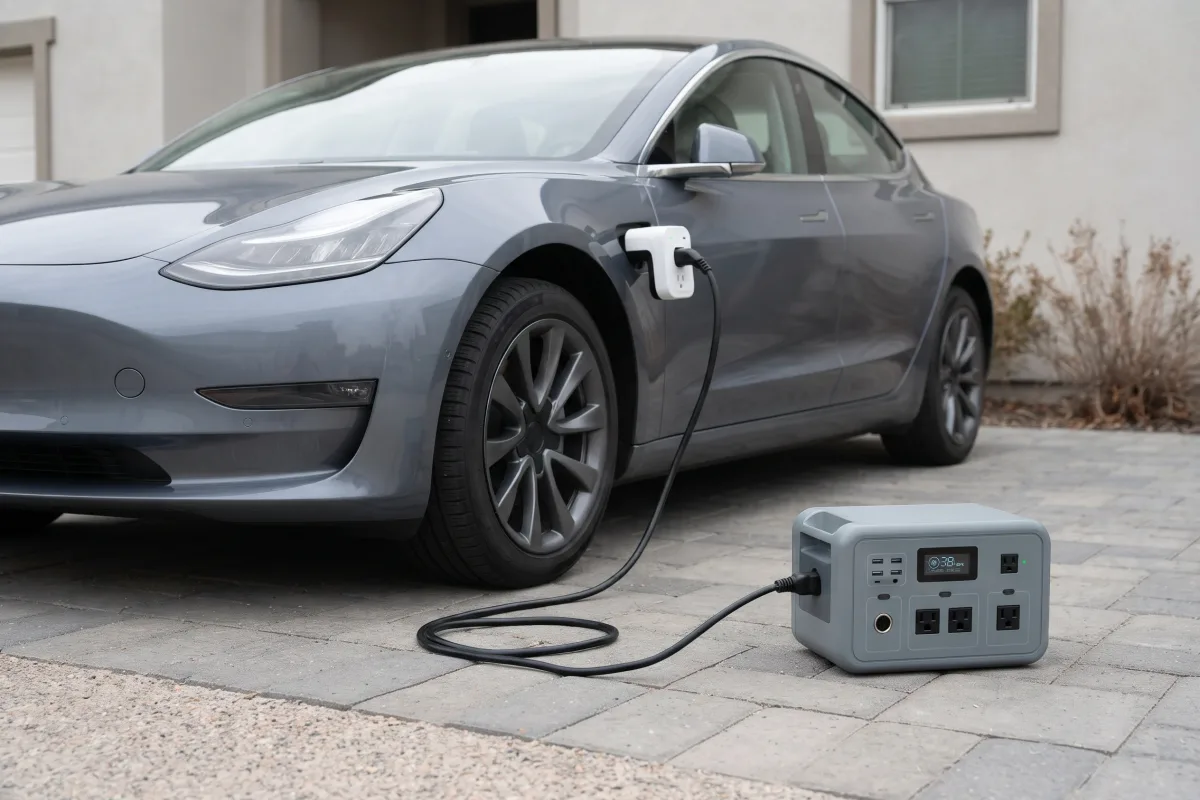
Charging an EV from a station. Possible, but it adds little. The US Department of Energy assumes 1.9 kW for Level 1 charging and about 5 miles of range per hour. A 1,024 Wh station delivers about 870 Wh on AC by our 85% estimate, which is roughly 2 miles of range, and its inverter must be able to supply the charger's full draw. It's an emergency trick for a few miles, not a way to charge an EV.
Planning car charging on a road trip: about 340 Wh per 4 hours on a socket
Four hours of driving on a 12 V socket refills about 340 Wh, by Jackery's 85 W average; an 800 W alternator charger refills 1 kWh in about 1.3 hours.
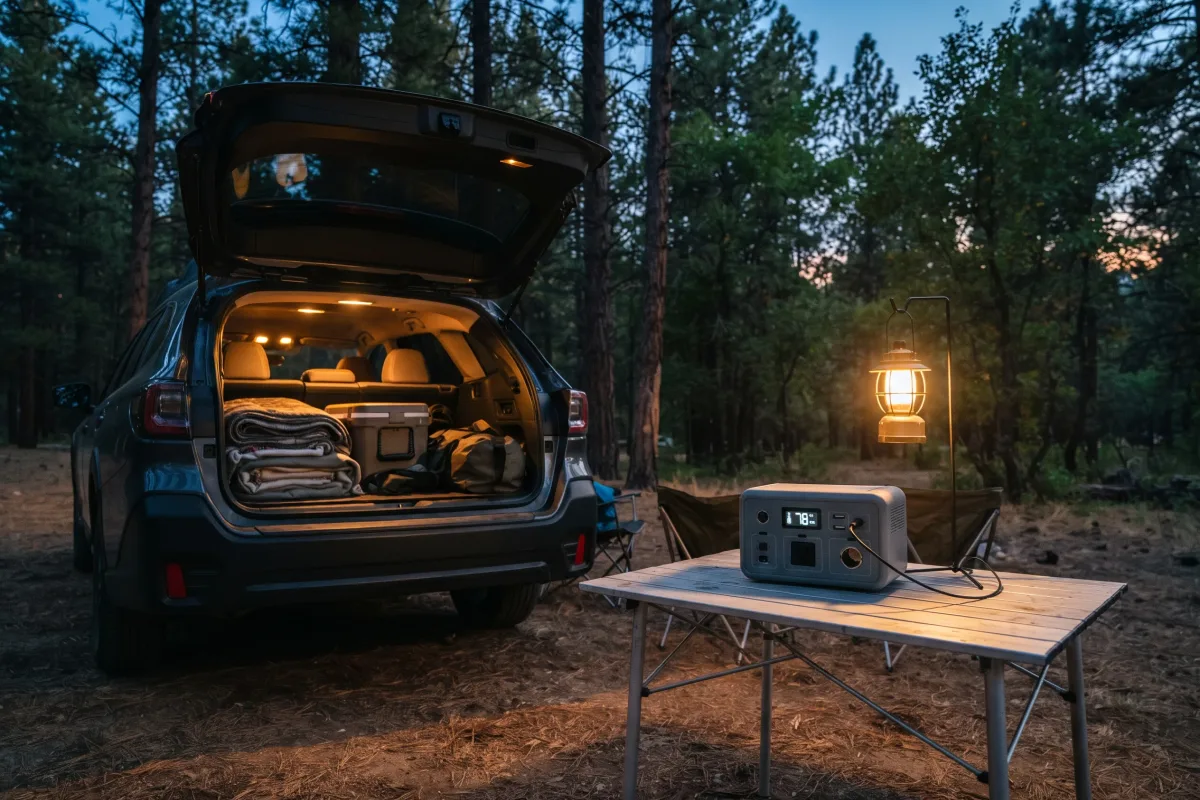
Work out what each day of driving puts back. By our estimates from the makers' times (Jackery's 12 hours for 1,024 Wh is about 85 W reaching the battery from a socket; its 600 W charger's 3.8 hours for 2,048 Wh is about 540 W; EcoFlow's 1.3 hours per kWh is about 770 W):
| Daily driving | 12 V socket (~85 W) | 600 W alternator charger | 800 W alternator charger |
|---|---|---|---|
| 1 hour | ~85 Wh | up to ~540 Wh | up to ~770 Wh (EcoFlow: 1 kWh in 1.3 h) |
| 4 hours | ~340 Wh | ~2,160 Wh (fills a 2 kWh station) | ~3,080 Wh (fills a 2 kWh station) |
The alternator-charger rows are our estimates from the makers' times: Jackery's 600 W unit fills the 2,048 Wh HomePower 2000 Plus v2 in about 3.8 hours, and EcoFlow's 800 W unit fills 1 kWh in about 1.3 hours. A compact station such as the Elite 30 V2 stays full on a socket alone. A 1 kWh station on a socket only keeps pace with light use, a fridge, CPAP or laptop at night; see how long a station runs a refrigerator or a CPAP. For camping and RV setups, compare our best portable power station for camping and best portable power station for RV picks. Adding solar at the campsite covers the rest; size panels with our solar panel sizing guide.
FAQ
Car sockets, alternator chargers, engine-off charging, Bluetti and EcoFlow: car-charging questions answered with makers' figures.
Can I charge a portable power station from my car?
Yes, from the 12 V socket with the engine running, using the maker's car cable. It's slow: about 12 hours for a 1 kWh station by Jackery's figure. An alternator charger is several times faster.
How long does it take to charge a power station in a car?
From a 12 V socket, about 4.2 hours for a 288 Wh Bluetti Elite 30 V2 and about 12 hours for a 1,024 Wh Jackery Explorer 1000 v2, by the makers' figures. With EcoFlow's 800 W alternator charger, about 1.3 hours per kWh.
Can I charge my EcoFlow with my car?
Yes. EcoFlow's stations list car input; the River 3 Plus up to 220 W. EcoFlow's 800W Alternator Charger works with all its stations (some larger DELTA models need an adapter cable) and tops up 1 kWh in about 1.3 hours.
Can you charge a Bluetti from a car?
Yes. The Elite 30 V2 takes 120 W at 12 V or 240 W at 24 V; the AC180 100 W or 200 W. Bluetti's 560 W Charger 1 fills a 1 kWh station in about 2.5 hours.
Can you charge a lithium battery from a car?
A power station's lithium battery, yes, through its own charge controller and the maker's car cable. Don't wire a bare lithium battery to a car's charging system without a DC-DC charger made for it.
Will charging a power station drain my car battery?
Not with the engine running. With it off, makers warn the starter battery can run flat; many cars cut the socket when the ignition is off, and alternator chargers list under-voltage protection.
Is it safe to charge a power station while driving?
Yes, with the maker's cable or a properly fitted alternator charger. Keep the station secured so it can't slide, and out of direct sun on a hot day.
Can a portable power station charge an electric car?
Only a few miles: a 1 kWh station adds roughly 2 miles of range by our estimate from the DOE's Level 1 figures.