 By
We may earn a commission if you buy through links on this page, at no extra cost to you. This never affects which products we recommend. How we make money.
On this page 9 sections
Choose EcoFlow for faster default charging, stronger solar input, a flat 5-year warranty and expansion on its 1 kWh model; choose Jackery for the lightest stations and the widest home-backup range, including 240 V. Both use LiFePO4 batteries throughout the models we've reviewed.
The short answer: EcoFlow vs Jackery
Depends on size and how you'll use it
- Choose EcoFlow for a 1 kWh station you might grow, charge from lots of solar or keep for years under a simple 5-year warranty.
- Choose Jackery if you'll carry it often, or you want a 2–5 kWh home station with a fast UPS or 240 V output.
EcoFlow vs Jackery at a glance
Based on the models we've reviewed
| Feature | EcoFlow | Jackery |
|---|---|---|
| Warranty | 5 years | 3 + 2 years (registration) |
| Cycle rating | 4,000 to 80% | 4,000 to 70% |
| 1 kWh wall charge | ~56 min | ~50 min (app mode) |
| 1 kWh solar input | 500–1,000 W | 400–800 W |
| UPS switchover | 10 ms | 10 ms (most models) |
| Largest reviewed | 4,096 Wh, 120/240 V (DELTA Pro 3) | 5,040 Wh, 120/240 V (Explorer 5000 Plus) |
Lineups compared
Where each brand has models
From EcoFlow we've reviewed the 286 Wh River 3 Plus, the 1 kWh Delta 3 and Delta 3 Plus, the 3.6 kWh DELTA Pro, which is 120 V from a single unit, and the 4 kWh DELTA Pro 3 with 120/240 V. Both expand to 5 kWh with EcoFlow extra batteries.
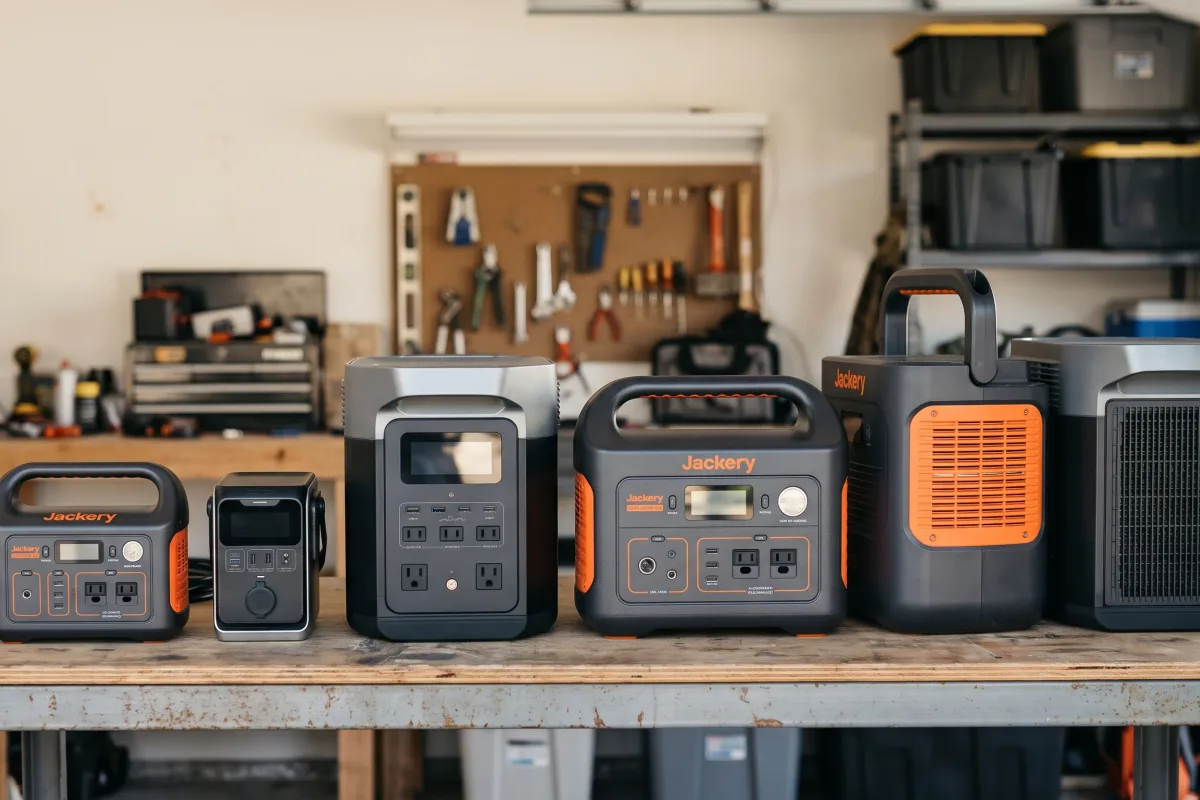
Jackery covers more sizes in our reviews: the small Explorer 300, the Explorer 1000 v2 and Explorer 1000 Plus, the 2 kWh HomePower 2000 Plus v2 the 3.6 kWh HomePower 3600 Pro Max and the 5 kWh Explorer 5000 Plus.
Charging and solar
EcoFlow charges faster by default and takes more sun
At 1 kWh, the Delta 3 Plus refills in about 56 minutes with no setting to change. The Explorer 1000 v2 can do it in about 50 minutes, but only with Emergency Super Charge switched on in the app; its standard mode takes about 1.6 hours.
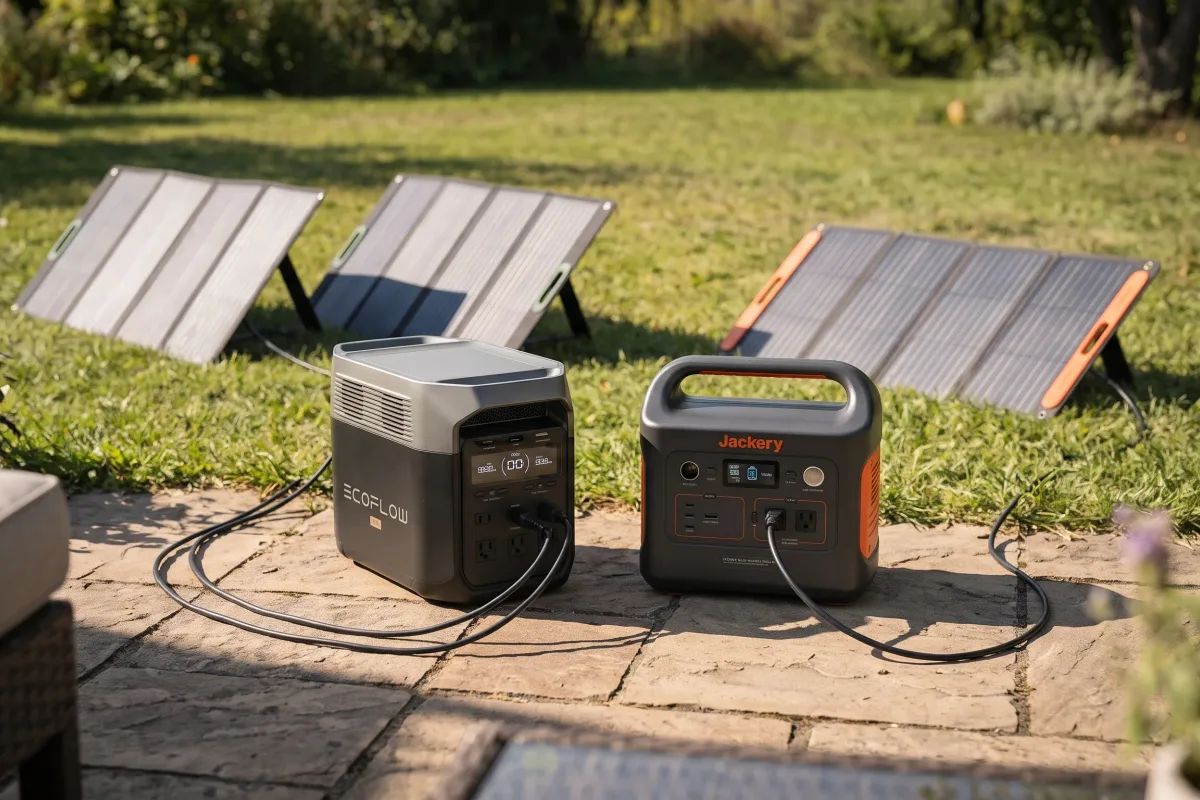
On solar, the Delta 3 Plus takes 1,000 W, the Explorer 1000 v2 400 W and the Explorer 1000 Plus 800 W. If you'll rely on panels, EcoFlow's 1 kWh model gets more from a sunny spell. See what size solar panel you need.
Backup (UPS) and expansion
Both fast; they expand at different sizes
Both brands' current models mostly switch over in about 10 ms, fast enough for computers and routers. The exception is the Explorer 1000 Plus, whose EPS mode has no published switchover time.
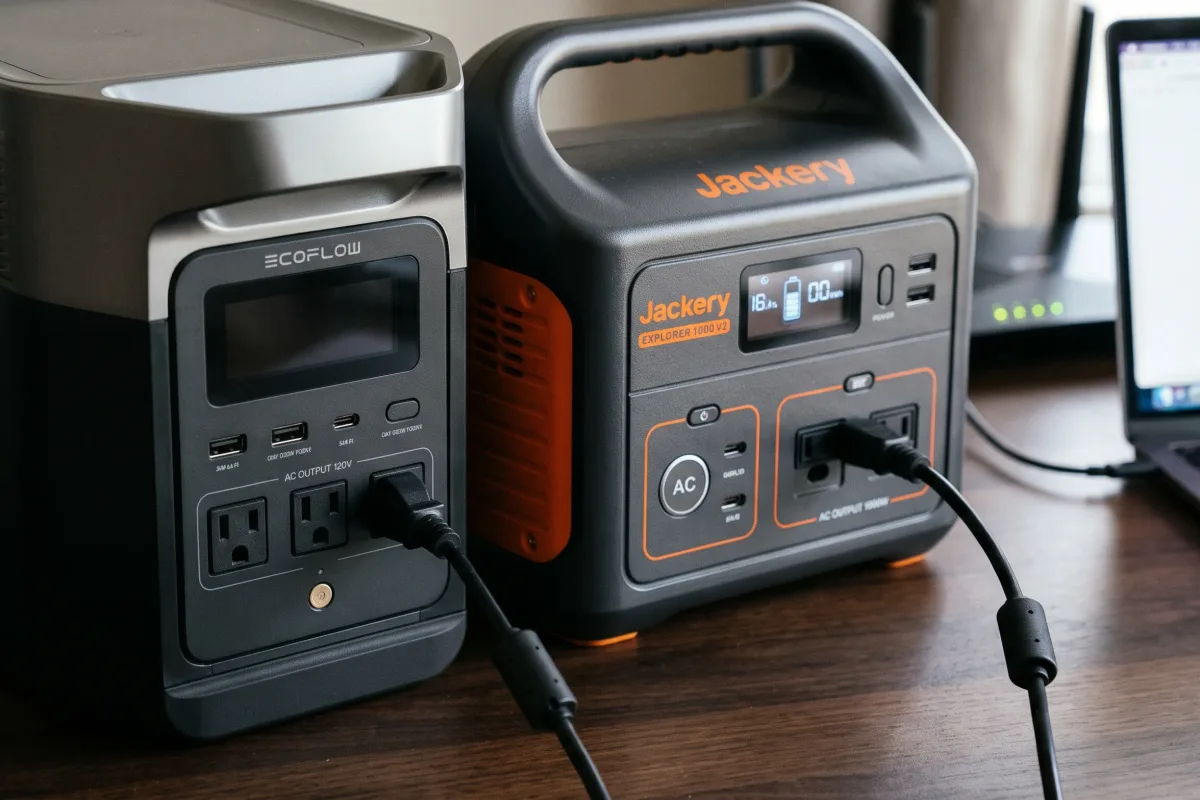
For expansion, EcoFlow's 1 kWh Delta 3 series grows to 5 kWh. Jackery's 1 kWh models don't expand (the 1000 Plus's add-on battery is no longer available), but its HomePower 2000 Plus v2 grows to about 12 kWh and the 3600 Pro Max to about 21.5 kWh, with 240 V output on the 3600 Pro Max.
Battery life and warranty
EcoFlow has the edge on paper
EcoFlow rates its batteries for 4,000 cycles to 80% capacity; Jackery rates the same number of cycles to 70%. Both use LiFePO4.
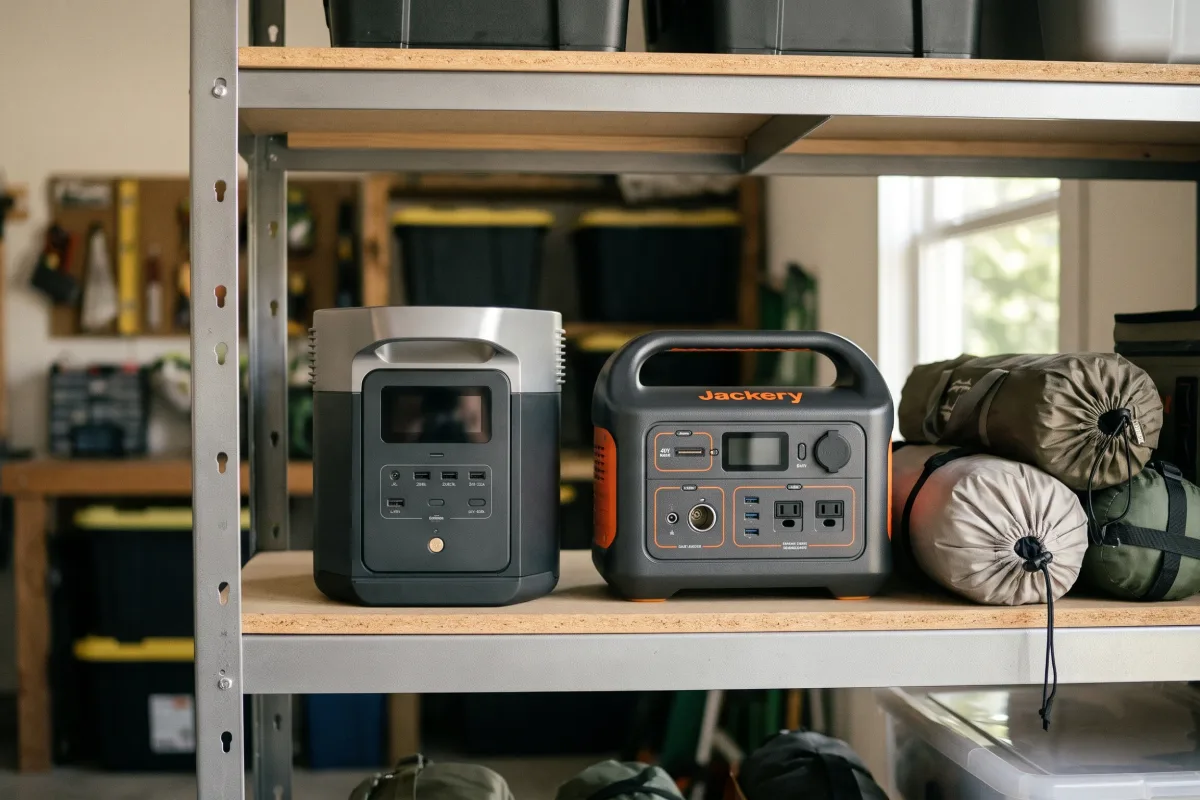
EcoFlow's warranty is a flat 5 years. Jackery's is 3 years, plus 2 more when you register, though the Amazon listing for the HomePower 3600 Pro Max shows 1 year.
Head-to-head: Delta 3 Plus vs Explorer 1000 v2
The closest pair at 1 kWh
| Spec | EcoFlow Delta 3 Plus | Jackery Explorer 1000 v2 |
|---|---|---|
| Capacity (Wh) | 1024 | 1024 |
| AC output, continuous (W) | 1800 | 1500 |
| AC charge time | 56 min | 50 min (Emergency, app) |
| Max solar input (W) | 1000 | 400 |
| Weight (lb) | 27.6 | 23.8 |
| Warranty (years) | 5 | 3 + 2 with registration |
| Price | Check price | Check price |
The Delta 3 Plus has more output, outlets and solar input and can expand; the Explorer 1000 v2 is about 4 lb lighter. Full detail: Delta 3 Plus vs Explorer 1000 v2.
Who should buy which
Matched to how you'll use it
- Home backup, room to grow at 1 kWh: EcoFlow Delta 3 Plus.
- Home backup at 2 kWh or more, or 240 V: Jackery HomePower 2000 Plus v2, HomePower 3600 Pro Max or Explorer 5000 Plus.
- Camping and travel: Jackery Explorer 1000 v2, the lighter 1 kWh option.
- Off-grid solar at 1 kWh: EcoFlow Delta 3 Plus.
Not sure what size you need? Add up your devices in the runtime calculator.
FAQ
Quick answers to common questions
Is EcoFlow better than Jackery?
Neither overall. EcoFlow leads on solar input, warranty and expansion at 1 kWh; Jackery leads on weight and offers larger home stations.
Which has the better warranty?
EcoFlow, with a flat 5 years. Jackery gives 3 years plus 2 with registration on most models.
Which is better for home backup?
For about 1 kWh, EcoFlow's Delta 3 Plus. For 2 kWh or more, or 240 V, Jackery's HomePower models.
Which charges faster?
EcoFlow by default (about 56 minutes). Jackery's Explorer 1000 v2 is slightly faster only with Emergency Super Charge on in the app.
Which is lighter?
Jackery. The Explorer 1000 v2 weighs 23.8 lb against 27.6 lb for the Delta 3 Plus.