 By
We may earn a commission if you buy through links on this page, at no extra cost to you. This never affects which products we recommend. How we make money.
On this page 9 sections
Our verdict · Bluetti
A 4 lb station for phones, a laptop and a router, not for appliances
The Elite 10 Mini is a power bank with an AC outlet: 128 Wh of LiFePO4 in 3.97 lb, quick to refill from the wall and quiet enough for a bedside table. It's a good fit for phones, a laptop, a router or a low-draw CPAP on DC, but 200 W and 128 Wh rule out kitchen appliances and long nights on AC.
- Capacity
- 128 Wh
- AC output
- 200 W
- Wall charge
- 80% in about 45 min
- Weight
- 3.97 lb
Best for
Travel, desks and short trips where you want a 200 W AC outlet and 100 W USB-C in a 3.97 lb box.
Skip it if
You need to run a fridge, a humidified CPAP through the night or anything over 200 W.
- 3.97 lb, the lightest station we've reviewed
- LiFePO4, 3,000+ cycles to 80%
- 80% in about 45 minutes on Turbo (Bluetti)
- 100 W USB-C and a 10 ms switchover
- 5-year warranty
- 128 Wh: about 2 hours of a 60 W laptop
- 200 W AC limit
- One AC outlet
- Not expandable
Rating breakdown (compact (under 1 kwh) class)
| Criterion | Weight | Score | Based on |
|---|---|---|---|
| Wall charging speed | 20% | 7.3 | 150 W input |
| AC output | 20% | 1.1 | 200 W |
| Solar input | 10% | 9.7 | 100 W |
| Portability | 25% | 4.9 | 32 Wh/lb |
| Battery life & warranty | 25% | 9.0 | 5-year warranty, 3,000+ cycles |
| Capacity (Wh) | 128 |
|---|---|
| Battery chemistry | LiFePO4 |
| Rated cycle life | 3,000+ cycles to 80% |
| AC output, continuous (W) | 200 |
| AC output, surge (W) | — |
| AC charge time | 80% in about 45 min (Turbo) |
| Max AC charging input (W) | 150 |
| Max solar input (W) | 100 |
| Solar input voltage range | 12–28 V, 8.2 A |
| UPS switchover (ms) | ≤10 |
| Weight (lb) | 3.97 |
| Expandable to (Wh) | Not expandable |
| Warranty (years) | 5 |
Key specs at a glance: 128 Wh, 200 W and 3.97 lb of LiFePO4
At 3.97 lb it's the lightest station we've reviewed, and 128 Wh is the smallest battery too.
- 128 Wh capacity: about a third of a typical 288 Wh compact station. Enough for a laptop recharge or two, a router for most of a night, or a low-draw CPAP for about a night on DC by our estimate.
- 200 W continuous, 400 W Power Lifting: one AC outlet for small devices. Power Lifting runs resistive loads rated 200 to 400 W at reduced power; actual output stays 200 W.
- LiFePO4, 3,000+ cycles to 80%: the long-life chemistry. See LiFePO4 vs lithium-ion.
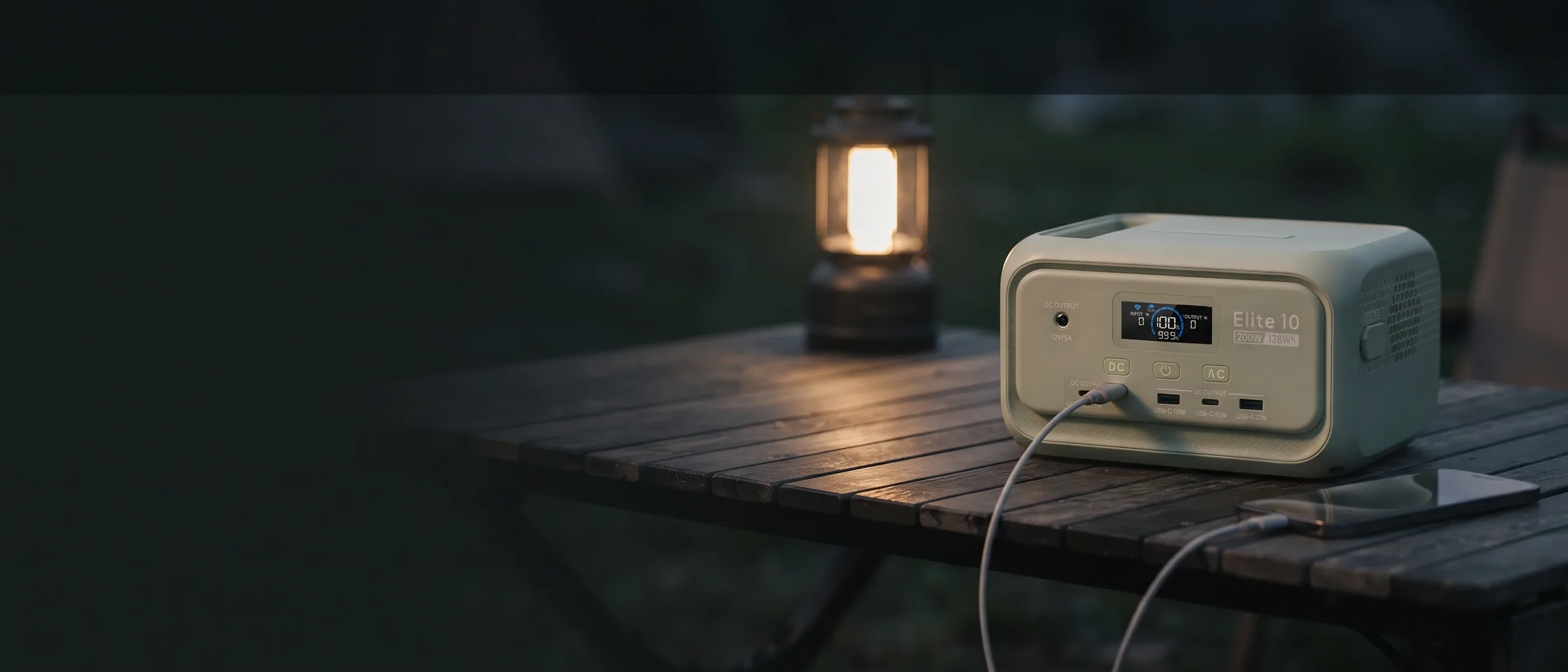
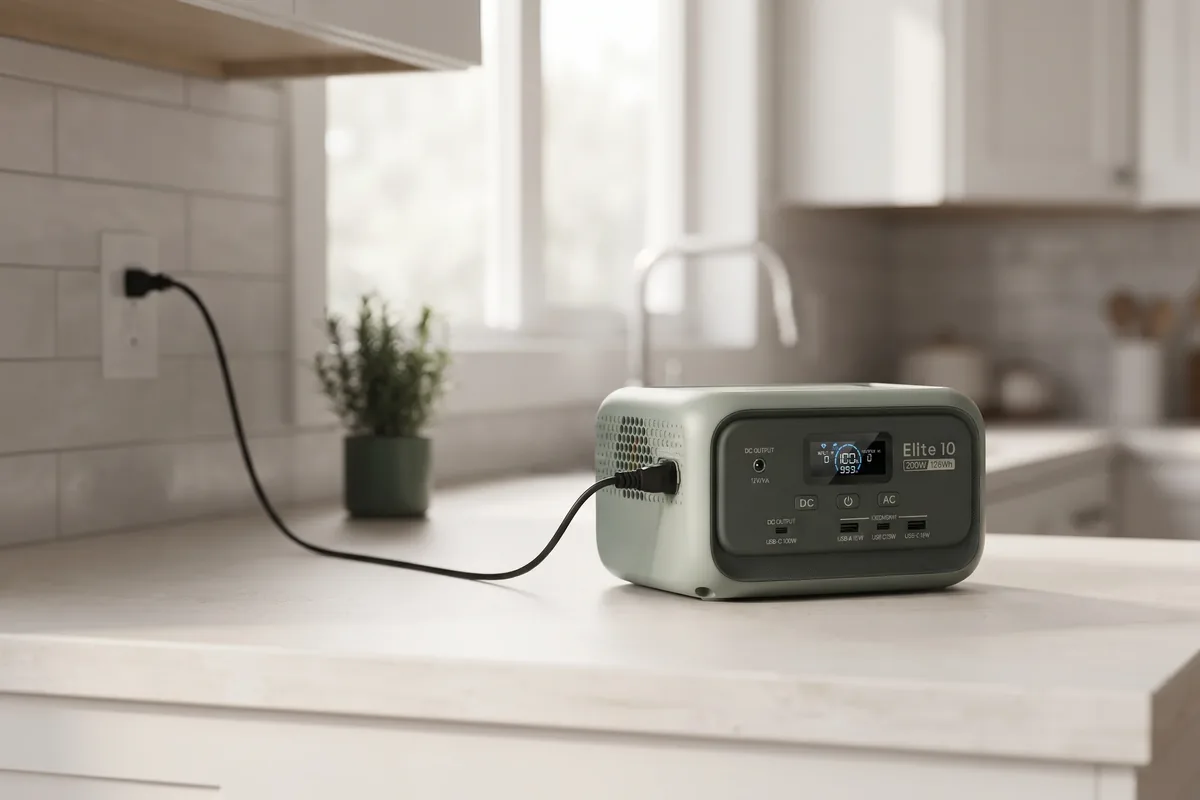
- Six outputs (Bluetti's "1 AC + 5 DC"): one AC outlet, a 100 W USB-C, a 15 W USB-C, two USB-A sharing 15 W and a 12 V DC5521 barrel port.
- 3.97 lb, 7.87 × 5.75 × 4.33 in: about 32 Wh per pound. The Anker SOLIX C300 DC carries more per pound (288 Wh in 6.17 lb), but has no AC outlet.
- Not expandable, IP20 (no water resistance).
- Same unit as the Elite 10: Bluetti sells it as the Elite 10 Mini; its manual and some listings call it the Elite 10.
- 5-year warranty.
Our Amazon link is for the Elite 10 Mini alone. If the specs read like a foreign language, watts vs watt-hours explains which number answers which question.
Charging speed: 80% in about 45 minutes on Turbo, 100 W of solar
Bluetti quotes 80% in about 45 minutes at 150 W in Turbo mode; Standard, the default, takes about 2 hours.
The Elite 10 Mini has three charging modes, set in the Bluetti app:
| Mode | Wall input | Charge time (Bluetti) |
|---|---|---|
| Turbo | 150 W | 80% in about 45 min |
| Standard (default) | 70 W | about 2 h |
| Silent | 40 W | about 5 h |
Bluetti's product page also says "70-min Fast Recharge", which matches a full charge on Turbo rather than the 80% figure. Bluetti calls Standard battery-friendly.
Solar goes into an XT60 input: up to 100 W at 12–28 V and 8.2 A on Turbo (70 W on Standard). Bluetti says to use at least 20 W of solar. By our estimate at 75% of the panels' rating:
- 100 W panel, Turbo: about 1.7 hours of good sun.
- 100 W panel, Standard (70 W cap): about 2.4 hours.
- 60 W panel: about 2.8 hours.
Car charging is up to 100 W from a 12 V or 24 V socket with the engine running. See how to charge a power station with solar and charging from a car.
Charge it between 32 and 104 °F; it can power devices down to −4 °F.
Capacity and real runtime: a low-draw CPAP for about one night on DC
By our estimate its 128 Wh runs a low-draw CPAP on DC for about 11 hours, but a humidified one on AC for under 2.
Estimated runtimes on the Elite 10 Mini
- CPAP, no humidifier, low-draw (11 W, DC)11 h
- Wi-Fi router on a 12 V cable (12 W)9.8 h
- LED lights ×4 (40 W, AC)2.2 h
- Laptop over USB-C (60 W)2.0 h
- Fan on AC (50 W)1.9 h
- CPAP with humidifier, typical (56 W, AC)1.7 h
The pattern is clear: on DC (USB-C or the 12 V barrel port) small loads run for most of a night; on AC the inverter's own draw and conversion loss leave about two hours for anything around 50 W. Run a router or CPAP from the 12 V port where you can, and turn AC off when you don't need it.
It won't run a fridge for any useful time, and it can't be expanded. For a CPAP through a full night with the humidifier on, a 288 Wh station such as the Bluetti Elite 30 V2 is the smallest sensible size; see how long a power station runs a CPAP and try your devices in the runtime calculator.
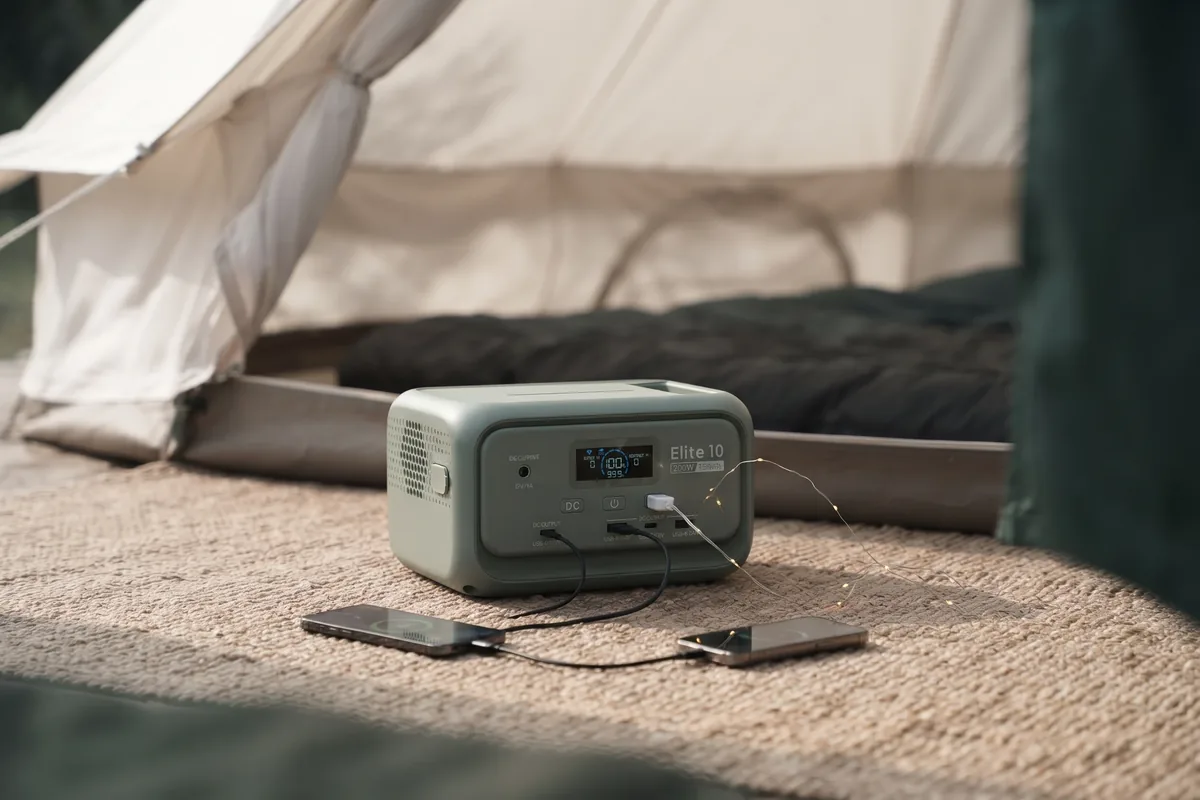
Output: 200 W on one AC outlet, 100 W on USB-C
Its one AC outlet tops out at 200 W, so the 100 W USB-C port does most of the useful work.
The AC outlet gives 200 W at 120 V: enough for a laptop charger, a fan, lights, a router or a camera battery charger.
Power Lifting (off by default) lets resistive loads rated 200 to 400 W run at reduced power, such as a small heating pad. But output stays at 200 W, so a kettle, hair dryer, coffee maker or microwave won't run. Bluetti caps AC and DC together at 300 W.
For devices:
- 100 W USB-C (PD 3.0): charges most laptops at full speed.
- Second USB-C: 15 W.
- Two USB-A ports: share 15 W.
- 12 V DC5521 barrel port: 13.5 V at 5 A by default (12.5 V through the app), handy for a CPAP DC cable or a 12 V router.
For what bigger stations can run, see what a power station can run in an outage.
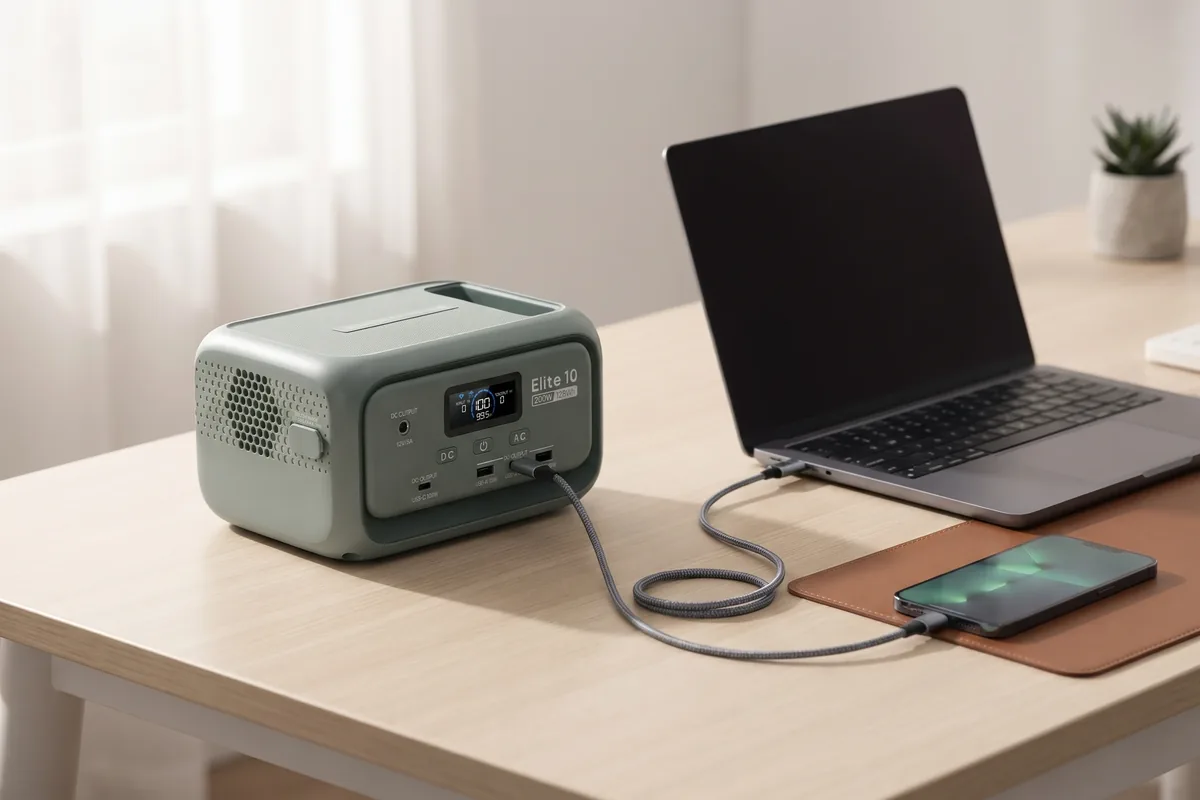
Backup (UPS) and app: a 10 ms switchover for a router or modem
Plugged into the wall, it switches to battery in 10 ms or less, fast enough for a router, modem or small PC.
Leave the Elite 10 Mini plugged in and it passes wall power through to its AC outlet (up to 350 W including charging). It switches to battery in 10 ms or less when the power drops.
That keeps a router and modem online through a short outage. With 128 Wh, expect most of a night on the 12 V port and around 2 hours on AC for a 50 W load by our estimate. See using a power station as a UPS and the power station for a Wi-Fi router guide.
The app works over Bluetooth only. It sets the charging mode, the 12 V port's voltage and ECO mode, which switches AC or DC off after a period of low or no load; leave it off for a router or CPAP. If it will sit plugged in for weeks, read whether you can leave a power station plugged in.
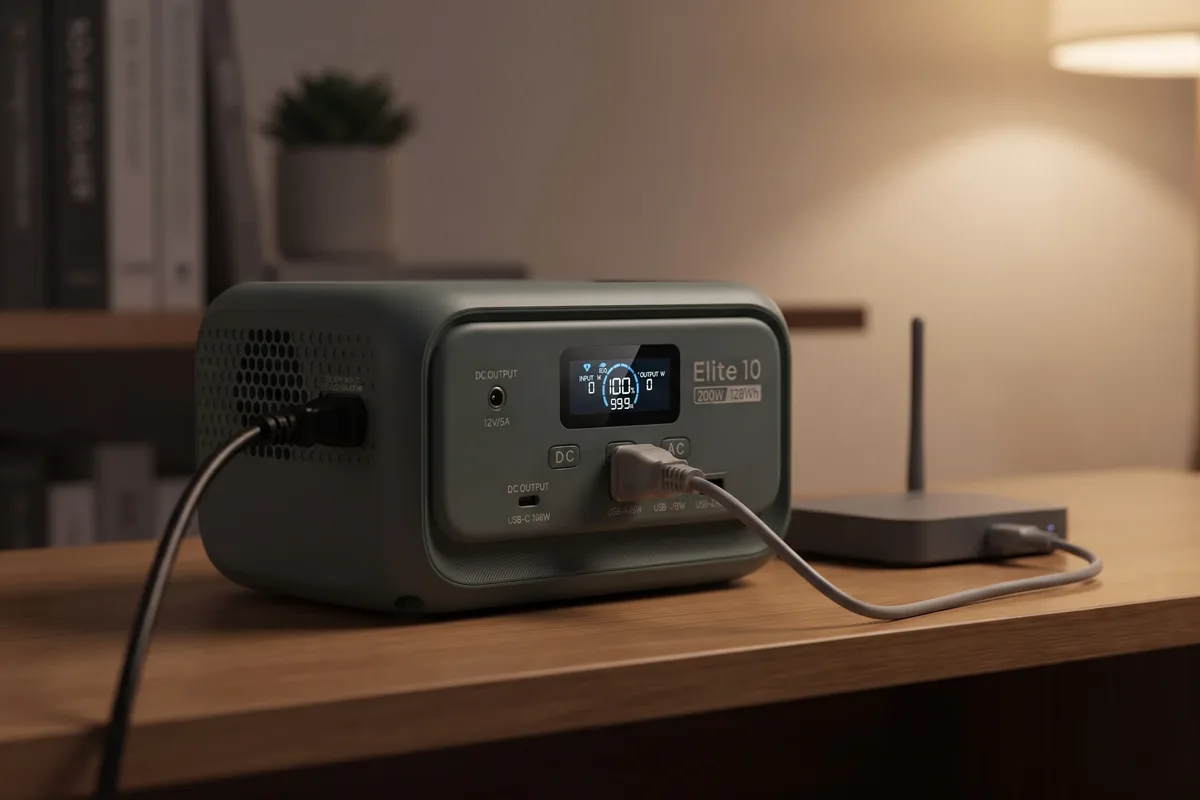
Noise: 45 dB at most, and a 40 W Silent charging mode
Bluetti rates it at 45 dB at most, and Silent mode charges at 40 W for a quieter night.
Bluetti's manual gives 45 dB as the maximum. For charging by the bed, Silent mode limits the wall input to 40 W and takes about 5 hours, so the fan has less to do.
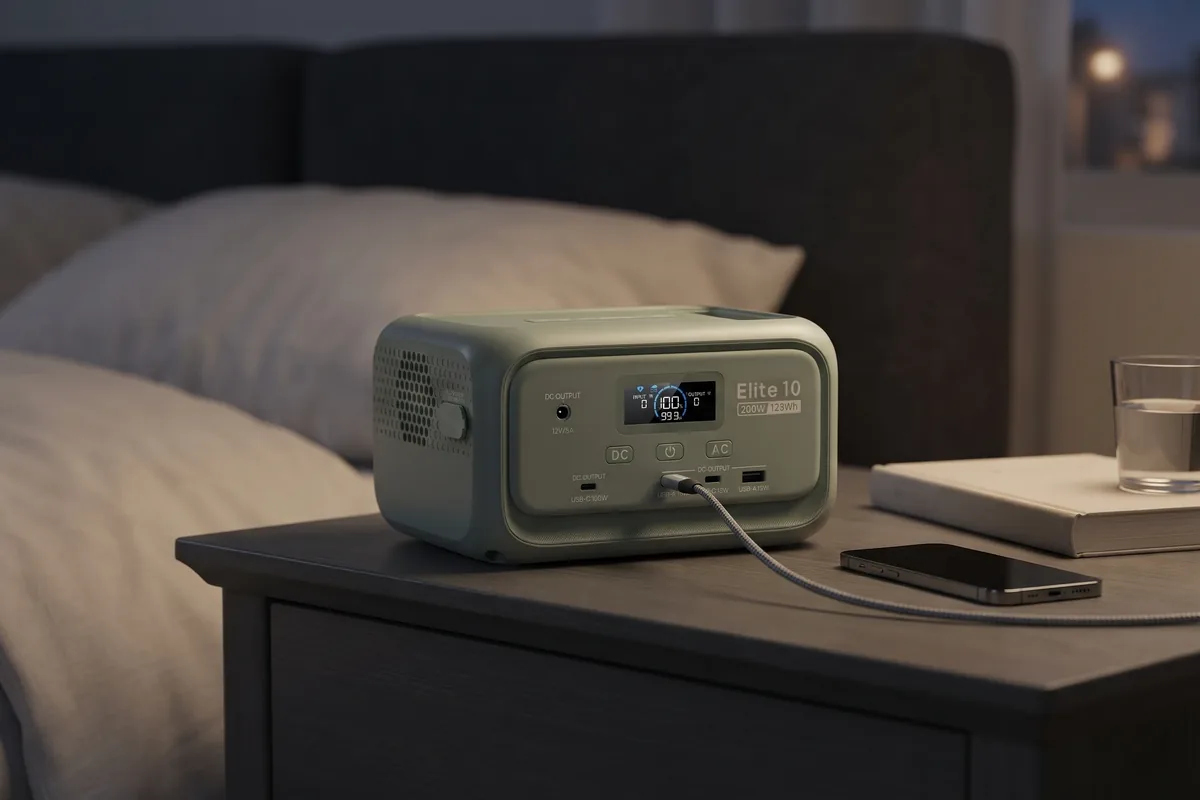
How it compares: 2.2 lb lighter than any 288 Wh station, under half the battery
Against the Elite 30 V2, Anker SOLIX C300 DC and Jackery Explorer 300, the Elite 10 Mini is the lightest by far but holds the least.
| Spec | Bluetti Elite 10 Mini | Bluetti Elite 30 V2 | Anker SOLIX C300 DC | Jackery Explorer 300 |
|---|---|---|---|---|
| Capacity (Wh) | 128 | 288 | 288 | 293 |
| AC output, continuous (W) | 200 | 600 | None (DC only; 300 W total DC output) | 300 |
| AC charge time | 80% in about 45 min (Turbo) | About 70 min | 80% in about 1 hr (2 × 140 W USB-C) | About 4.5 h (Jackery) |
| Max solar input (W) | 100 | 200 | 100 | 100 |
| Weight (lb) | 3.97 | 9.5 | 6.17 | 7.1 |
| Warranty (years) | 5 | 5 | 5 | 3 + 2 with registration |
| Price | Check price | Check price | Check price | Check price |
- Capacity
- 128 Wh
- AC output
- 200 W
- Wall charge
- 80% in about 45 min
- Solar input
- 100 W
- Weight
- 3.97 lb
- Warranty
- 5 years
- Capacity
- 288 Wh
- AC output
- 600 W
- Wall charge
- About 70 min
- Solar input
- 200 W
- Weight
- 9.5 lb
- Warranty
- 5 years
- Capacity
- 288 Wh
- AC output
- None
- Wall charge
- 80% in about 1 hr
- Solar input
- 100 W
- Weight
- 6.17 lb
- Warranty
- 5 years
- Capacity
- 293 Wh
- AC output
- 300 W
- Wall charge
- About 4.5 h
- Solar input
- 100 W
- Weight
- 7.1 lb
- Warranty
- 3 + 2 years
- Bluetti Elite 30 V2: 288 Wh and 600 W in 9.5 lb, with a 10 ms switchover too. More than twice the battery and three times the output for about 5.5 lb more; it rates 7.8 against the Elite 10 Mini's 6.1 and is our pick for the best small portable power station.
- Anker SOLIX C300 DC: 288 Wh in 6.17 lb, with two 140 W USB-C ports but no AC outlet. It rates 6.8.
- Jackery Explorer 300: 293 Wh and 300 W AC in 7.1 lb, but an older NMC battery and slower charging. It rates 5.0.
In our rating the Elite 10 Mini scores well for solar input and charging speed for its size, but low for AC output (200 W) and middling for capacity per pound (see how we rate). Choosing a brand? See Jackery vs Bluetti and EcoFlow vs Bluetti.
Who should buy the Bluetti Elite 10 Mini: travel, desks and router backup
Buy it to carry a 200 W outlet and 100 W USB-C everywhere; skip it if you need a night of AC power.
Good fit: travel and day trips; a desk or bedside power source; router and modem backup on the 12 V port; anyone who finds even a 288 Wh station too heavy to bring along.
Look elsewhere if: you need a CPAP with its humidifier through the night, a mini fridge, or anything over 200 W. The Elite 30 V2 is the step up; for camping picks, see the best portable power stations for camping. Not sure what size you need? Start with how to choose a portable power station.
In our buying guides, the Elite 10 Mini is lightest in Best Small Portable Power Stations. It is also covered in the best portable power stations and best value portable power stations guides.
FAQ
Size, CPAP runtime, flying, UPS use, lifespan and warranty for the Elite 10 Mini
Is the Bluetti Elite 10 Mini worth it?
It is if weight matters most: 3.97 lb gets you a 200 W AC outlet, 100 W USB-C, a 10 ms switchover and a 5-year warranty. If you can carry 9.5 lb, the Elite 30 V2 gives more than twice the battery.
What can the Bluetti Elite 10 Mini power?
Anything under 200 W on its one AC outlet: a laptop charger, a fan, lights, a router or a camera battery charger. The 100 W USB-C charges most laptops at full speed, and the 12 V port suits a CPAP DC cable or a 12 V router.
It won't run a kettle, hair dryer, coffee maker, microwave or mini fridge. Power Lifting lets resistive loads rated 200 to 400 W run at reduced power, but output stays at 200 W.
How long will the Elite 10 Mini run a CPAP?
By our estimate, about 11 hours for a low-draw CPAP without the humidifier on the 12 V port, but under 2 hours for a typical humidified CPAP on AC.
Can I take the Elite 10 Mini on a plane?
Amazon's listing calls it "flight approved". At 128 Wh it's above the FAA's 100 Wh limit for carrying a battery without approval; batteries of 101 to 160 Wh need your airline's approval, so check with the airline before you fly.
Can the Elite 10 Mini be used as a UPS?
Yes. Plugged in, it switches to battery in 10 ms or less, quick enough for a router or modem. With 128 Wh, the backup lasts hours, not a day.
How long will a Bluetti Elite 10 Mini last?
Bluetti rates its LiFePO4 battery for 3,000+ cycles to 80% capacity. At one full cycle a day that's about 8 years by our estimate. See how long power stations last.
Is Bluetti better than Jackery, EcoFlow or Anker?
It depends on the model. At this size, the Elite 10 Mini is lighter than anything Jackery, EcoFlow or Anker sells in the stations we've reviewed, but holds less than all of them. For brand-level differences, see Jackery vs Bluetti, EcoFlow vs Bluetti and Anker SOLIX vs Bluetti.
What warranty does the Elite 10 Mini have?
Five years.
Is the Elite 10 Mini expandable?
No. It has no expansion port, so 128 Wh is all it holds.