 By
We may earn a commission if you buy through links on this page, at no extra cost to you. This never affects which products we recommend. How we make money.
On this page 12 sections
Pick the Anker SOLIX F3800 Plus for the most output (6,000 W), the most solar input (3,200 W) and the biggest battery bank (about 26.9 kWh from one unit). Pick the EcoFlow Delta Pro 3 for a lighter unit (113.5 lb), a 10 ms backup switchover and 4,000 W charging from a 240 V source. Both are 120/240 V LiFePO4 stations built to back up a home.
The short answer: Delta Pro 3 vs F3800 Plus
Anker gives you 50% more output and more than twice the expansion; EcoFlow is 23 lb lighter and switches over twice as fast
Both stations hold about 4 kWh, run on LiFePO4, deliver 120 V and 240 V, and roll on wheels. The choice comes down to what you'll ask of them.
- Choose the Anker SOLIX F3800 Plus if you want to run large 240 V loads such as a well pump or an electric dryer circuit, charge from a big solar array, or build toward a battery bank of 20 kWh or more.
- Choose the EcoFlow Delta Pro 3 if your backup has to keep computers or network gear running without a blink, you'll move the unit around, or you can charge it from a 240 V EV charger.
Delta Pro 3 vs F3800 Plus specs
Similar batteries; different strengths in output, solar, expansion and switchover
| Spec | EcoFlow Delta Pro 3 | Anker SOLIX F3800 Plus |
|---|---|---|
| Capacity (Wh) | 4096 | 3840 |
| AC output, continuous (W) | 4000 | 6000 |
| AC charge time | 0–80% in about 50 min (EcoFlow; setup not stated) | — |
| Max solar input (W) | 2600 | 3200 |
| Weight (lb) | 113.5 | 136.7 |
| Warranty (years) | 3 + 2 with app registration | 5 |
| Price | Check price | Check price |
- Same: LiFePO4 chemistry, 120/240 V output, 1,800 W charging from a 120 V outlet, wheels.
- F3800 Plus wins: continuous output (6,000 vs 4,000 W), solar input (3,200 vs 2,600 W), expansion per unit (about 26.9 vs 12 kWh), cold-weather use (down to −4°F vs 14°F), a full 5-year warranty.
- Delta Pro 3 wins: capacity (4,096 vs 3,840 Wh), UPS switchover (10 vs 20 ms), weight (113.5 vs 136.7 lb), a higher published cycle rating (4,000 to 80% vs 3,000+), a published surge rating (8,000 W), 240 V charging (4,000 W), charging in heat (to 113°F vs 104°F).
Both sit in our whole-home class, so their ratings compare directly: the F3800 Plus scores 7.8 and the Delta Pro 3 scores 7.0. The F3800 Plus scores higher for output, solar and expansion; the Delta Pro 3 scores higher for backup switchover, portability and battery life. Both score low for wall charging, because 1,800 W from a 120 V outlet is slow for a 4 kWh battery. How We Test explains the method.
Charging speed: Delta Pro 3 vs F3800 Plus
From a regular outlet both take a little over 2 hours by our estimate; EcoFlow adds a 240 V route
From a 120 V wall outlet, both take 1,800 W. At that rate a full charge takes about 2.1 hours on the F3800 Plus and 2.3 hours on the Delta Pro 3 by our estimate, and longer in practice as charging slows near full.
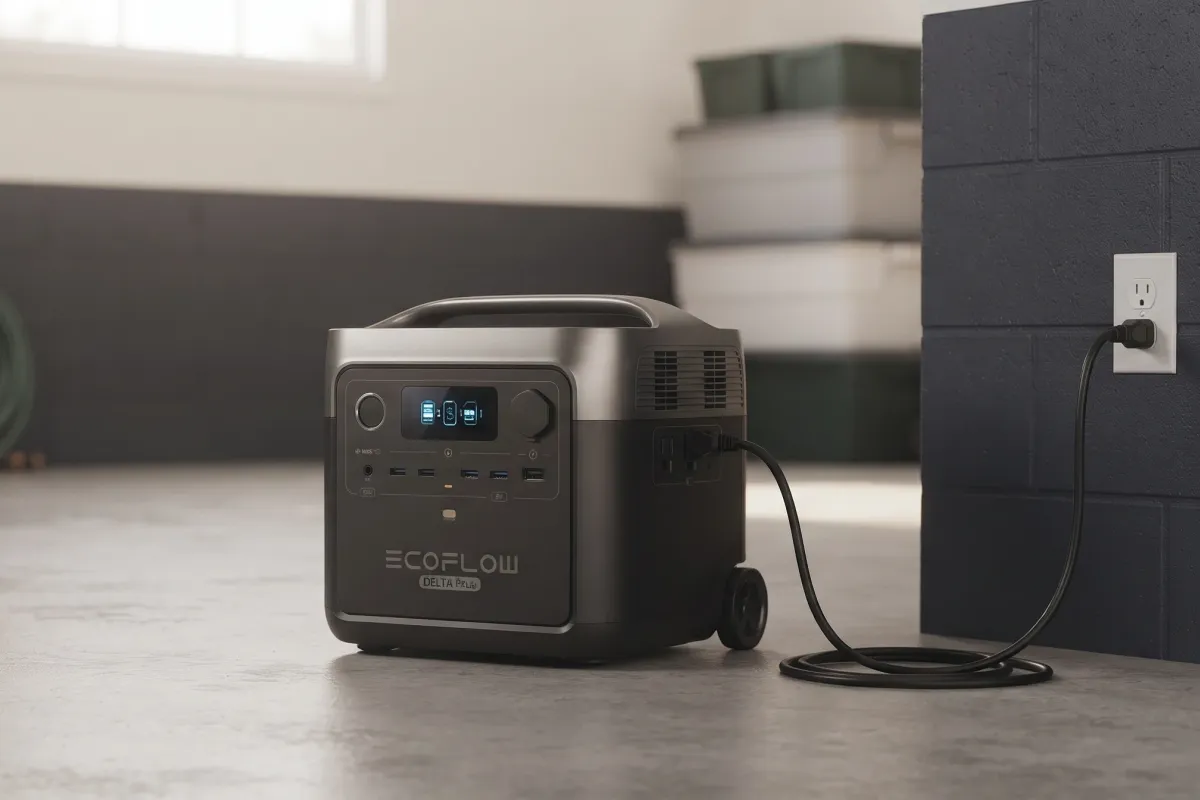
The Delta Pro 3 adds faster routes:
- 240 V: 4,000 W through its AC Power In/Out port with EcoFlow's EV X-Stream Adapter, which plugs into a Level 1 or Level 2 EV charger. EcoFlow quotes 0 to 80% in about 50 minutes, without saying which input it used.
- Multi-charging: up to 7,000 W combined from AC and solar.
- Car: 12 V or 48 V input, and EcoFlow's 800 W Alternator Charger.
- Generator: pairs with EcoFlow's Smart Generator, which the app can start and stop automatically.
The F3800 Plus takes up to 6,000 W from a generator through an adapter, the main upgrade over the original F3800, and it can pass generator power through to your loads. It has no 240 V wall-charging route like EcoFlow's.
Solar input: Delta Pro 3 vs F3800 Plus
Anker's two high-voltage inputs take more panels; EcoFlow splits a high- and low-voltage input
The F3800 Plus takes 3,200 W of solar through two inputs of 1,600 W each, each accepting 11–165 V at up to 17 A. That wide voltage window lets you wire several panels in series on each input. A full charge takes about 1.6 hours at 75% of the panels' rating, by our estimate.
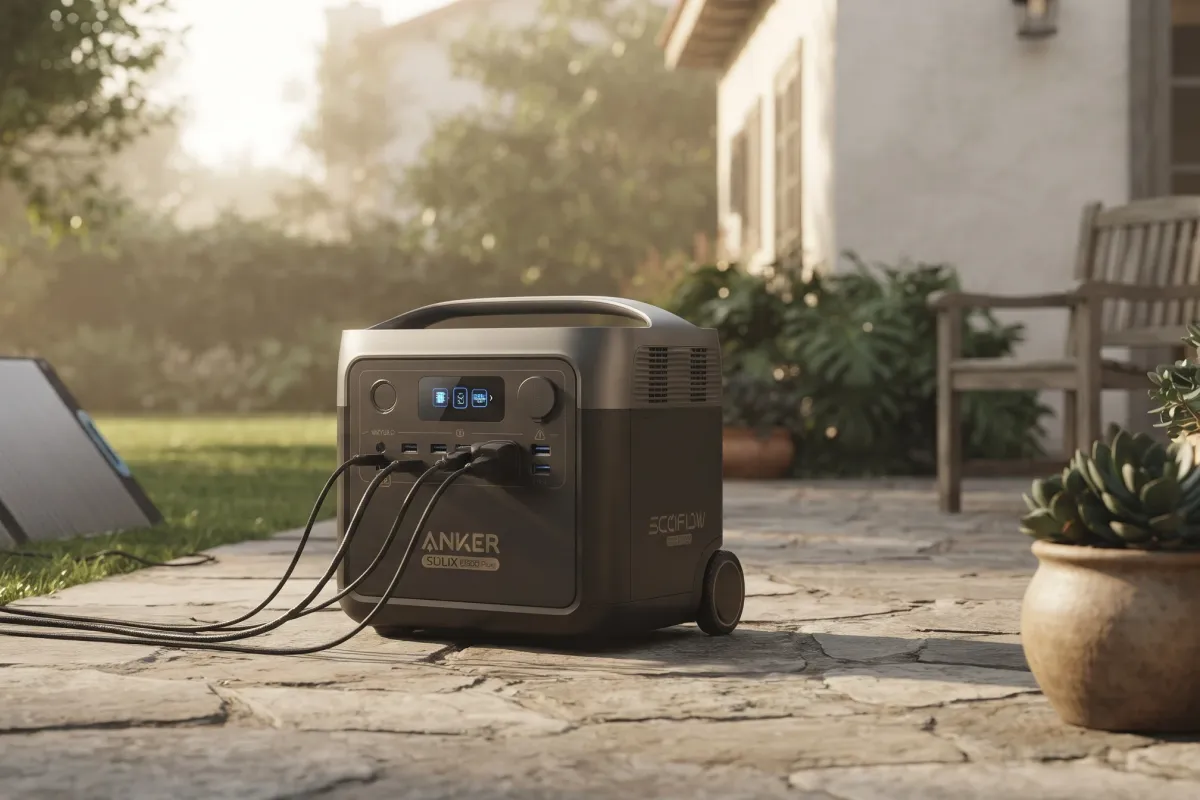
The Delta Pro 3 takes 2,600 W across two different inputs: a high-voltage input of 1,600 W at 30–150 V (15 A) and a low-voltage input of 1,000 W at 11–60 V (20 A). The low-voltage input suits portable folding panels; the high-voltage one suits a series string of rigid panels. A full charge takes about 2.1 hours at 75% of the panels' rating, by our estimate.
On either, keep each string's open-circuit voltage (Voc) below the input's maximum, with a margin for cold mornings, when Voc rises. Our guides to series vs parallel solar panels and solar panel sizing show how to plan an array.
Output and outlets: Delta Pro 3 vs F3800 Plus
The F3800 Plus runs bigger loads; the Delta Pro 3 publishes an 8,000 W surge
The F3800 Plus delivers 6,000 W at 120 V and 240 V. That total depends on the outlet: the regular 120 V NEMA 5-20R outlets share 2,400 W, the TT-30R outlet gives 3,000 W, and the full 6,000 W comes through the L14-30R 120/240 V outlet. Anker doesn't publish a surge rating for the Plus. One limit to plan around: 240 V output isn't available while it charges from a 120 V wall outlet.
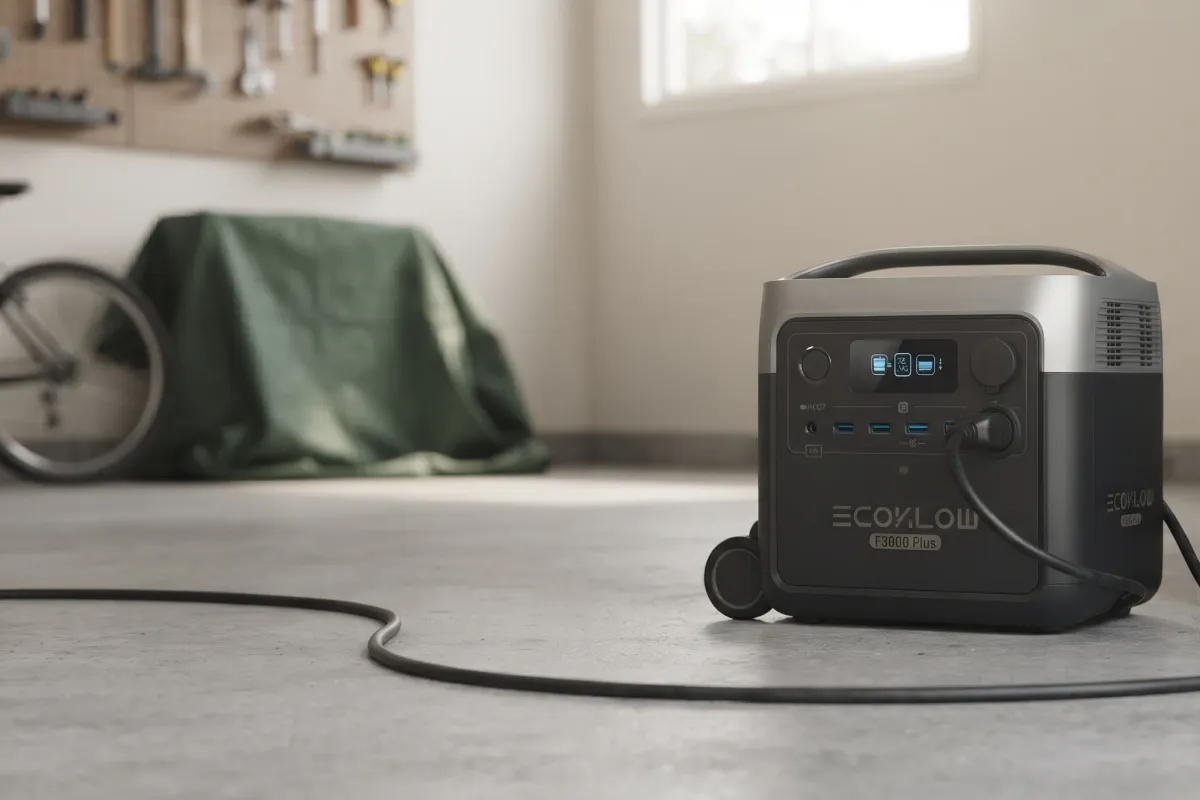
The Delta Pro 3 delivers 4,000 W with an 8,000 W surge. Its outlets are 4 × NEMA 5-20R and a TT-30R on the 120 V side, and a NEMA 6-20R and an L14-30R on the 240 V side. You choose 120 V or 240 V with a button, and the 120 V and 240 V outlets don't run at the same time, except that the L14-30R gives split-phase 120/240 V. Its X-Boost runs some resistive appliances up to 6,000 W at reduced power; that isn't continuous output. EcoFlow says it ran a 3-ton central air conditioner (with a soft starter) and a 1 HP well pump in its lab.
What it means at home:
- Big 240 V loads (well pump, dryer circuit, central AC): the F3800 Plus has more headroom for running two at once. The Delta Pro 3's 8,000 W surge helps motors start, but 4,000 W continuous limits what runs together.
- Everyday 120 V loads (fridge, freezer, lights, router): both are plenty.
- RV: both have a TT-30R outlet for a travel trailer's 30-amp cord.
See surge vs continuous watts for why the two ratings differ.
Runtime: Delta Pro 3 vs F3800 Plus
The Delta Pro 3's extra 256 Wh adds a few hours; expansion changes the picture
The Delta Pro 3 stores 4,096 Wh and the F3800 Plus 3,840 Wh, about 6% less. On their own, they run the same loads for almost the same time.
Estimated runtimes: Delta Pro 3 (4,096 Wh)
- Wi-Fi router (12 W, DC)13.1 days
- CPAP with humidifier, typical (56 W, AC)2.3 days
- Fridge (67 W average, AC)46 h
- Essentials: fridge, freezer, 4 LED lights, router21 h
Estimated runtimes: F3800 Plus (3,840 Wh)
- Wi-Fi router (12 W, DC)12.3 days
- CPAP with humidifier, typical (56 W, AC)2.1 days
- Fridge (67 W average, AC)43 h
- Essentials: fridge, freezer, 4 LED lights, router20 h

With expansion, the gap reverses. A Delta Pro 3 at its 12 kWh per-unit maximum runs the same essentials for about 61 hours; an F3800 Plus with six BP3800 batteries (about 26.9 kWh) runs them for about 137 hours, nearly six days, by our estimate. Real runtimes drop in the cold, with an older battery and with a reserve set in the app. Put your own appliances into the runtime calculator.
Expandability: Delta Pro 3 vs F3800 Plus
One F3800 Plus grows more than twice as far as one Delta Pro 3
- F3800 Plus: up to six BP3800 batteries of 3,840 Wh each (72.8 lb apiece). One unit plus six batteries makes 26,880 Wh, about 26.9 kWh. Anker's headline figure of about 53.8 kWh needs two linked F3800 Plus units, each with six batteries.
- Delta Pro 3: up to two Delta Pro 3 Extra Batteries, for 12 kWh per unit; the older DELTA Pro Smart Extra Battery also fits. Three units on EcoFlow's Smart Home Panel 2 make 36 kWh and 12 kW. EcoFlow's 48 kWh figure needs three units, three extra batteries, three Smart Generator 4000s and the Smart Home Panel 2. It doesn't connect to DELTA Pro or DELTA Pro Ultra units.
If you want multi-day backup from a single station, the F3800 Plus goes further. Check that any extra battery is listed for your exact model before buying.
Backup (UPS), noise and app: Delta Pro 3 vs F3800 Plus
The Delta Pro 3 switches over twice as fast; both connect to a home through a panel or transfer switch
When the grid fails while they're plugged in, EcoFlow rates the Delta Pro 3 at 10 ms to switch to battery and Anker rates the F3800 Plus at 20 ms (30 or 50 ms when switching from a generator). Ten milliseconds is fast enough for most computers; at 20 ms most routers and laptops carry on, but some desktop PCs may restart. Test yours, or see using a power station as a UPS.
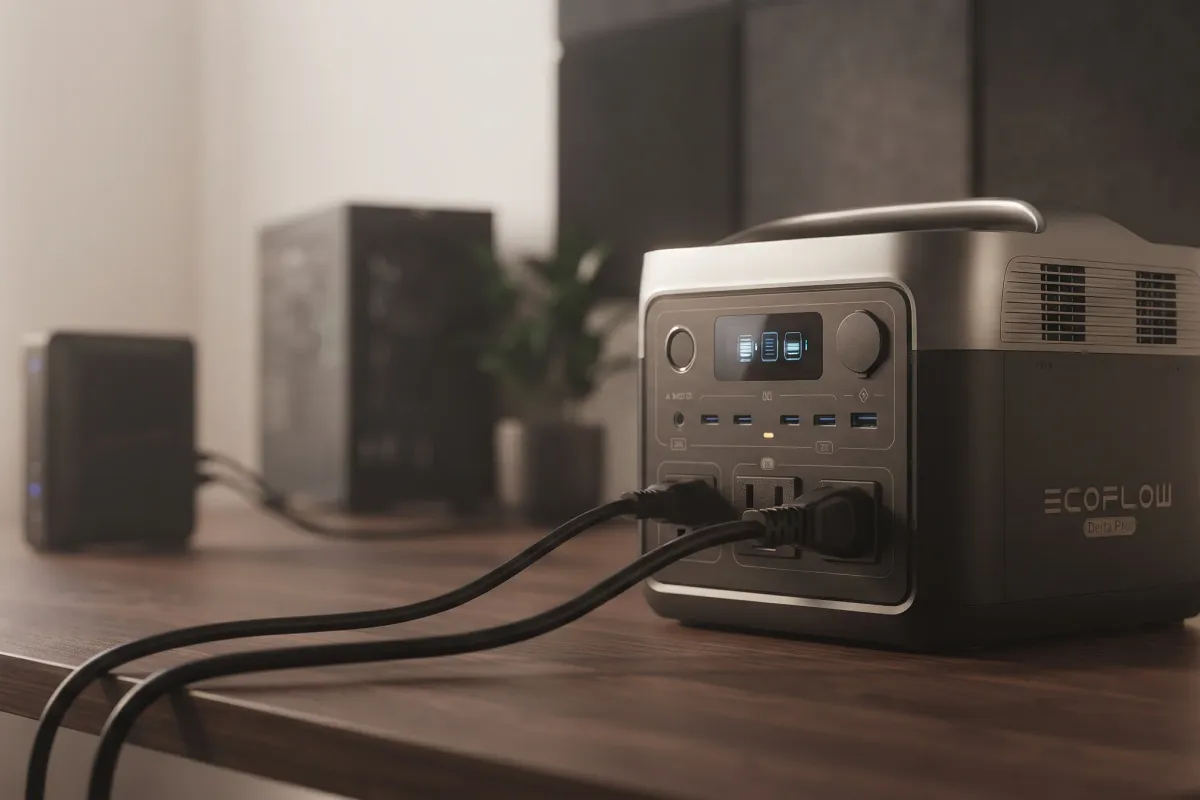
To power home circuits, both need hardware installed by a licensed electrician: EcoFlow's Smart Home Panel 2 or a transfer switch for the Delta Pro 3, and a transfer switch or inlet box on the L14-30R outlet for the F3800 Plus. Never back-feed a house through a wall outlet. Our transfer switch guide explains the options.
Both have phone apps. EcoFlow's works over 2.4 GHz Wi-Fi and Bluetooth, with scheduled tasks and automatic start and stop of its Smart Generator; the F3800 Plus review covers Anker's.
Noise: EcoFlow rates the Delta Pro 3 as low as 30 dB in its X-Quiet mode. Anker publishes no noise figure for the F3800 Plus.
Battery life, weight and warranty: Delta Pro 3 vs F3800 Plus
The Delta Pro 3 is 23.2 lb lighter and rated for more cycles; Anker's 5 years need no registration
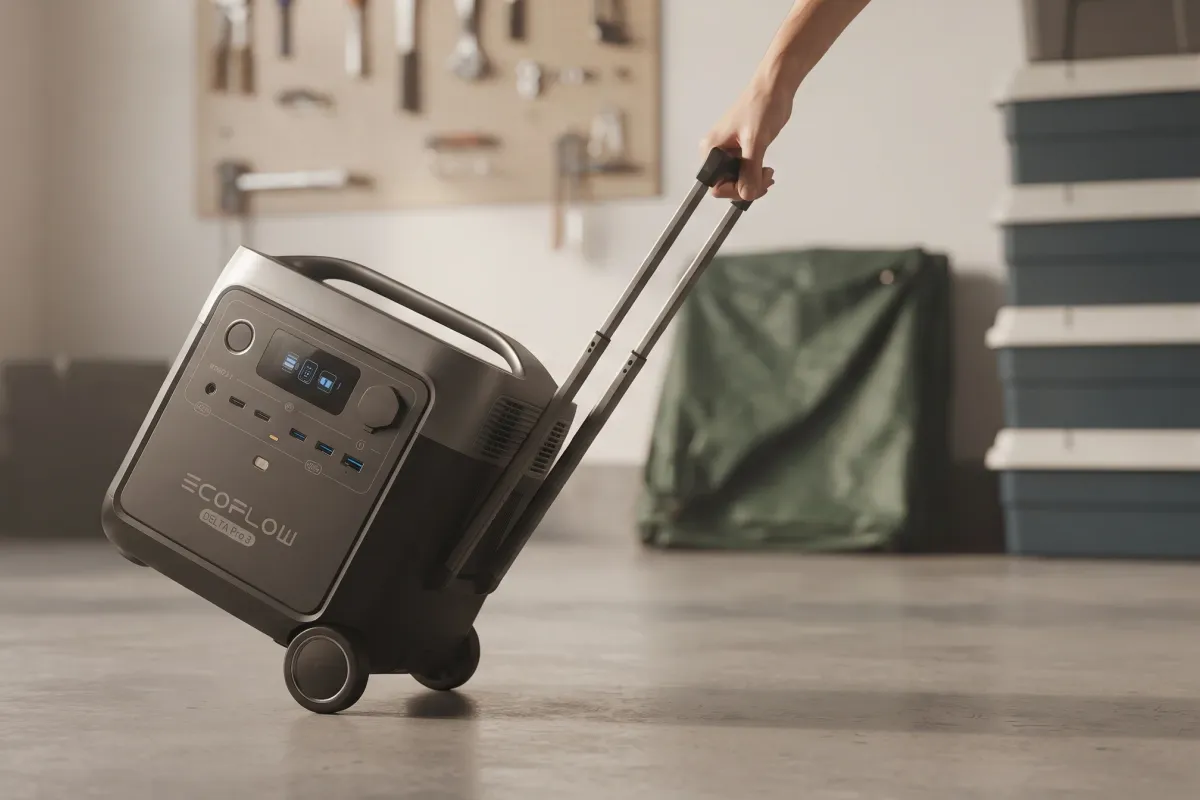
- Weight: Delta Pro 3 113.5 lb, F3800 Plus 136.7 lb. Neither is carried by one person; both roll on wheels.
- Size: Delta Pro 3 16.16 × 13.43 × 27.28 in; F3800 Plus 27.6 × 15.3 × 15.6 in, both including wheels.
- Weather: the Delta Pro 3's battery pack is rated IP65; the unit as a whole is IP20. Keep either indoors or under cover.
- Cycles: EcoFlow rates the Delta Pro 3 at 4,000 cycles to 80%; Anker rates the F3800 Plus at 3,000+ cycles. Used for occasional outages, either lasts well beyond its warranty. See how long portable power stations last.
- Warranty: F3800 Plus 5 years; Delta Pro 3 3 years, plus 2 more when you register it in the EcoFlow app.
- Temperature: the Delta Pro 3 charges at 32–113°F and runs at 14–113°F; the F3800 Plus charges at 32–104°F and runs at −4–104°F. In an unheated garage in winter, the F3800 Plus keeps running colder; in a hot one, the Delta Pro 3 has more margin. See cold weather use.
Original F3800 and Delta Pro Ultra X: how the siblings differ
The Plus adds generator bypass and more solar; the Ultra X is EcoFlow's bigger system
The original Anker SOLIX F3800 looks the same but takes 2,400 W of solar instead of 3,200 W, has no generator bypass, and has a NEMA 14-50 outlet where the Plus has a TT-30R. Against the Delta Pro 3, the original's 2,400 W of solar falls short of EcoFlow's 2,600 W, so the solar lead belongs to the Plus alone. For most buyers the Plus is the better choice; the F3800 Plus review covers the differences. Anker's smaller 120 V model is the SOLIX F3000.
EcoFlow's larger option is the Delta Pro Ultra X, a modular whole-home system. Brand-level differences, such as apps, warranties and range, are in our Anker SOLIX vs EcoFlow comparison.
Who should buy the F3800 Plus, and who the Delta Pro 3
Pick by your biggest load, your solar plans and how sensitive your electronics are
Best for big loads and a large battery bank
Anker SOLIX F3800 Plus
Pick it for whole-home backup with a well pump or other 240 V loads, large solar arrays and multi-day outages.
Pros
- 6,000 W at 120/240 V
- 3,200 W solar input
- About 26.9 kWh per unit with six BP3800s
Cons
- 136.7 lb
- No published surge rating
- No 240 V output while charging from 120 V
Best for fast switchover and lighter handling
EcoFlow Delta Pro 3
Pick it for homes with desktop computers or network gear, for moving it between rooms, and if you have an EV charger to refill it quickly.
Pros
- 10 ms UPS switchover
- 113.5 lb
- 4,000 W charging at 240 V
Cons
- 4,000 W continuous
- 12 kWh per-unit expansion
- Warranty needs app registration for 5 years
- Whole-home backup with 240 V loads: F3800 Plus. See our best whole-home battery backup.
- Home office and networking: Delta Pro 3, for the 10 ms switchover.
- Off-grid solar: F3800 Plus, for 3,200 W of input and more storage.
- Essentials through a day-long outage: either. See our best portable power stations for home backup.
FAQ
Delta Pro 3 or F3800 Plus: questions from buyers choosing a 240 V station
Which is better, the Delta Pro 3 or the F3800 Plus?
The F3800 Plus rates higher in our method (7.8 vs 7.0) on the strength of its output, solar input and expansion. The Delta Pro 3 is the better choice if you need a 10 ms switchover or a lighter unit.
Can either power a house?
Both can run selected home circuits through a transfer switch or a maker's home panel installed by an electrician. Neither runs a whole house's full load on its own; plan around essential circuits.
Can they run central air or a well pump?
EcoFlow says the Delta Pro 3 ran a 3-ton central AC with a soft starter and a 1 HP well pump in its lab. The F3800 Plus's 6,000 W L14-30R output gives more running headroom, but Anker publishes no surge figure. Check your appliance's starting draw before relying on either.
How many batteries can each add?
The F3800 Plus takes up to six BP3800s, about 26.9 kWh per unit. The Delta Pro 3 takes two extra batteries, 12 kWh per unit.
Which charges faster?
From a 120 V outlet both take 1,800 W. The Delta Pro 3 also takes 4,000 W at 240 V through an EV charger; the F3800 Plus takes 6,000 W from a generator and more solar (3,200 W vs 2,600 W).
Is the F3800 Plus worth it over the original F3800?
For most buyers, yes: it adds 800 W of solar input and generator bypass. The original has a NEMA 14-50 outlet that some RV owners prefer.
Which is better for whole-home backup?
The F3800 Plus, for most homes: 6,000 W runs more 240 V circuits at once, and six BP3800s give about 26.9 kWh from one unit. The Delta Pro 3 suits homes where a 10 ms switchover for computers matters more than total capacity.
Do the 120 V and 240 V outlets work together?
On the Delta Pro 3, the 120 V and 240 V outlets don't run at the same time, but the L14-30R gives split-phase 120/240 V. On the F3800 Plus, 240 V output isn't available while it charges from a 120 V outlet.