 By
We may earn a commission if you buy through links on this page, at no extra cost to you. This never affects which products we recommend. How we make money.
On this page 8 sections
Our verdict · Bluetti
3 kWh in a 58 lb box, built for RVs and home backup, but it can't grow
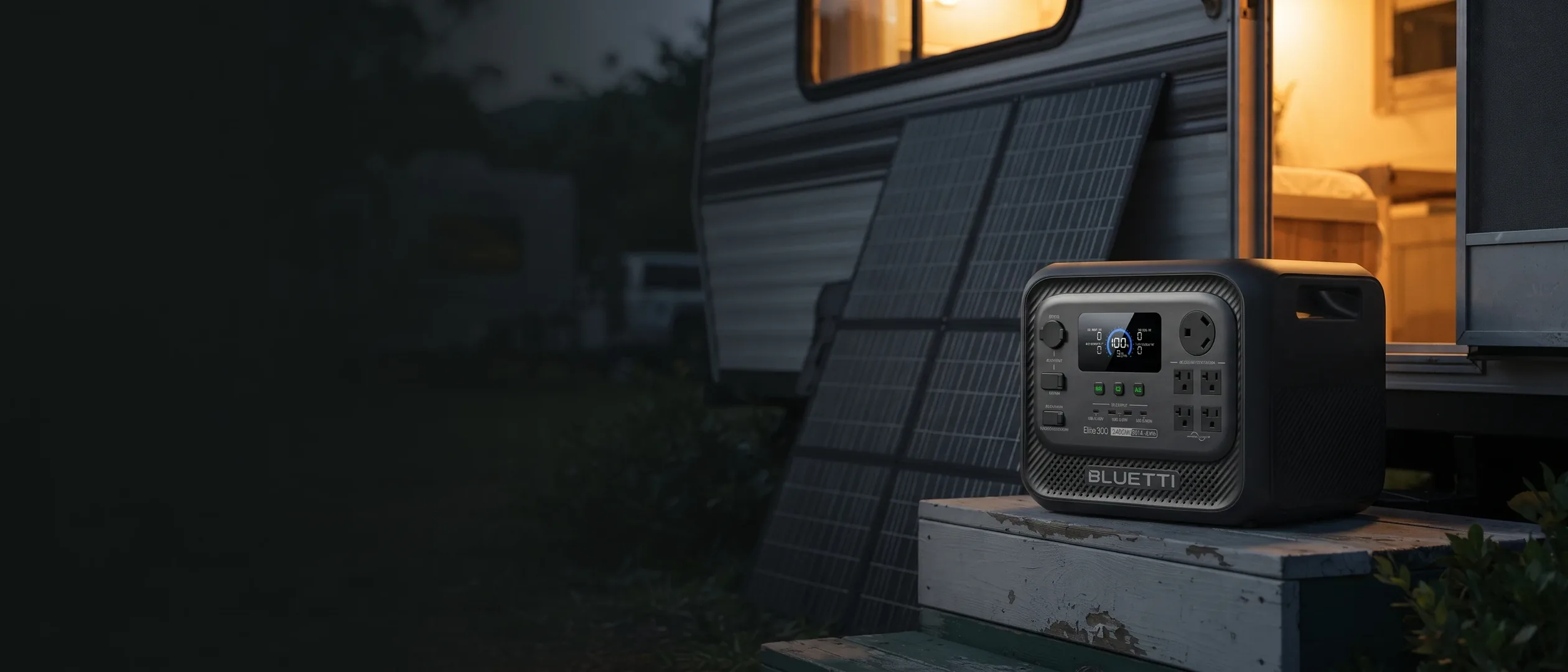
The Elite 300 packs about 3 kWh of LiFePO4 into a 58 lb unit, the lightest station of 3 kWh or more we've reviewed, with RV-friendly outputs and a 10 ms switchover. What you give up is growth: there's no expansion port, so 3,014.4 Wh is all it will ever hold, and it charges more slowly than rivals with bigger inputs.
- Capacity
- 3,014.4 Wh
- AC output
- 2,400 W
- Wall charge
- 80% in 95 min
- Weight
- 57.98 lb
Best for
RV owners and home backup where you want about 3 kWh in one unit you can still lift, with a TT-30 outlet, a 12 V/30 A DC port and a 10 ms switchover.
Skip it if
You want to add batteries later, need 240 V or more than 2,400 W, or want the fastest wall and solar charging in this size.
- 3,014.4 Wh LiFePO4 in about 58 lb
- TT-30 RV outlet and 12 V/30 A DC port
- 10 ms UPS switchover
- 140 W and 100 W USB-C
- 5-year warranty
- Not expandable
- 1,800 W wall input: 80% in about 95 minutes
- 1,200 W solar input
- 120 V only, 2,400 W
Rating breakdown (large (2 to 3 kwh) class)
| Criterion | Weight | Score | Based on |
|---|---|---|---|
| Wall charging speed | 20% | 3.3 | 1,800 W input |
| AC output | 20% | 6.0 | 2,400 W |
| Solar input | 10% | 3.3 | 1,200 W |
| Backup switchover | 15% | 10.0 | 10 ms |
| Portability | 10% | 10.0 | 52 Wh/lb |
| Expandability | 10% | 0.0 | Not expandable |
| Battery life & warranty | 15% | 10.0 | 5-year warranty, 6,000+ cycles |
| Capacity (Wh) | 3014.4 |
|---|---|
| Battery chemistry | LiFePO4 |
| Rated cycle life | 6,000+ cycles |
| AC output, continuous (W) | 2400 |
| AC output, surge (W) | — |
| AC charge time | 80% in 95 min (Turbo) |
| Max AC charging input (W) | 1800 |
| Max solar input (W) | 1200 |
| Solar input voltage range | 12–60 V, 22 A |
| UPS switchover (ms) | 10 |
| Weight (lb) | 57.98 |
| Expandable to (Wh) | Not expandable |
| Warranty (years) | 5 |
Key specs at a glance: 3,014.4 Wh, 2,400 W and about 52 Wh per pound
About 52 Wh per pound: among the Large stations we've reviewed, only the Anker SOLIX S2000 carries more.
- 3,014.4 Wh capacity: enough for a fridge and router for more than a day by our estimate, or a weekend of RV essentials.
- 2,400 W continuous, 4,800 W Power Lifting: runs most household appliances one or two at a time at 120 V. There's no 240 V output.
- LiFePO4, 6,000+ cycles: Bluetti doesn't say to what capacity the cycle rating runs. See LiFePO4 vs lithium-ion.
- Eight ports (Bluetti's count): a TT-30 RV outlet and standard AC outlets, a 140 W and a 100 W USB-C, two USB-A (15 W shared), a 12 V car socket and a 12 V/30 A DC port.
- About 58 lb (57.98 lb), 14.4 × 12 × 11.7 in: the lightest station of 3 kWh or more we've reviewed (see the Anker SOLIX S2000 for the most per pound in this class). It's rated IP20, so it has no water resistance: keep it under cover at a campsite or on an RV step.
- Not expandable: the manual lists no expansion port or battery.
- 5-year warranty (60 months in Bluetti's warranty table).
Our Amazon link is for the Elite 300 with two 200 W solar panels; Bluetti also sells the unit alone and with other panel sizes. If the specs read like a foreign language, watts vs watt-hours explains which number answers which question.
Charging speed: 80% in about 95 minutes on Turbo, 1,200 W of solar
Bluetti quotes 80% in about 95 minutes at 1,800 W, but only after you switch to Turbo mode.
The Elite 300 has three wall-charging modes, set in the app or in the unit's settings. Standard is the default:
| Mode | Wall input | Charge time (Bluetti) |
|---|---|---|
| Turbo | 1,800 W | 80% in about 95 min |
| Standard (default) | 1,200 W | 100% in about 2.8 h |
| Silent | 800 W | 100% in about 4.2 h |
Bluetti calls Standard battery-friendly and Turbo the quick recharge. Either way, 1,800 W is modest for 3 kWh: the Bluetti Apex 300 takes up to 3,840 W from the wall, and because our rating scores wall input per watt-hour, 1,800 W for 3,014.4 Wh is one of its low scores.
Solar goes into one XT60 input: up to 1,200 W at 12–60 V and 22 A, and Bluetti says third-party panels with MC4 connectors work. With wall and solar together it takes up to 2,400 W on Turbo (1,500 W on Standard). By our estimate at 75% of the panels' rating, the two 200 W panels in the Amazon bundle refill it in about 10 hours of good sun, and a full 1,200 W array in about 3.3 hours. See how to charge a power station with solar and what size solar panel you need.
It also charges from a 12 V or 24 V car socket (engine running) and from a pure sine wave generator, with Grid Self-Adaption mode on for generators. It passes power through to your devices while charging. Charge it only between 32 and 104 °F; it can power devices down to −4 °F.
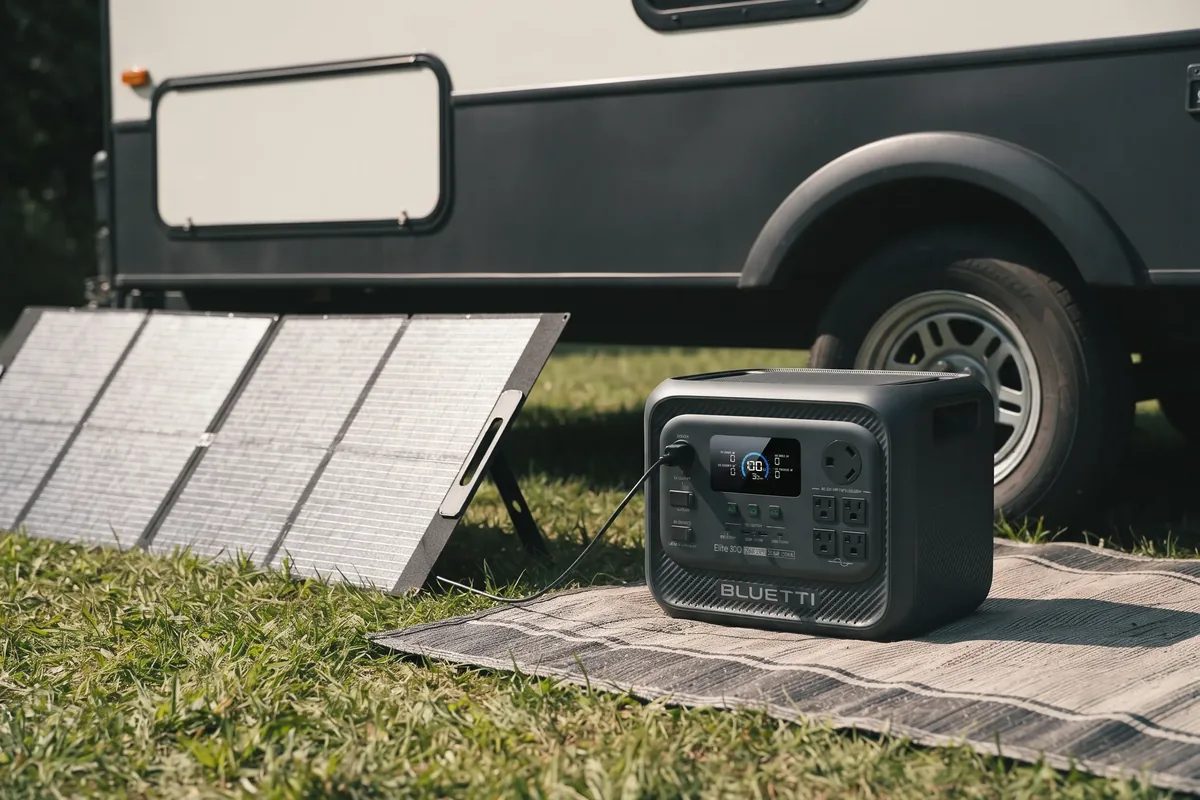
Capacity and real runtime: a fridge and router for about 30 hours
By our estimate its 3,014.4 Wh runs a fridge and router for about 30 hours, more than a full day.
Estimated runtimes on the Elite 300
- CPAP, no humidifier, low-draw (11 W, DC)10.5 days
- CPAP with humidifier, typical (56 W, AC)40 h
- Fridge alone (67 W, AC)34 h
- Fridge + Wi-Fi router30 h
- Space heater (1,500 W, AC)1.7 h
That's a full day of fridge and router backup with room to spare, which is where the Elite 300 sits: between the 2 kWh stations that cover about a day and whole-home systems that cover several. A humidified CPAP gets about five nights, a low-draw one on DC far more. Heat is the exception: a 1,500 W space heater empties it in under two hours.
Because it can't be expanded, 3,014.4 Wh is the ceiling. For longer outages the answer is solar or a generator to refill it, not a second battery. Check your own devices in the runtime calculator, and see how long a power station runs a refrigerator and how long it runs a CPAP.
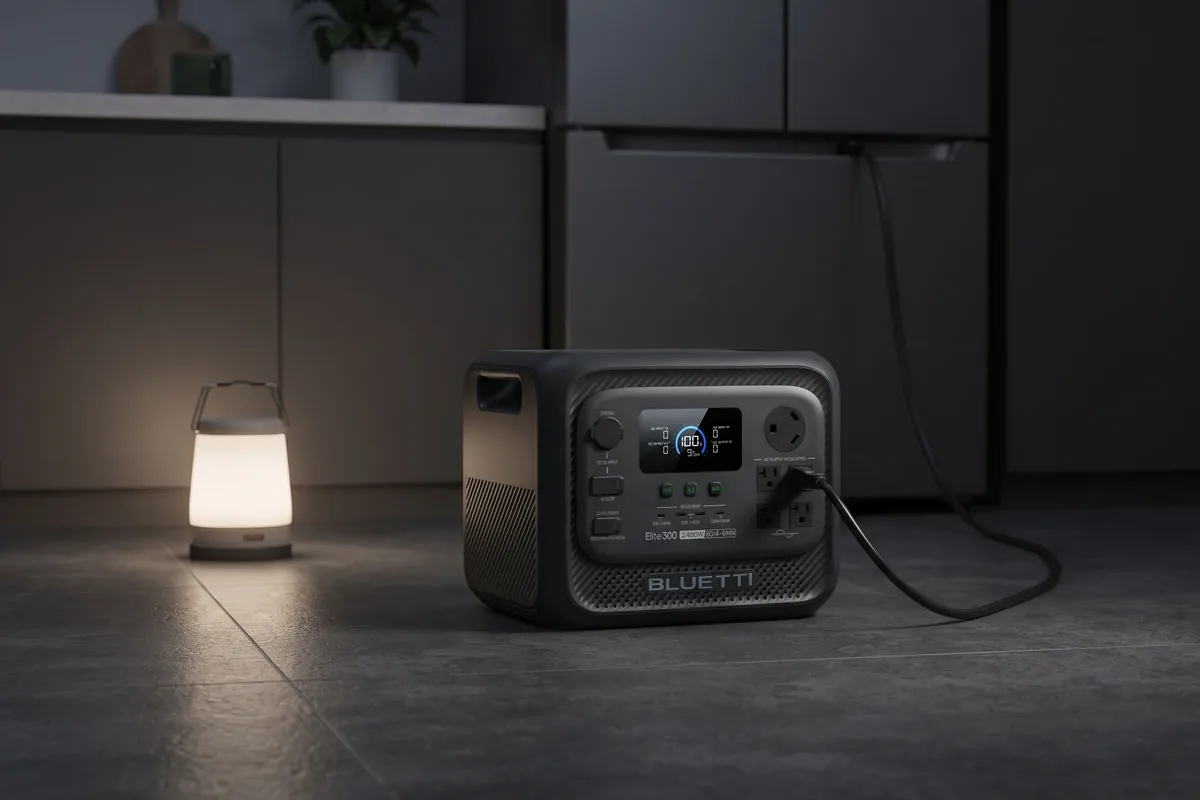
Output: 2,400 W at 120 V, with a TT-30 RV outlet and a 12 V/30 A port
Its 2,400 W covers most single appliances at 120 V, and the TT-30 outlet plugs a travel trailer straight in.
The 2,400 W continuous rating covers a microwave, a coffee maker or a window air conditioner, though not all at once.
Power Lifting mode (off by default) runs pure resistive loads rated 2,400 to 4,800 W, such as kettles, hair dryers and electric blankets, at reduced power. Actual output stays 2,400 W. Bluetti's manual warns that motors and compressors can draw two to four times their rating at startup, which can overload it.
There's no 240 V output, so it can't run 240 V well pumps or dryers.
For RVs, two ports matter:
- TT-30 outlet: takes a travel trailer's 30 A shore-power plug, but the limit is the station's 2,400 W (20 A at 120 V), not the plug's 30 A. Unplug the trailer from campground power first.
- 12 V/30 A DC port: feeds a 12 V system directly, sharing 30 A with the car socket.
A rooftop air conditioner is the hard load. Check its running watts and startup surge against 2,400 W, and expect hours rather than nights. Our best power station for RV guide covers RV loads in detail.
For devices there's a 140 W USB-C, enough for most laptops, a 100 W USB-C and two USB-A ports sharing 15 W.
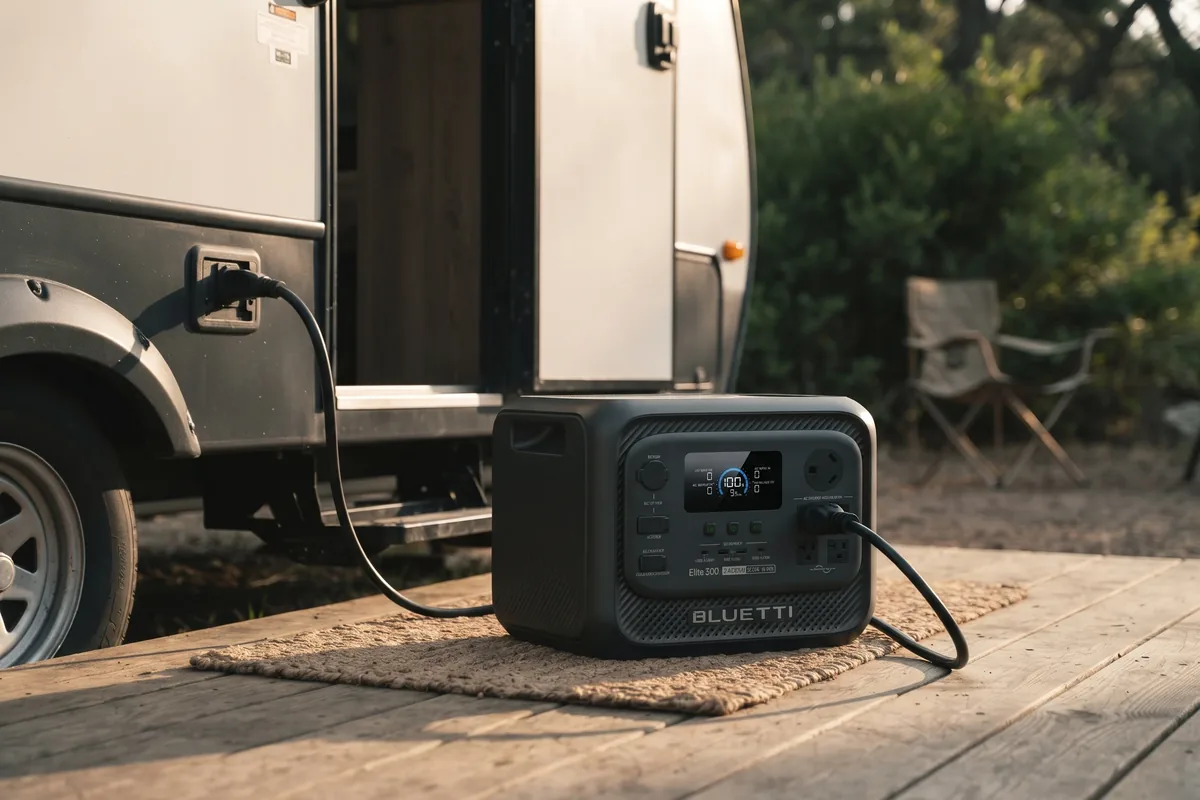
Backup (UPS) and app: a 10 ms switchover, with 1,800 W while on the grid
The Elite 300 switches to battery in 10 ms, fast enough for most desktop PCs, but passes only 1,800 W through from the wall.
Plugged into the wall, the Elite 300 powers the devices on its AC outlets from the grid and switches to battery in 10 ms when the power drops. That's quick enough for routers, modems and most desktop PCs. See using a power station as a UPS.
One limit: while it runs on the grid, pass-through output is 1,800 W, not 2,400 W, so keep the connected load below that.
The app (Wi-Fi and Bluetooth) sets two UPS modes:
- Standard charges from solar first, then the grid.
- Time Control charges in off-peak hours and runs your devices from the battery and solar at peak times.
ECO mode turns the AC or DC outputs off below a load you set (10–40 W for AC, 5–20 W for DC) after 1 to 4 hours. Bluetti says to leave it off for lights, fridges and other critical devices. Over Wi-Fi you can also check it and wake it remotely. If it will sit plugged in for months, read whether you can leave a power station plugged in.
How it compares: the lightest 3 kWh we've reviewed, but no expansion
Against the Apex 300, Anker SOLIX F3000 and HomePower 2000 Plus v2, the Elite 300 is the easiest 3 kWh to move but the only one that can't grow.
| Spec | Bluetti Elite 300 | Bluetti Apex 300 | Anker SOLIX F3000 | Jackery HomePower 2000 Plus v2 |
|---|---|---|---|---|
| Capacity (Wh) | 3014.4 | 2764.8 | 3072 | 2048 |
| AC output, continuous (W) | 2400 | 3840 | 3600 | 2400 |
| AC charge time | 80% in 95 min (Turbo) | 80% in 45 min (Turbo, 3,840 W) | Under 3 h (Anker) | About 1.5 hours (Emergency Charging mode) |
| Max solar input (W) | 1200 | 2,400 W (2 × 1,200 W, Turbo; 1,440 W Standard; 4,000 W with SolarX 4K add-on) | 2400 | 800 |
| Weight (lb) | 57.98 | 83.8 | 91.5 | 41.5 |
| Warranty (years) | 5 | 5 | 5 | 3 + 2 with registration |
| Price | Check price | Check price | Check price | Check price |
- Capacity
- 3,014 Wh
- AC output
- 2,400 W
- Wall charge
- 80% in 95 min
- Solar input
- 1,200 W
- Weight
- 57.98 lb
- Warranty
- 5 years
- Capacity
- 2,765 Wh
- AC output
- 3,840 W
- Wall charge
- 80% in 45 min
- Solar input
- 2,400 W
- Weight
- 83.8 lb
- Warranty
- 5 years
- Capacity
- 3,072 Wh
- AC output
- 3,600 W
- Wall charge
- Under 3 h
- Solar input
- 2,400 W
- Weight
- 91.5 lb
- Warranty
- 5 years
- Capacity
- 2,048 Wh
- AC output
- 2,400 W
- Wall charge
- About 1.5 hours
- Solar input
- 800 W
- Weight
- 41.5 lb
- Warranty
- 3 + 2 years
- Bluetti Apex 300: less capacity (2,764.8 Wh) but 3,840 W at 120/240 V, much faster charging and expansion to about 19.4 kWh per unit. It weighs 83.8 lb and rates 8.7 against the Elite 300's 6.2.
- Anker SOLIX F3000: a similar 3,072 Wh with 3,600 W and a TT-30R outlet, expandable, but 91.5 lb and a 20 ms switchover. It rates 7.4.
- Jackery HomePower 2000 Plus v2: less capacity (2,048 Wh) and the same 2,400 W in 41.5 lb, and it expands to about 12 kWh. It rates 7.8 and is our home backup pick for a full day.
The Elite 300 rates 6.2: top marks for its switchover, its portability for the size and its battery life, but low for charging speed and solar input and zero for expansion (see how we rate). Choosing a brand? See Jackery vs Bluetti, EcoFlow vs Bluetti and Anker SOLIX vs Bluetti.
Who should buy the Bluetti Elite 300: RVs and day-long backup in one unit
Buy it for about 3 kWh you can still lift, with RV outlets; skip it if you'll ever want more capacity.
Good fit: travel trailers with a TT-30 inlet; home backup of a fridge, router, lights and a desktop PC for a day or more; anyone who wants about 3 kWh without the 74 lb or more of the other 3 kWh stations we've reviewed.
Look elsewhere if: you may add batteries later (the HomePower 2000 Plus v2 expands to about 12 kWh), need 240 V or more output (the Apex 300), or want the fastest recharge from the wall. For smaller Bluetti options, see the Elite 200 V2 (2,073.6 Wh). Not sure what size you need? Start with how to choose a portable power station, and see the best portable power stations for our picks in every size.
The Bluetti Elite 300 is also covered in the best portable power station for a refrigerator and best 2000Wh portable power stations guides.
FAQ
Expansion, RV air conditioners, fridges, UPS use, lifespan and warranty for the Elite 300
Is the Bluetti Elite 300 worth it?
It is if you want about 3 kWh in one unit you can lift, with RV outputs, a 10 ms switchover and a 5-year warranty. If you may need more capacity later, an expandable station such as the HomePower 2000 Plus v2 or the Apex 300 is the better buy.
Is the Bluetti Elite 300 expandable?
No. The manual lists no expansion port or battery, so its 3,014.4 Wh can't be increased. Solar (up to 1,200 W) or a generator is how you extend it in a long outage.
Will the Bluetti Elite 300 run an RV air conditioner?
Possibly, if the unit's running watts and startup surge fit within 2,400 W; a soft-start kit lowers the surge. Even then, an air conditioner drains it in hours, not nights.
How long will the Elite 300 run a refrigerator?
By our estimate, about 34 hours for a typical 67 W fridge alone, or about 30 hours with a Wi-Fi router too.
Can the Elite 300 be used as a UPS?
Yes. It switches over in 10 ms, quick enough for most desktop PCs. While it runs on the grid, keep the load under its 1,800 W pass-through limit.
How long will a Bluetti Elite 300 last?
Bluetti rates its LiFePO4 battery for 6,000+ cycles. At one full cycle a day that's about 16 years by our estimate, and backup units cycle far less. See how long power stations last.
What warranty does the Elite 300 have?
Five years (60 months in Bluetti's warranty table).
Is Bluetti better than Jackery or EcoFlow?
It depends on the model, not the brand. Against the Jackery HomePower 2000 Plus v2, the Elite 300 has more capacity (3,014.4 Wh against 2,048 Wh) but can't expand, while the Jackery reaches about 12 kWh and rates higher (7.8 against 6.2). See Jackery vs Bluetti and EcoFlow vs Bluetti.
Does the Elite 300 come with solar panels?
Not on its own: Bluetti's box has the unit, an AC charging cable, a grounding screw and the manual. Bundles add panels, and our Amazon link is for the version with two 200 W panels.