 By
We may earn a commission if you buy through links on this page, at no extra cost to you. This never affects which products we recommend. How we make money.
On this page 8 sections
Our verdict · Anker
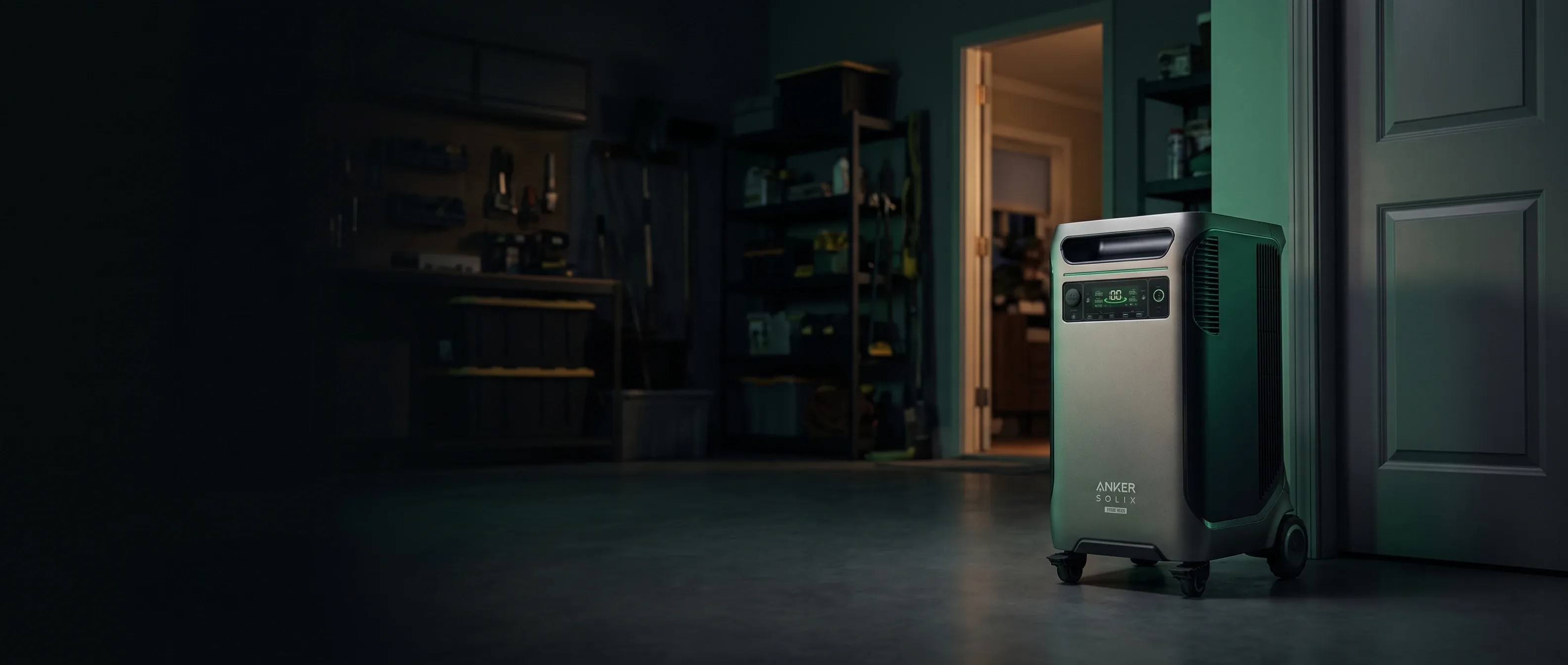
A 3 kWh, 3,600 W home and RV station that grows to 12 kWh, if you can move 91.5 lb
The F3000 pairs a 3 kWh battery with a 3,600 W inverter, an RV-style TT-30R outlet and 2,400 W of solar input, and it takes up to three extra batteries. It rates 7.4, below the Bluetti Apex 300 (8.7) and the Jackery HomePower 2000 Plus v2 (7.8): slow wall charging for its size, its weight and a 20 ms switchover hold it back.
- Capacity
- 3,072 Wh
- AC output
- 3,600 W
- Wall charge
- Under 3 h
- Weight
- 91.5 lb
Best for
Home backup on 120 V circuits and RVs with a 30-amp TT-30 hookup, where 3,600 W of output, big solar input and the option to add batteries matter more than weight.
Skip it if
You need 240 V from one unit, a sub-10 ms switchover for a desktop PC, or something you can lift into a car.
- 3,072 Wh LiFePO4, 4,000 cycles to 80%
- 3,600 W continuous, 7,200 W surge, TT-30R outlet
- 2,400 W solar over two inputs
- Expands to 12,288 Wh with three BP3000s
- 5-year warranty
- 91.5 lb (wheels and pull rod help)
- 1,800 W from a standard wall outlet
- 20 ms switchover
- 120 V only without a second unit
Rating breakdown (large (2 to 3 kwh) class)
| Criterion | Weight | Score | Based on |
|---|---|---|---|
| Wall charging speed | 20% | 3.2 | 1,800 W input |
| AC output | 20% | 10.0 | 3,600 W |
| Solar input | 10% | 9.7 | 2,400 W |
| Backup switchover | 15% | 6.0 | 20 ms |
| Portability | 10% | 4.5 | 34 Wh/lb |
| Expandability | 10% | 9.0 | to 12,288 Wh |
| Battery life & warranty | 15% | 10.0 | 5-year warranty, 4,000+ cycles |
| Capacity (Wh) | 3072 |
|---|---|
| Battery chemistry | LiFePO4 |
| Rated cycle life | 4,000 cycles to 80% |
| AC output, continuous (W) | 3600 |
| AC output, surge (W) | 7200 |
| AC charge time | Under 3 h (Anker) |
| Max AC charging input (W) | 1800 |
| Max solar input (W) | 2400 |
| Solar input voltage range | High-PV 11–165 V, 17 A (1,600 W) + low-PV 11–60 V, 17 A (800 W) |
| UPS switchover (ms) | 20 |
| Weight (lb) | 91.5 |
| Expandable to (Wh) | 12288 |
| Warranty (years) | 5 |
Anker SOLIX F3000 key specs
3,072 Wh and 3,600 W in a 91.5 lb wheeled unit
- 3,072 Wh LiFePO4 (51.2 V, 60 Ah), which Anker rates to keep over 80% after 4,000 cycles. That puts it in our Large band (2 to 3 kWh class). See LiFePO4 vs lithium-ion.
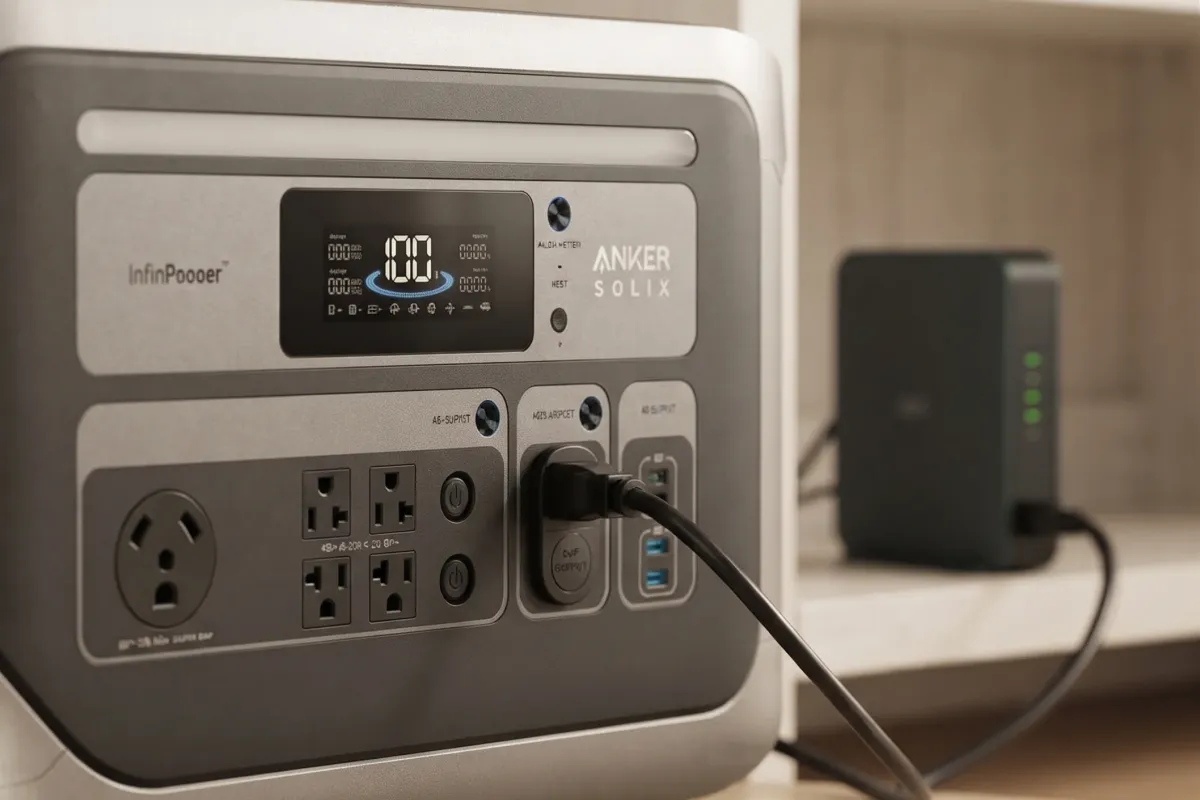
- 3,600 W continuous, 7,200 W surge across four NEMA 5-20R outlets (2,400 W max each) and one TT-30R (3,600 W), the 30-amp RV plug. All at 120 V.
- Expandable to 12,288 Wh per unit with up to three BP3000 batteries (3,072 Wh, 55.12 lb each). Anker's "24 kWh" headline is two linked F3000s, not one.
- 91.5 lb and 25.6 × 11.8 × 14.8 in, with wheels, a pull rod and a handle; Anker calls it an "EasyTow" suitcase design.
- UL 9540 certified, the standard for energy storage systems.
- 5-year warranty, confirmed by the owner for this review.
Expansion adds weight as well as capacity: with all three BP3000s the system weighs about 256.9 lb in total (91.5 lb plus 3 × 55.12 lb), so plan where it will live. The BP3000 also fits the Anker SOLIX C2000 Gen 2, so a battery bought for one can serve the other.
Small devices get four 100 W USB-C ports, 12 W USB-A ports, a 12 V car outlet (10 A) and an Anderson port (13.4 V, 30 A). For which spec answers which question, see watts vs watt-hours.
Charging speed: under 3 hours from the wall (Anker), about 1.7 hours on solar by our estimate
A standard outlet gives 1,800 W; the TT-30 cable or EV adapter doubles that to 3,600 W.
From an ordinary 120 V outlet the F3000 charges at up to 1,800 W. With Anker's TT-30 cable (from a generator or RV pedestal) or its EV-charger adapter (J1772, at 240 V), it takes up to 3,600 W. Anker quotes under 3 hours for both, without a separate 80% figure. For a 3 kWh battery, 1,800 W from the wall is on the slow side: that's why its wall-charging score (3.2) is its weakest.
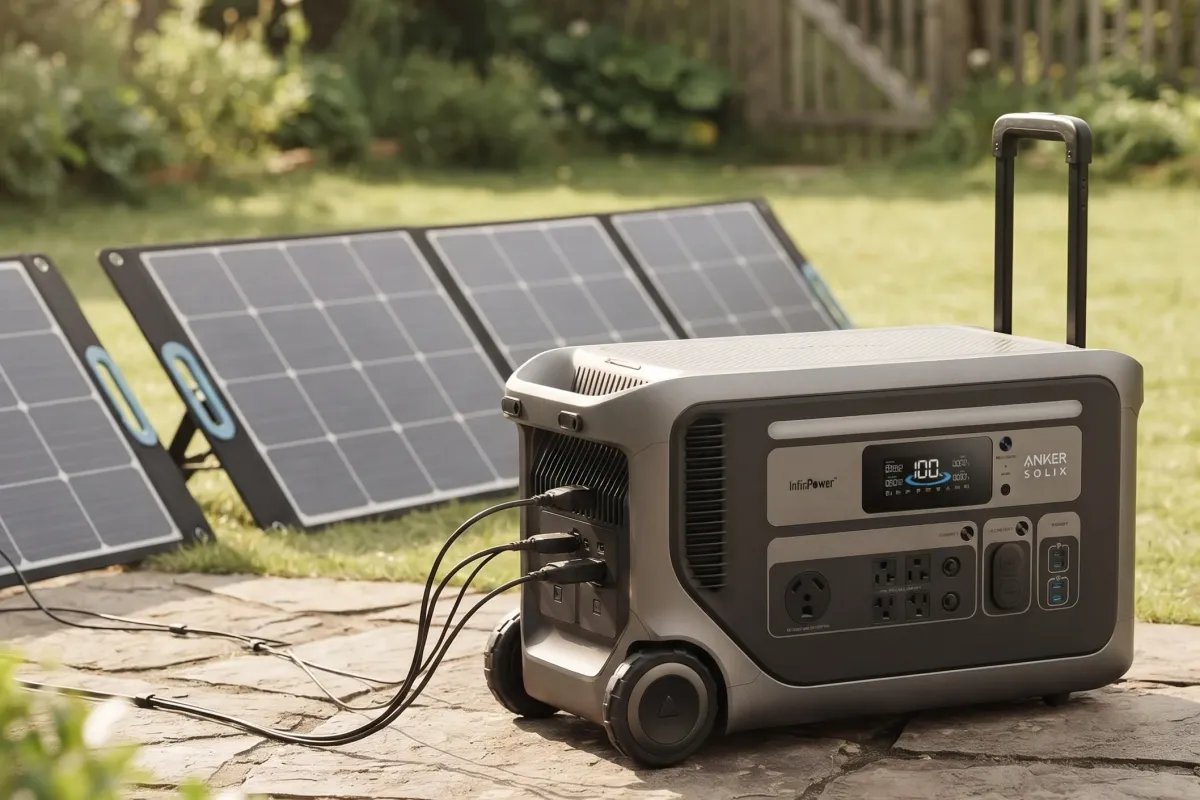
Solar comes in through two inputs that work together (as an example of ours, four 400 W panels on the high-PV input and two on the low-PV input reach 2,400 W, as long as each string's open-circuit voltage stays inside that input's limit):
| Input | Voltage | Current | Max |
|---|---|---|---|
| High-PV | 11–165 V | 17 A | 1,600 W |
| Low-PV | 11–60 V | 17 A | 800 W |
With the full 2,400 W of panels, Anker quotes a full solar charge in 1.5 hours (elsewhere on its page, "under 2 hours"). By our estimate at 75% of the panels' rating, it's about 1.7 hours of strong sun. The high-PV input's 165 V limit allows long series strings; see series vs parallel solar panels and solar panel sizing.
Cold weather: Anker rates charging at 32–104°F and use at −4–104°F. Below freezing it won't take a charge from the wall, solar or a generator until the battery warms; see using a power station in cold weather.
Generator charging: it works with most 120 V gas generators through the TT-30 input, and with the 120 V side of a 240 V generator. While a generator is connected, the F3000 runs in bypass and switches back to battery in 35 ms if the generator stops, by Anker's figure.
Capacity and real runtime: a fridge for more than a day
Its 3,072 Wh runs a fridge and router for about 30 hours by our estimate.
Estimated runtimes on the F3000
- CPAP, no humidifier, low-draw (11 W, DC)10.7 days
- CPAP with humidifier, typical (56 W, AC)41 h
- Fridge alone (67 W average)35 h
- Fridge + Wi-Fi router30 h
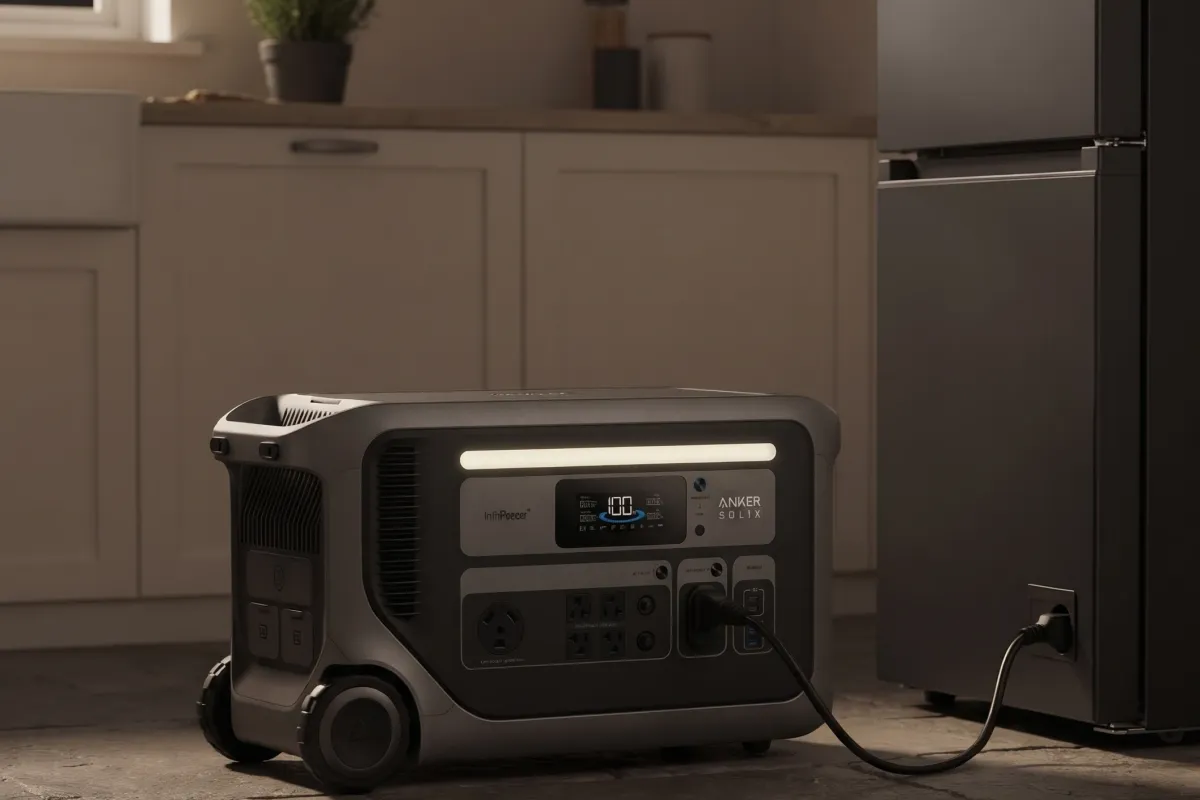
A fridge and router for about 30 hours means a full day and night of essentials from one charge. With all three BP3000 batteries (12,288 Wh), the same pair would run for about 120 hours, roughly five days, by the same estimate. For a multi-day outage plan, see the best stations for home backup and try your own devices in the runtime calculator.
Heavier loads drain it much faster. A 10,000 BTU window air conditioner, which a generator maker's chart puts at 900 to 1,200 running watts, would run for roughly 2.2 to 2.9 hours on the F3000 alone by our estimate, or about 8.6 hours at 1,200 W with three BP3000s. For cooling, plan on solar or a generator as well.
Anker says it lasts up to 125 hours in standby, but gives no idle draw in watts; we use the site's 10 W allowance for AC loads.
Output: 3,600 W and a TT-30R outlet for RVs
It runs two big appliances at once, a 30-amp RV and most household motors on 120 V.
The 3,600 W inverter is the F3000's strongest point (a full 10 on our output score). It can run a microwave and a coffee maker together, a window air conditioner, or a sump pump, as long as the total stays under 3,600 W and no single 5-20R outlet goes over 2,400 W. The 7,200 W surge covers the start of most 120 V motors; see surge watts vs running watts. (Anker also lists a 4,860 W "SurgePad" figure, a separate boost mode.)
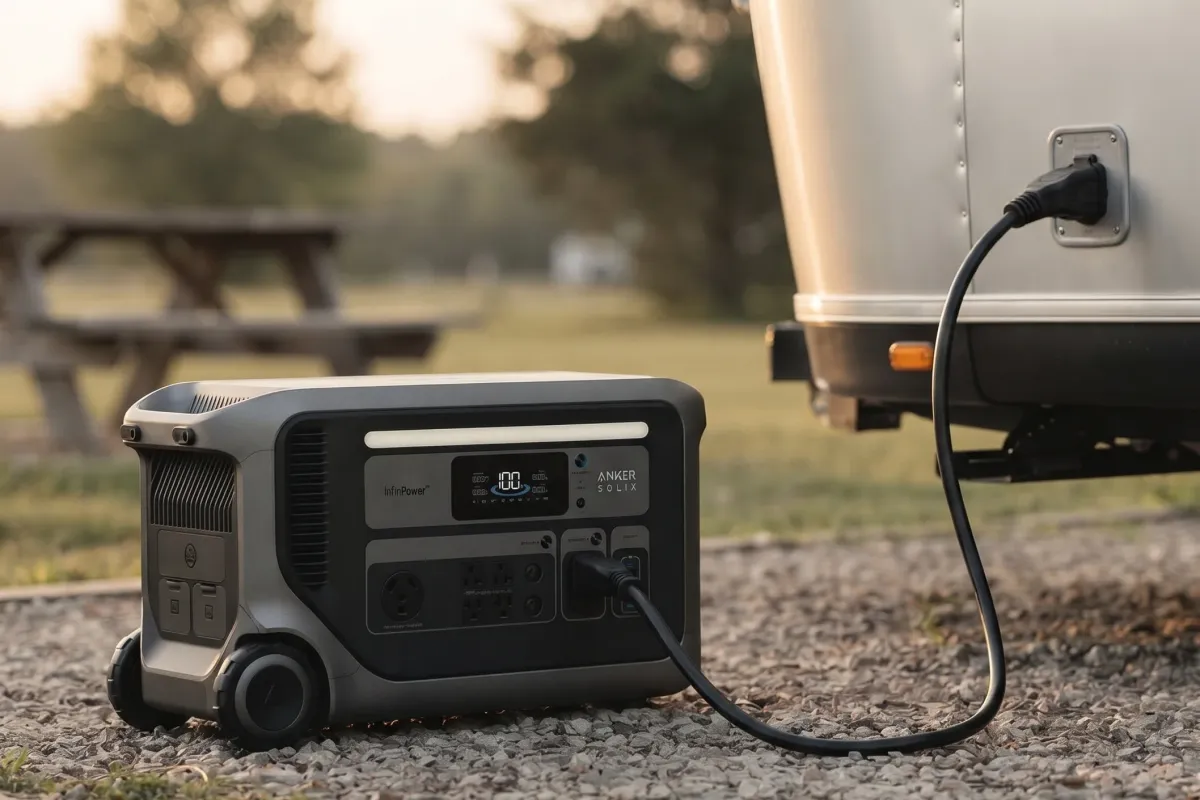
The TT-30R outlet takes a 30-amp RV cord directly, which makes it a strong fit for travel trailers; see the best power stations for RVs.
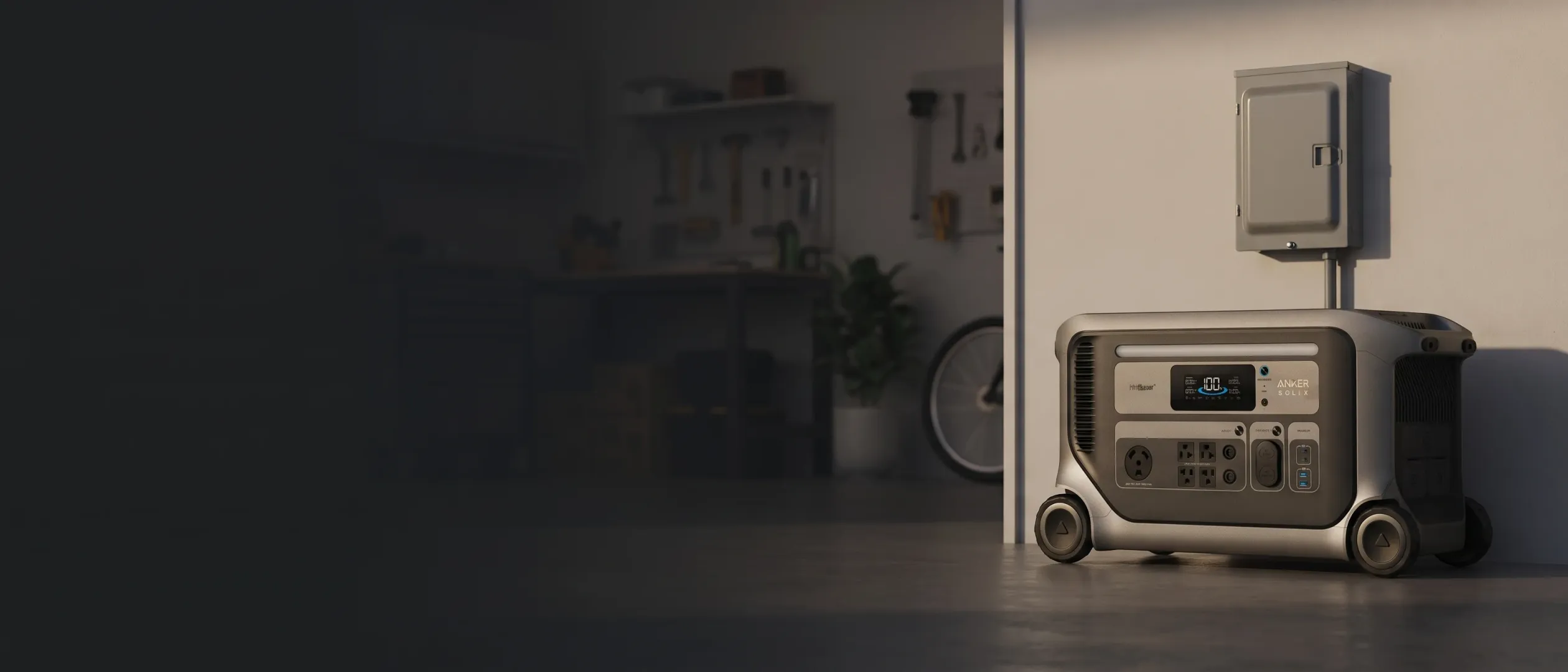
What it won't do on its own: 240 V. One F3000 is 120 V only, so it can't run a 240 V well pump, dryer or a 240 V transfer switch. Two F3000s linked through Anker's Double Voltage Hub give 240 V and 7,200 W through L14-30R and 6-20 outlets. Wired to a home through Anker's Bi-Directional Inlet Box, the F3000 delivers up to 1,800 W, by Anker's figure; see transfer switches for power stations.
Backup (UPS) and app: a 20 ms switchover on every AC outlet
Fine for routers, lights and fridges; test a desktop PC before relying on it.
All five AC outlets (the four 5-20R and the TT-30R) switch from grid to battery in 20 ms when the power drops. That keeps routers, modems, lights, fridges and most laptops running; some desktop PCs need 10 ms or less, so test yours. In this size, the HomePower 2000 Plus v2 switches in 10 ms, and the Apex 300 reaches 0 ms on two outlets in its 240 V setting (20 ms otherwise). More in using a power station as a UPS.
The Anker app connects over Bluetooth or Wi-Fi to monitor input and output and change charging settings. Anker's FAQ also covers using the F3000 to lower electricity bills by charging when power is cheap and running devices from the battery at peak times; how much that saves depends on your utility's rates, so check them before counting on it.
Because every AC outlet has the 20 ms switchover, you can leave a fridge, router and lights plugged in permanently and let the F3000 take over in a power cut, then recharge it from the wall once the grid returns.
How the F3000 compares: 3,600 W and 2,400 W solar, fourth-rated in the Large band
Stronger output and solar than the 2 kWh class, but heavier and slower from the wall
| Spec | Anker SOLIX F3000 | Jackery HomePower 2000 Plus v2 | Bluetti Apex 300 | Anker SOLIX F3800 Plus |
|---|---|---|---|---|
| Capacity (Wh) | 3072 | 2048 | 2764.8 | 3840 |
| AC output, continuous (W) | 3600 | 2400 | 3840 | 6000 |
| AC charge time | Under 3 h (Anker) | About 1.5 hours (Emergency Charging mode) | 80% in 45 min (Turbo, 3,840 W; 1,440 W Standard) | — |
| Max solar input (W) | 2400 | 800 | 2,400 W (2 × 1,200 W, Turbo; 1,440 W Standard; 4,000 W with SolarX 4K add-on) | 3200 |
| Weight (lb) | 91.5 | 41.5 | 83.8 | 136.7 |
| Warranty (years) | 5 | 3 + 2 with registration | 5 | 5 |
| Price | Check price | Check price | Check price | Check price |
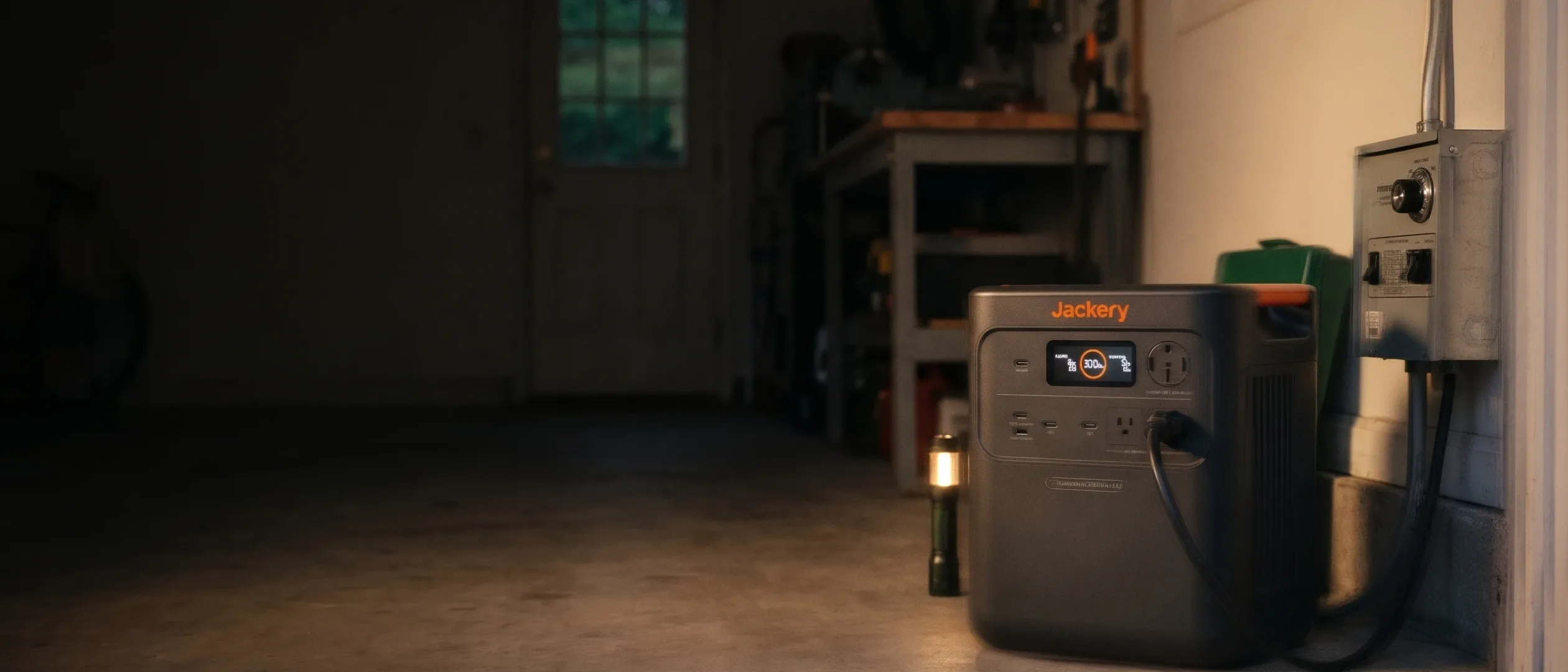
- Jackery HomePower 2000 Plus v2: less capacity (2,048 Wh) and 2,400 W, but half the weight (41.5 lb), a 10 ms switchover, and expandable to 12,288 Wh. Rated 7.8 against the F3000's 7.4: lighter, quicker to switch and rated for 6,000 cycles to 70%+, but far less output and solar.
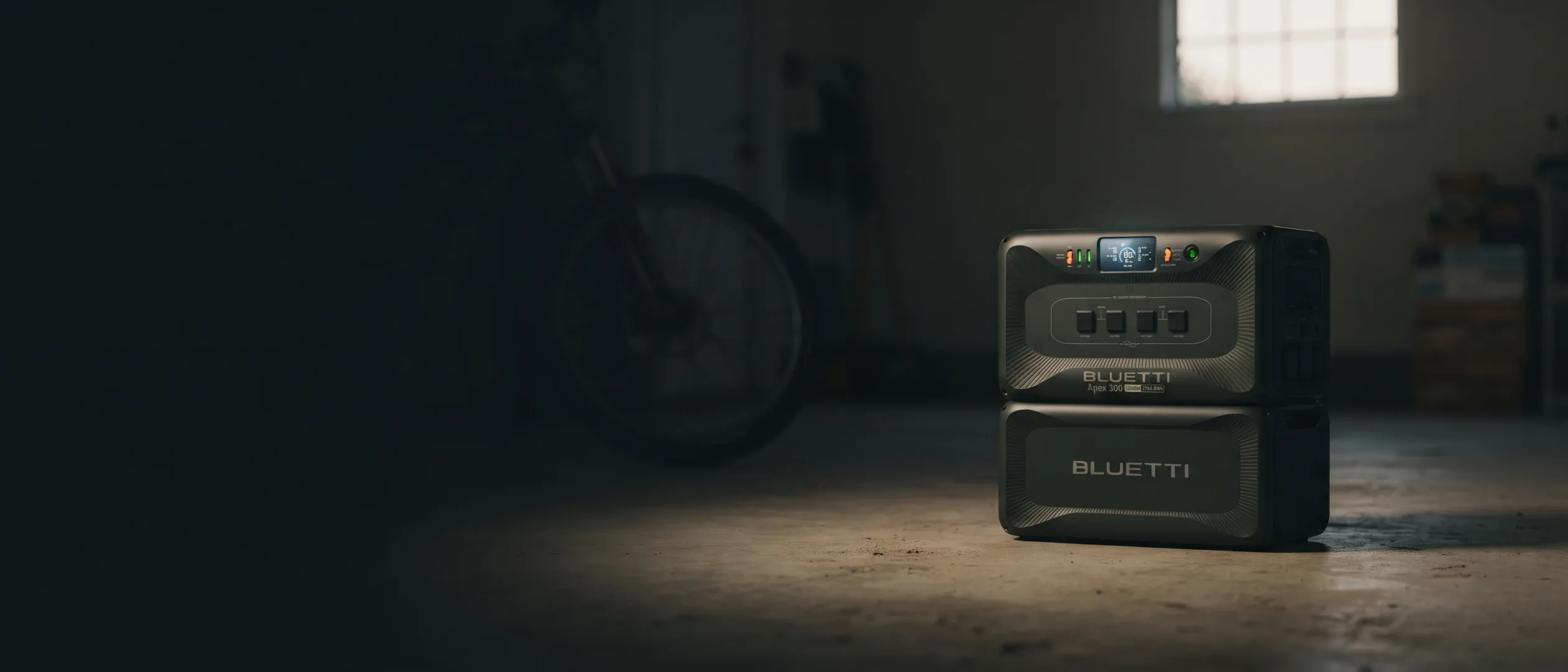
- Bluetti Apex 300: 2,764.8 Wh and 3,840 W at 83.8 lb, with faster wall charging and a switchover of 0 ms on two outlets in its 240 V setting (20 ms otherwise). Rated 8.7, the top Large station we review.
- Anker SOLIX F3800 Plus: the bigger sibling: 3,840 Wh, 6,000 W and 120/240 V from one unit, with an L14-30R outlet, but 136.7 lb. Rated 7.8 in our Whole-home band. Pick it if you need 240 V without a second unit.
The Anker SOLIX C2000 Gen 2 uses the same BP3000 expansion battery; it's lighter (41.7 lb) and rates 7.5, just above the F3000, on faster wall charging and a 10 ms switchover, but with 2,400 W and 800 W of solar. Pick it if you don't need the F3000's 3,600 W and TT-30R.
Who should buy the Anker SOLIX F3000
Best for 120 V home backup and 30-amp RVs that want 3,600 W and room to grow.
Good fit: home backup for essentials on 120 V circuits; travel trailers with a TT-30 hookup; anyone who wants to start at 3 kWh and add batteries later; generator owners who want to charge at 3,600 W through the TT-30 input.
Is it worth it? Yes, if 3,600 W and the TT-30R outlet matter to you and the station mostly stays put. No, if you need 240 V from one unit (the F3800 Plus or Apex 300), a faster switchover for a PC, or a lighter station (the HomePower 2000 Plus v2 is 41.5 lb).
For whole-house plans, see whole-home battery backup.
FAQ
240 V, expansion, generator charging, the F3800 Plus and known limits
Can the Anker SOLIX F3000 do 240 V?
Not on its own: one F3000 is 120 V only. Two F3000s linked through Anker's Double Voltage Hub give 240 V and 7,200 W through L14-30R and 6-20 outlets.
How far can you expand the F3000?
Up to three BP3000 batteries per unit, for 12,288 Wh in total. Anker's "24 kWh" figure is two linked F3000s, each with three batteries.
Can you charge the F3000 from a generator?
Yes. It works with most 120 V gas generators that have a TT-30 plug or adapter, at up to 3,600 W, and with the 120 V output of a 240 V generator. It passes generator power through to your devices and switches back to battery in 35 ms if the generator stops.
F3000 or F3800 Plus?
The F3800 Plus is bigger (3,840 Wh), stronger (6,000 W) and gives 120/240 V from one unit, but weighs 136.7 lb. The F3000 is the lighter 120 V option at 91.5 lb, with a TT-30R outlet for RVs.
Does the F3000 have known problems?
The CPSC lists no recall for the F3000 (Anker's recalls have been power banks). The practical limits are in its specs: 91.5 lb, 120 V only on one unit, a 20 ms switchover, 1,800 W charging from a standard outlet, and no charging below 32°F (it runs from −4 to 104°F).
How heavy is the F3000 with expansion batteries?
The F3000 weighs 91.5 lb on its own. Each BP3000 adds 55.12 lb, so with all three the system weighs about 256.9 lb. The main unit has wheels and a pull rod; the batteries are best set up once and left in place.
Can the F3000 run a window air conditioner?
Yes, a typical 10,000 BTU window unit (900 to 1,200 running watts on a generator maker's chart) is well within its 3,600 W output, and the 7,200 W surge covers the compressor start. Runtime is the limit: about 2.2 to 2.9 hours on the F3000 alone by our estimate.
What's in the F3000's warranty?
Five years, the same term Anker gives its BP3000 batteries.
Is the F3000 a solar generator?
With solar panels, yes: "solar generator" is a name for a power station sold with panels. Its two inputs take up to 2,400 W; see solar generator vs portable power station.