 By
We may earn a commission if you buy through links on this page, at no extra cost to you. This never affects which products we recommend. How we make money.
On this page 9 sections
Our verdict · Jackery
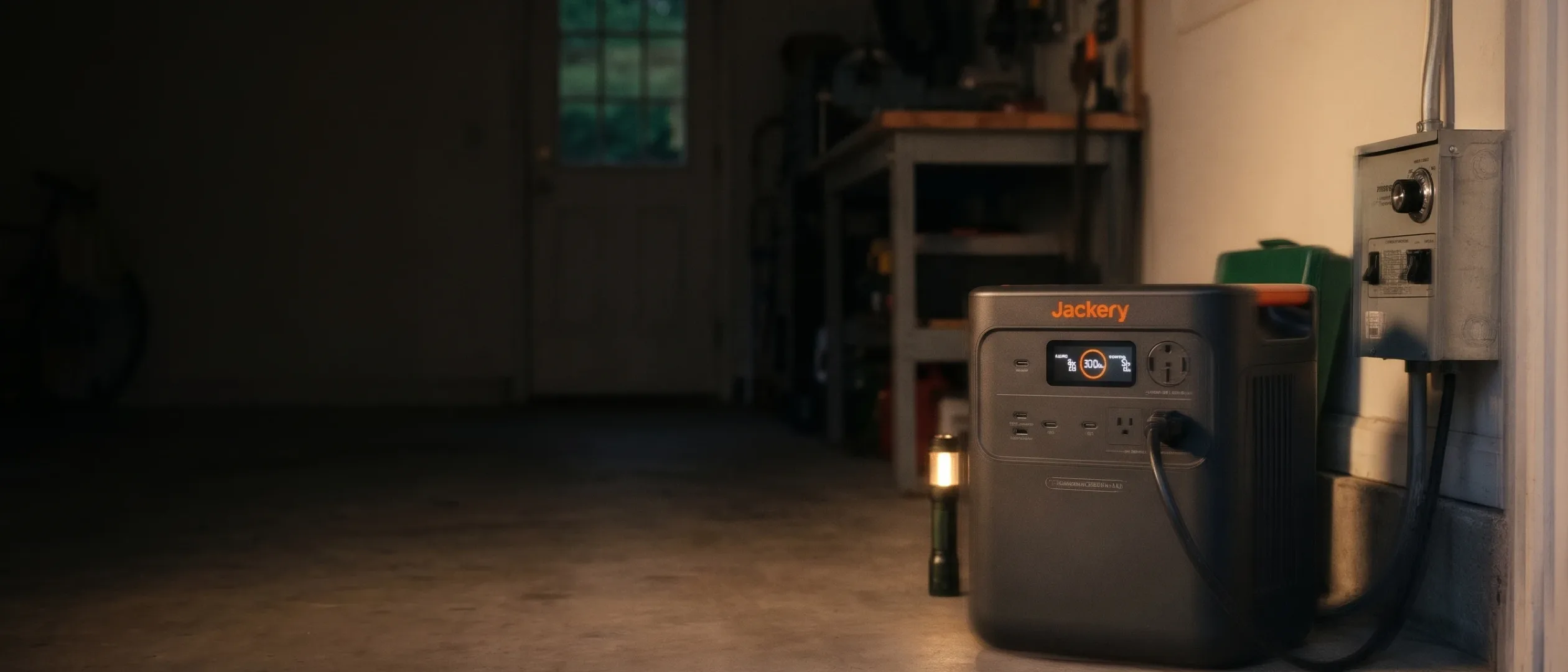
A 3.6 kWh home backup station with real 240 V output
Gives you 3.6 kWh and genuine 240 V output in one box, switches over in under 10 ms and can grow to about 21.5 kWh. The catch: 120 V output is limited to 2,000 W, and it's heavy.
- Capacity
- 3,584 Wh
- AC output
- 4,000 W
- Wall charge
- 1.3 h
- Weight
- 73.9 lb
Best for
Home backup that needs 240 V for a well pump, dryer or transfer switch, plus a fridge, router and CPAP through a long outage.
Skip it if
You only need 120 V, want to carry it around often, or need more than 4,000 W without buying a second unit.
- 3,584 Wh LiFePO4, 6,000 cycles
- 4,000 W at 240 V (8,000 W peak)
- 1.3-hour charge with the optional 40 A cable
- Under 10 ms UPS switchover
- Only 2,000 W at 120 V
- About 73.9 lb with no wheels
- 25 W standby draw
- 1-year warranty
Rating breakdown (whole-home (3.5 kwh and up) class)
| Criterion | Weight | Score | Based on |
|---|---|---|---|
| Wall charging speed | 20% | 5.0 | 1,800 W input |
| AC output | 20% | 3.3 | 4,000 W |
| Solar input | 10% | 2.2 | 1,200 W |
| Backup switchover | 15% | 10.0 | <10 ms |
| Portability | 10% | 10.0 | 48 Wh/lb |
| Expandability | 10% | 10.0 | to 21,504 Wh |
| Battery life & warranty | 15% | 6.0 | 1-year warranty, 6,000+ cycles |
| Capacity (Wh) | 3584 |
|---|---|
| Battery chemistry | LiFePO4 |
| Rated cycle life | 6,000 cycles to 70% |
| AC output, continuous (W) | 4000 |
| AC output, surge (W) | 8000 |
| AC charge time | 1.3 h (240 V, optional 40 A cable) |
| Max AC charging input (W) | 1800 |
| Max solar input (W) | 1200 |
| Solar input voltage range | 2 × DC8020 inputs |
| UPS switchover (ms) | <10 |
| Weight (lb) | 73.9 |
| Expandable to (Wh) | 21504 |
| Warranty (years) | 1 |
Key specs at a glance
What the numbers mean in practice
- 3,584 Wh capacity: a very large battery. Enough to keep a fridge and router going for well over a day, or a CPAP for most of a week on DC.
- 4,000 W at 240 V, 2,000 W at 120 V: the full 4,000 W is only available on the 240 V outlet; ordinary household outlets share 2,000 W.
- Peak output 4,000 W at 120 V and 8,000 W at 240 V: helps start motors such as well pumps.
- LiFePO4, 6,000 cycles to 70%: the long-life chemistry. See LiFePO4 vs lithium-ion.
- About 73.9 lb (33.5 kg): a station you place once, not one you carry around.
- UL 9540 certified, with an emergency power-off (EPO) switch.
- Expandable to about 21.5 kWh with up to five Jackery Battery Pack 3600 units, or about 43 kWh with two units in parallel.
- Warranty: 1 year, shorter than most rivals in this class.
Spec sheets are easy to misread; watts vs watt-hours explains which number answers which question.
Charging speed
Fast on 240 V, ordinary on 120 V
From a standard 120 V wall outlet it takes up to 1,800 W. Jackery doesn't state a full charge time on 120 V. At that rate, expect about two and a half hours or more from empty.
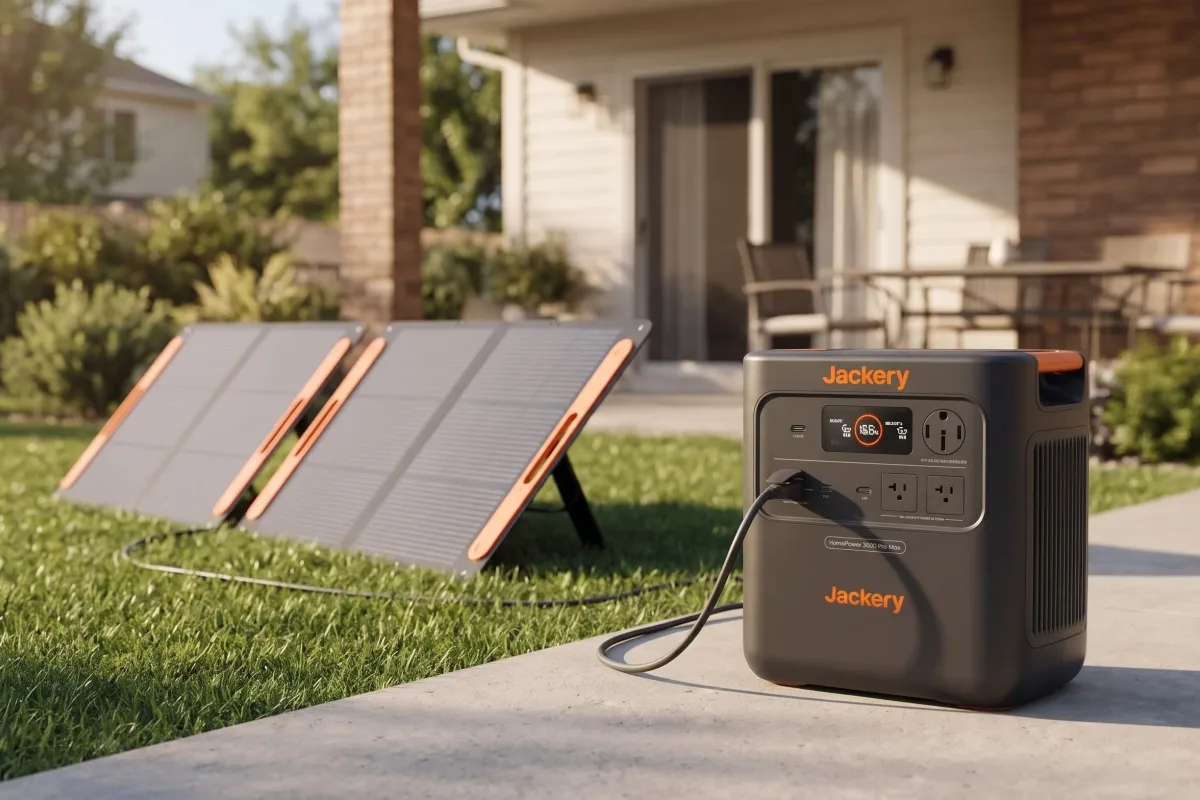
With the optional 40 A charging cable on a 240 V outlet, such as a dryer or EV outlet, Jackery quotes a full charge in about 1.3 hours. That matters when grid power returns briefly during a long outage.
It accepts up to 1,200 W of solar across two inputs. The Amazon bundle covered here adds two 200 W SolarSaga panels (400 W). That's enough to top up a day's essentials in good sun, but it won't refill the battery in a day. (A station sold with panels like this is what brands call a solar generator.) Add panels to use more of the input; see what size solar panel you need. Jackery lists 8 ways to recharge in total, including a gas generator (see power station vs generator for using the two together).
Capacity and real runtime
How long it actually keeps things running
Estimated runtimes on the HomePower 3600 Pro Max
- CPAP, no humidifier, DC cord3.9 days
- CPAP with humidifier, AC33 h
- Fridge + Wi-Fi router33 h
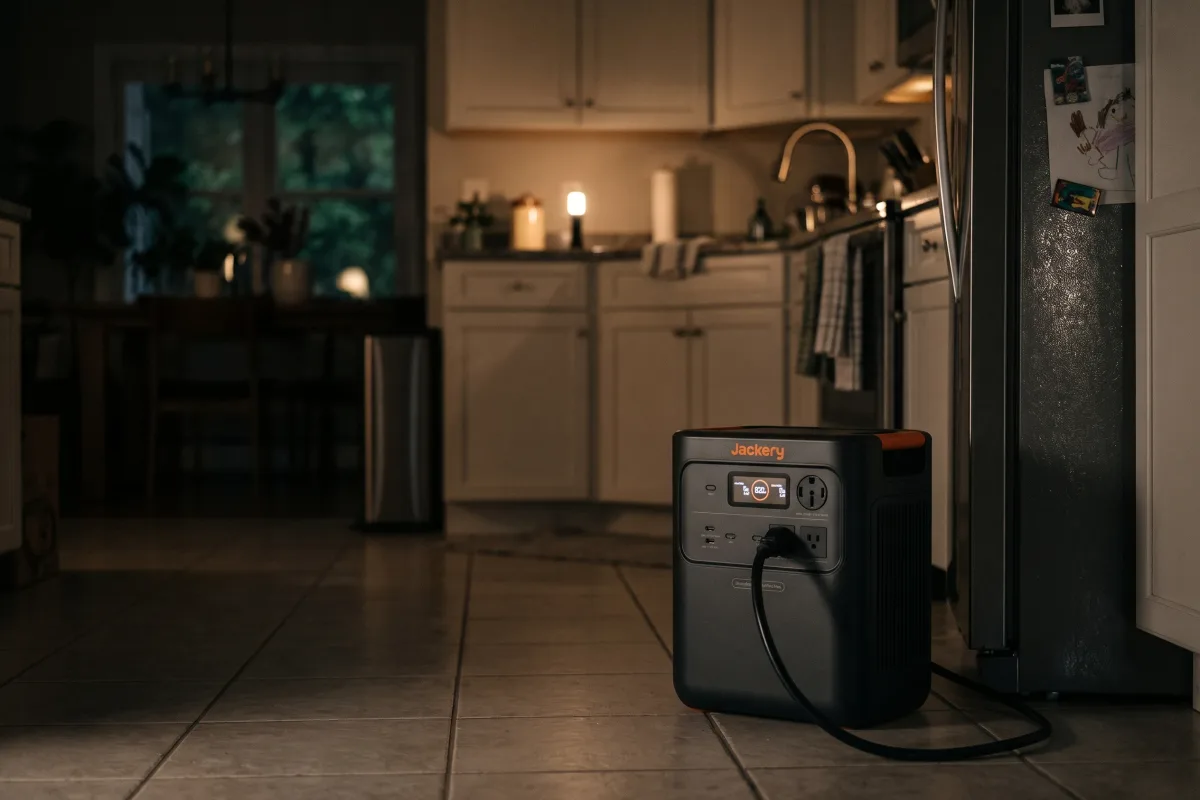
A fridge and router for well over a day is realistic on one charge. Its 25 W standby draw is higher than most smaller stations, so switch AC off when you don't need it. Each added battery pack roughly doubles the base capacity. Try your own devices in the runtime calculator.
Output: what it can and can't run
Strong at 240 V, modest at 120 V
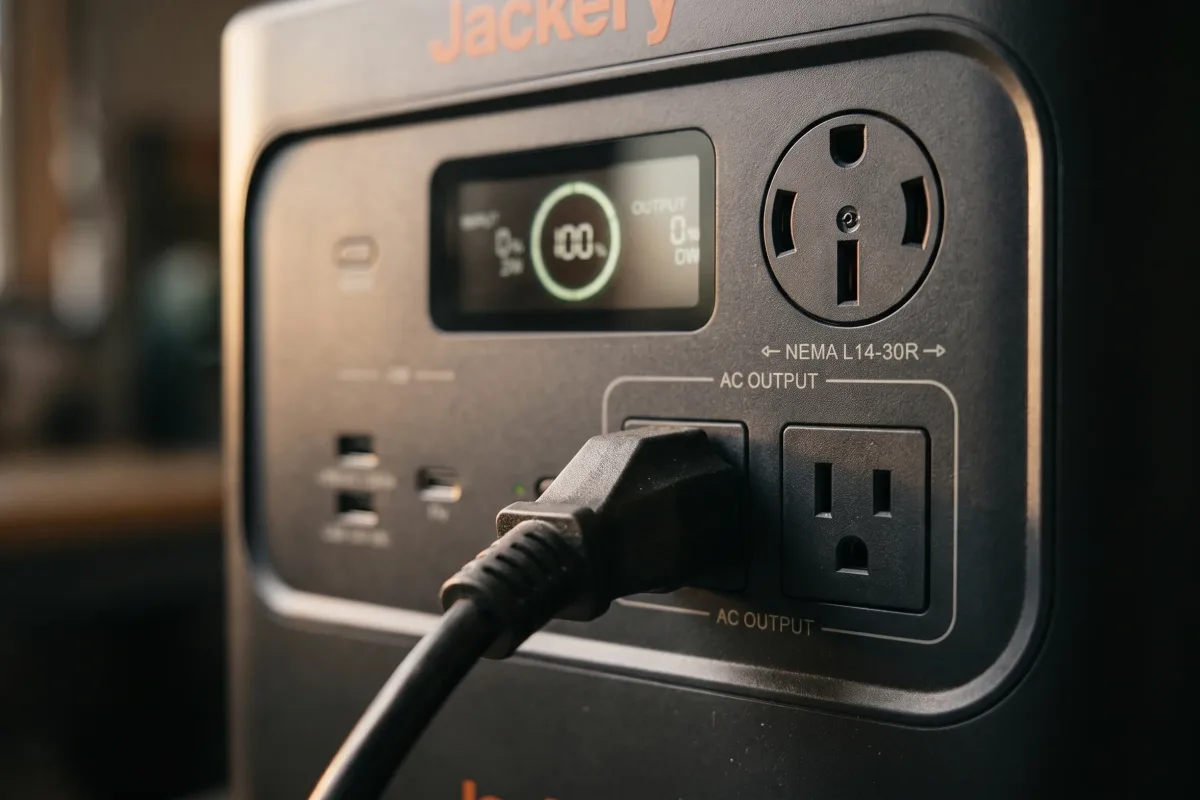
Its standout is the NEMA 14-50 outlet, which supplies 120/240 V at up to 4,000 W (8,000 W peak). With a manual transfer switch installed by a licensed electrician, it can feed selected home circuits. That includes 240 V loads like a well pump. Its NEMA 5-20 outlets cover everyday 120 V appliances, and USB-C (100 W) and USB-A (18 W) handle phones and laptops.
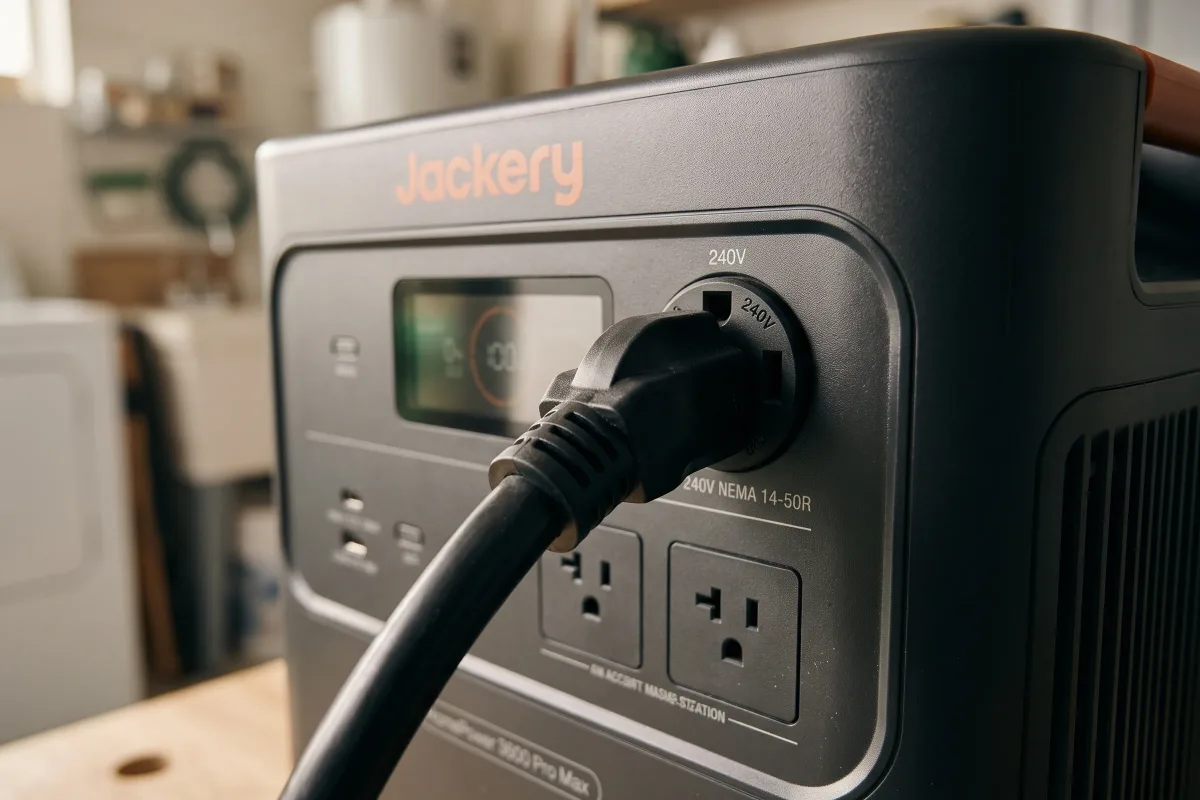
What it won't do well: run more than 2,000 W of 120 V appliances at once. A microwave and a kettle together is too much. It also can't power central air or an electric range, or supply over 4,000 W without a second unit. For 6,000 W from one unit, look at the Anker SOLIX F3800 Plus.
Backup (UPS) and app
Fast switchover for computers and routers
The HomePower 3600 Pro Max switches to battery in under 10 ms when the grid drops. That's fast enough for most computers, routers and networking gear. It can also charge from a 120 V outlet while powering loads.
The Jackery app (Wi-Fi and Bluetooth) lets you monitor output and change settings. A Time-of-Use mode charges when electricity is cheap and runs your loads when rates peak. Savings depend on your utility's rates and how much battery you have.
Noise
Quiet Mode for bedrooms
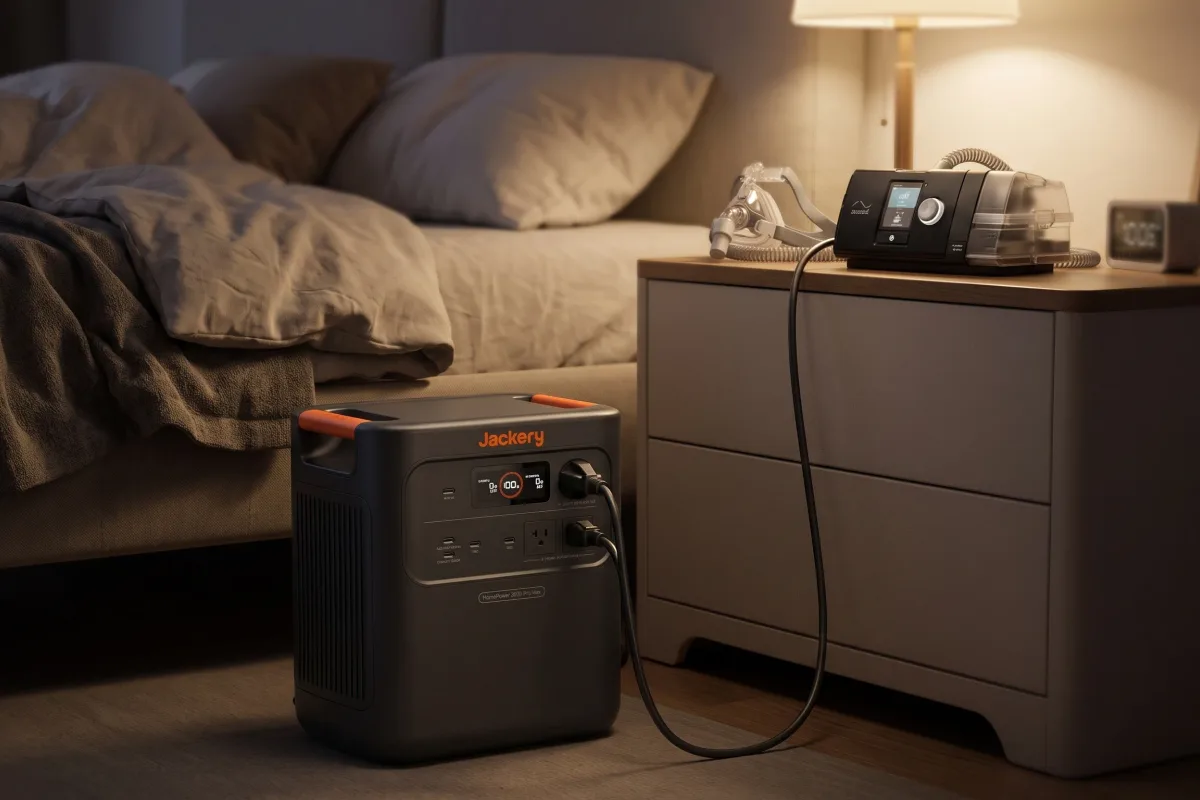
Jackery rates it at under 30 dB in Quiet Mode at 1 meter, quiet enough for a bedroom. Expect louder fans when charging fast or running heavy loads.
How it compares
Against other large home backup stations
| Spec | Jackery HomePower 3600 Pro Max | Anker SOLIX F3800 Plus | Jackery HomePower 2000 Plus v2 |
|---|---|---|---|
| Capacity (Wh) | 3584 | 3840 | 2048 |
| AC output, continuous (W) | 4000 | 6000 | 2400 |
| AC charge time | 1.3 h (240 V, optional 40 A cable) | — | Not stated |
| Max solar input (W) | 1200 | 3200 | 800 |
| Weight (lb) | 73.9 | 136.7 | 41.5 |
| Warranty (years) | 1 | 5 | 3 + 2 with registration |
| Price | Check price | Check price | Check price |
- Anker SOLIX F3800 Plus: similar capacity (3,840 Wh) with much more output (6,000 W) and solar (3,200 W), but nearly twice the weight and a slower 20 ms switchover.
- Jackery Explorer 5000 Plus: 5,040 Wh and 7,200 W at 120/240 V, with a 5-year warranty.
- EcoFlow DELTA Pro: 3,600 Wh at 120 V only from one unit.
- Jackery HomePower 2000 Plus v2: 2,048 Wh and 2,400 W at 120 V only, but much lighter (41.5 lb).
- EcoFlow DELTA Pro 3: 4,096 Wh and 4,000 W at 120/240 V from one unit, with a 10 ms switchover and expansion to 48 kWh.
- Bluetti Apex 300: 2,764.8 Wh and 3,840 W at 120/240 V in 83.8 lb, with expansion batteries for more capacity.
The HomePower 3600 Pro Max sits between them: 240 V output and lots of capacity in a unit one person can still move.
Who should buy it
And who should look elsewhere
Good fit: home backup that needs 240 V for a well pump or transfer switch; long outages where 3.6 kWh and expansion to about 21.5 kWh matter; anyone who wants solar included from day one.
Look elsewhere if: you only need 120 V for a fridge and router (the HomePower 2000 Plus v2 is lighter), you need more than 4,000 W or a lot of solar input (consider the Anker SOLIX F3800 Plus), or you'll carry it often.
In our buying guides, the HomePower 3600 Pro Max is best 240 V outlet in Best Whole-Home Battery Backup (Portable).
FAQ
Quick answers to common questions
Does the HomePower 3600 Pro Max have 240 V output?
Yes. Its NEMA 14-50 outlet supplies 120/240 V at up to 4,000 W, or 8,000 W with two units in parallel.
How much can it run at 120 V?
2,000 W continuous across its 120 V outlets, with a 4,000 W surge.
How long will it run a refrigerator?
About 33 hours for a typical fridge plus a router. Real results depend on your fridge's average draw.
Can it power a house?
Not a whole house. Through a manual transfer switch it can run selected circuits, up to 4,000 W at 240 V or 8,000 W with two units in parallel. Central air and electric ranges are beyond it.
What's the difference between the 3600 Pro Max and the 3600 Plus?
Both hold 3,584 Wh. The Pro Max adds 240 V output from one unit, takes 1,200 W of solar instead of 1,000 W and weighs 33.5 kg instead of 35 kg. The 3600 Plus offers 3,600 W at 120 V.
What comes with the solar bundle?
The Amazon bundle pairs the station with two 200 W SolarSaga panels (400 W in total).