 By
We may earn a commission if you buy through links on this page, at no extra cost to you. This never affects which products we recommend. How we make money.
On this page 9 sections
Wiring solar panels in series adds their voltages; wiring them in parallel adds their currents. The total watts are the same either way. For a portable power station, the choice comes down to its solar input limits: series is usually right when two panels' combined voltage stays under the station's maximum, and parallel is the fix when it wouldn't, as long as the combined current stays under the station's maximum amps.
Series vs parallel solar panels: series adds volts, parallel adds amps
Power is volts times amps, so both wirings give the same watts, just in a different shape.
Every solar panel has two figures on its label that matter here: its open-circuit voltage (Voc), the highest voltage it makes with nothing connected, and its short-circuit current (Isc), the most current it can push. There are also the working figures (Vmp and Imp) the panel delivers while it's charging something.

Join two identical panels and the result depends on how you wire them:
| Wiring | Voltage | Current | Watts |
|---|---|---|---|
| One panel | 24 V | 11 A | 200 W |
| Two in series | 48 V | 11 A | 400 W |
| Two in parallel | 24 V | 22 A | 400 W |
Example panel: 24 V Voc, 11 A Isc, 200 W. Read your own panel's label.
The watts don't change; what changes is whether the station sees a higher voltage or a higher current. And a station has a separate limit for each. That's the whole decision: pick the wiring that keeps both numbers inside the station's limits.
Wiring panels in series: how to connect and the voltage math
Two panels in series double the voltage, and most stations rated to 60 V take two typical portable panels.
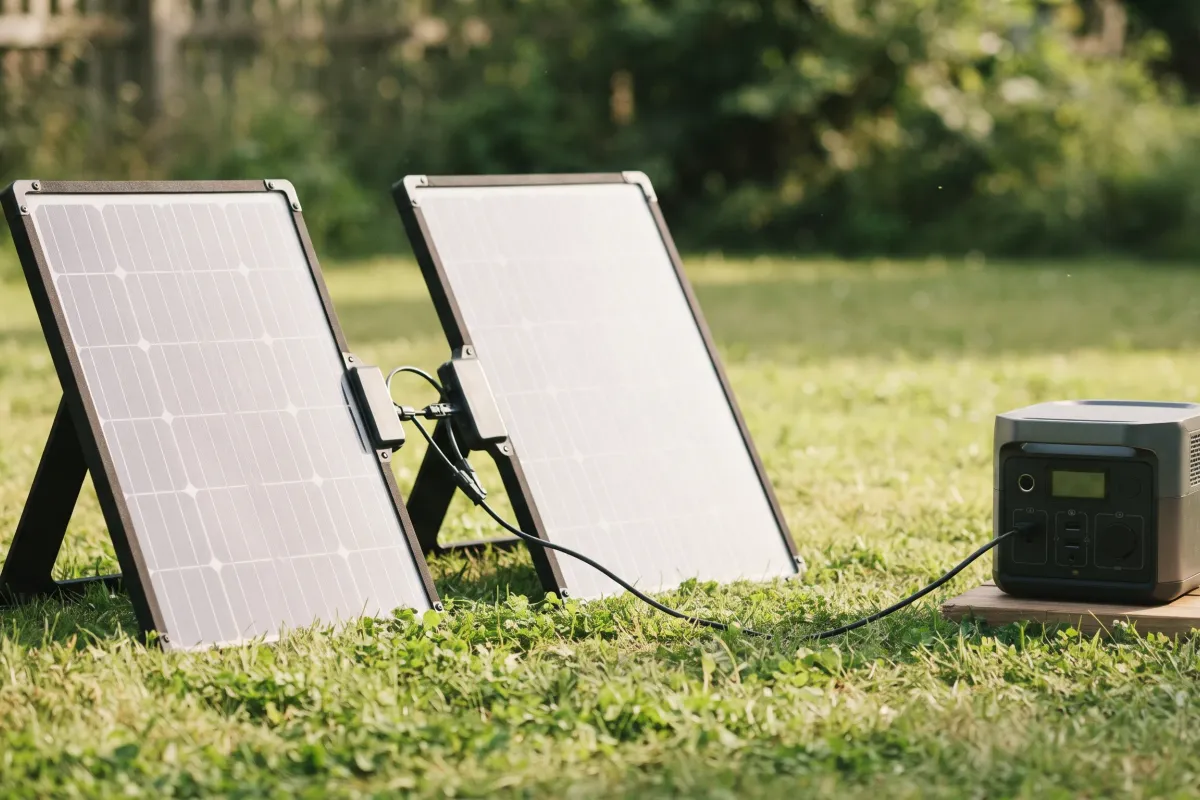
To wire in series, connect the positive lead of the first panel to the negative lead of the second. The two free leads, one negative and one positive, go to the station's solar cable. With MC4 connectors this is a direct plug: the male end of one panel into the female end of the next, no adapter needed.
The math is addition:
- Total voltage = sum of each panel's Voc. Two 24 V panels: 48 V. Three: 72 V.
- Total current = the current of one panel (the lowest one, if they differ).
Then compare the total Voc with the station's maximum input voltage. On a station whose solar input tops out at 60 V, like the EcoFlow Delta 3 Plus (11–60 V on each of its two inputs), two of those panels fit and three don't. On an input rated far higher, like the high-voltage input of the EcoFlow Delta Pro 3 (30–150 V, 15 A), you can string more.
Why series is usually the first choice for a portable station:
- Higher voltage reaches the charger's working window sooner. Many stations need a minimum voltage before they charge at all (16 V on the Jackery Explorer 1000 v2, 30 V on the EcoFlow TITAN 5000 Classic, 80 V on the EcoFlow Delta Pro Ultra X). Series gets there earlier in the morning and on cloudy days.
- Lower current means less loss in long cables. The same watts at double the voltage need half the current, so a longer extension cable wastes less.
- No extra parts. Series needs no branch connector.
The reason higher voltage costs nothing is the station's built-in MPPT (maximum power point tracking) charge controller. It works anywhere inside the station's voltage window, finds the voltage at which the panels give the most power, and converts it to the current the battery needs. So 48 V at 11 A and 24 V at 22 A both arrive as about the same charging power, provided both fit the window and the current limit.
Wiring panels in parallel: branch connectors and the current limit
Two panels in parallel double the current, so the station's amp limit becomes the one to watch.
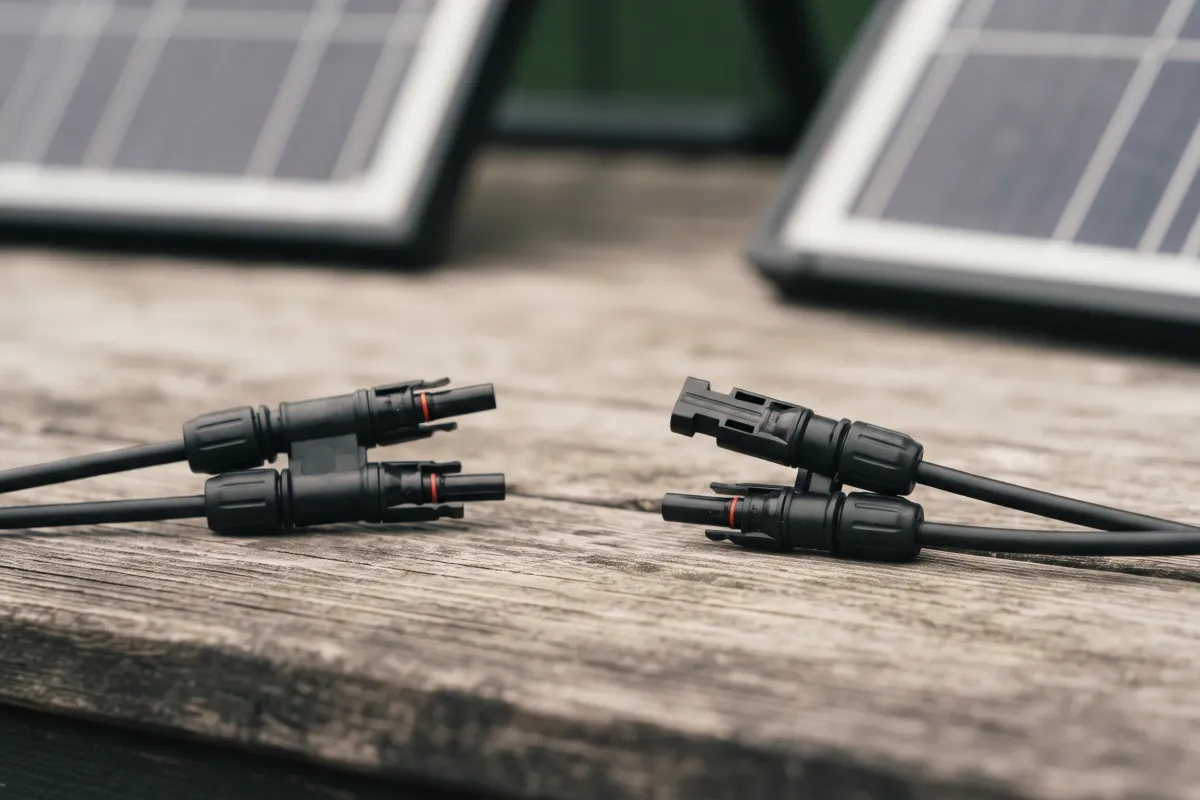
To wire in parallel, join all the positives together and all the negatives together, using an MC4 Y-branch connector (one for each polarity), then run the single pair of leads to the station. The voltage stays at one panel's figure; the current adds.
The math:
- Total voltage = one panel's Voc (if the panels match).
- Total current = sum of each panel's Isc. Two 11 A panels: 22 A.
Now the station's current limit decides. The Bluetti Elite 200 V2 accepts 20 A, so two 11 A panels in parallel go just over it. The Bluetti Elite 30 V2 takes 12–28 V at 10 A, so one 200 W panel of up to 10 A is its whole solar input. Some makers also split their limits into bands: the Anker SOLIX C1000 Gen 2 accepts 8.2 A between 11 and 28 V but 14.5 A between 29 and 60 V, so two panels in series (higher voltage, same current) suit it better than two in parallel.
When parallel is the right call:
- The station's voltage window is low. A station capped at 22 or 28 V (the Jackery Explorer 300, the Elite 30 V2) can't take two typical panels in series.
- Partial shade is common. A shaded panel in parallel drags down only its own share.
- Adding a panel to a 12 V setup. Panels sold for 12 V batteries keep the voltage low in parallel.
Two cautions with parallel. The combined current is higher, so a long run needs a thicker cable (a lower AWG number) to keep losses down. And with three or more panels in parallel, panel makers usually call for an inline fuse on each panel, because a fault in one panel can draw current from all the others; check your panel's manual. Two panels on one branch connector don't need one.
Solar input limits by power station: voltage window and current
Most stations we review accept 11 or 12 V up to 60 V; the big ones run to 150 V and beyond.
These are the solar input limits makers publish for stations we review. The voltage window is the range the charger works in (the top of it is the Voc you must stay under); the current is the most it accepts per input.
| Station | Voltage window | Current | Good fit |
|---|---|---|---|
| Bluetti Elite 30 V2 | 12–28 V | 10 A | One panel |
| Jackery Explorer 300 | 12.6–22 V | 3–7 A | One panel only |
| Anker SOLIX C1000 Gen 2 | 11–28 V or 29–60 V | 8.2 A or 14.5 A | Two in series if total Voc ≤ 60 V |
| EcoFlow Delta 3 Plus | 11–60 V, two inputs | not stated | Two in series per input |
| Jackery Explorer 1000 v2 | 16–60 V | not stated | Two in series |
| Bluetti Elite 200 V2 | 12–60 V | 20 A | Series, or parallel within 20 A |
| EcoFlow Delta Pro 3 | 30–150 V high input; 11–60 V low input | 15 A; 20 A | Series on the high input |
| Anker SOLIX F3800 Plus | 11–165 V, per input | 17 A | Longer series strings |
| EcoFlow TITAN 5000 Classic | 30–250 V | 16 A | Long series strings |
| EcoFlow Delta Pro Ultra X | 80–500 V, two inputs | 15 A | Series only (80 V minimum) |
Where a maker gives no current limit, stick to series with matched panels, so the current stays at one panel's figure. Each station's review lists its full solar setup, and the solar panel sizing guide covers how many watts of panels to buy.
Cold weather raises panel voltage: leave room under the limit
A panel's voltage climbs as it gets colder, so a string that fits in summer can pass the limit on a frosty morning.
The Voc on a panel's label is measured at 25 °C (77 °F). Below that, the voltage rises: for typical crystalline panels by roughly 0.3 to 0.4% for every degree Celsius colder, a figure the panel's datasheet gives as its "temperature coefficient of Voc". Electrical codes use the same idea to size home solar strings for the coldest expected day.
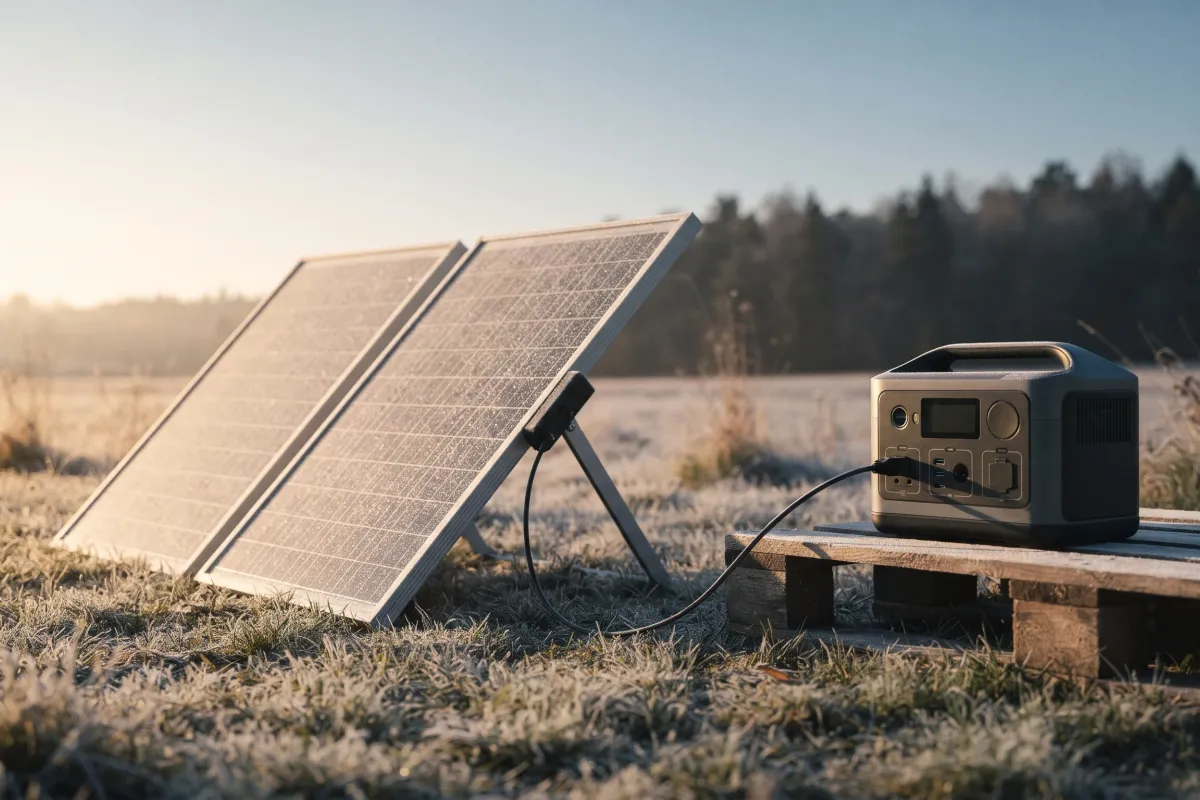
Worked example, our estimate. Two panels rated 28 V Voc in series make 56 V, under a 60 V limit. At −10 °C (14 °F), 35 degrees below the rating temperature, a 0.3% per degree rise adds about 10.5%: 56 × 1.105 ≈ 61.9 V, over the limit. Two 24 V panels (48 V) would rise to about 53 V and stay inside.
So:
- Leave about 10 to 15% headroom under the station's maximum voltage if you charge in freezing weather.
- Use the panel's own coefficient when its datasheet gives one; work it out for the coldest morning you expect.
- If it's close, wire in parallel (current, not voltage, adds) or use one panel less per string.
Cold doesn't raise current much, so it's series strings that need the margin. Batteries have their own cold limits for charging; see how to charge a power station with solar.
Shade, low light and cable length: when each wiring wins
Series loses more to shade; parallel loses more to long cables and dim light.
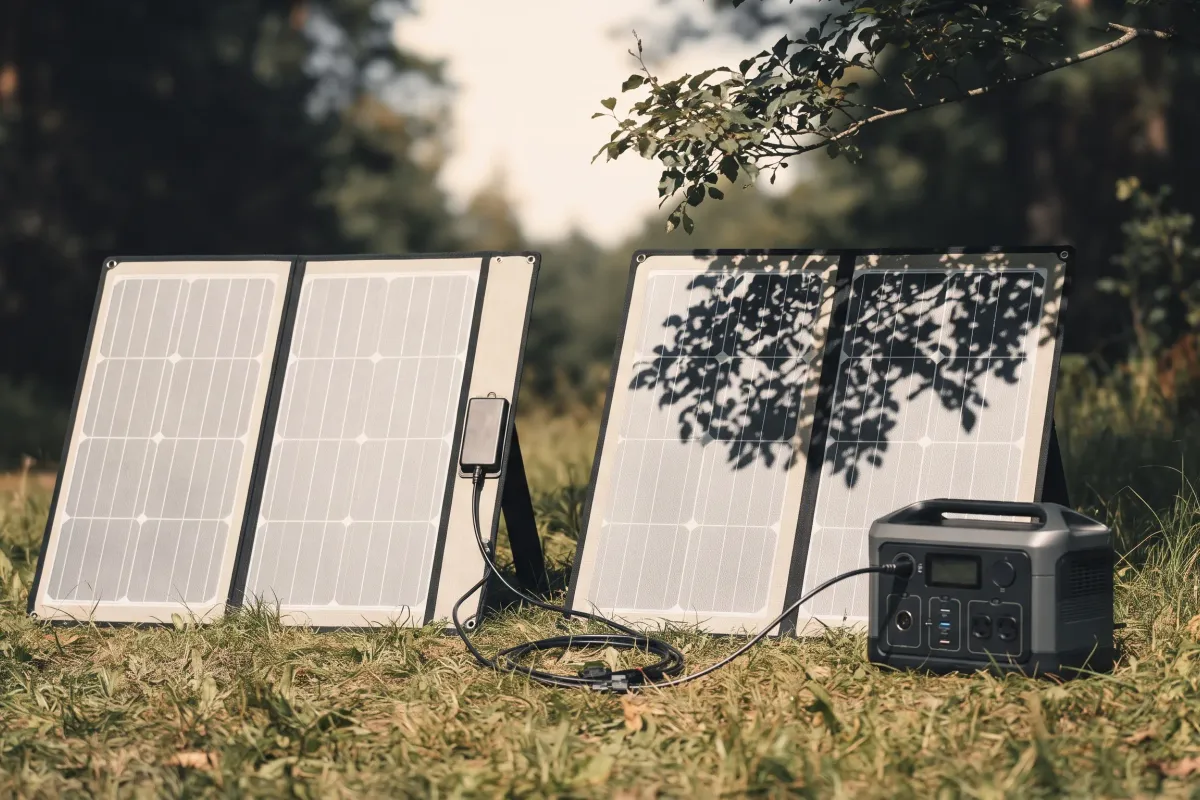
Neither wiring is better everywhere. These are the pros and cons of series vs parallel, by situation:
| Situation | Better wiring | Why |
|---|---|---|
| Partial shade on one panel | Parallel | In series, the shaded panel limits the whole string's current |
| Cloudy mornings, low light | Series | Higher voltage reaches the charger's minimum sooner |
| Long cable to the station | Series | Half the current means less loss in the cable |
| Station capped at 28–30 V | Parallel | Series would pass the voltage limit |
| Station with no stated amp limit | Series | Current stays at one panel's figure |
Cable length matters more than it seems: at the same watts, parallel carries twice the current of series, and the loss in a cable grows with the square of the current, so a parallel pair on a long extension loses noticeably more than the same pair in series. If the station has to sit far from the panels, series with a standard cable is usually the better answer.
Panels have bypass diodes that let current flow around a shaded section, so a shadow doesn't kill a series string completely, but it still costs more than it would in parallel. The simple fix for shade is placement: move the panels apart or into full sun, and aim them using the solar charging guide.
Series-parallel wiring and mixing different panels
Four panels can be wired as two series pairs in parallel, and mismatched panels cost power in either layout.
With four or more panels, you can combine both: wire them in series pairs, then join the pairs in parallel. Four 24 V, 11 A panels as two series pairs give 48 V and 22 A, which suits a station with a 60 V limit and at least 22 A, or two separate inputs of 11 A each (one pair per input).
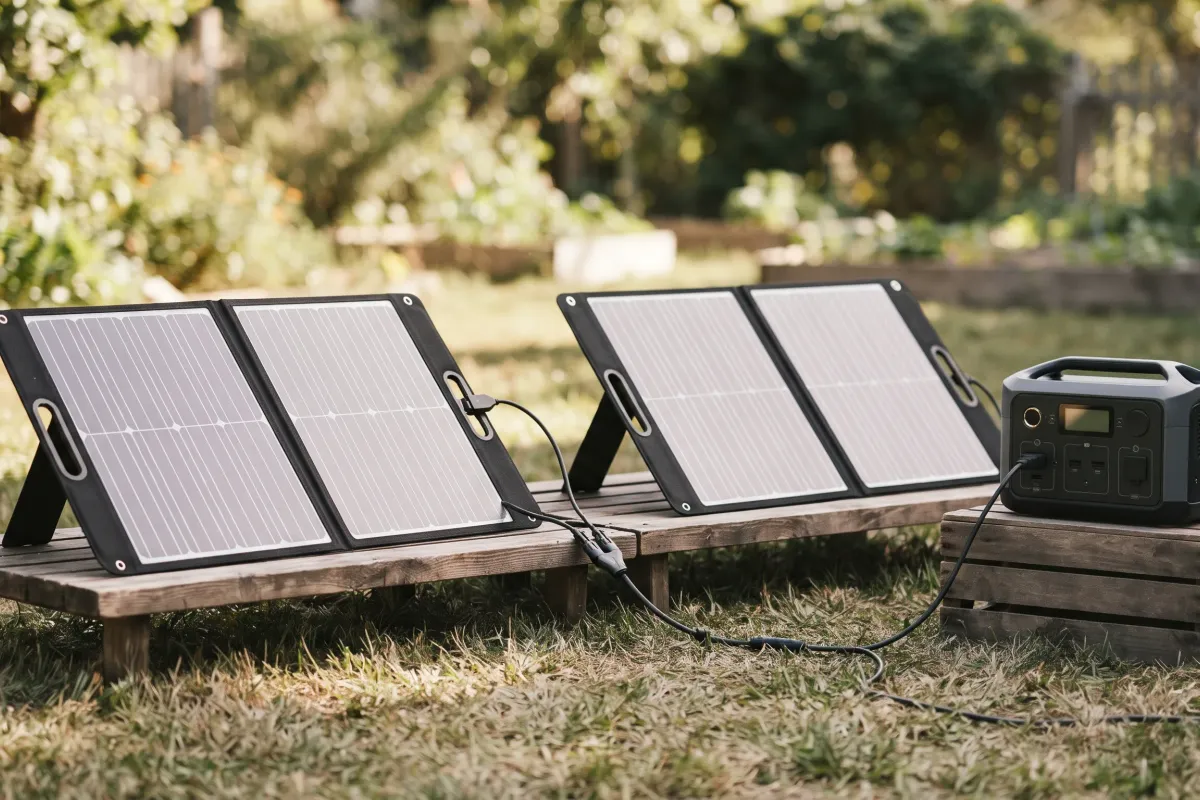
Many larger stations have two solar inputs, which is often simpler than series-parallel: one string on each input, each checked against that input's own limits. The EcoFlow Delta 3 Plus takes up to 500 W on each of its two inputs, and the Anker SOLIX F3800 Plus up to 1,600 W on each of two.
Mixing panels (a 100 W with a 200 W, or two brands):
- In series, the string's current is set by the weakest panel, so a 200 W panel paired with a 100 W one works at roughly the smaller panel's current.
- In parallel, the voltages should match; a panel with a lower voltage pulls the pair's working voltage down.
- Best option: keep the same model together, or give each different panel its own input if the station has two.
How to wire solar panels to your power station, step by step
Five checks before you plug in, using numbers from the panel label and the station's spec sheet.
- Read the panel label: note Voc, Isc and watts for each panel.
- Read the station's solar input: the voltage window, the current limit, the maximum watts and the number of inputs. The station's manual or its review lists them.
- Try series first: add the Voc of the panels. If the total, plus about 10 to 15% for cold, is under the maximum voltage, wire them in series.
- Otherwise use parallel: add the Isc. If the total is under the station's current limit, wire them in parallel with Y-branch connectors.
- Check the watts: the station only takes up to its solar rating, so extra panel watts are clipped rather than added; the solar panel sizing guide explains how much to buy.
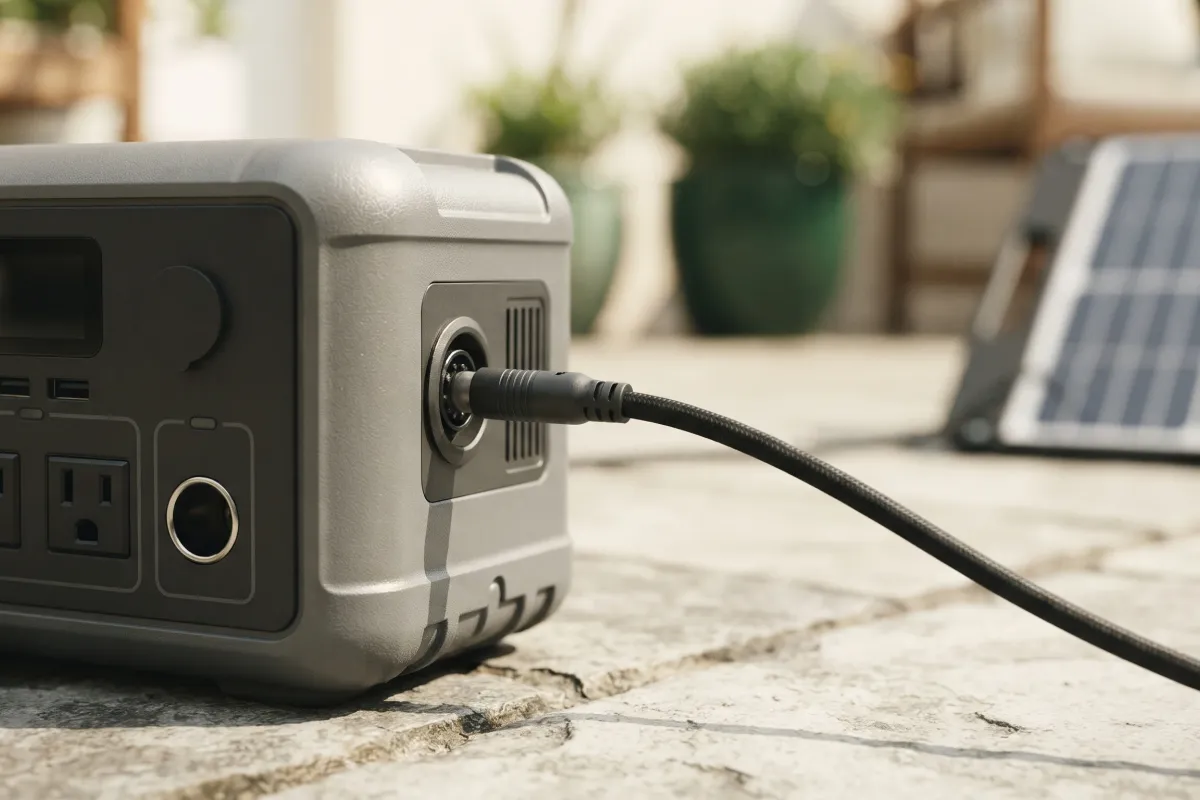
Then connect the panels to the station's solar cable (MC4 on the panel end, the station's own connector on the other: XT60 on many EcoFlow and Anker models, DC8020 on many Jackery models) and watch the input reading. If it shows far less than you expect in full sun, see why a power station is not charging.
FAQ
Eight quick answers on panel count, mixing, adding panels and damage risk.
Is it better to run solar panels in series or parallel?
For most portable power stations, series, as long as the panels' combined open-circuit voltage stays under the station's limit with room for cold. Choose parallel when series would pass the voltage limit or when one panel is often shaded.
Do you get more watts in series or parallel?
Neither. Watts are volts times amps, so two 200 W panels make up to 400 W either way. In practice series loses a little less in long cables, and parallel a little less in partial shade.
What is the 33% rule in solar panels?
It's a home-solar rule of thumb: an array can be up to about a third larger than the inverter it feeds, because panels rarely make their full rating. On a power station, the solar input rating plays the inverter's part: panels above it are simply limited to what the station accepts, but the voltage and current limits still apply.
Can I mix 100 W and 200 W solar panels?
Yes, but you'll lose some power. In series the pair runs at about the smaller panel's current; in parallel the voltages should match. Where the station has two solar inputs, put each panel on its own input.
Do you wire 12 V solar panels in series or parallel?
To charge a power station, usually in series. A "12 V" panel's open-circuit voltage is often about 20 V or more, so two in series fit a 60 V input; three may not, especially in cold weather. For a station with a 22 or 28 V limit, use one panel or wire them in parallel if the maker allows two (the Explorer 300 takes one panel only).
How many solar panels can I connect in series?
As many as keep the total open-circuit voltage, plus a cold-weather margin, under the station's maximum. On a 60 V station that's usually two typical portable panels; on an input rated to 150 V, about five 24 V panels by our estimate, leaving a cold-weather margin.
Can I add more solar panels later?
Yes. Add the new panel's Voc (series) or Isc (parallel) to your totals and check them against the station's limits again, with the cold margin for series. A panel of the same model keeps the string balanced; a different one costs some power, as above.
Can solar panels in series damage a power station?
Exceeding the maximum input voltage can damage the charger, which is why the voltage limit is the one never to pass. Too much current is less of a risk with most stations, which limit how much they draw, but stay within the maker's stated maximum.