 By
We may earn a commission if you buy through links on this page, at no extra cost to you. This never affects which products we recommend. How we make money.
On this page 11 sections
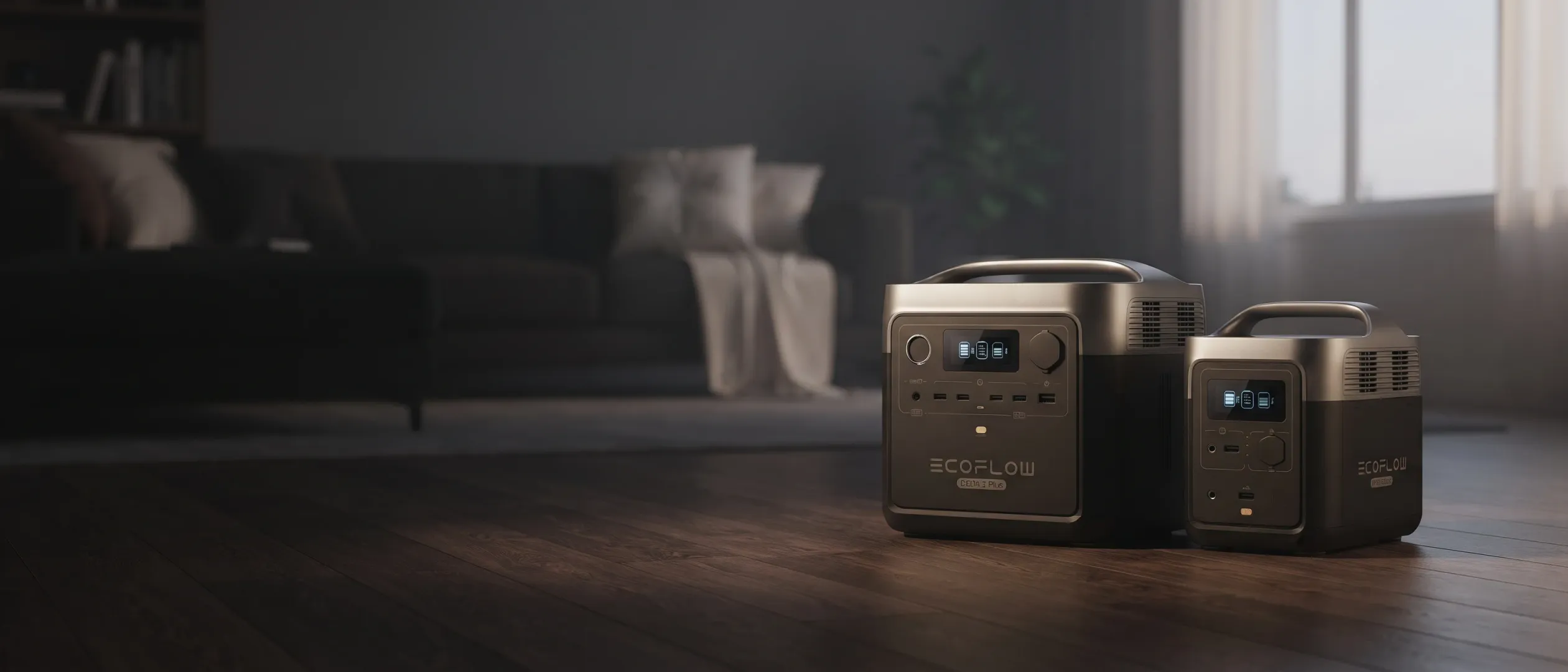
Pick the EcoFlow Delta 3 Plus for home backup, a fridge through an outage or anything that draws more than 600 W. Pick the EcoFlow River 3 Plus for CPAP nights, laptops and camping, where carrying 10.4 lb instead of 27.6 lb matters more than capacity. The Delta 3 Plus holds 1,024 Wh against the River 3 Plus's 286 Wh, so it runs the same device about 3.6 times longer.
The short answer: Delta 3 Plus vs River 3 Plus
The two share a battery type, a backup speed and a warranty, and differ in almost everything else
These are not two takes on the same machine. The Delta 3 Plus is a 1 kWh home-backup station that can grow to about 5 kWh. The River 3 Plus is a 286 Wh carry-along that tops out at 858 Wh with its largest extra battery.
- Choose the Delta 3 Plus if you want to keep a fridge, router and lights going through an outage, run kitchen appliances, charge from a lot of solar, or add capacity later.
- Choose the River 3 Plus if your loads are small (CPAP, laptop, phones, a fan, lights), you'll carry it often, or you want a desk-side backup for a router and computer.
Delta 3 Plus vs River 3 Plus specs
About 3.6 times the capacity and three times the output, at 2.7 times the weight
| Spec | EcoFlow Delta 3 Plus | EcoFlow River 3 Plus |
|---|---|---|
| Capacity (Wh) | 1024 | 286 |
| AC output, continuous (W) | 1800 | 600 |
| AC charge time | 56 min | 1 hr (0–100%) |
| Max solar input (W) | 1000 | 220 |
| Weight (lb) | 27.6 | 10.4 |
| Warranty (years) | 5 | 5 |
| Price | Check price | Check price |
- Same: LiFePO4 chemistry, under 10 ms UPS switchover, 5-year warranty, charge at 32–113°F and run at 14–113°F.
- Delta 3 Plus wins: capacity (1,024 vs 286 Wh), output (1,800 vs 600 W), surge (3,600 vs 1,200 W), wall charging (1,500 vs 360 W), solar (1,000 vs 220 W), expansion (about 5 kWh vs 858 Wh), cycle life (4,000 vs 3,000 to 80%), outlets.
- River 3 Plus wins: weight (10.4 vs 27.6 lb) and size (9.2 × 9.1 × 5.7 in vs about 16 × 8.0 × 11 in).
Our ratings put the Delta 3 Plus at 8.9 among mid-size stations and the River 3 Plus at 7.6 among compact ones. They're scored against different size classes, so the two numbers aren't a head-to-head result; How We Test explains the method. If the specs are new to you, watts vs watt-hours explains which figure answers which question.
Charging speed and solar: Delta 3 Plus vs River 3 Plus
Both refill in about an hour from an outlet, but the Delta 3 Plus takes 1,000 W of solar against 220 W
From a wall outlet the two are close in time. EcoFlow quotes 0 to 100% in 56 minutes for the Delta 3 Plus (1,500 W input) and about 1 hour for the River 3 Plus (360 W input). The River's battery is a quarter of the size, so it needs far less power to fill in the same time.
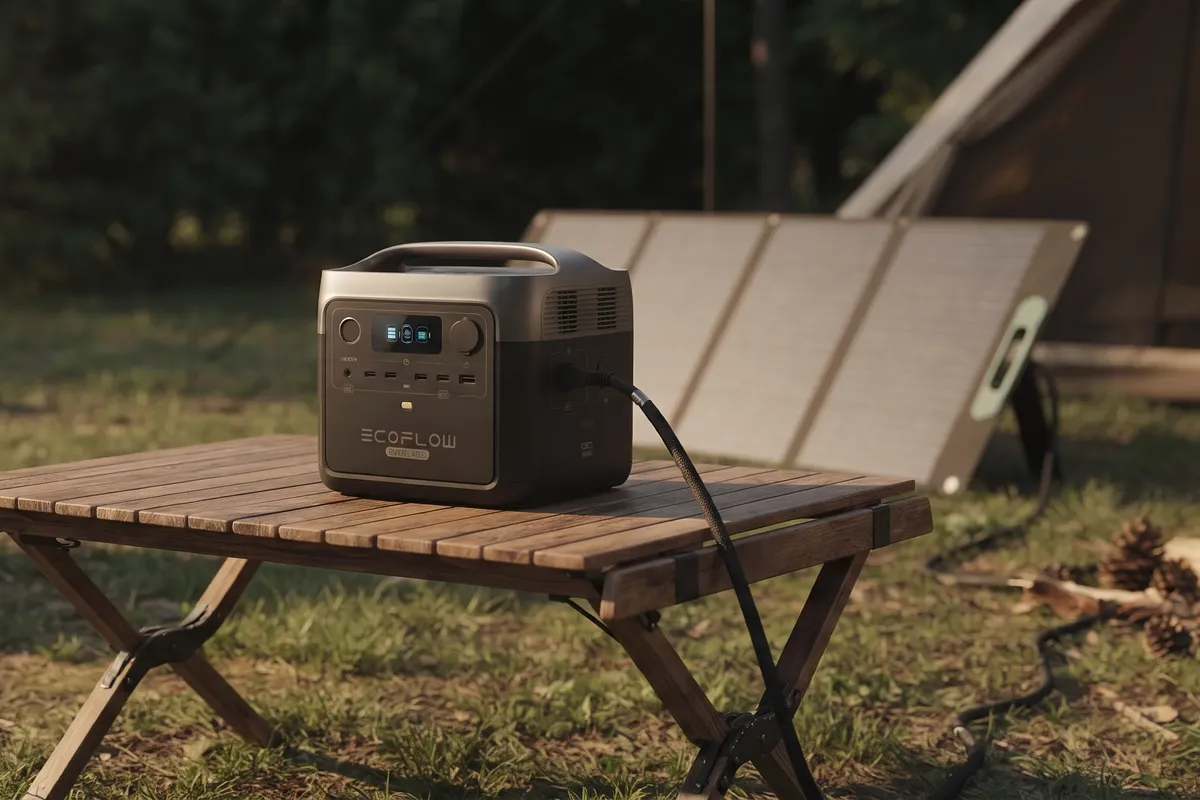
Solar is where they part ways:
- Delta 3 Plus: two MPPT solar inputs of 500 W each, 1,000 W in total. Your panels' open-circuit voltage (Voc) must stay within 11–60 V on each input. EcoFlow quotes a full charge in 70 minutes with both inputs at their maximum. EcoFlow suggests 2 × 400 W panels (one per input) or 4 × 220 W panels wired two in series per input.
- River 3 Plus: one solar input, 220 W; keep the panels' open-circuit voltage within 11–55 V and the current within 13 A. EcoFlow quotes a full charge in 1.5 hours at 220 W. One 220 W panel fills it.
In real sun, panels give less than their rating, so expect longer in both cases. For an off-grid cabin or multi-day outages, the Delta 3 Plus's solar capacity is what keeps it topped up. For a weekend camping trip, one panel on the River 3 Plus is enough. See what size solar panel you need and how to charge a power station with solar.
In the car: the River 3 Plus takes 220 W from a 12 V car outlet, filling in about 3.3 hours by EcoFlow's figure. For the Delta 3 Plus, EcoFlow's 800 W Alternator Charger (sold separately, wired to the vehicle's battery) tops up 1 kWh in about 1.3 hours. It can also pair with EcoFlow's Smart Generator 3000 (Dual Fuel), which starts and stops automatically and charges at 1,500 W.
Output and outlets: Delta 3 Plus vs River 3 Plus
Microwaves, kettles and hair dryers need the Delta 3 Plus's 1,800 W
The River 3 Plus delivers 600 W continuous (1,200 W surge) from 3 AC outlets. That covers laptops, a TV, fans, lights, a CPAP and a fridge's running draw. It does not cover most heating and kitchen appliances: a microwave (about 1,100 W in our calculator), a kettle, a toaster, a coffee maker, a hair dryer or a space heater.
The Delta 3 Plus delivers 1,800 W continuous (3,600 W surge) from 6 AC outlets, which covers almost any single household appliance on a 120 V outlet. Neither runs 240 V appliances.
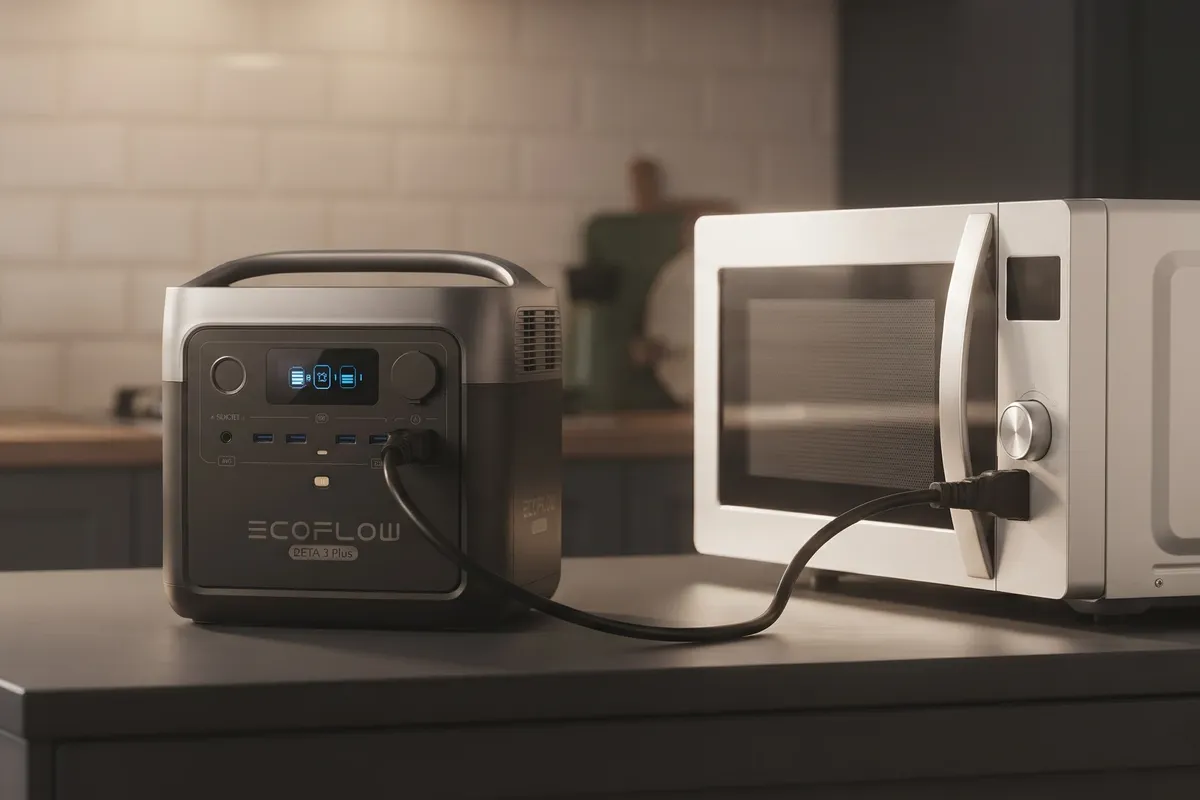
Both have EcoFlow's X-Boost, which runs some simple heating appliances at reduced power: up to 1,200 W on the River 3 Plus and 2,200 W on the Delta 3 Plus. A kettle on X-Boost heats more slowly, and X-Boost doesn't help motors or electronics. It's not extra continuous output; surge vs continuous watts explains the difference.
Starting a fridge: a fridge compressor draws several times its running watts for a moment at start-up. The River 3 Plus's 1,200 W surge is above the start-up draw of many kitchen fridges (check your fridge's label), but its capacity limits how long it runs one. The Delta 3 Plus has headroom for a fridge plus other loads at once.
| Port | Delta 3 Plus | River 3 Plus |
|---|---|---|
| AC outlets | 6 (1,800 W) | 3 (600 W) |
| USB-C | 2 × 140 W | 1 × 100 W |
| USB-A | 2 × 36 W | 2 × 12 W |
| 12 V DC | Car outlet + 2 × DC5521, 126 W total | Car outlet, 126 W |
For laptops, the Delta 3 Plus's 140 W USB-C ports charge large laptops at full speed; the River 3 Plus's single 100 W port covers most laptops. The Delta 3 Plus's AC outlets are pure sine wave, safe for electronics and CPAP machines.
Runtime: Delta 3 Plus vs River 3 Plus
A typical CPAP with its humidifier runs about 13.5 hours on the Delta 3 Plus and under 4 on the River 3 Plus
Capacity decides how long anything runs. The Delta 3 Plus stores 1,024 Wh, the River 3 Plus 286 Wh. Here is the same set of devices on each, worked out with our calculator's method.
Estimated runtimes: Delta 3 Plus
- CPAP, no humidifier, low-draw (11 W, DC)3.6 days
- Wi-Fi router (12 W, DC)3.3 days
- Box fan (50 W, AC)15 h
- CPAP with humidifier, typical (56 W, AC)14 h
- Laptop (60 W, AC)13 h
- Fridge (67 W, AC) + router (12 W, DC)10 h
Estimated runtimes: River 3 Plus
- CPAP, no humidifier, low-draw (11 W, DC)24 h
- Wi-Fi router (12 W, DC)22 h
- Box fan (50 W, AC)4.2 h
- CPAP with humidifier, typical (56 W, AC)3.8 h
- Laptop (60 W, AC)3.5 h
- Fridge (67 W, AC) + router (12 W, DC)2.8 h
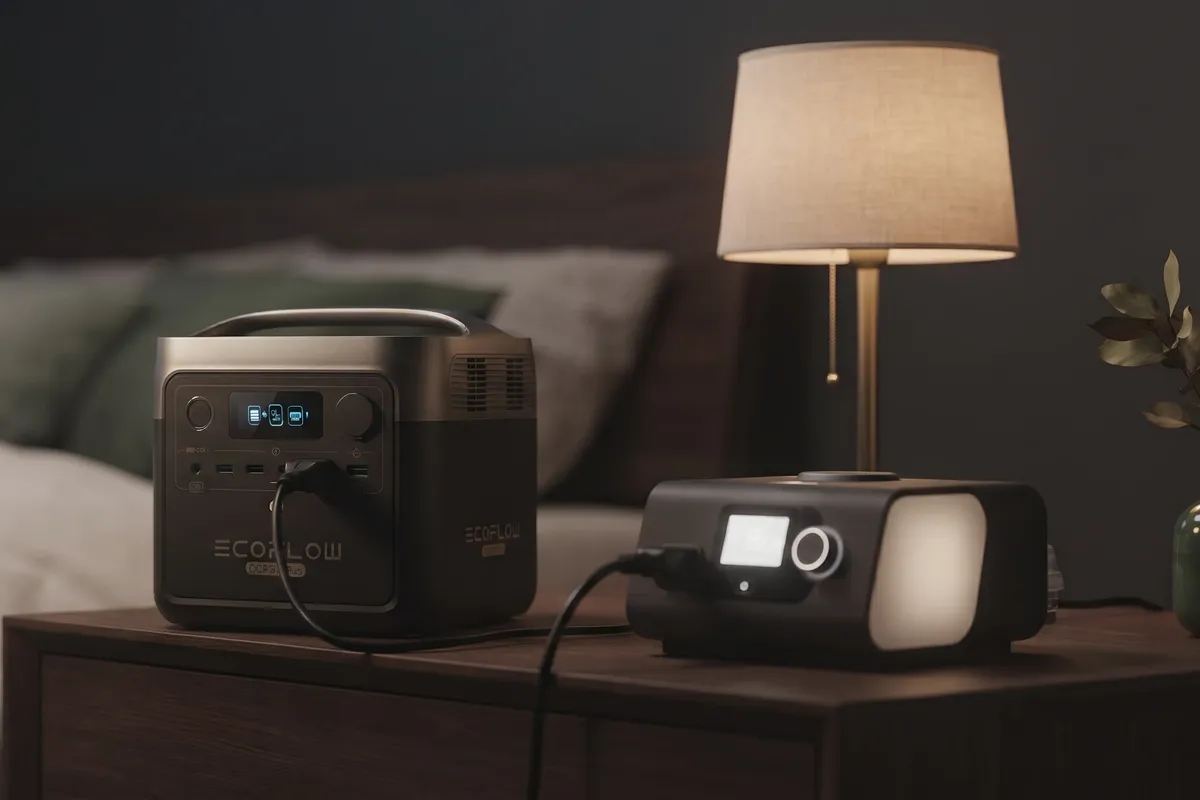
What that means in practice:
- CPAP: without the humidifier, on a DC cable, the River 3 Plus covers about three 8-hour nights; the Delta 3 Plus about ten. With the humidifier on AC, the River 3 Plus doesn't last one full night; the Delta 3 Plus covers more than one and a half. Our CPAP runtime guide explains how to cut the draw.
- Fridge: the River 3 Plus keeps a fridge and router going for under 3 hours, enough to ride out a short cut. The Delta 3 Plus manages about 10 hours, or most of a night. See how long a power station runs a fridge.
- Router: both are excellent on DC: about 22 hours on the River 3 Plus and more than three days on the Delta 3 Plus.
All of these are estimates. Real runtime drops in the cold, with an older battery, and when a reserve is set in the app. Put your own devices into the runtime calculator to check.
Expandability: Delta 3 Plus vs River 3 Plus
Even fully expanded, the River 3 Plus holds less than a bare Delta 3 Plus and still delivers only 600 W
A common question is whether to buy a River 3 Plus and expand it later instead of buying the Delta 3 Plus now.
- River 3 Plus: EcoFlow sells two extra batteries. With the 286 Wh EB300 it becomes a 572 Wh system (sold as the River 3 Max, 8.4 kg, about 18.5 lb). With the 572 Wh EB600 it becomes an 858 Wh system (the River 3 Max Plus, 10.8 kg, about 23.8 lb).
- Delta 3 Plus: takes one EcoFlow Smart Extra Battery. EcoFlow lists the DELTA 3 (1,024 Wh), DELTA 2 (1,024 Wh), DELTA 2 Max (2,048 Wh) and DELTA Pro 3 (4,096 Wh) packs as compatible, so the largest takes it to about 5 kWh. It can't be chained to a second power station.
| River 3 Max Plus (858 Wh) | Delta 3 Plus (1,024 Wh) | |
|---|---|---|
| Weight | About 23.8 lb | 27.6 lb |
| AC output | 600 W | 1,800 W |
| Wall charging | 360 W | 1,500 W |
| Solar input | 220 W | 1,000 W |
The expanded River is about 4 lb lighter, but it has less capacity, a third of the output and a quarter of the wall and solar input. If you know you'll need around 1 kWh, the Delta 3 Plus is the better buy. Expanding a River makes sense when you mostly want a light unit and only sometimes need more hours. Check any extra battery's compatibility with your exact model before buying; packs from other EcoFlow lines won't fit.
Backup (UPS), noise and app: Delta 3 Plus vs River 3 Plus
Both keep a router, computer or CPAP running through a power cut; only the Delta 3 Plus has room for a whole desk
EcoFlow rates both at under 10 ms to switch to battery (this backup mode is also called EPS, for emergency power supply) when the wall power drops, quick enough for most computers, routers and CPAP machines. On the River 3 Plus, the backup runs through its 3 AC outlets.
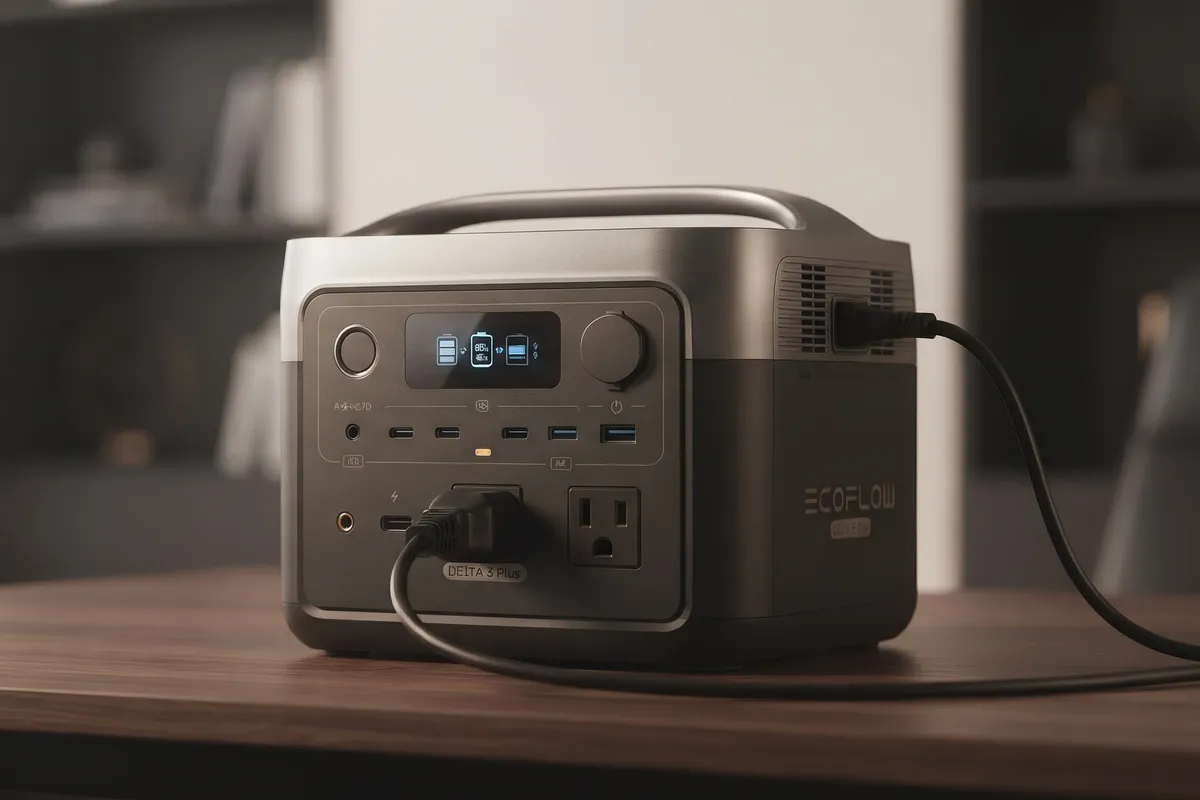
The difference is how much they can protect and for how long. The River 3 Plus suits a router and modem (about 22 hours on DC) or a single computer for a short cut. The Delta 3 Plus can hold a desktop, monitor and network gear for hours. It also adds NAS support through EcoFlow PowerManager and a NUT server, so a home server shuts down cleanly when the battery runs low. Read more in using a power station as a UPS.
Both work with the EcoFlow app. On the Delta 3 Plus it connects over Wi-Fi or Bluetooth and adds Time-of-Use charging, a storm warning alert, and charge and discharge limits.
Noise: EcoFlow rates the River 3 Plus under 30 dB at half a metre, and the Delta 3 Plus at under 30 dB below 600 W and under 40 dB at 1,200 W. Both are quiet at low loads; the fans speed up when charging fast or under heavy load.
Battery life, weight and warranty: Delta 3 Plus vs River 3 Plus
The River 3 Plus carries in one hand at 10.4 lb; both carry 5-year warranties
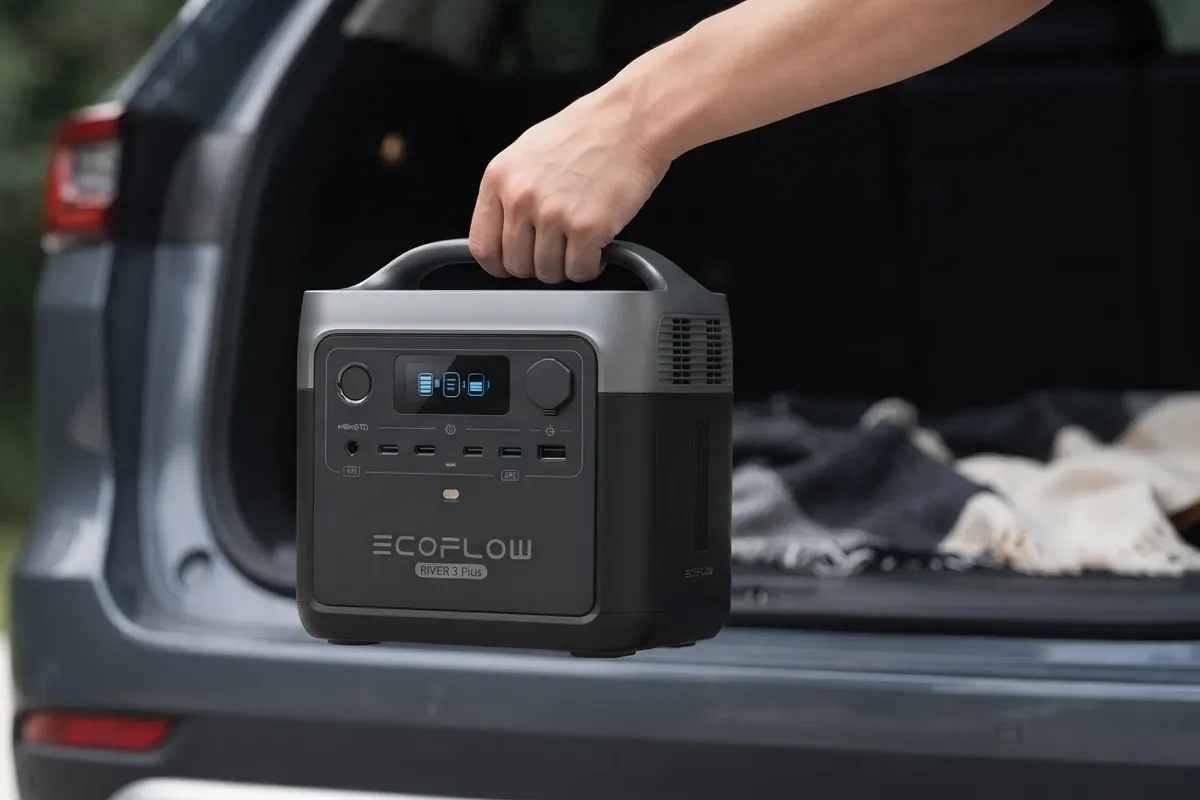
- Weight: River 3 Plus 10.4 lb, Delta 3 Plus 27.6 lb.
- Size: River 3 Plus 9.2 × 9.1 × 5.7 in, about the size of a lunch box; Delta 3 Plus about 16 × 8.0 × 11 in.
- Battery life: both use LiFePO4. EcoFlow rates the Delta 3 Plus at 4,000 cycles and the River 3 Plus at 3,000 cycles to 80% capacity. Either outlasts years of weekly use; see how long portable power stations last.
- Warranty: 5 years on both.
- Temperature: the same on both: charge at 32–113°F, use at 14–113°F.
Delta 3 and River 3: how the siblings differ
The Delta 3 Plus adds a second 500 W solar input and 140 W USB-C over the Delta 3
These four names get mixed up in searches. The EcoFlow Delta 3 has the same 1 kWh class as the Delta 3 Plus but one 500 W solar input instead of two, and slower USB ports (USB-C 100 W, USB-A 18 W). For most buyers comparing against the River 3 Plus, the Delta 3 Plus is the one to consider; the Delta 3 Plus review covers both.
The EcoFlow River 3 is a separate, smaller model: 245 Wh and 300 W at 7.7 lb, with a 20 ms switchover, a 2-year warranty and no expansion. Our River 3 Plus review compares the two.
Who should buy the Delta 3 Plus, and who the River 3 Plus
Match the station to your biggest load and how often you'll carry it
Best for home backup and kitchen loads
EcoFlow Delta 3 Plus
Pick it for outages, a fridge, kitchen appliances, an off-grid cabin or RV living.
Pros
- 1,024 Wh, expands to about 5 kWh
- 1,800 W runs most appliances
- 1,000 W solar input
Cons
- 27.6 lb
- More than you need for a CPAP or laptop
Best for carrying and small loads
EcoFlow River 3 Plus
Pick it for camping, CPAP without humidifier, laptops, photography and a router backup.
Pros
- 10.4 lb
- Refills in about an hour
- Under 10 ms backup switchover
Cons
- 600 W limit
- 286 Wh runs a fridge for under 3 hours
- Home backup: Delta 3 Plus. The River 3 Plus can't keep a fridge going through a long outage. See our best home backup power stations.
- Camping and road trips: River 3 Plus, unless you cook on electric or run a fridge for days. See best portable power stations for camping.
- CPAP: River 3 Plus for one or two nights without humidifier; Delta 3 Plus for humidifier use or several nights. See best portable power station for CPAP.
- Small and light: the River 3 Plus is among our best small portable power stations.
For the full field, see our best portable power stations.
FAQ
Delta 3 Plus or River 3 Plus: the questions EcoFlow buyers ask
Which EcoFlow is better, the Delta 3 Plus or the River 3 Plus?
The Delta 3 Plus for capacity, output and home backup; the River 3 Plus for portability. With 1,024 Wh and 1,800 W against 286 Wh and 600 W, the Delta 3 Plus does more; the River 3 Plus weighs 17.2 lb less.
Is the EcoFlow Delta better than the River?
For backup and high-power appliances, yes: the Delta line is EcoFlow's larger range. The River line is built to be carried. Pick by your biggest load and how often you'll move the unit.
Is the EcoFlow River 3 Plus worth it?
Yes, if your loads stay under 600 W and you value weight: it runs a low-draw CPAP for about three nights, refills in an hour and weighs 10.4 lb. It isn't the right buy for a fridge through a long outage.
Which EcoFlow Delta 3 is the best?
Of the Delta 3 and Delta 3 Plus, the Plus: it has two solar inputs (1,000 W) instead of one, and faster USB ports, on the same 1 kWh battery class.
Can the River 3 Plus run a fridge?
Yes, its 1,200 W surge starts most kitchen fridges, but a fridge and router run for under 3 hours by our estimate. The Delta 3 Plus manages about 10 hours.
Can the River 3 Plus be expanded to match the Delta 3 Plus?
No. Its largest extra battery makes an 858 Wh system, still below the Delta 3 Plus's 1,024 Wh, and output stays at 600 W.
Which charges faster?
From the wall, both take about an hour (EcoFlow: 56 minutes for the Delta 3 Plus, 1 hour for the River 3 Plus). From solar, EcoFlow quotes 70 minutes for the Delta 3 Plus at 1,000 W and 1.5 hours for the River 3 Plus at 220 W.
Can either run a CPAP all night?
Both, without the humidifier on a DC cable. With the humidifier on AC, the River 3 Plus lasts about 3.8 hours, under one night; the Delta 3 Plus about 13.5 hours.