 By
We may earn a commission if you buy through links on this page, at no extra cost to you. This never affects which products we recommend. How we make money.
On this page 8 sections
Our verdict · Daran
A 288 Wh LiFePO4 station with a 5-year warranty, held back by slow charging
The Daran NEO300L packs 288 Wh of LiFePO4 behind two pure sine wave AC outlets sharing 350 W, a 60 W USB-C port and a 120 W car outlet, with a 5-year warranty. Its weak spot is charging: 40 W of solar is the lowest input of the compact stations we've reviewed and 100 W from the wall is among the slowest, which pulls its rating down to 4.7.
- Capacity
- 288 Wh
- AC output
- 350 W
- Weight
- 8.16 lb
Best for
Phones, laptops, a router or a CPAP for a few nights on its 12 V outlet, on trips where you can recharge slowly.
Skip it if
You need a quick refill, want to recharge from solar in a day, need a fast UPS for a computer, or want to run anything over 350 W.
- 288 Wh LiFePO4, 3,500+ cycles to 80%
- 350 W pure sine wave, 600 W surge
- 5-year warranty
- 120 W car outlet for a CPAP or 12 V cooler
- 100 W wall input: about 2.9 hours by our estimate
- 40 W solar input: about 8 hours by Daran's figure
- No UPS switchover time published
- 8.16 lb, heavier than some 288 Wh rivals
Rating breakdown (compact (under 1 kwh) class)
| Criterion | Weight | Score | Based on |
|---|---|---|---|
| Wall charging speed | 20% | 0.4 | 100 W input |
| AC output | 20% | 4.4 | 350 W |
| Solar input | 10% | 0.0 | 40 W |
| Portability | 25% | 6.1 | 35 Wh/lb |
| Battery life & warranty | 25% | 9.0 | 5-year warranty, 3,500+ cycles |
| Capacity (Wh) | 288 |
|---|---|
| Battery chemistry | LiFePO4 |
| Rated cycle life | 3,500+ cycles to 80% |
| AC output, continuous (W) | 350 |
| AC output, surge (W) | 600 |
| AC charge time | — |
| Max AC charging input (W) | 100 |
| Max solar input (W) | 40 |
| Solar input voltage range | 10–30 V DC |
| UPS switchover (ms) | — |
| Weight (lb) | 8.16 |
| Expandable to (Wh) | Not expandable |
| Warranty (years) | 5 |
Key specs at a glance: 288 Wh and 350 W at 8.16 lb
The NEO300L pairs 288 Wh of LiFePO4 rated for 3,500+ cycles with two AC outlets sharing 350 W and a 5-year warranty.
- 288 Wh capacity, the same as the Bluetti Elite 30 V2 and Anker SOLIX C300 DC: enough for a router overnight or a low-draw CPAP for about three nights.
- LiFePO4, rated by Daran for 3,500+ cycles to 80% of its original capacity. See LiFePO4 vs lithium-ion.
- 350 W continuous, 600 W surge, pure sine wave, from 2 AC outlets.
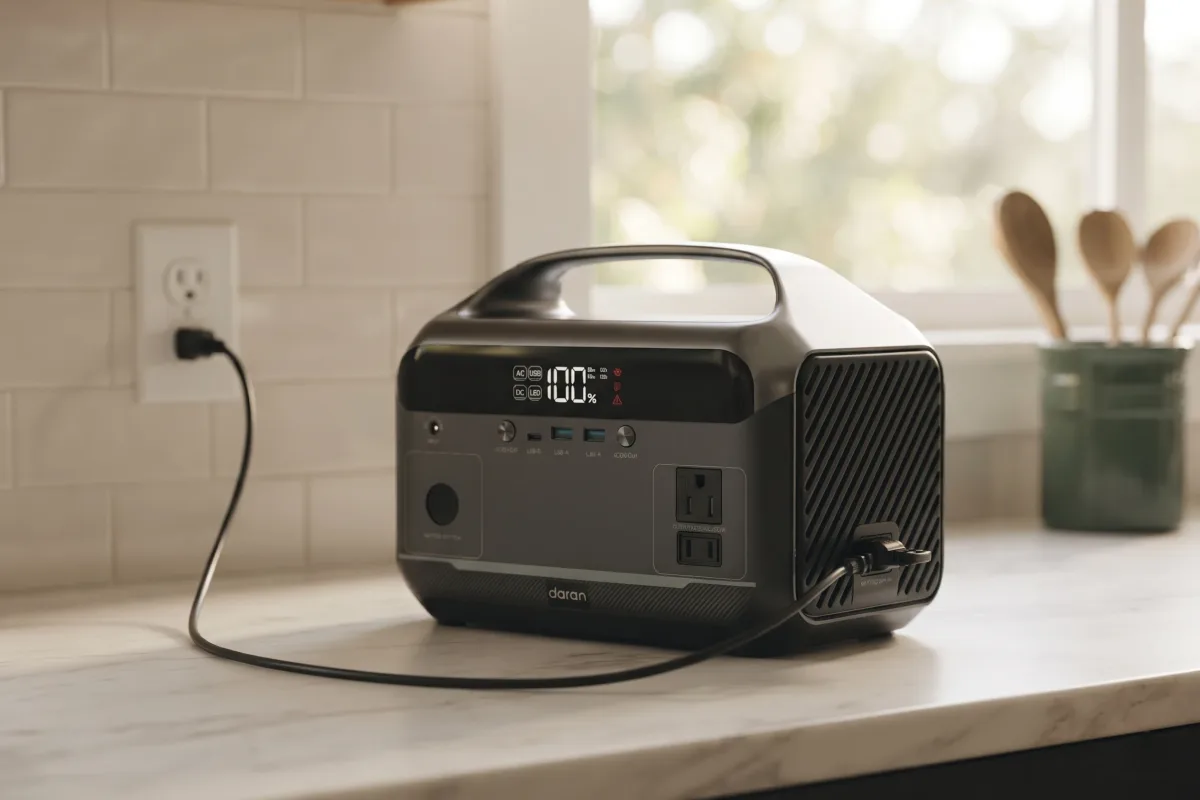
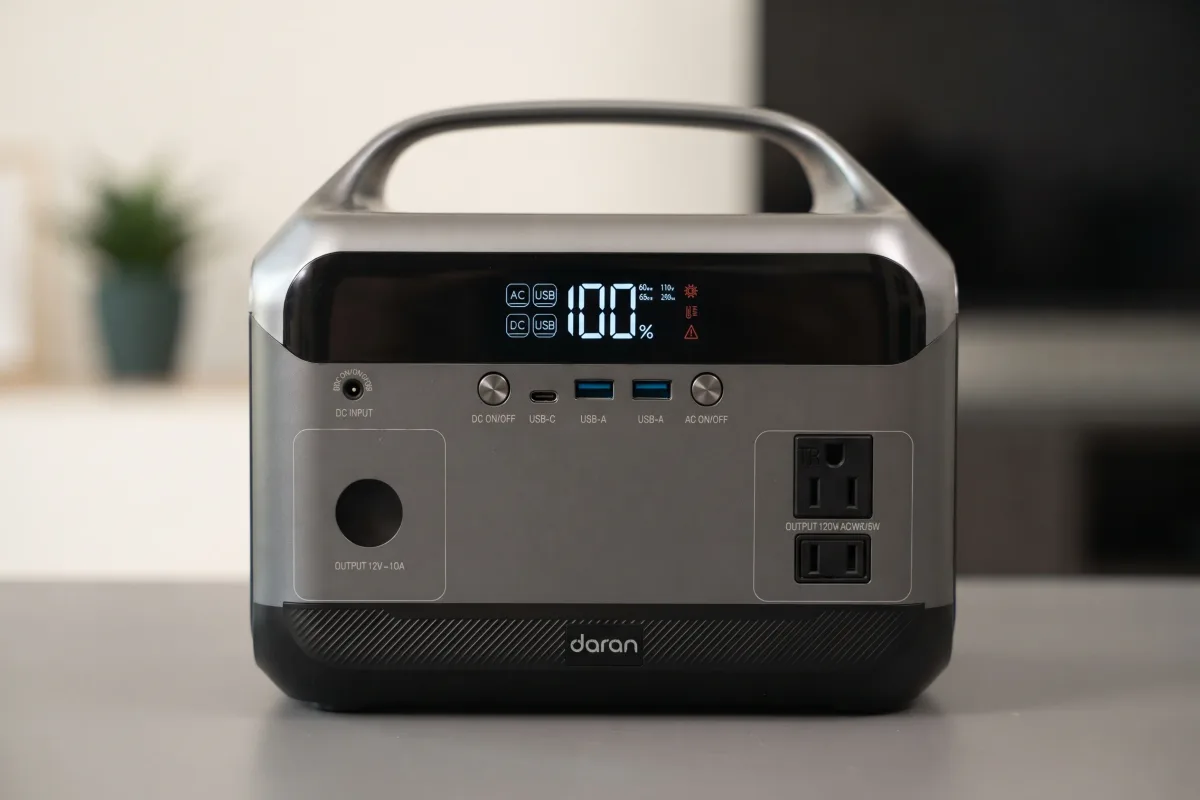
- Other ports: a 60 W USB-C (PD), two 18 W USB-A ports, a 120 W car outlet (12 V, 10 A) and one DC output Daran doesn't rate.
- 8.16 lb (3.7 kg), 10 × 6.6 × 8.2 in.
- Built-in 3 W LED light with four brightness levels and SOS, and a battery-level screen.
- Not expandable, no app.
- Warranty: 5 years, per Daran's product page.
It isn't the NEO300 (268.8 Wh, 300 W) or the NEO300 Pro (299 Wh, 600 W), which share the name. Which spec answers which question is explained in watts vs watt-hours.
Charging speed: 100 W from the wall, about 2.9 hours by our estimate
Daran caps wall input at 100 W and solar at 40 W, and quotes about 8 hours for a full solar charge.
Daran lists the AC input at 100 W maximum (90–130 V) but publishes no wall charge time. At 100 W, 288 Wh takes about 2.9 hours by our estimate, before charging losses and the slow-down near full. That's slow next to the compact stations we've reviewed: EcoFlow quotes one hour for the 245 Wh River 3, and Bluetti about 70 minutes for the 288 Wh Elite 30 V2.
Solar: 40 W maximum at 10–30 V DC. Daran says it "only takes 8 hours" to charge from 0 to 100% on solar, so a single day of sun is about one full charge at best. Daran doesn't name the solar connector; it sells the station with an optional 40 W panel, which is the simplest match. Panel sizing for any station is in what size solar panel you need.
Car: Daran lists cigarette-lighter charging but no wattage or time; see how to charge a power station from your car for what a 12 V socket delivers.
Capacity and real runtime: about three CPAP nights or 22 hours of router
On its 12 V outlet, 288 Wh runs an 11 W CPAP for about 24 hours (three 8-hour nights) or a 12 W router for about 22 hours.
Estimated runtimes on the Daran NEO300L
- CPAP, no humidifier (11 W, DC)24 h
- Wi-Fi router (12 W, DC)22 h
- LED lights ×4 (40 W, AC)5.0 h
- Laptop, USB-C (60 W, DC)4.4 h
- Box fan (50 W, AC)4.2 h
- CPAP with humidifier (56 W, AC)3.8 h
- Laptop, AC (60 W)3.6 h
Its best use is DC loads: a CPAP without the humidifier for about three nights from the car outlet with the CPAP maker's DC cord, or a router for about a day. On AC, the inverter's losses and idle draw cut that sharply: a 55-inch TV at 90 W runs about 2.5 hours. A laptop lasts longer on the 60 W USB-C port than on its own AC charger.
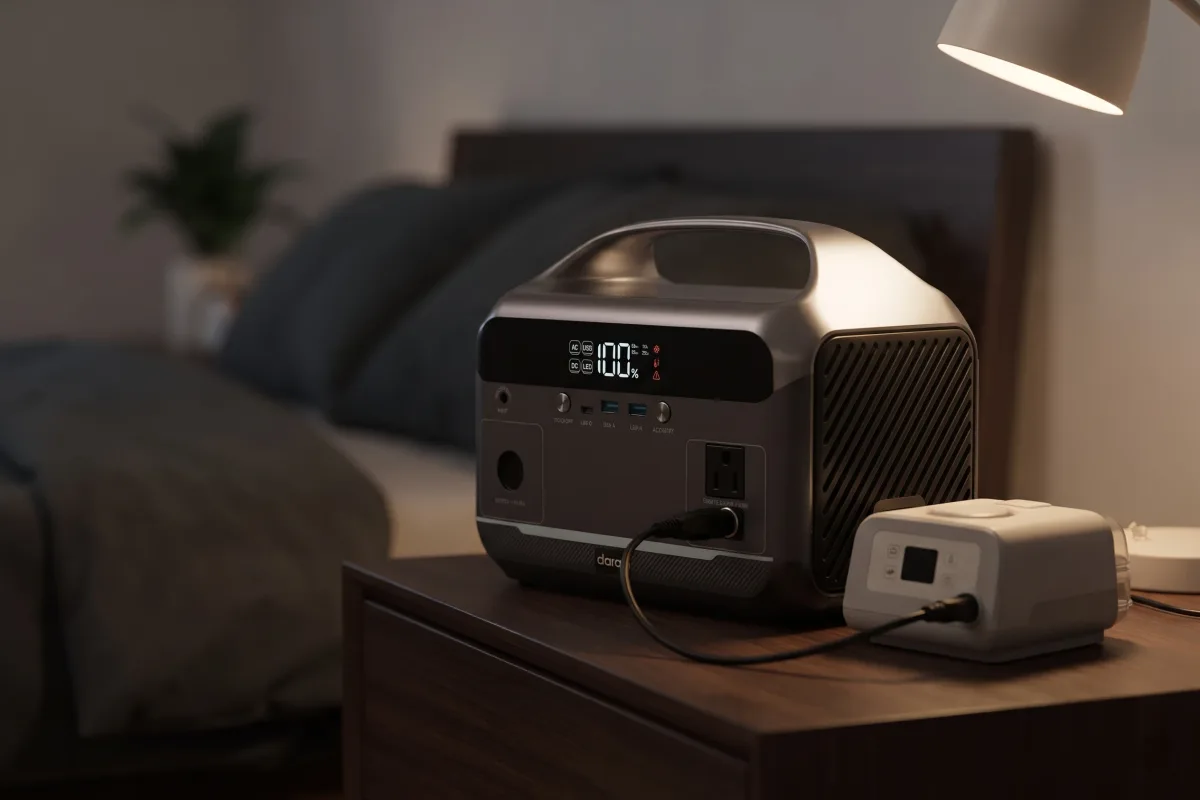
Try your own devices in the runtime calculator; CPAP settings are covered in how long a power station runs a CPAP and routers in running a Wi-Fi router from a power station.
Output: 350 W runs laptops, fans and a TV, not a kettle or fridge
Two pure sine wave outlets share 350 W (600 W surge); a fridge's start or any heating appliance is beyond it.
The two AC outlets share 350 W: enough for laptop chargers, fans, LED lights, a TV, a printer, camera and drone chargers. The 600 W surge covers small motors starting, but not a full-size fridge, whose compressor needs about 800 to 1,200 W to start (see how long a power station runs a fridge). It won't run a kettle, coffee maker, hair dryer, microwave or space heater, and Daran lists no boost mode for heating loads.
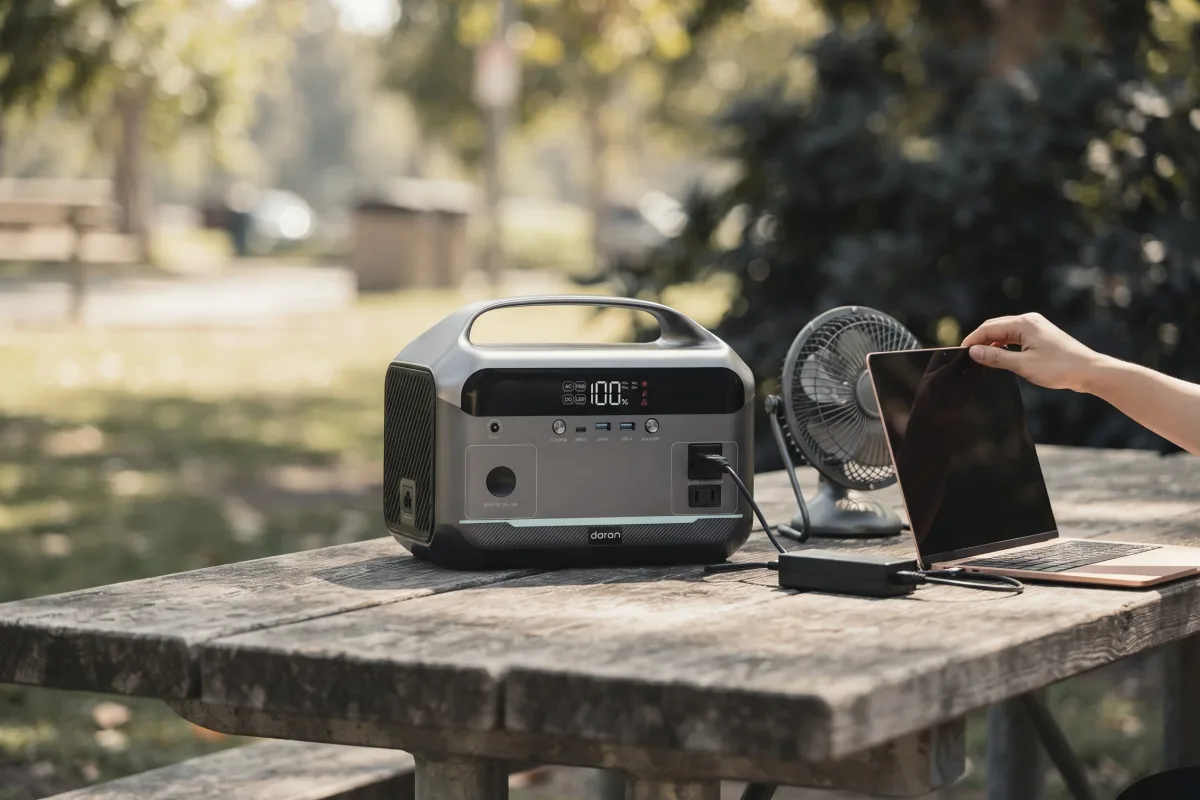
- USB-C 60 W: most 13- and 14-inch laptops charge at full speed; bigger laptops charge more slowly.
- USB-A 18 W × 2: phones, earbuds, lights.
- Car outlet 120 W (12 V, 10 A): a CPAP's DC converter or a 12 V cooler.
Ratings explained in surge vs continuous watts.
Backup (UPS) and app: "UPS" listed, with no switchover time
Daran's page names a UPS function but publishes no switchover time, so it's not the pick for a desktop PC.
Daran's page lists "UPS" among the NEO300L's protections, but gives no switchover time and doesn't say which outlets switch. A desktop PC needs a switchover of 10 ms or less to ride through (see using a power station as a UPS), so without a published figure don't rely on it for a computer; a router or lamp that may blink is fine. There's no app; the screen shows battery level. For storage, Daran says to charge it to 80% every 3 to 6 months.
How the Daran NEO300L compares: the same 288 Wh, much slower to refill
Against the Bluetti Elite 30 V2, EcoFlow River 3 Plus and Anker SOLIX C300 DC, it matches their capacity but charges several times slower.
| Spec | Daran NEO300L | Bluetti Elite 30 V2 | EcoFlow River 3 Plus | Anker SOLIX C300 DC |
|---|---|---|---|---|
| Capacity (Wh) | 288 | 288 | 286 | 288 |
| AC output, continuous (W) | 350 | 600 | 600 | None (DC only; 300 W total DC output) |
| AC charge time | — | About 70 min | 1 hr (0–100%) | 80% in about 1 hr (2 × 140 W USB-C) |
| Max solar input (W) | 40 | 200 | 220 | 100 |
| Weight (lb) | 8.16 | 9.5 | 10.4 | 6.17 |
| Warranty (years) | 5 | 5 | 5 | 5 |
| Price | Check price | Check price | Check price | Check price |
- Bluetti Elite 30 V2: 288 Wh and 600 W at 9.5 lb, about 70 minutes from the wall by Bluetti's figure, a 10 ms or faster switchover and a 5-year warranty. Rated 7.8, the highest of the compact stations.
- EcoFlow River 3 Plus: 286 Wh and 600 W at 10.4 lb, a switchover under 10 ms and PC/NAS shutdown support. Rated 7.6.
- Anker SOLIX C300 DC: 288 Wh with two 140 W USB-C ports and no AC outlet, at 6.17 lb. Rated 6.8.
- EcoFlow River 3: 245 Wh and 300 W at 7.7 lb, one hour from the wall by EcoFlow's figure. Rated 5.2.
For a 288 Wh station that also recharges from solar in a day, the Elite 30 V2 rates highest of the compact stations we've reviewed.
By our method on How We Test, the NEO300L rates 4.7: its battery life and warranty score 9, but its solar input scores 0, the lowest of the compact stations we've reviewed, and its wall charging 0.4, above only the Jackery Explorer 300's 0.1.
Who should buy the Daran NEO300L: patient chargers who want a long warranty
Good for phones, laptops, a router or CPAP nights when you can recharge overnight; not for fast refills or solar trips.
Good fit: a backup for phones, laptops and a router in short outages; a CPAP for a long weekend on its car outlet; car camping where you recharge at home or overnight from the wall.
Look elsewhere if: you want a quick refill, plan to recharge from solar on multi-day trips, need a computer UPS, or need more than 350 W. The best small portable power stations and best value portable power stations compare the alternatives.
FAQ
Daran NEO300L runtime, charging, CPAP use, warranty and the NEO300 differences, answered with Daran's figures.
Is the Daran NEO300L any good?
For light loads, yes: 288 Wh of LiFePO4 rated for 3,500+ cycles, two pure sine wave outlets sharing 350 W and a 5-year warranty. Its weak points are slow charging (100 W wall, 40 W solar) and no published UPS switchover time.
How long does the Daran NEO300L take to charge?
Daran doesn't publish a wall time; at its 100 W maximum it's about 2.9 hours by our estimate. On solar, Daran says about 8 hours at its 40 W maximum.
Can the Daran NEO300L run a CPAP?
Yes: about 24 hours, or three 8-hour nights, for an 11 W CPAP without the humidifier on the 12 V car outlet, by our estimate. With the humidifier on AC (about 56 W), about 3.8 hours.
Will it run a refrigerator?
Not reliably. A fridge needs about 800 to 1,200 W to start its compressor, above the NEO300L's 600 W surge. A 12 V cooler on the car outlet is the better match.
What is the difference between the NEO300L, NEO300 and NEO300 Pro?
The NEO300L has 288 Wh and 350 W; the NEO300 268.8 Wh and 300 W; the NEO300 Pro 299 Wh and 600 W.
Who makes Daran power stations?
DaranEner, a company based in Kowloon, Hong Kong, which sells them under the Daran and DaranEner names.
Is Daran a good brand?
Daran is a smaller maker than EcoFlow, Bluetti or Anker. Its NEO models use LiFePO4 batteries and the NEO300L carries a 5-year warranty, but Daran publishes fewer specs: no UPS switchover time, car-charging watts or certifications, and no app. That's the main gap this Daran portable power station review finds; it suits light loads.
What warranty does it have?
Five years, per Daran's product page. Daran doesn't publish the terms there, so keep your receipt and register it if Daran offers registration.
Can I take it on a plane?
No: at 288 Wh it's well over the common 100 Wh limit for carry-on batteries.