 By
We may earn a commission if you buy through links on this page, at no extra cost to you. This never affects which products we recommend. How we make money.
On this page 9 sections
Our verdict · EcoFlow
A 7.7 lb LiFePO4 station for phones, laptops, lights and a router, not for anything over 300 W
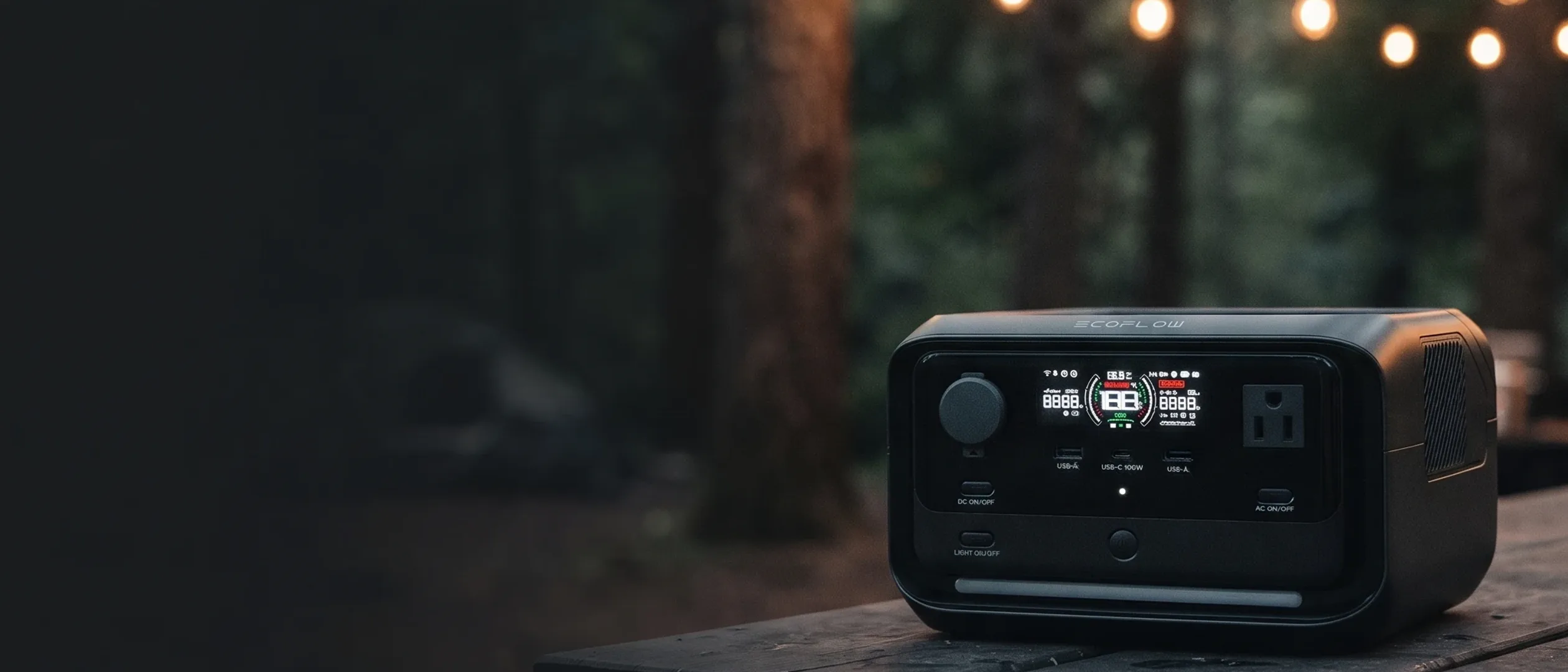
The River 3 is EcoFlow's smallest current LiFePO4 station: 245 Wh and 300 W in a 7.7 lb box that refills from the wall in about an hour. It covers phones, laptops, lights, a router and a low-draw CPAP. For anything bigger, or for a 5-year warranty and expansion, the River 3 Plus is the better buy.
- Capacity
- 245 Wh
- AC output
- 300 W
- Wall charge
- 0–100% in 1 hr
- Weight
- 7.7 lb
Best for
Day trips, tent camping, a CPAP without the humidifier on DC, and keeping a router or laptop going through a short outage.
Skip it if
You need to run anything over 300 W, want a backup switch under 10 ms, or want more than a 2-year warranty.
- 7.7 lb, 10.04 × 8.35 × 4.45 in
- 0–100% in about 1 hour from the wall (EcoFlow)
- LiFePO4 rated for 3,000 cycles to 80%
- Wi-Fi and Bluetooth app
- 300 W AC output (X-Boost to 600 W for heating loads only)
- 110 W solar input
- 20 ms backup switchover
- 2-year warranty; not expandable
Rating breakdown (compact (under 1 kwh) class)
| Criterion | Weight | Score | Based on |
|---|---|---|---|
| Wall charging speed | 20% | 8.4 | 320 W input |
| AC output | 20% | 3.3 | 300 W |
| Solar input | 10% | 4.1 | 110 W |
| Portability | 25% | 4.7 | 32 Wh/lb |
| Battery life & warranty | 25% | 5.0 | 2-year warranty, 3,000+ cycles |
| Capacity (Wh) | 245 |
|---|---|
| Battery chemistry | LiFePO4 |
| Rated cycle life | 3,000 cycles to 80% |
| AC output, continuous (W) | 300 |
| AC output, surge (W) | — |
| AC charge time | 0–100% in 1 hr (EcoFlow) |
| Max AC charging input (W) | 320 |
| Max solar input (W) | 110 |
| Solar input voltage range | 11–30 V, 8 A (shared solar/car XT60i port) |
| UPS switchover (ms) | <20 (EPS) |
| Weight (lb) | 7.7 |
| Expandable to (Wh) | Not expandable |
| Warranty (years) | 2 |
Key specs at a glance: 245 Wh and 300 W in 7.7 lb
A pocket-sized LiFePO4 station with a 1-hour wall charge and a 2-year warranty
- 245 Wh capacity: a router on DC for about 19 hours, or a CPAP without the humidifier for about two and a half nights (our estimates below).
- 300 W AC output: pure sine wave, enough for laptops, a fan, lights and a TV, not kettles or microwaves.
- LiFePO4, 3,000 cycles to 80%: EcoFlow's manual rates the battery at 80% or more of its capacity after 3,000 cycles. See LiFePO4 vs lithium-ion.
- 7.7 lb (3.5 kg), 10.04 × 8.35 × 4.45 in: low and flat, so it slides under a car seat.
- Built-in charger and X-GaNPower: one AC cable, no external brick; EcoFlow credits its gallium-nitride electronics for the small size and for double the runtime on loads under 100 W. The battery pack is rated IP54 against dust and splashes; the unit as a whole isn't waterproof.
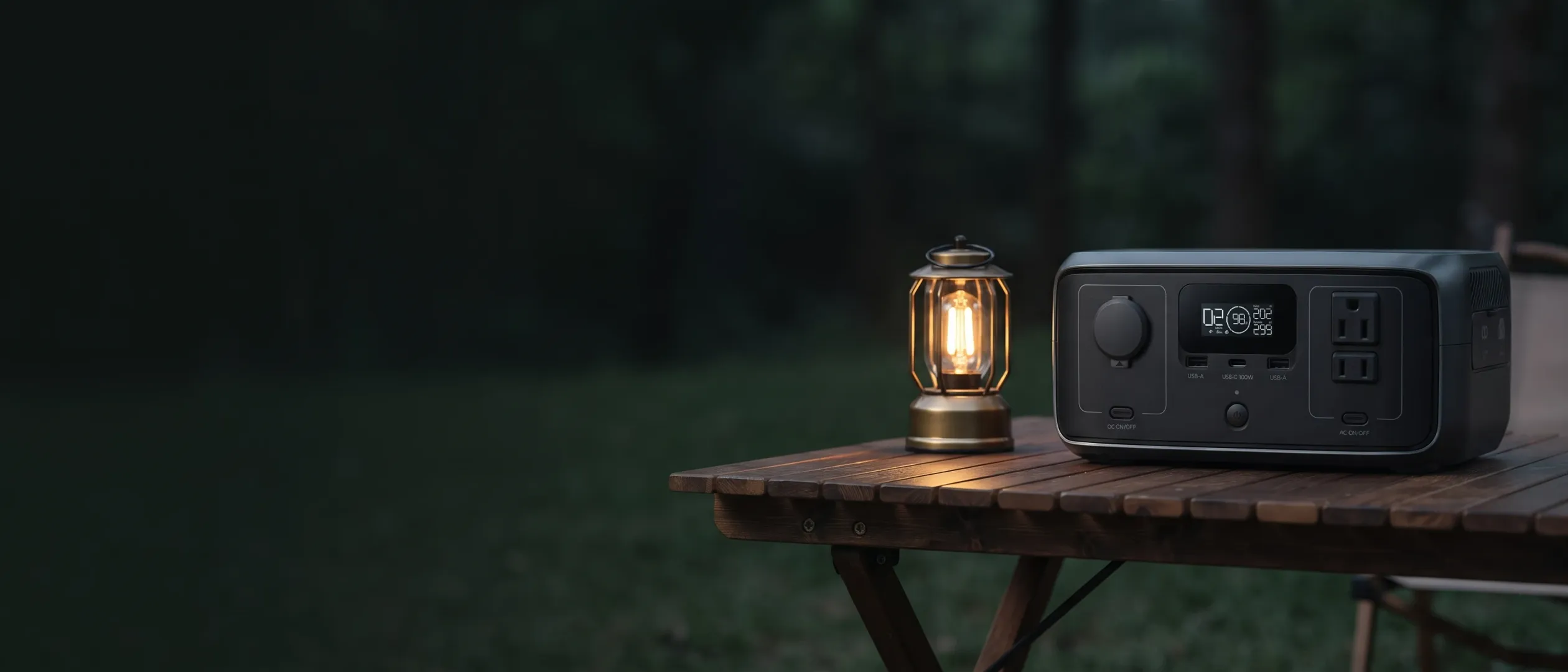
- Ports: AC outlets, one 100 W USB-C (PD 3.0), two 12 W USB-A and a 12 V car outlet (126 W); 550 W total output across all ports.
- Warranty: 2 years (the River 3 Plus has 5). EcoFlow's manual says the warranty is void if it's left uncharged or unused for more than 6 months.
- Not expandable: EcoFlow's extra batteries fit the River 3 Plus, not the River 3.
On our method it rates 5.2 among compact stations. How We Test explains the scoring, and watts vs watt-hours explains which spec answers which question.
Charging speed: 0 to 100% in about 1 hour on 320 W from the wall
EcoFlow quotes 1 hour at up to 320 W from an outlet and 2.6 hours from 110 W of solar
The charger is built in, so a single AC cable goes straight into the wall. EcoFlow quotes 0 to 100% in about 1 hour, and its US manual lists a maximum AC input of 320 W. That's the River 3's strongest point: it scores 8.4 for wall charging in our ratings, higher than the River 3 Plus.
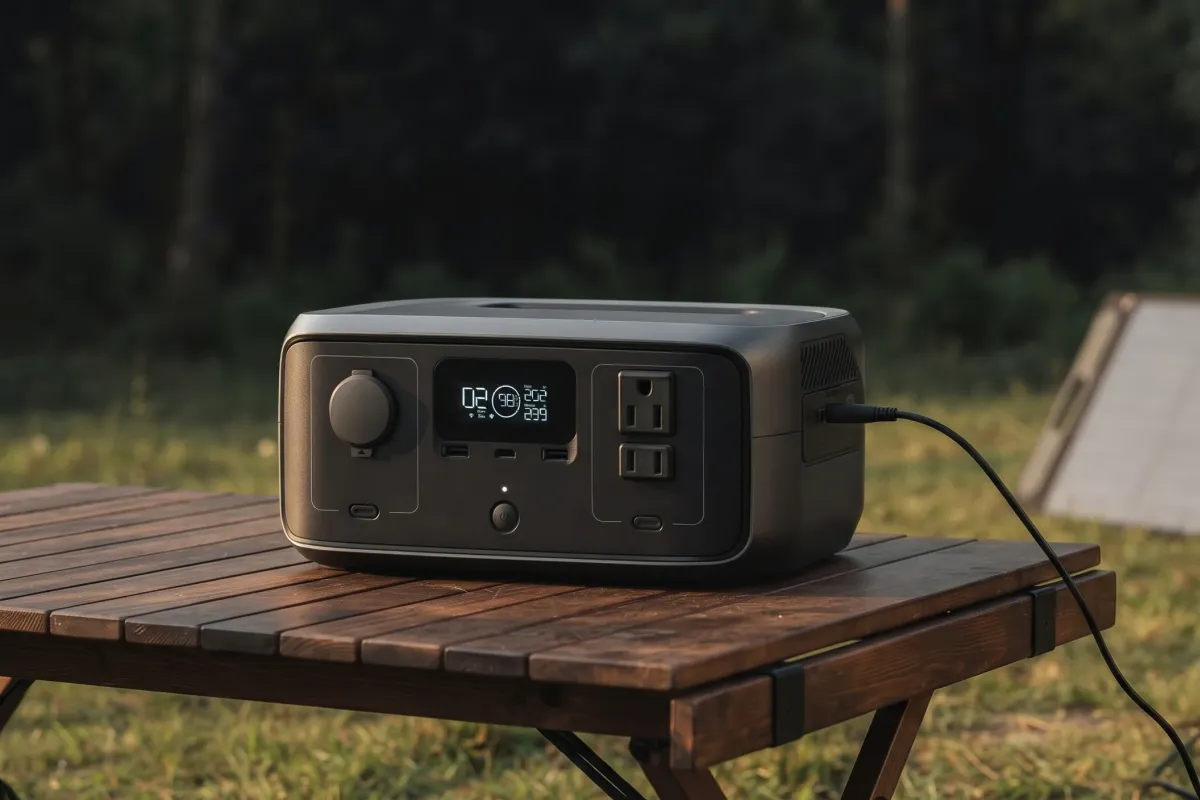
Solar: one input takes 11–30 V at up to 8 A, 110 W max, through an XT60i port it shares with car charging. EcoFlow quotes 2.6 hours at a full 110 W. Real panels rarely deliver their full rating: at 75% of a 110 W panel (about 83 W), a full charge takes about 3 hours of strong sun by our estimate. Keep the panel's open-circuit voltage (Voc) at 30 V or less, which in practice means one panel of 110 W or less. See what size solar panel you need and how to charge from solar.
Car: the same port takes 12 or 24 V at up to 8 A, 100 W max with EcoFlow's car charging cable, sold separately. At 100 W that's about 2.5 hours to full by our estimate. EcoFlow's manual says to start the engine first so the car battery isn't drained.
Capacity and real runtime: a router for about 19 hours
245 Wh runs a low-draw CPAP for about two and a half nights on DC, but a laptop on AC for about 3 hours
Estimated runtimes on the River 3
- CPAP, no humidifier, low-draw (11 W, DC)21 h
- Wi-Fi router (12 W, DC)19 h
- Box fan (50 W, AC)3.6 h
- CPAP with humidifier, typical (56 W, AC)3.2 h
- Laptop (60 W, AC)3.0 h
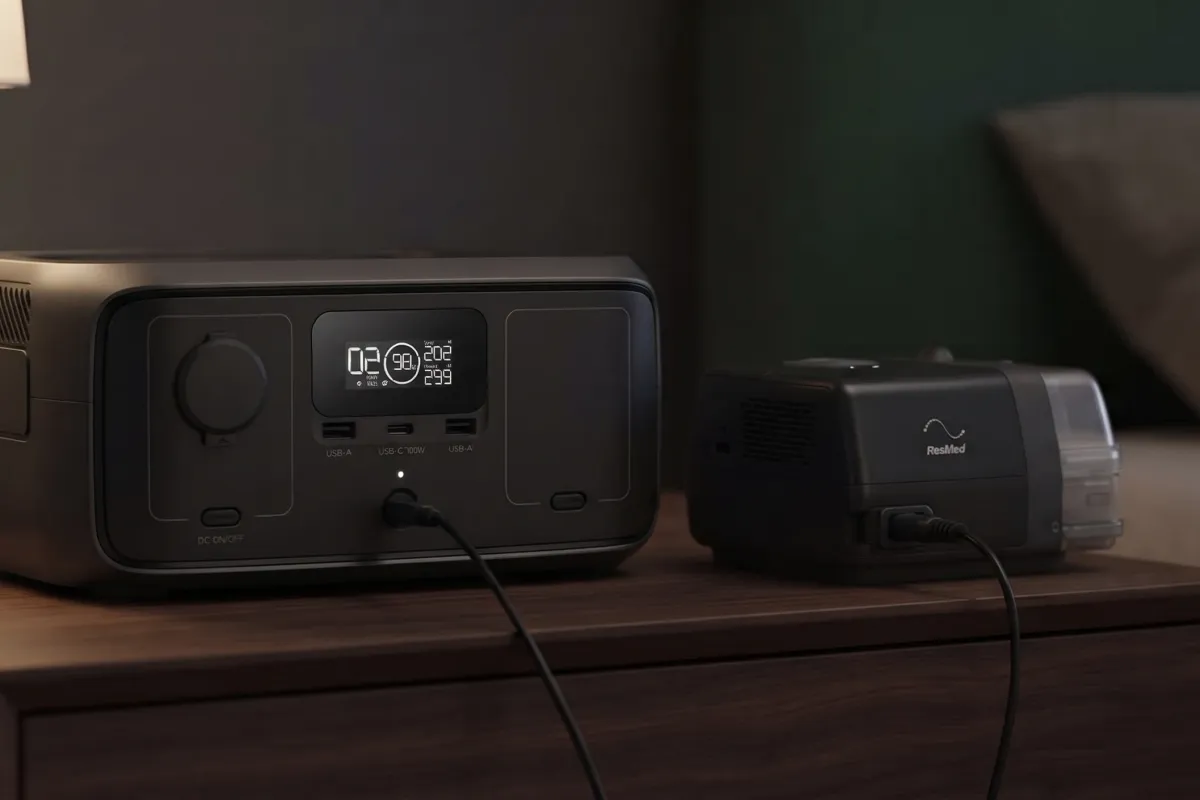
What that means in practice:
- CPAP: on a DC cable without the humidifier, about two and a half 8-hour nights. With the humidifier on AC, about 3 hours, so not a full night. See how long a power station runs a CPAP.
- Router and modem: about 19 hours on DC. EcoFlow quotes 30.8 hours for a 3 W light or router, a lighter load than ours.
- Laptop: about 3 hours on AC. Charging it over the 100 W USB-C port skips the inverter and lasts longer.
- Fridge: possible for a short cut, but 245 Wh empties in about 2.4 hours with a 67 W average fridge and a router, and the manual's AC timeout should be set to "never" in the app so the outlet doesn't switch off between compressor cycles.
Put your own devices into the runtime calculator. In the cold or with an older battery, expect less.
Output: 300 W runs devices, not kitchen appliances
Laptops, a fan and a TV fit; kettles, microwaves and hair dryers don't
The River 3's AC outlets deliver 300 W total at 120 V, pure sine wave. EcoFlow's manual says the number and type of AC sockets vary by region. The USB-C port gives up to 100 W (enough for most laptops), the two USB-A ports 12 W each, and the 12 V car outlet 126 W. All outputs together top out at 550 W.
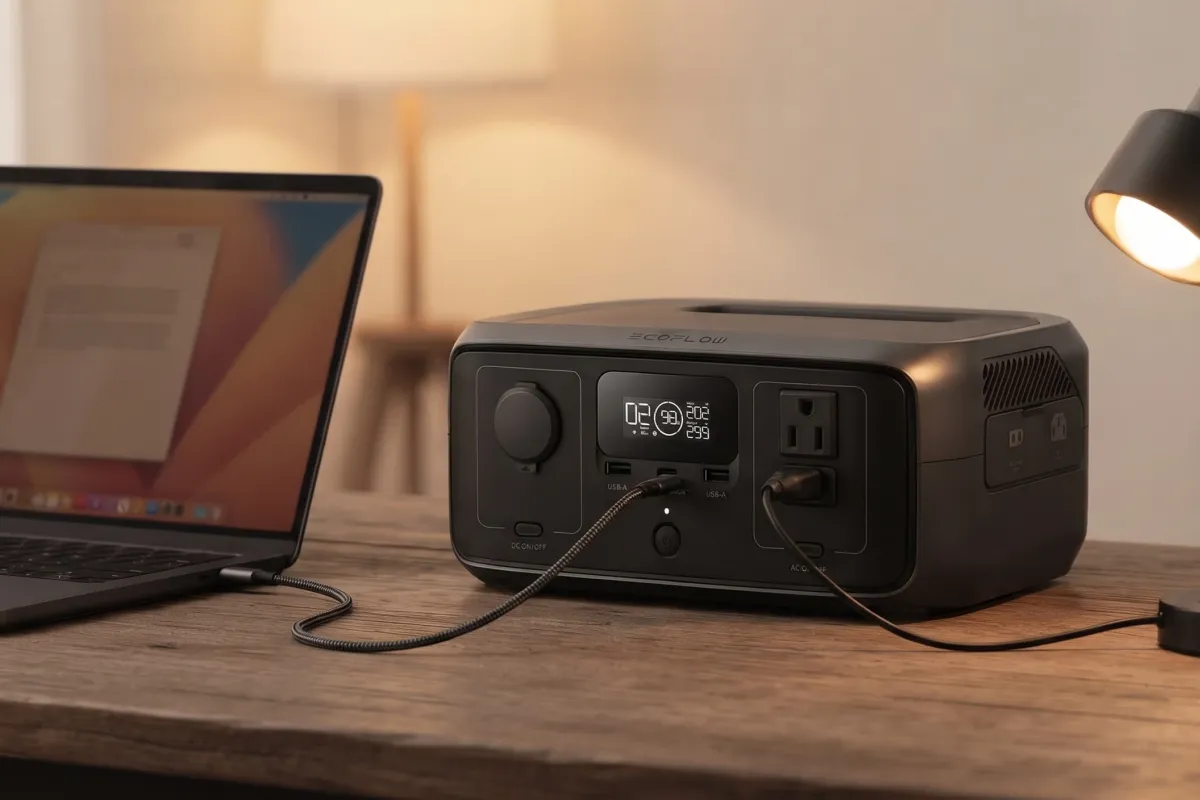
X-Boost lets it run some heating devices rated up to 600 W by lowering their power: a small kettle heats slowly, but motors and electronics don't benefit. EcoFlow's manual says X-Boost is off while the station is passing wall power through. See surge vs continuous watts.
What it can run: phones, tablets, laptops, cameras, drones, LED lights, a fan, a router, a TV, a CPAP. What it can't: microwaves, kettles at full power, coffee makers, hair dryers, space heaters or power tools. For those, the River 3 Plus (600 W) or a 1 kWh station is the step up.
Backup (UPS) and app: a 20 ms switch and Wi-Fi control
The River 3 switches to battery in under 20 ms; a separate 10 ms version exists
Plugged into the wall with devices on its AC outlets, the River 3 passes grid power through (up to 300 W) and switches to battery if the power cuts. EcoFlow's manual gives within 20 ms for the River 3, which is the version on Amazon in the US. A separate RIVER 3 (10 ms UPS) version is listed in the same manual at within 10 ms.
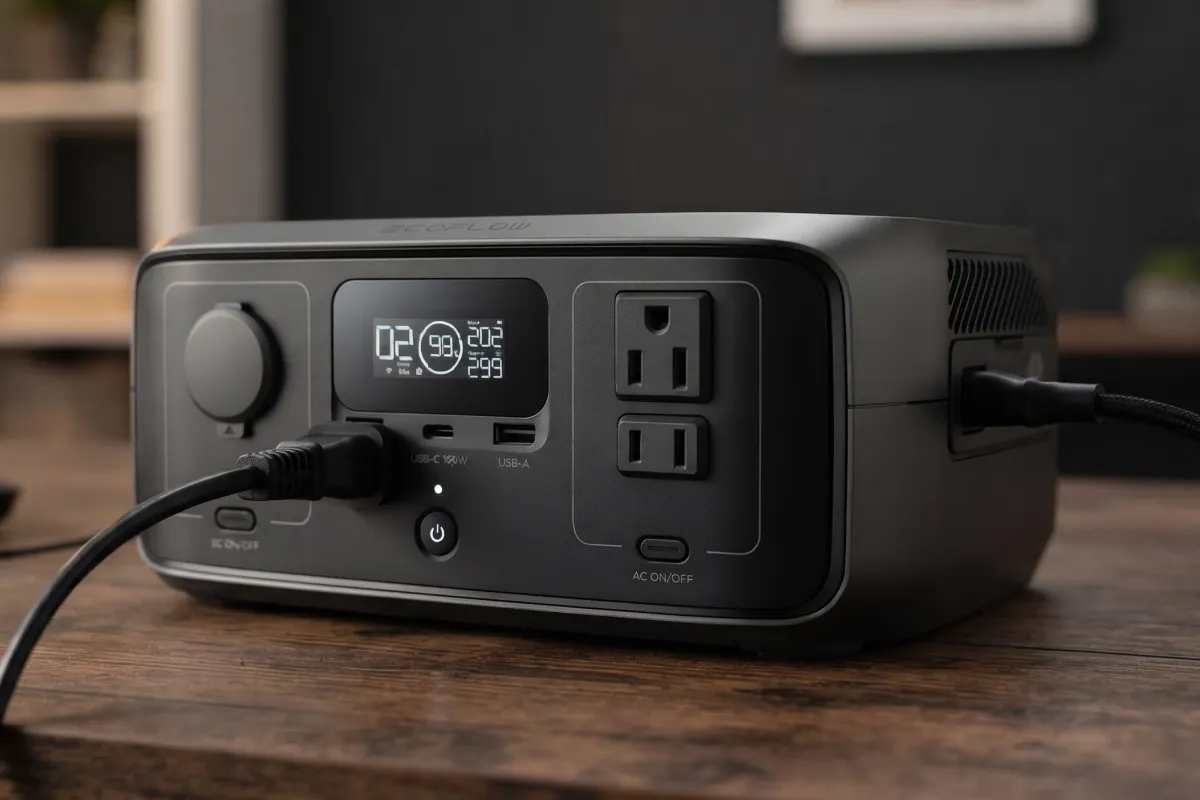
Twenty milliseconds keeps most routers, modems and laptops running. Some desktop PCs restart at that speed, so check yours or buy a station with 10 ms or less. See using a power station as a UPS.
The EcoFlow app connects over Wi-Fi or Bluetooth. It shows input, output and time remaining, turns X-Boost on or off, and sets the AC timeout, which you should set to "never" for a fridge or anything that cycles on and off.
Noise: under 30 dB at 1.5 ft
EcoFlow rates it quieter than a whisper from 1.5 ft at light loads
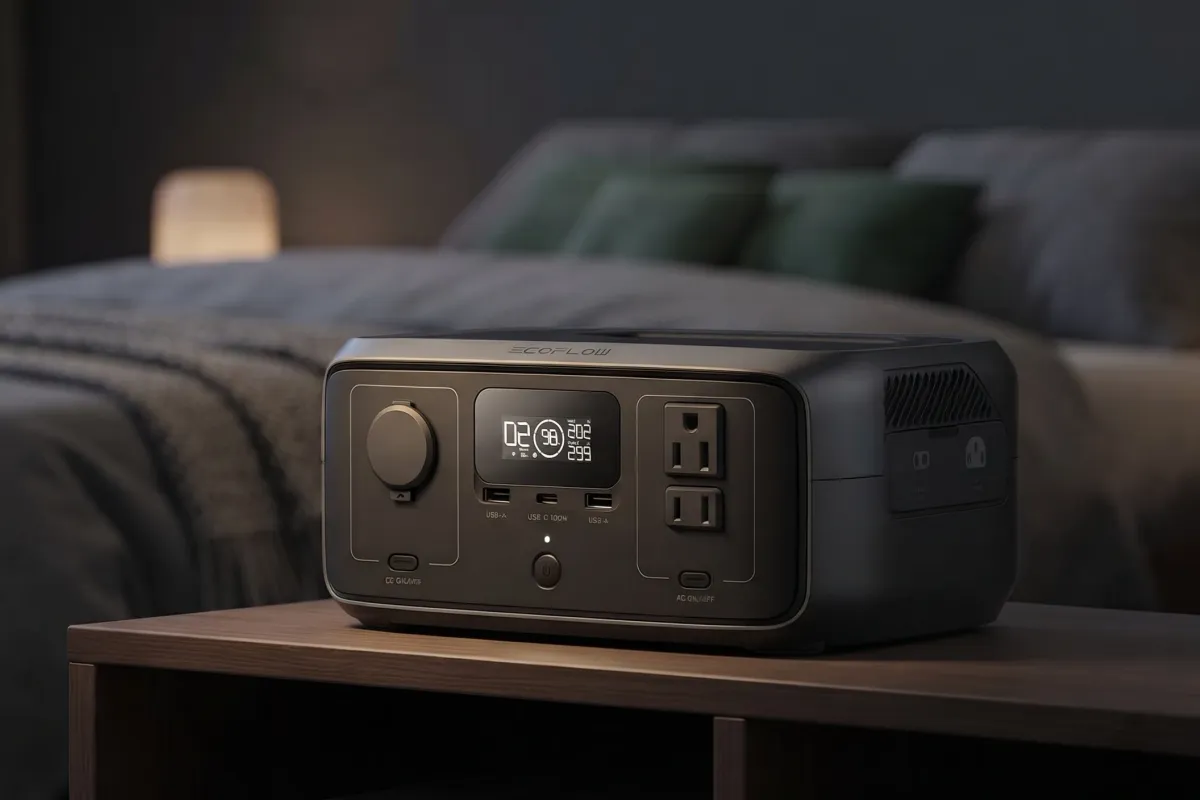
The Amazon listing gives under 30 dB at 1.5 ft, and EcoFlow's US River 3 Series page gives under 30 dB at 1.6 ft in a lab test at 89.6°F. That's quiet enough for a bedside table. Like any station, its fan speeds up when charging fast or near its 300 W limit.
How it compares: lighter and faster to refill than the Plus, with half the output
It wins on weight and wall charging; the River 3 Plus wins on output, solar, warranty and expansion
| Spec | EcoFlow River 3 | EcoFlow River 3 Plus | Bluetti Elite 30 V2 |
|---|---|---|---|
| Capacity (Wh) | 245 | 286 | 288 |
| AC output, continuous (W) | 300 | 600 | 600 |
| AC charge time | 0–100% in 1 hr (EcoFlow) | 1 hr (0–100%) | About 70 min |
| Max solar input (W) | 110 | 220 | 200 |
| Weight (lb) | 7.7 | 10.4 | 9.5 |
| Warranty (years) | 2 | 5 | 5 |
| Price | Check price | Check price | Check price |
- EcoFlow River 3 Plus (7.6): 286 Wh, double the output (600 W) and double the solar (220 W), under 10 ms backup, a 5-year warranty and expansion to 858 Wh, at 10.4 lb. Our ratings score the River 3 higher only for wall charging and portability.
- Bluetti Elite 30 V2 (7.8): 288 Wh, 600 W, 200 W solar, 10 ms or faster switchover and a 5-year warranty at 9.5 lb; the top-rated compact station we cover.
- Anker SOLIX C300 DC (6.8): 288 Wh with fast USB-C and a 5-year warranty at 6.17 lb, but no AC outlets.
- Jackery Explorer 300 (5.0): the same 300 W with 293 Wh, but an NMC battery rated for 800 cycles and about 4.5 hours to refill from the wall by Jackery's figure.
The River 3 rates 5.2: it scores well for wall charging (8.4) but low for output (3.3, at 300 W), solar (4.1) and battery life and warranty (5, held back by the 2-year warranty). For two of these side by side, see Elite 30 V2 vs River 3 Plus.
Who should buy the EcoFlow River 3: light trips and small electronics
Buy it for weight and a fast recharge; buy the Plus for anything more
Good fit: day trips and tent camping where weight matters, charging phones, cameras and a laptop, a CPAP without the humidifier on DC for a night or two, and a small backup for a router and modem.
Look elsewhere if: you need more than 300 W, want a 10 ms switchover for a desktop PC, plan to add solar beyond one small panel, or want a longer warranty. The River 3 Plus fixes all four for 2.7 lb more, and our best small portable power stations guide covers the rest of this size.
FAQ
River 3 questions: worth it, what it runs, the Plus, Max, Delta 3 and Jackery
Is the EcoFlow River 3 worth it?
For light use, yes: it's 7.7 lb, refills in about an hour and runs phones, laptops, lights and a router. It rates 5.2 by our method, held back by its 300 W output, 110 W solar input and 2-year warranty. If you'll run anything bigger, the River 3 Plus (7.6) is worth the extra weight.
What can an EcoFlow River 3 run?
Anything under 300 W on AC: laptops, a fan, a TV, LED lights, a router or a CPAP. USB-C charges laptops up to 100 W. It can't run microwaves, kettles at full power, hair dryers or power tools.
How long does the EcoFlow River 3 last?
The battery is rated for 80% or more of its capacity after 3,000 cycles. On a single charge, a router runs about 19 hours and a low-draw CPAP about 20 hours on DC, by our estimate.
River 3 or River 3 Plus?
The Plus, unless weight and price matter most. It has double the output (600 W) and solar input (220 W), a 10 ms switchover, a 5-year warranty and optional extra batteries. The River 3 is 2.7 lb lighter and refills at a similar speed.
Which is better, the Delta 3 or the River 3?
They're different sizes. The Delta 3 is a 1 kWh station for home backup and kitchen appliances; the River 3 is a 245 Wh carry-along. See the Delta 3 review and EcoFlow vs Jackery for EcoFlow against other brands.
River 3, River 3 Plus or River 3 Max?
The River 3 Max and Max Plus are River 3 Plus units with an extra battery attached: 572 Wh and 858 Wh, at 600 W. The base River 3 can't take those batteries. Choose the River 3 for the lightest carry, the Plus for 600 W, and a Max if you want 572 or 858 Wh in one portable unit. See the River 3 Plus review.
Jackery or EcoFlow at this size?
Against the Jackery Explorer 300, the River 3 has a LiFePO4 battery rated for 3,000 cycles (the Jackery's NMC is rated for 800) and refills from the wall in about 1 hour against about 4.5 hours (both makers' figures). The Jackery has the longer warranty: 3 years plus 2 with registration, against 2. It rates 5.0 to the River 3's 5.2. For the brands overall, see EcoFlow vs Jackery.
Can the River 3 charge from solar?
Yes, from one panel of up to 110 W (11–30 V). EcoFlow quotes 2.6 hours at a full 110 W; about 3 hours of strong sun by our estimate.
Does the River 3 work as a UPS?
It switches to battery within 20 ms, which suits routers, modems and laptops. EcoFlow sells a separate RIVER 3 (10 ms UPS) version for more sensitive equipment.