 By
We may earn a commission if you buy through links on this page, at no extra cost to you. This never affects which products we recommend. How we make money.
On this page 9 sections
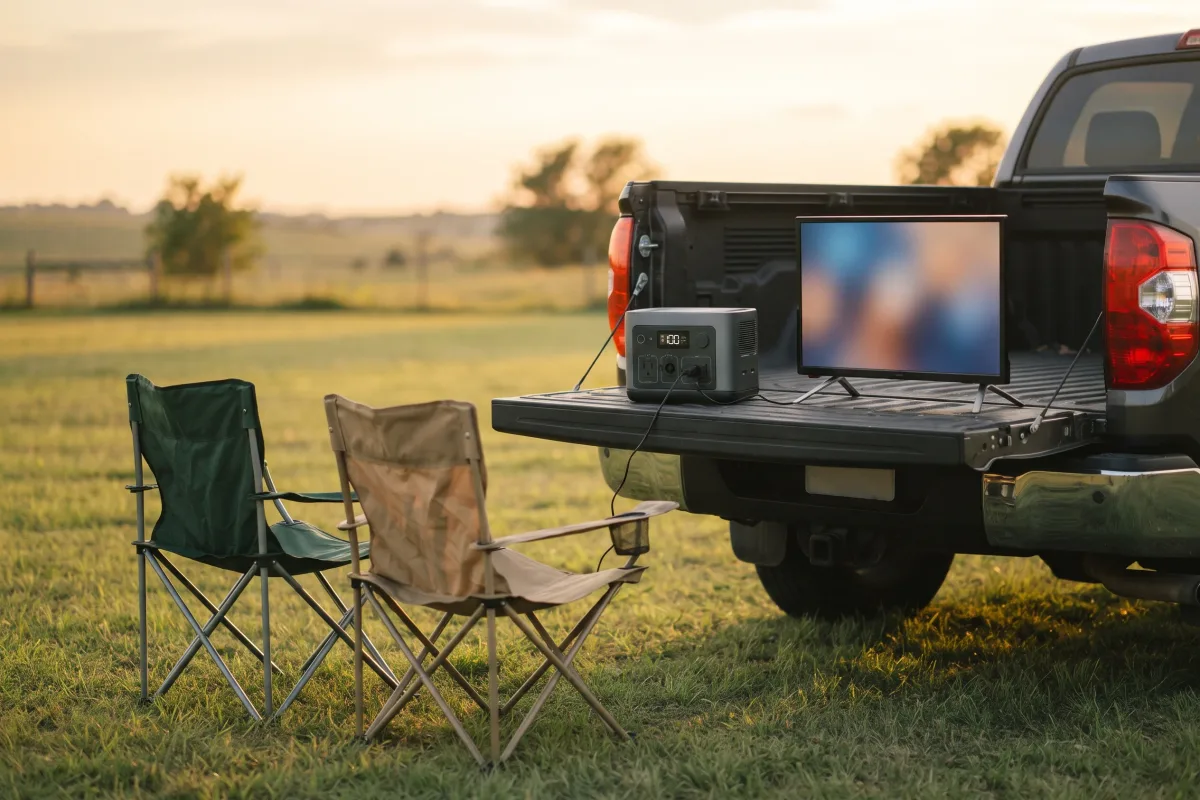
For most tailgates, pick a 1 kWh portable power station with at least 1,800 W of output. A TV, a 12 V cooler, lights and phones take about 700 Wh over a game day by our estimate; add 20 minutes on an electric griddle and it's about 1,300 Wh. A compact 300 Wh station runs a TV for about 2.5 hours but can't run a griddle or blender; a 2 kWh station covers the whole day with cooking.
Tailgate appliance watts: from 12 W for a cooler to 1,500 W for a griddle
A TV, lights and a cooler together draw under 150 W; one electric griddle draws ten times that.
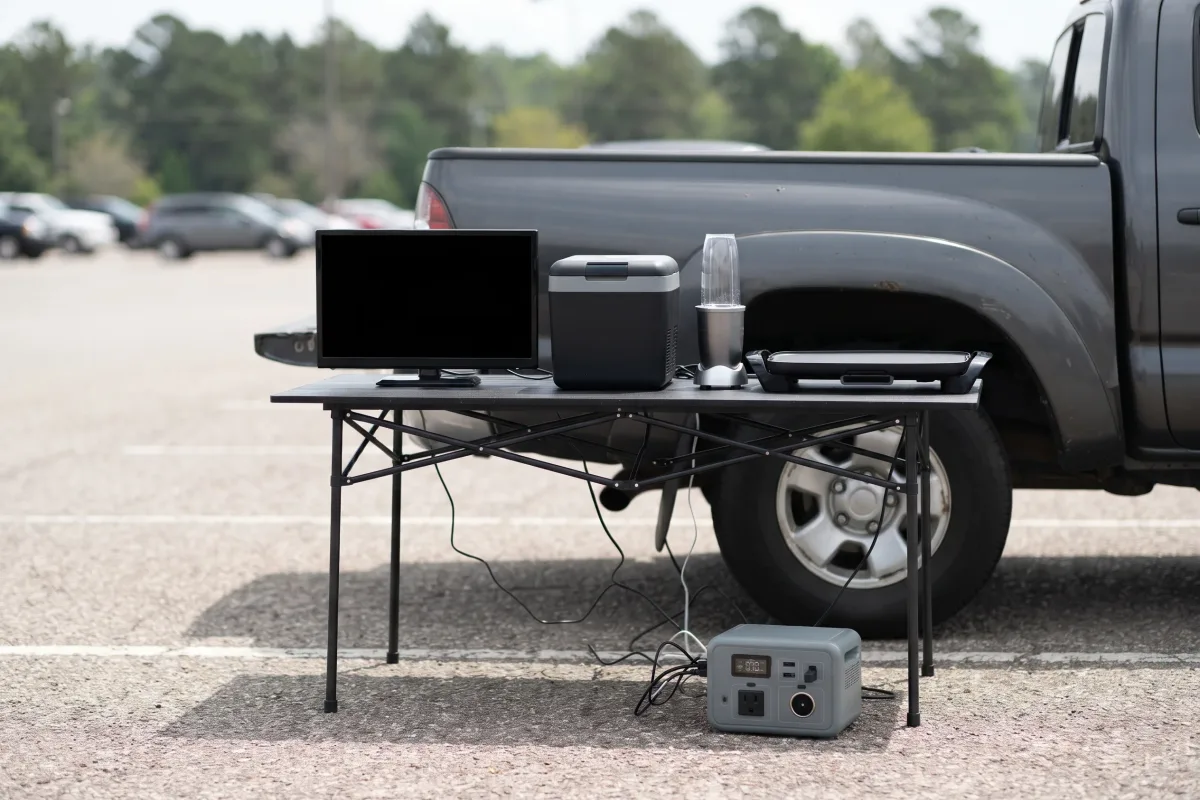
The appliances people bring to a tailgate split into two groups: entertainment and cold drinks, which draw little, and electric cooking, which draws a lot. Makers' figures and the typical draws we use in our runtime calculator:
| Appliance | Power | Source |
|---|---|---|
| 12 V fridge-cooler (Dometic CFX3 45) | about 12 W average | Dometic, 1.03 Ah per hour at 12 V in 32°C heat |
| LED string or camp lights | about 40 W | our calculator preset |
| 55-inch TV | about 90 W | our calculator preset |
| Sony PS5 | about 213 W gaming, 47 W at the menu | Sony |
| NutriBullet 700W blender | 700 W | NutriBullet |
| Presto 22-inch electric griddle | 1,500 W | Presto |
A slow cooker, coffee maker or kettle varies too much by model to list one figure; check the label on yours. Anything with a heating element is usually in the hundreds of watts or more, which matters for output more than for battery. A party speaker's rating is its sound output, not what it draws from the outlet, so check its power adapter label instead.
How much battery a game day takes: about 700 Wh without cooking
Eight hours of cooler, four hours of TV and lights, and phone charging come to about 700 Wh; 20 minutes of griddle adds about 590 Wh.
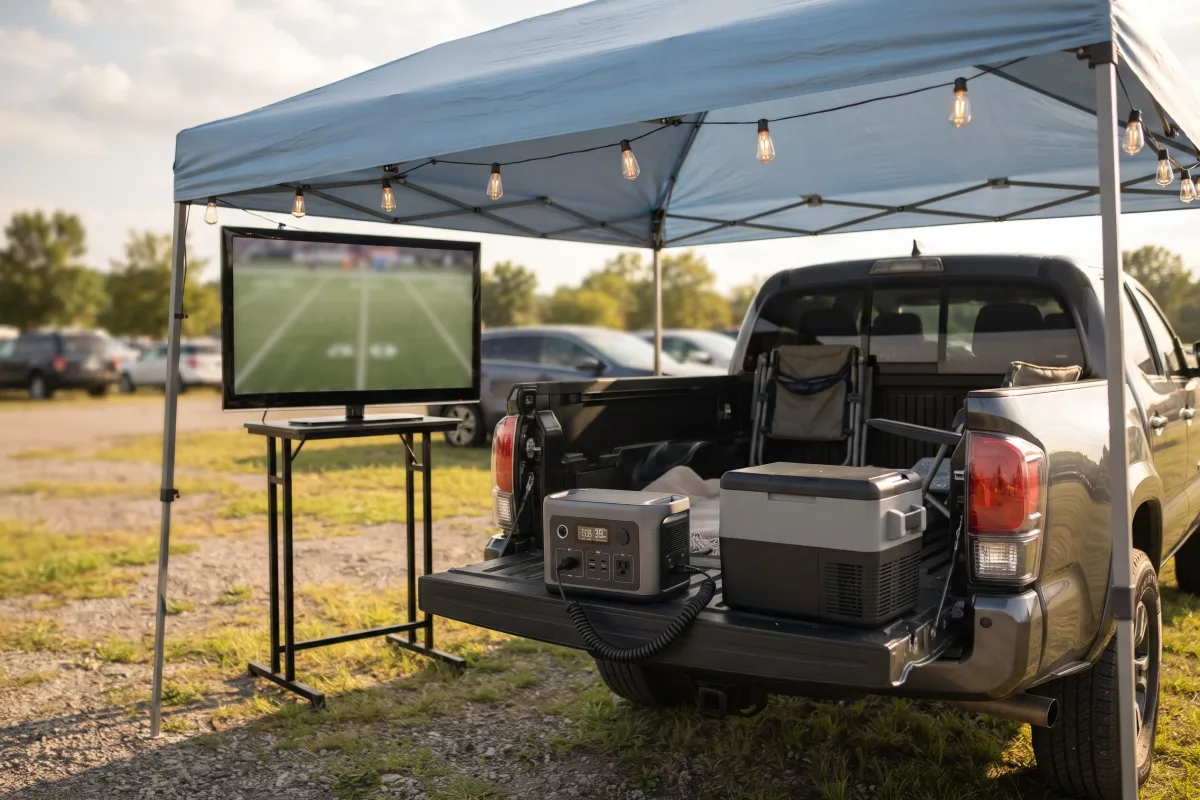
Here's a typical game day, by our estimate. On AC we divide the load by 0.85 for inverter loss and add about 10 W for the inverter itself while it's on; on a 12 V port we allow 92% efficiency:
| Load | Use | From the battery |
|---|---|---|
| 12 V cooler, 12 W (DC) | 8 hours | about 104 Wh |
| 55-inch TV, 90 W (AC) | 4 hours | about 424 Wh |
| Lights, 40 W (AC) | 2 hours | about 94 Wh |
| Phones (about 30 Wh, USB) | — | about 33 Wh |
| Inverter on for 4 hours | — | about 40 Wh |
| Total without cooking | about 695 Wh | |
| Griddle, 1,500 W (AC) | 20 minutes | about 588 Wh |
| Blender, 700 W (AC) | 3 minutes | about 41 Wh |
| Total with cooking | about 1,324 Wh |
Swap the TV for a game console and TV (about 303 W together) and four hours takes about 1,470 Wh on its own. Add your own list in the runtime calculator; a 20% margin covers a cold morning or a battery that's a few years old.
Tailgate runtime by station size: about 9 hours of TV per kWh
A 1,024 Wh station runs a 55-inch TV for about 8.8 hours, a TV and PS5 for about 2.8, and a 12 V cooler for over 3 days.
These are our estimates, one load at a time, from a full battery:
| Station capacity | 55-inch TV (90 W) | TV + PS5 (303 W) | 12 V cooler (12 W) | Griddle (1,500 W) |
|---|---|---|---|---|
| 288 Wh | ~2.5 h | ~0.8 h | ~22 h | over its limit |
| 1,024 Wh | ~8.8 h | ~2.8 h | ~79 h | ~35 min |
| 1,264 Wh | ~10.9 h | ~3.4 h | ~97 h | ~43 min |
| 2,048 Wh | ~17.7 h | ~5.6 h | ~157 h | ~69 min |
The cooler runs from the station's 12 V car outlet, which skips the inverter. The griddle column is the whole battery spent on cooking; in practice you'd cook for 20 to 30 minutes and leave the rest for the TV.
Cooking at a tailgate: output, not capacity, is the limit
A 1,500 W griddle needs a station rated 1,800 W or more continuous; compact 600 W stations can't run a griddle or a 700 W blender.
A station shuts its output off when a load exceeds its continuous rating. For electric cooking, check that number first:
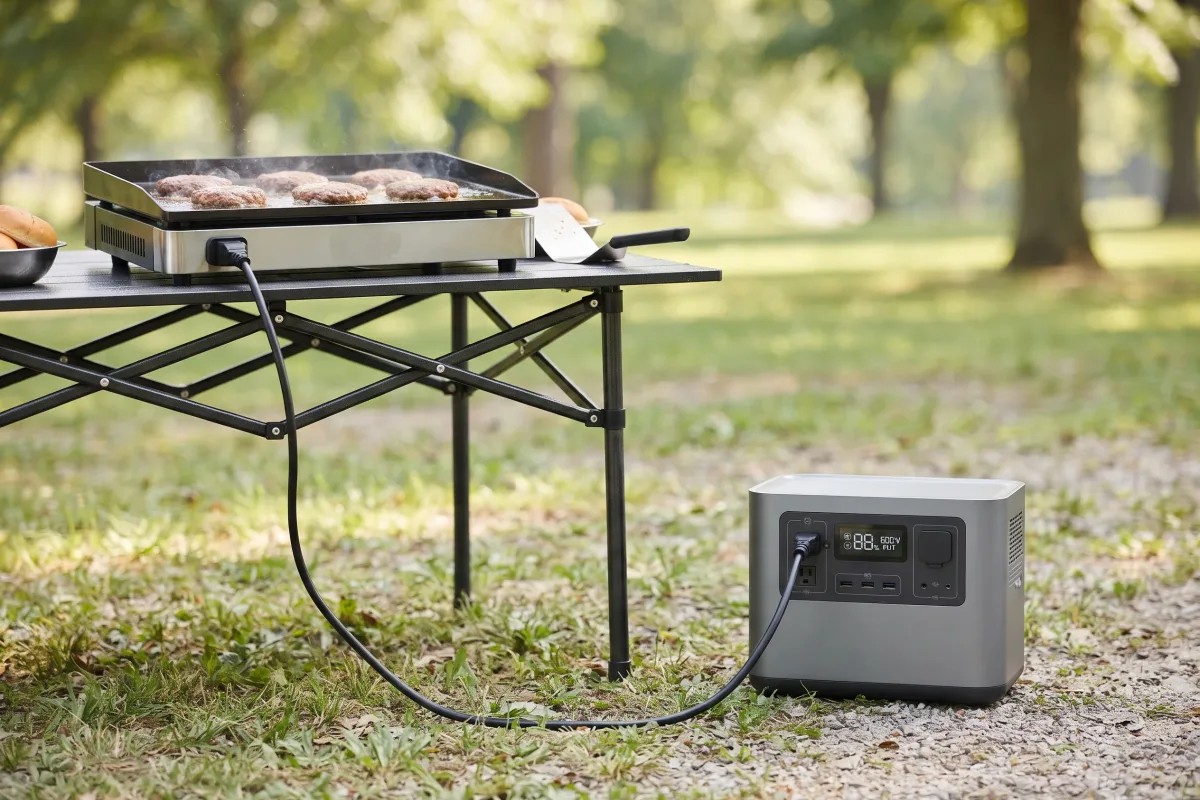
- Compact stations (600 W): a small portable power station for tailgating, such as the Bluetti Elite 30 V2 or EcoFlow River 3 Plus, runs a TV, lights and the cooler, but not a griddle, kettle or a 700 W blender.
- 1 kWh stations (1,500–2,000 W): the Anker SOLIX C1000 Gen 2 (2,000 W) and EcoFlow Delta 3 Plus (1,800 W) run a 1,500 W griddle with headroom; the Jackery Explorer 1000 v2 (1,500 W) is right at the limit, so a griddle that runs slightly over its label could trip it.
- 2 kWh stations (2,400 W): the Jackery HomePower 2000 Plus v2 and Anker SOLIX C2000 Gen 2 run the griddle and still have twice the battery for the rest of the day.
- One heater at a time: a griddle and a kettle together pass 2,000 W on most stations. Cook first, then boil.
Motors like blenders draw a short surge at start-up; every 1 kWh station above lists a surge rating of 3,000 W or more, so a 700 W blender starts easily. More on this in surge vs continuous watts. A station can cook, but cooking is what empties it fastest, so keep a gas grill for long cooks.
Stadium tailgating rules: generator limits and battery power
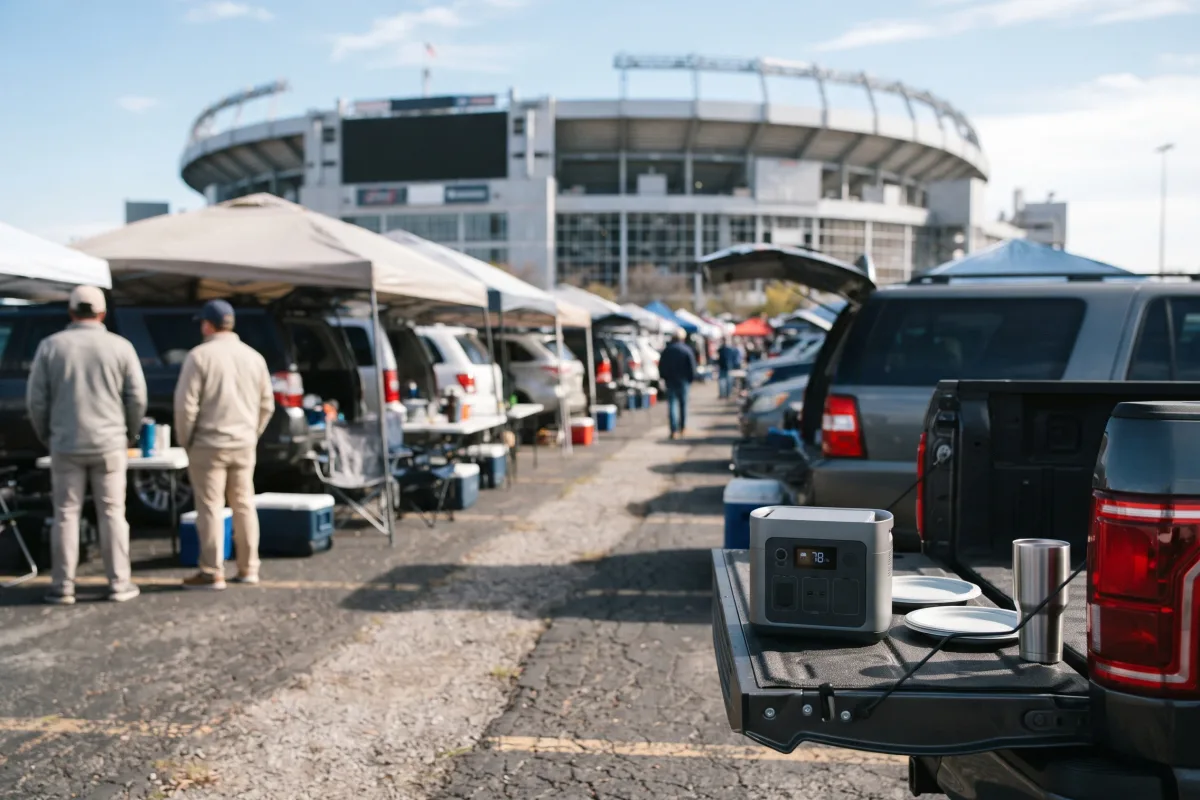
SoFi Stadium allows only generators of 600 W or less; LSU discourages generators and recommends battery power.
Many stadiums and universities limit generators in their lots because of noise, fumes and fire risk. Rules we checked:
- SoFi Stadium (Los Angeles): "small portable electric generators (600W or less)" only in parking-lot tailgating areas.
- LSU: portable generators are permitted but discouraged; LSU recommends battery-operated inverters instead.
- East Tennessee State University: properly ventilated gas generators up to 1,500 W.
- Arizona Cardinals and Mercedes-Benz Stadium (Atlanta): generators up to 6,500 W; Atlanta requires a plywood or decking base so the generator doesn't burn the grass.
None of these bans a battery power station, and a station has no exhaust, no fuel and no hot muffler. Rules change by season and venue, so read your stadium's current tailgating policy before you go.
Power station vs generator for tailgating: quiet and no fumes
Honda lists its EU2200i at 48 to 57 dBA; the stations we've reviewed list about 20 to 30 dB.
A small inverter generator gives more energy per trip, because you refuel it. A power station wins on everything else at a tailgate:
| Power station | Inverter generator | |
|---|---|---|
| Noise | about 20–30 dB listed | 48–57 dBA (Honda EU2200i) |
| Fumes | none | carbon monoxide; keep it away from people and cars |
| Stadium rules | not restricted in the policies above | capped or discouraged at some venues |
| Energy | 1–2 kWh per charge | as long as the fuel lasts |
| Cooking | griddle for 30–70 minutes | all day |
EcoFlow lists the Delta 3 Plus at under 30 dB at 600 W, and Anker the C1000 Gen 2 at 20 dB.
Power station vs your car's 12 V socket
The car's own socket is the free option, but it's small. Toyota's manuals limit it to 12 V at 10 A, about 120 W: enough for a TV or a 12 V cooler, not both with lights, and nothing with a heating element. Kia's manual says to use the outlet only with the vehicle on, because long use with it off can drain the starter battery; idling instead means engine noise and exhaust in a crowded lot. A station runs from its own battery with the engine off. See how to charge a power station from your car for the socket's limits in detail.
For the full comparison, including cost and long outages, see portable power station vs generator.
Tailgate power in rain and heat: keep the station covered and shaded
Most stations aren't waterproof: EcoFlow's manual says not to use its stations in the rain.
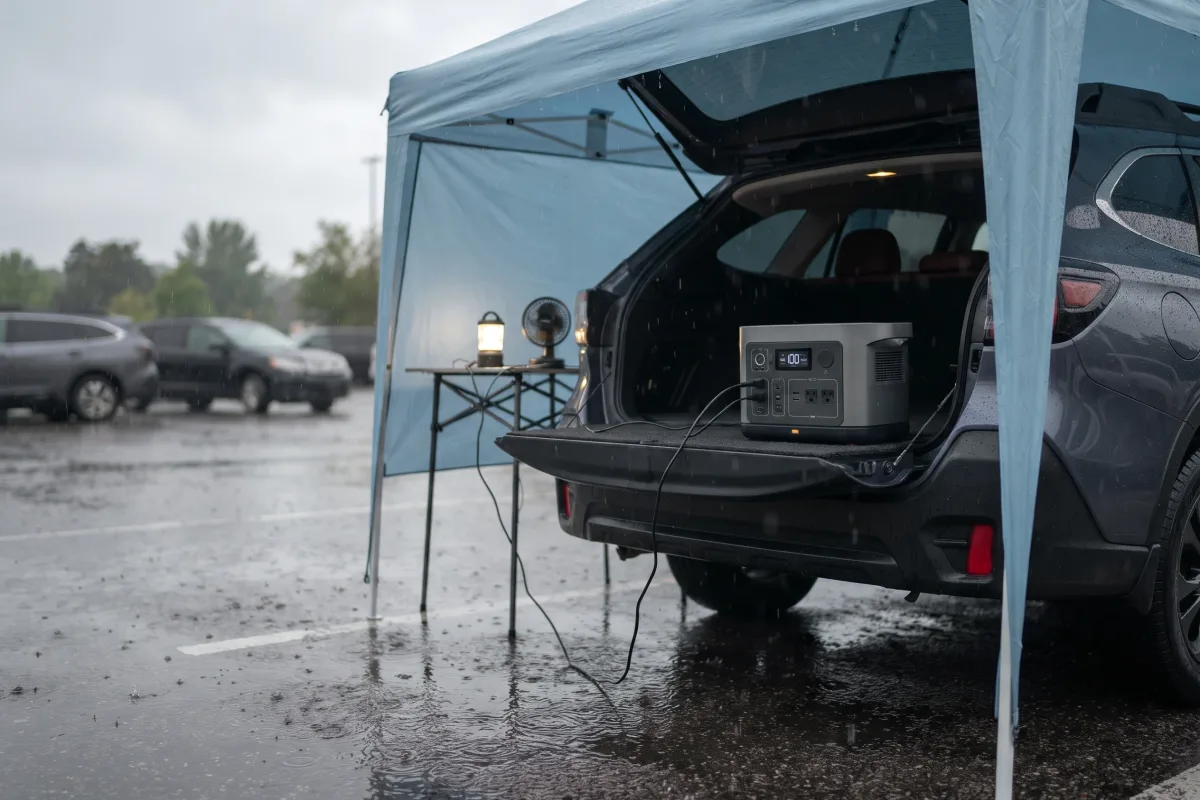
- Rain: EcoFlow's Delta 2 Max manual says to avoid liquids and not to use the station in the rain. Some battery packs carry ratings (EcoFlow lists the Delta 3 Plus battery pack at IP65, the pack only), but the station itself isn't waterproof; Bluetti lists the Elite 30 V2 at IP20. Keep it under the canopy or in the truck bed with a cover that doesn't block the vents.
- Heat: don't leave it in a closed car or in direct sun before the game. Many stations stop charging above about 104°F (Anker lists 104°F for the SOLIX C2000 Gen 2); see are portable power stations safe indoors for ventilation.
- Cords: run extension cords where nobody walks, and keep the station and its cords away from the grill.
- Jump-starting: a power station isn't a jump starter. Jackery says its stations can't jump-start a car, though they can charge a car battery with its 12 V battery charging cable; EcoFlow points buyers to a dedicated jump starter.
- Refilling on the way: a 12 V car socket adds only about 100 W while you drive (Anker lists 100 W car input for the SOLIX C2000 Gen 2); see how to charge a power station from your car.
Best power stations for tailgating: the C1000 Gen 2 for most
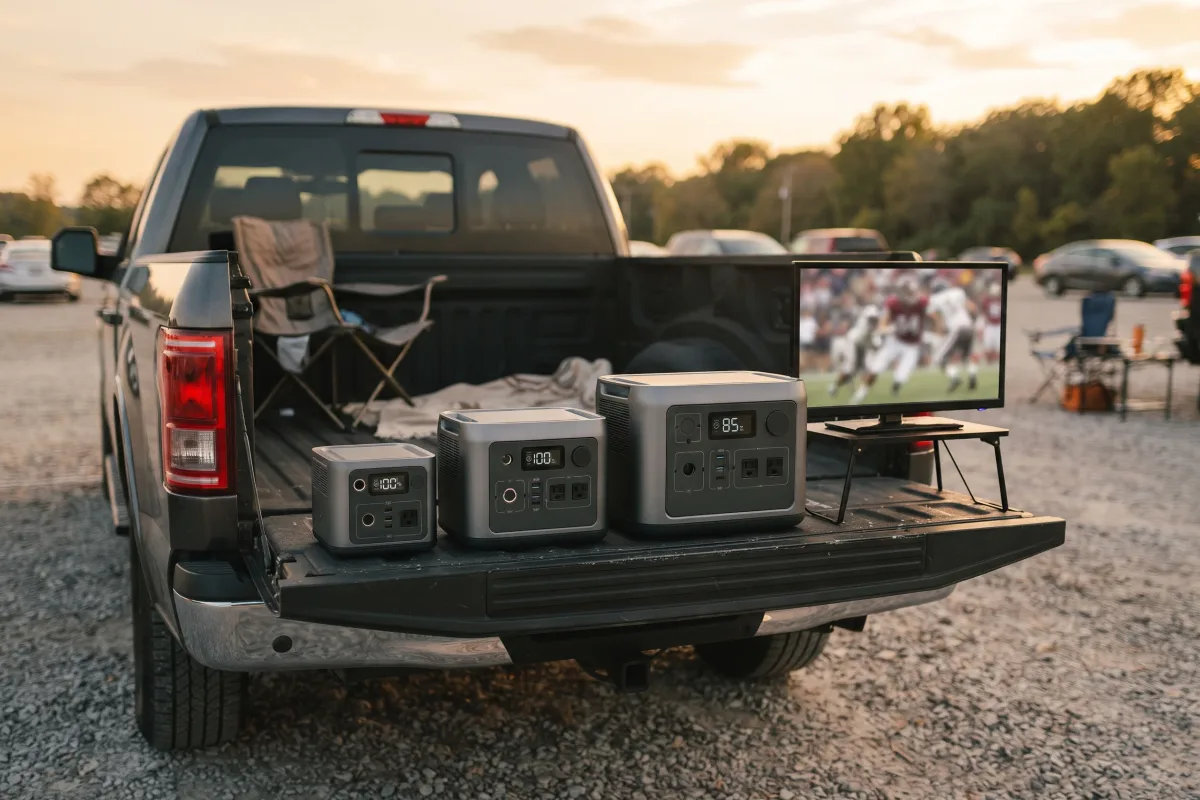
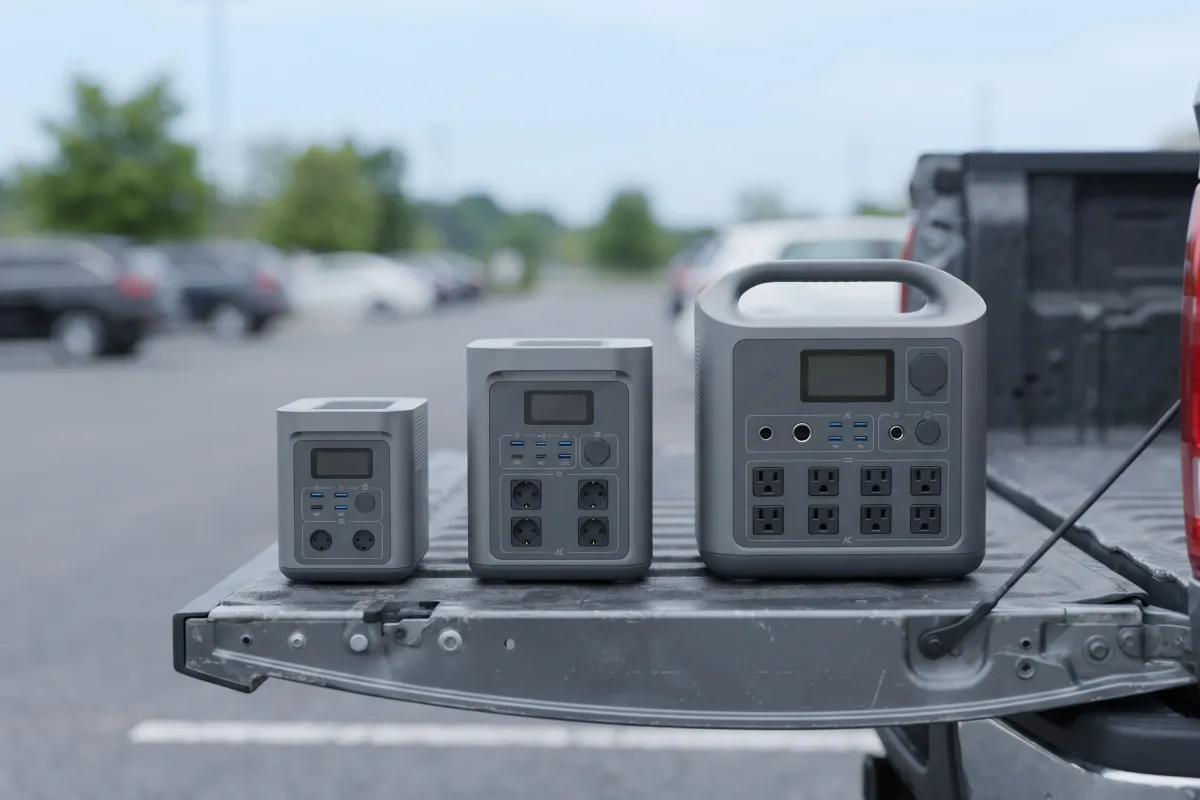
The Elite 30 V2 for a TV and cooler, the C1000 Gen 2 for cooking, the HomePower 2000 Plus v2 for a full day with a griddle.
| Station | Capacity / output | Weight | Best for |
|---|---|---|---|
| Bluetti Elite 30 V2 | 288 Wh / 600 W | 9.5 lb | TV for the game, cooler, phones |
| Anker SOLIX C1000 Gen 2 | 1,024 Wh / 2,000 W | 24.9 lb | game day with a griddle or blender |
| EcoFlow Delta 3 Plus | 1,024 Wh / 1,800 W | 27.6 lb | game day, with an 800 W alternator charger option |
| Jackery HomePower 2000 Plus v2 | 2,048 Wh / 2,400 W | 41.5 lb | all day with cooking and a console |
What to check before you buy:
- Output above your largest heater (1,800 W or more for a 1,500 W griddle).
- Capacity from the game-day budget above: about 700 Wh without cooking, about 1,300 Wh with it.
- AC outlets for the TV and the griddle at once, and a 12 V car outlet for the cooler.
- Wall recharge time, so it's full by game day: EcoFlow quotes 56 minutes for the Delta 3 Plus, Anker 49 minutes for the C1000 Gen 2 in UltraFast mode, Bluetti about 70 minutes for the Elite 30 V2.
- Weight and handles: 2 kWh stations weigh over 40 lb, so park close.
The night before: charge it to 100%, pack an outdoor extension cord, and check your stadium's current tailgating policy.
The C1000 Gen 2 is the best fit for most tailgaters: the most output of the 1 kWh stations, so a griddle runs with room to spare, at under 25 lb. If you never cook electrically, the Elite 30 V2 at 9.5 lb is easier to carry from the lot. These also fit camping trips; compare them in our best portable power stations for camping and the overall best portable power stations.
FAQ
Size, stadium rules, noise, TVs and jump-starting: tailgate power questions answered with the numbers above.
What size power station do I need for tailgating?
About 1 kWh with 1,800 W or more of output for a TV, cooler, lights and a short session on a griddle. Without cooking, about 700 Wh covers a game day by our estimate; a 300 Wh station covers the game itself.
What is the best portable power source for tailgating?
For most people, a 1 kWh power station such as the Anker SOLIX C1000 Gen 2: quiet, no fumes, and enough output for a griddle. A gas generator gives more energy for all-day cooking but is noisier and restricted at some stadiums.
How do you have electricity at a tailgate?
Bring a power station charged at home, use your car's 12 V socket for small loads, or bring a generator where the stadium allows it. A power station is the simplest: plug in and go.
What is the best small, quiet generator for tailgating?
A power station is quieter than any gas generator: about 20–30 dB listed, against 48–57 dBA for a Honda EU2200i. For a TV and cooler, a compact one like the Bluetti Elite 30 V2 (9.5 lb) is enough.
How long will a power station run a TV at a tailgate?
About 2.5 hours for a 55-inch TV on a 288 Wh station and about 8.8 hours on 1,024 Wh, by our estimate.
Can a portable power station run a blender?
Yes, if its output is above the blender's rating: a 700 W NutriBullet needs more than the 600 W of compact stations. A 1 kWh station with 1,800–2,000 W runs it easily.
Can a portable power station jump start a car?
No. Jackery says its stations can't jump-start a car, and EcoFlow recommends a dedicated jump starter. Some can slowly charge a car battery with a 12 V charging cable.
Are power stations allowed at stadium tailgates?
None of the policies we checked bans them; the rules target generators. LSU recommends battery power over generators. Check your stadium's current policy.