 By
We may earn a commission if you buy through links on this page, at no extra cost to you. This never affects which products we recommend. How we make money.
On this page 9 sections
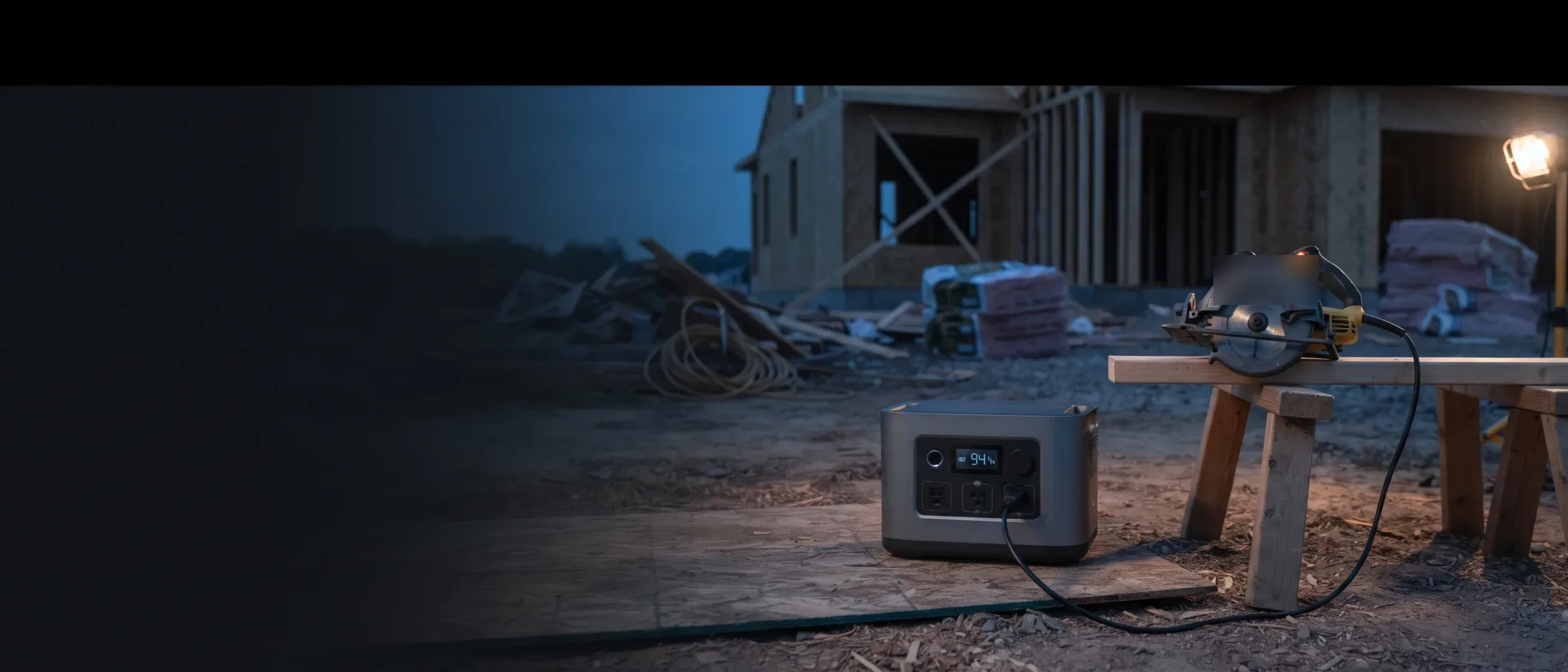
Yes: a portable power station can run power tools, if its continuous output covers the tool's rating and its surge rating covers the start. A 15 A circular, miter or table saw is rated at up to 1,800 W, so pick a station rated 1,800 W or more continuous, ideally 2,000 W with 3,000 W or more surge. Capacity sets how long you can cut: a 1 kWh station gives about 29 minutes of a 15 A saw at full load by our estimate, or about 10 recharges of an 18 V 5.0 Ah tool battery.
Power tool watts: a 15 A saw draws up to 1,800 W
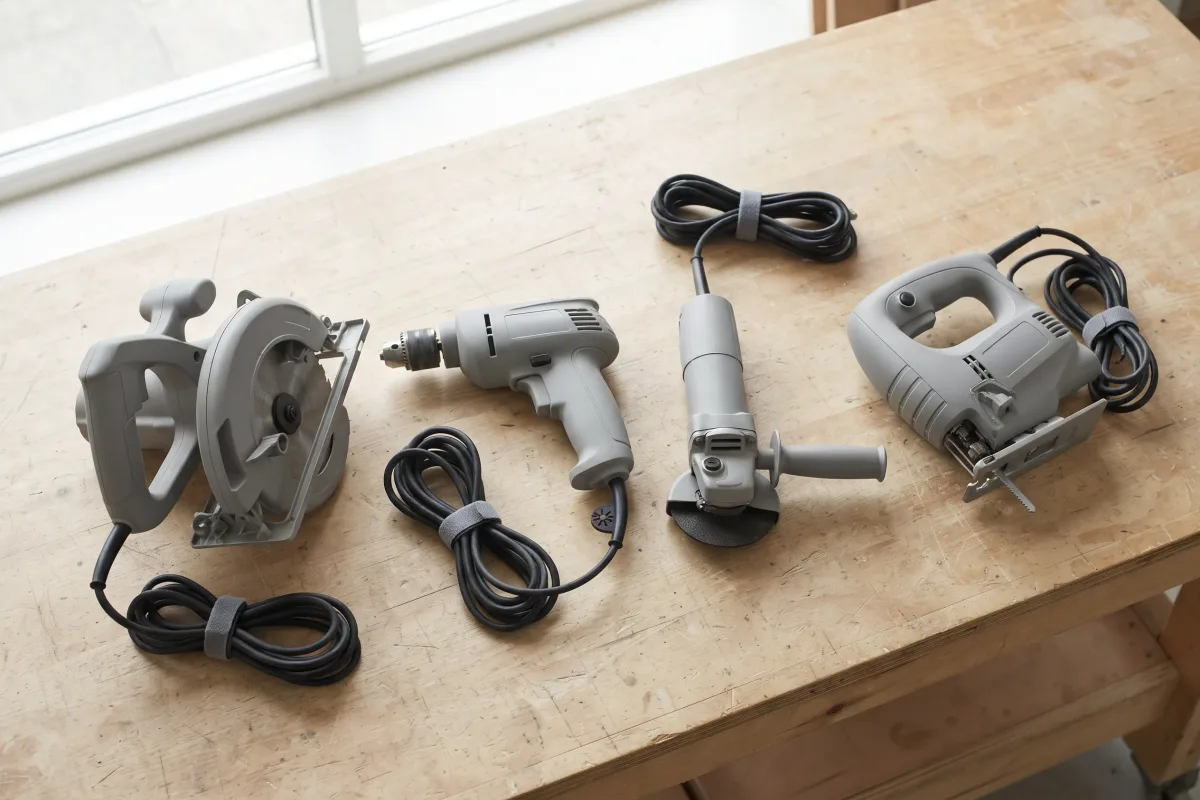
Watts are amps × 120 V: DeWalt's 15 A saws come to 1,800 W, Makita's 6.5 A drill to 780 W and its jigsaw to about 470 W.
Corded tools list their current draw in amps. Multiply by 120 V for the watts. That figure is the tool's full-load rating; it draws less when it runs free and close to it when it's cutting hard:
| Tool | Maker's rating | Watts at 120 V |
|---|---|---|
| 7-1/4" circular saw (DeWalt DWE575) | 15 A | 1,800 W |
| 12" miter saw (DeWalt DWS780) | 15 A | 1,800 W |
| 10" jobsite table saw (DeWalt DWE7491RS) | 15 A | 1,800 W |
| Corded reciprocating saw (Milwaukee Sawzall 6519-31) | 12 A | 1,440 W |
| 4-1/2" angle grinder (Makita 9557PB) | 7.5 A | 900 W |
| 1/2" corded drill (Makita 6302H) | 6.5 A | 780 W |
| Jigsaw (Makita 4329K) | 3.9 A | about 470 W |
Air compressors, shop vacs and electric chainsaws vary widely by model; read the amps on your tool's nameplate. Anything at 15 A is in the same class as the saws above.
Start-up surge: motors draw extra for a second or two
Honda sizes a motor's starting load at its running amps × 3; Generac says the extra lasts about two to three seconds.
A power tool's motor draws a burst of current when it starts, and again when a blade binds in a cut. Honda's generator guidance treats saws and drills as reactive loads and calculates their starting load at running amps × 3; Generac says this extra demand typically lasts two to three seconds before the tool settles to its running draw.
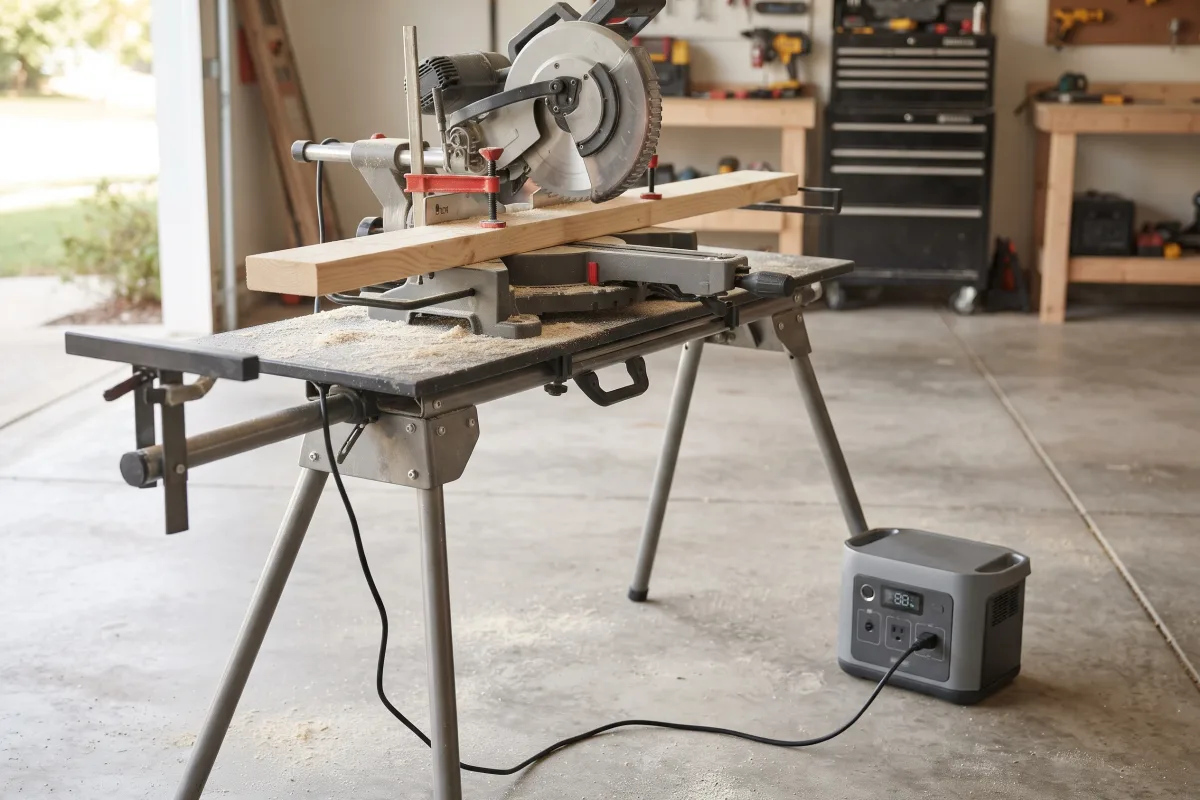
A power station handles that burst with its surge (peak) rating, which it can hold only briefly. If the surge rating is too low, the station cuts its output and you have to reset it; on some models the tool just stalls. Honda's × 3 is a rule for sizing generators; power stations list their own surge ratings, so the tiers below use our margins of roughly 1.7 to 2.2 times the tool's full-load watts rather than × 3. That's also why a station rated exactly 1,800 W continuous can run a 15 A saw that is cutting steadily but may trip as it starts or binds. More on the two ratings in surge vs continuous watts.
Which stations run a 15 A saw: 2,000 W and up
The Anker SOLIX C1000 Gen 2 (2,000 W, 3,000 W surge) and Jackery Explorer 1000 Plus (2,000 W, 4,000 W surge) are the lightest we've reviewed with that headroom.
Our guide for corded tools, from the stations we've reviewed (these are our margins, not maker requirements):
| Tool class | Continuous output | Surge | Stations we've reviewed |
|---|---|---|---|
| Jigsaw, drill, grinder (up to 900 W) | 1,000 W or more | 2,000 W or more | any 1 kWh station we've reviewed with a published surge rating |
| Recip saw (12 A, 1,440 W) | 1,800 W or more | 3,000 W or more | Delta 3 Plus and the 15 A picks below |
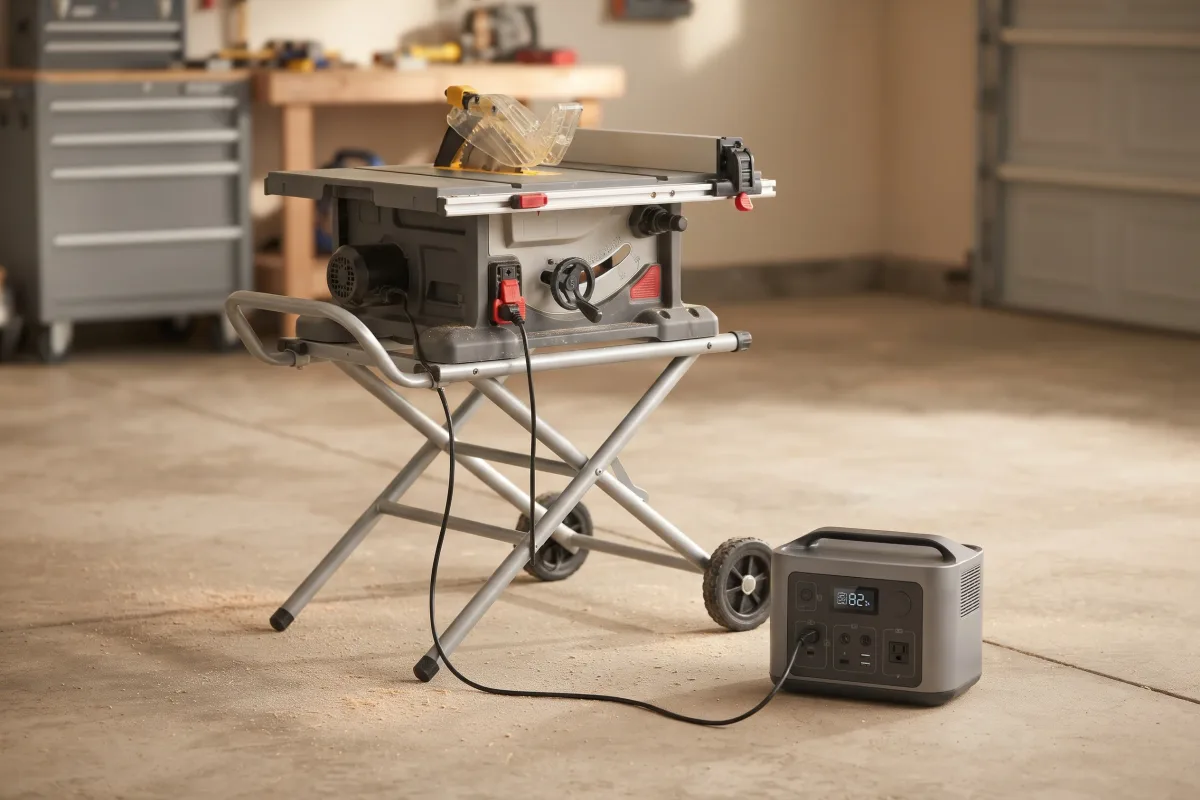
| 15 A saws (1,800 W) | 2,000 W or more | 3,000 W or more | C1000 Gen 2, Explorer 1000 Plus |
| 15 A saw plus a vac or second tool | 2,400 W or more | 4,000 W or more | HomePower 2000 Plus v2, C2000 Gen 2 |
- Compact 600 W stations such as the EcoFlow River 3 Plus (1,200 W surge) and Bluetti Elite 30 V2 run a jigsaw at most; use them for charging cordless batteries.
- Stations without a published surge rating, such as the Bluetti AC180 and DJI Power 1000 V2, are harder to judge for saws; their makers list continuous output only.
- One tool at a time. A 15 A saw (1,800 W) plus a 10 A second tool (1,200 W) already reaches 3,000 W running, before either motor's start.
X-Boost, SurgePad and Power Lifting don't help saw motors
EcoFlow lists X-Boost for heating appliances; Bluetti's Power Lifting and Anker's SurgePad are listed for heating and other resistive loads.
Several brands let a station run appliances above its rating by lowering the voltage: EcoFlow's X-Boost (up to 2,200 W on the Delta 3 Plus), Anker's SurgePad (heating devices up to 2,400 W on the C1000 Gen 2) and Bluetti's Power Lifting (2,700 W on the AC180). A kettle or heater simply runs slower at lower voltage.
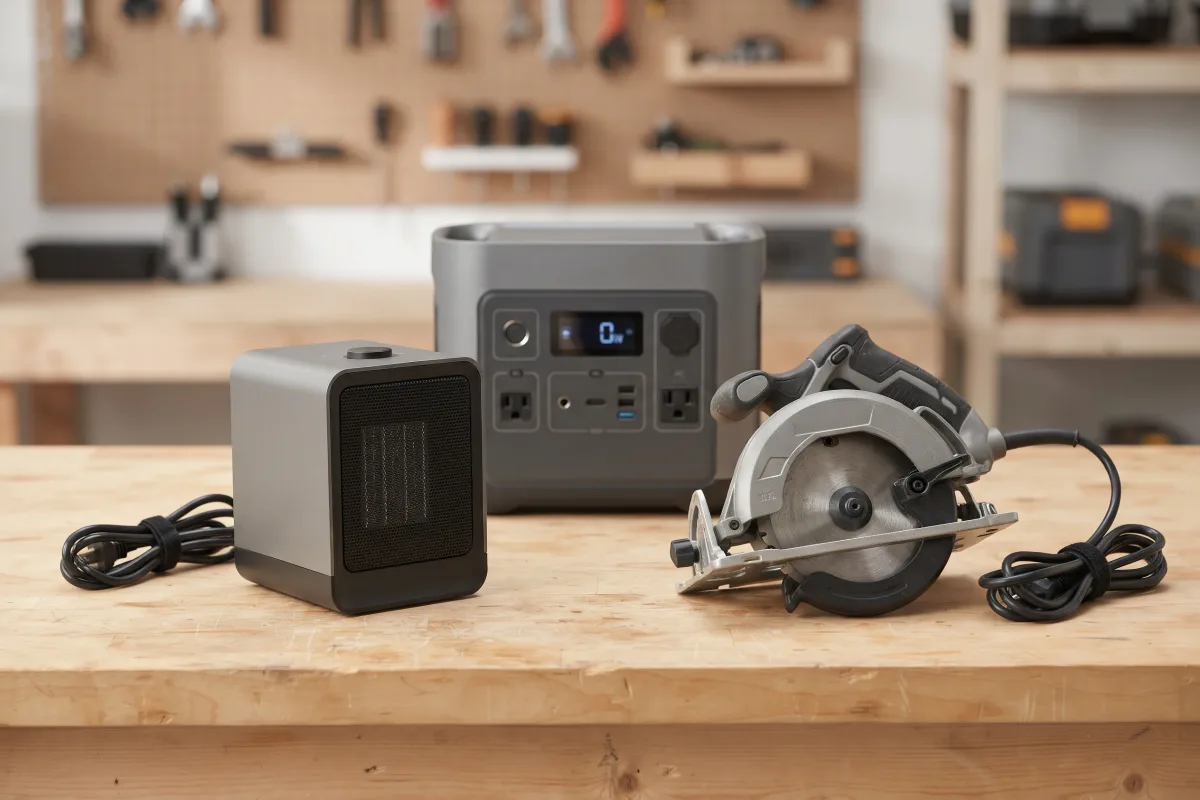
A motor isn't a heater, and all three makers describe these modes for heating or resistive loads. For a saw, count only the station's continuous output and surge rating, not its boost mode.
Power tool runtime: about 29 minutes of full-load cutting from a 1 kWh station
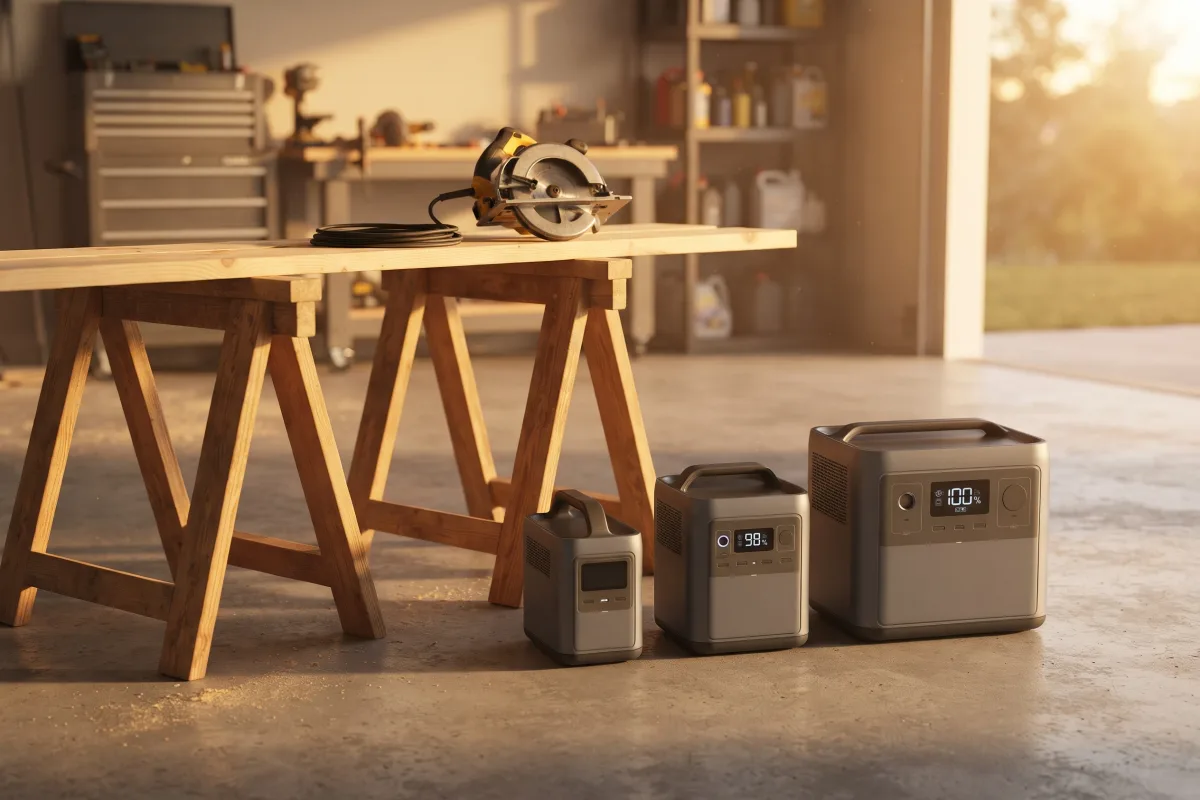
A 15 A saw at full load takes about 35 Wh a minute from the battery; a 1,024 Wh station gives about 29 minutes of it, or over an hour of a drill.
Tools rarely run continuously: a saw cuts for seconds at a time. So count minutes of actual cutting. By our estimate (load ÷ 0.85 for inverter loss, plus 10 W for the inverter while it's on), at the tool's full rating:
| Station capacity | 15 A saw (1,800 W) | Grinder (900 W) | Drill (780 W) |
|---|---|---|---|
| 288 Wh | over a 600 W station's limit | over its limit | over its limit |
| 1,024 Wh | ~29 min | ~57 min | ~66 min |
| 1,264 Wh | ~36 min | ~71 min | ~82 min |
| 2,048 Wh | ~58 min | ~115 min | ~132 min |
These are full-load figures, so real work lasts longer: a saw running between cuts or a drill driving screws uses well under its rating. A busy day of half an hour of sawing, half an hour of drilling and 15 minutes of grinding at full rating, with the station on for 8 hours, comes to about 1,860 Wh by our estimate; plan on a 2 kWh station, or recharge at lunch. Check your own mix in the runtime calculator.
Charging cordless tool batteries: about 10 packs per kWh
An 18 V 5.0 Ah pack holds 90 Wh; a 1,024 Wh station refills about 10 of them by our estimate, before the charger's own losses.
For many trades, the most useful job for a power station is keeping cordless batteries charged. A charger draws far less than a saw, so even a compact station works:
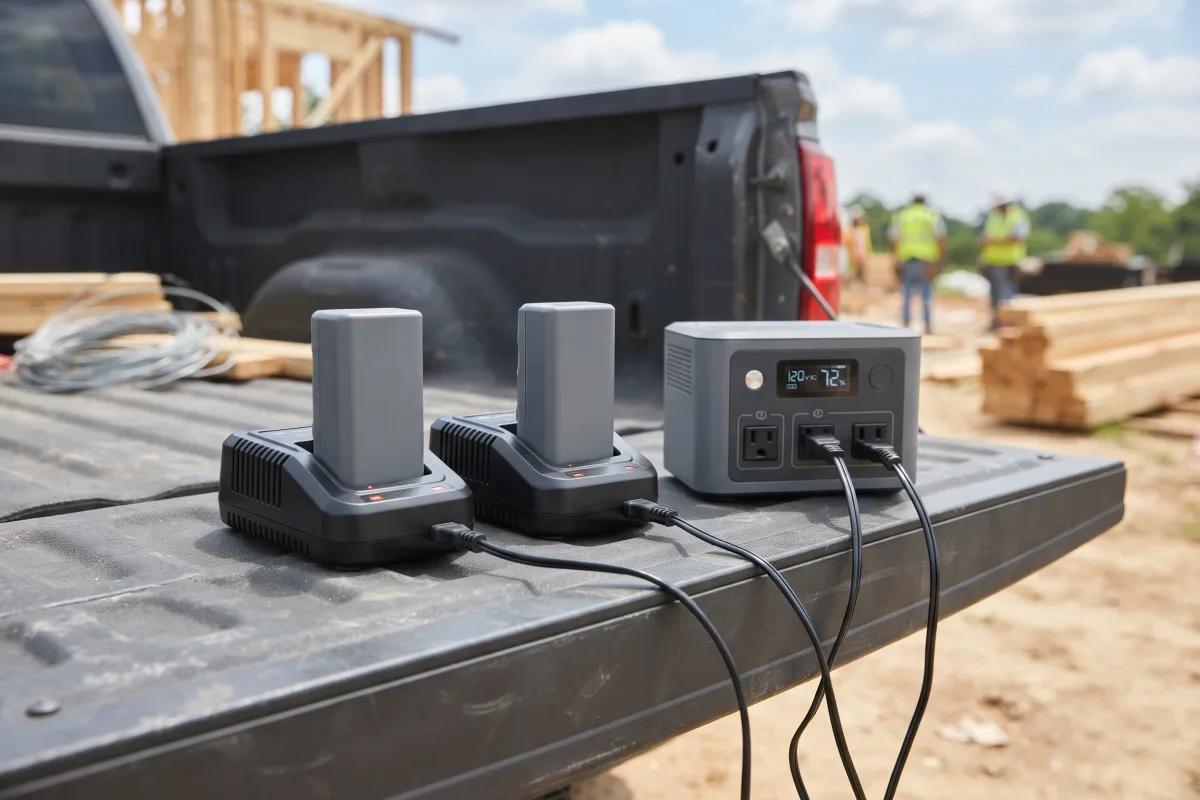
- Energy per pack: volts × amp-hours. An 18 V 5.0 Ah pack holds 90 Wh; a 2.0 Ah pack 36 Wh.
- Packs per charge (our estimate): about 3 per 288 Wh, 10 per 1,024 Wh and 19 per 2,048 Wh for 5.0 Ah packs, at 85% AC efficiency. The charger's own losses lower that somewhat.
- Charge time: set by the charger, not the station. Makita lists 45 minutes for a 5.0 Ah LXT pack on its DC18RC rapid charger, and 25 minutes for 2.0 Ah.
- Use AC: tool chargers plug into a standard outlet; a compact station such as the River 3 Plus (600 W) runs one rapid charger easily.
Power stations on job sites: GFCI and OSHA
OSHA requires GFCI protection on temporary 120 V, 15 and 20 A outlets used by employees on construction sites.
OSHA's construction rule (29 CFR 1926.404) says all 120 V, single-phase, 15 and 20 A receptacles on a site that aren't part of the building's permanent wiring and are used by employees must have ground-fault circuit interrupters. It exempts small portable generators of 5 kW or less whose circuits are insulated from the frame; it doesn't mention battery power stations.
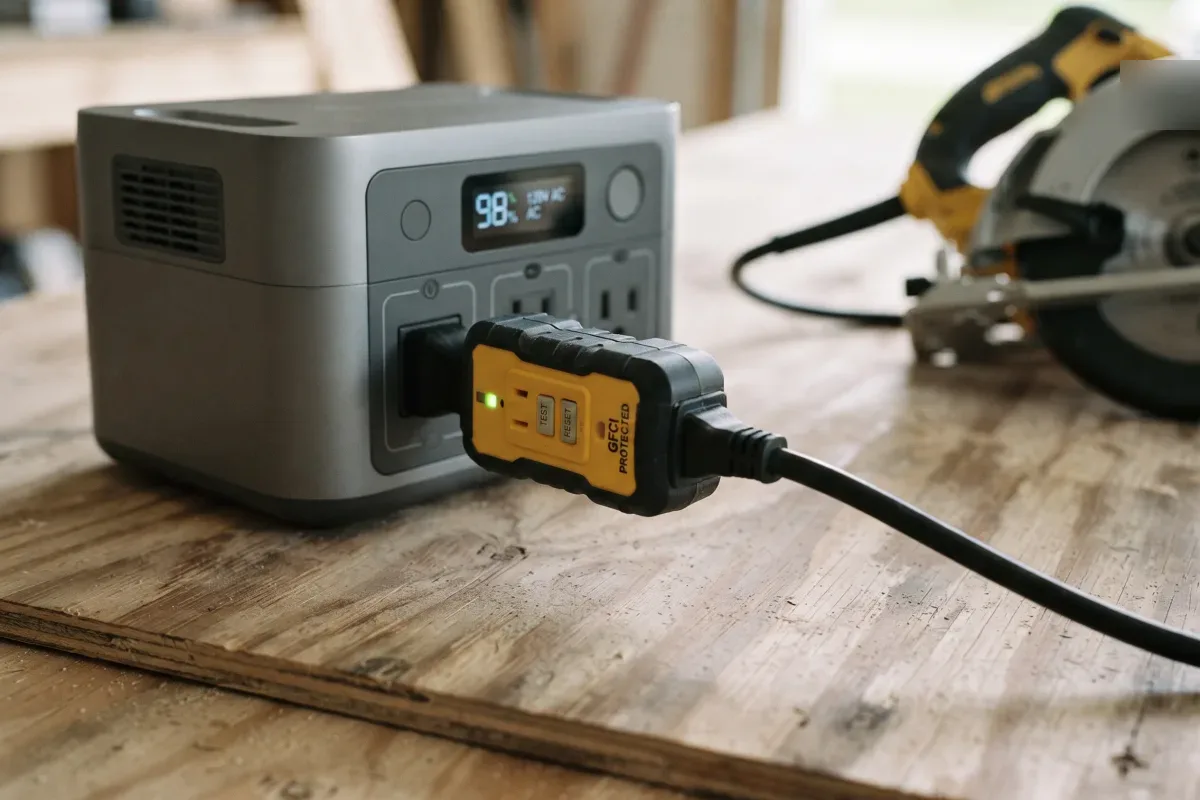
The simple answer is a portable GFCI cord or adapter between the station and the tool. Also on site:
- Keep it dry and off wet ground; most stations aren't rated for rain (see portable power stations in cold weather for low-temperature limits too).
- Short, heavy cords: a long thin extension cord drops voltage and makes a saw work harder.
- Dust: keep the station away from the cutting, with its vents clear.
- Recharge: from a site outlet at lunch, from solar, or from a vehicle with an alternator charger; see how to charge a power station from your car.
Best power stations for power tools: the C1000 Gen 2 for most
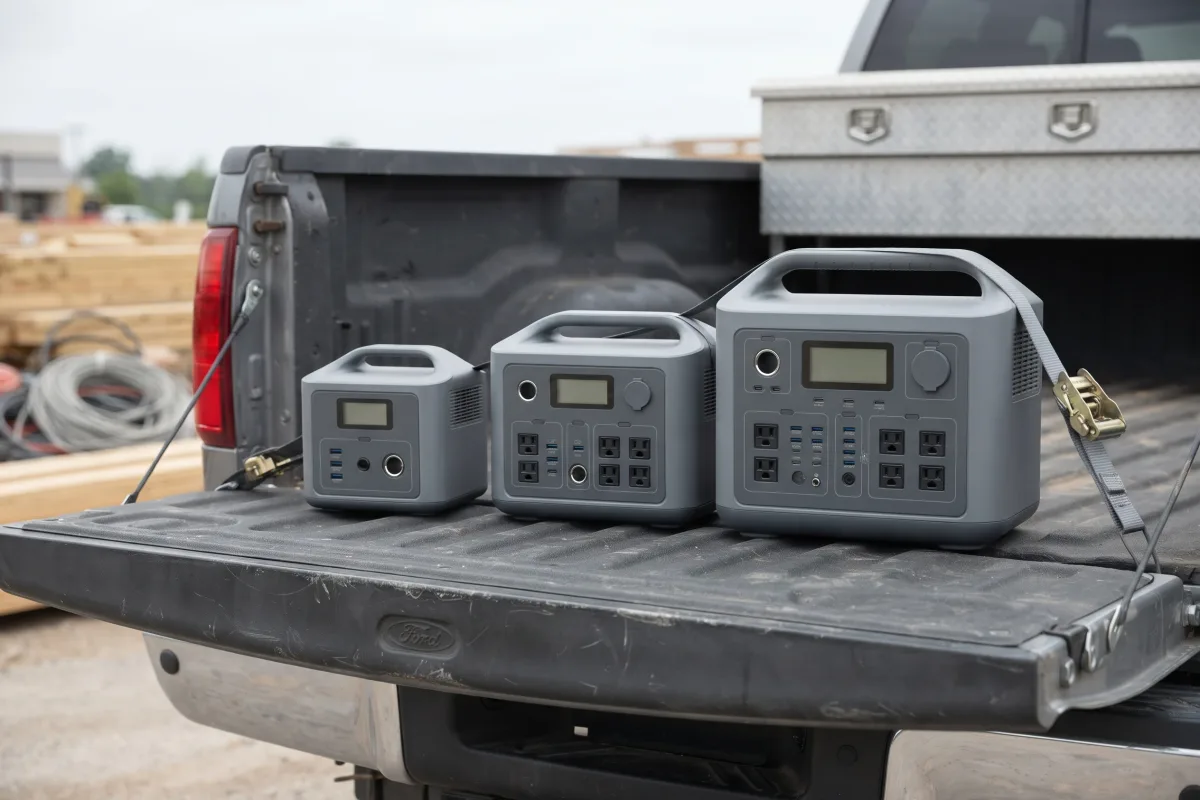
The C1000 Gen 2 runs a 15 A saw at 24.9 lb; the HomePower 2000 Plus v2 runs a full day; the River 3 Plus charges cordless packs.
| Station | Output / surge | Capacity / weight | Best for |
|---|---|---|---|
| Anker SOLIX C1000 Gen 2 | 2,000 W / 3,000 W | 1,024 Wh / 24.9 lb | a 15 A saw for a few jobs |
| Jackery Explorer 1000 Plus | 2,000 W / 4,000 W | 1,264 Wh / 32 lb | more surge headroom and capacity |
| Jackery HomePower 2000 Plus v2 | 2,400 W / 4,800 W | 2,048 Wh / 41.5 lb | a full day with a saw and a vac |
| EcoFlow River 3 Plus | 600 W / 1,200 W | 286 Wh / 10.4 lb | charging cordless batteries |
The C1000 Gen 2 is the best fit for most people who cut occasionally: the most output of the 1 kWh stations we've reviewed at under 25 lb. If you cut for hours, the HomePower 2000 Plus v2 doubles the battery (2,048 Wh) and raises surge to 4,800 W. For off-site jobs that run all day, a station won't match a gas generator's fuel-tank runtime; see portable power station vs generator. Every station we've reviewed is compared in the best portable power stations guide.
FAQ
Saws, drills, Jackery models, power banks and wattage: power-tool questions answered with the figures above.
Can a portable power station run power tools?
Yes, if its continuous output is above the tool's watts and its surge rating covers the start. A 15 A saw is rated up to 1,800 W, so choose 2,000 W or more continuous for it.
How many watts do I need to run power tools?
Multiply the tool's amps by 120 V: 1,800 W for a 15 A saw, 780 W for a 6.5 A drill. Allow extra for the start: Honda sizes motor starting at running amps × 3.
Can a Jackery run power tools?
The larger ones can. The Jackery Explorer 1000 Plus (2,000 W, 4,000 W surge) and HomePower 2000 Plus v2 (2,400 W, 4,800 W surge) run a 15 A saw; the 300 W Explorer 300 is for tool-battery chargers, not corded tools.
Can you run power tools off a power bank?
Not corded tools: a power bank has no 120 V outlet. For 18 V and 20 V packs, use a power station's AC outlet and the tool's own charger.
Can a power station run a circular saw?
Yes, a station with 2,000 W or more continuous and 3,000 W or more surge runs a 15 A circular saw; a 1 kWh one gives about 29 minutes of full-load cutting by our estimate.
Can a power station run an air compressor?
A small one, if the station's continuous output covers its nameplate watts (amps × 120 V) and the surge rating covers the start. Honda sizes generators for motor starting at running amps × 3, so the more surge headroom, the better.
What's the smallest power station for power tools?
For corded saws, a 1 kWh station with 2,000 W of output. For cordless tools only, a compact 300 Wh station running a charger is enough.
Do I need a GFCI with a power station on a job site?
On a construction site with employees, OSHA requires GFCI protection on temporary 15 and 20 A outlets. A portable GFCI cord between the station and the tool covers it.